


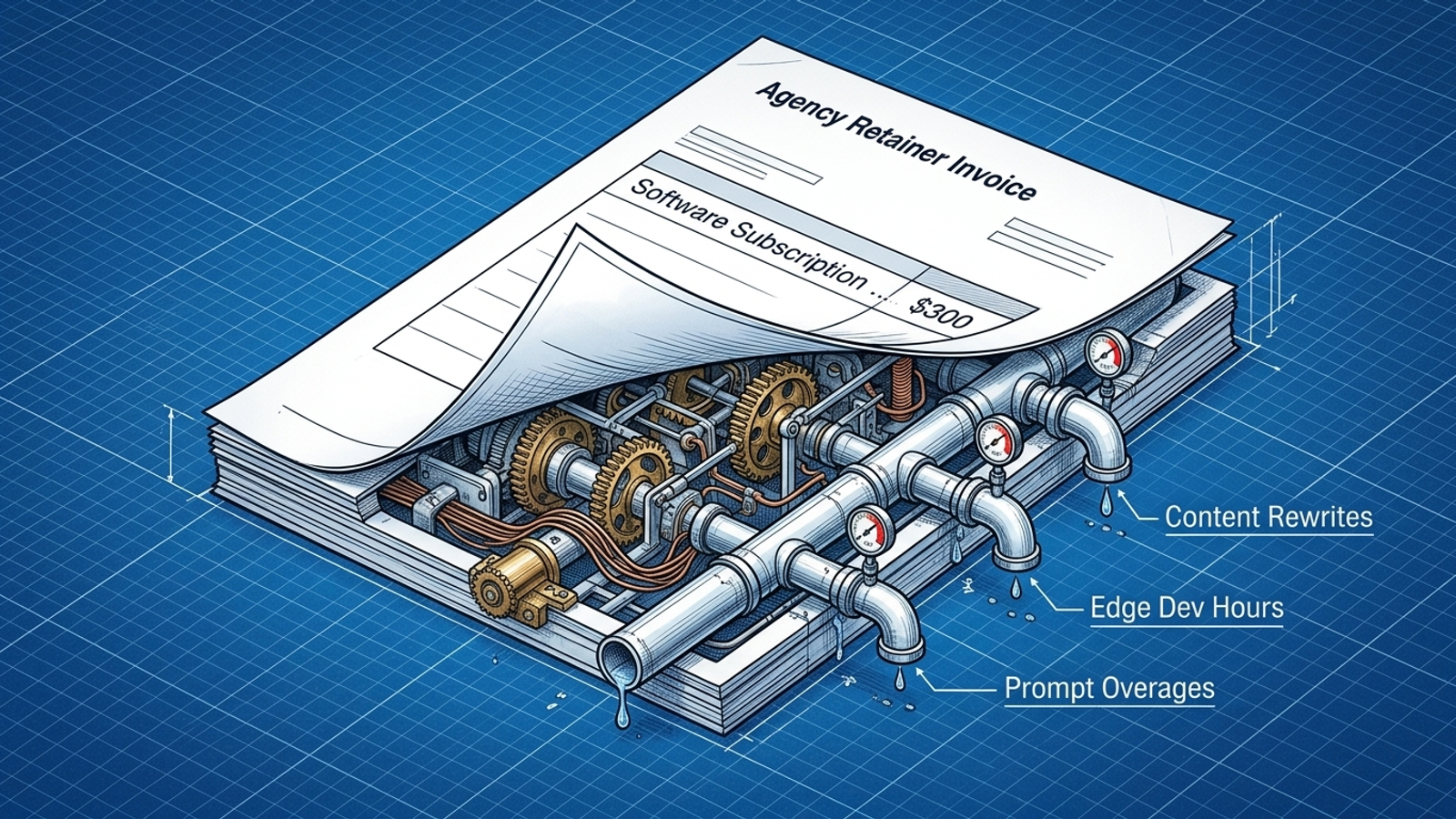
Ten AEO clients can cost an agency $14,050 to $23,700 a month to serve before it takes a dollar of gross profit. That is $1,405 to $2,370 per domain, not the few hundred dollars a tracking-tool subscription suggests. At 10 domains, prompt and seat fees grow with the roster while writers and developers still have to do the work. A flat per-domain delivery rate is the predictable alternative.
This is a monthly fulfillment model, not a claim that every agency receives the same invoices. It assumes 10 domains, 50 commercial prompts per domain, 40 content assets across the roster, and the labor rates shown below. The linked pricing pages and analyses inform individual lines; where a figure is a workload assumption rather than a published vendor price, I label it.
| Monthly cost category | Sticker-price assumption | Modeled fulfillment cost: 10 domains | Basis for the figure |
|---|---|---|---|
| Tracking and prompt caps | $189–$489 | $850–$1,450 | Tool tiers and add-ons illustrated by Otterly.AI pricing; actual spend depends on engines, checks, and refresh frequency. |
| Answer-first content | $0 if assumed in-house | $6,000–$10,000 | 40 pages at an assumed $150–$250 each. The GEO study discussion informs the work, not the writer rate. |
| Technical fixes | $5 cloud-plan assumption | $2,400–$4,500 | 20–30 assumed senior developer hours at $120–$150 an hour. See the edge SEO analysis for the type of work. |
| Citation and authority work | $0 if left to client PR | $2,500–$4,000 | Assumed $250–$400 per domain for coordination; white-label fulfillment pricing illustrates the alternative, not this rate. |
| Client reporting | $0 if treated as dashboard access | $2,000–$3,000 | 20–30 assumed strategist hours at a $100 loaded hourly cost. |
| Workspaces and seats | $99 base-plan assumption | $300–$750 | Assumed $30–$75 per client workspace; verify the tools in your stack. |
| Total recurring delivery | $293–$593 | $14,050–$23,700 | $1,405–$2,370 per domain per month. |
The sticker column is what a proposal can look like when someone counts subscriptions and assigns no cost to work already done by employees. It is not a second quote for the same scope. One-off implementation can also sit outside this monthly model; I separate it below rather than hiding it in a recurring number.
Why a $35,000 retainer book can feel smaller
AEO agency pricing benchmarks put retainers at $1,600 to $10,000 a month, with standard B2B accounts clustering around $3,000 to $5,000. Sell 10 at $3,500 and you have $35,000 in monthly revenue. If the delivery plan is a dashboard and an existing account manager, the spreadsheet looks lovely.
Then a client asks why a competitor appears in an answer and they do not. The dashboard identifies the gap. It does not rewrite a page, fix an unreadable site, or coordinate a third-party citation. If the retainer promises more than monitoring, those jobs belong in cost of delivery, whether a contractor invoices you or your own team absorbs the hours.
At the modeled $14,050 to $23,700 monthly cost, that $35,000 book leaves $11,300 to $20,950 in gross profit, or roughly 32% to 60% gross margin. The range is wide because the work is variable. Do not sell the low-cost case and staff for the high-cost one.
Set the meter: 500 prompts across 10 domains
Say each of your 10 clients needs 50 commercial prompts tracked. Not five brand-name checks, but questions about problems, categories, competitors, and buying decisions. That gives the agency 500 prompts before it adds another account.
A prompt is not necessarily a single billable check. Test all 500 across five engines and one complete run becomes 2,500 prompt-engine checks. Weekly runs mean about 10,000 checks in four weeks; daily runs mean 75,000 in a 30-day month. Pricing pages may meter stored prompts, executed checks, supported engines, or users. The distinction matters more than the entry-tier headline.

Listed cost: tracking software and its caps
Consider three ways a low starting price changes under that workload:
- Otterly.AI: The pricing breakdown lists a $189 Standard tier for 100 prompts across four base engines. In the draft’s five-engine configuration, Claude adds $109 a month; Gemini and Google AI Mode add $59 each. Four $99 packs take the allowance from 100 to 500 prompts. Those listed charges sum to $812 a month, before any different plan or agency requirement changes the bill.
- SE Ranking: Its AI Search Add-on documentation meters checks: one prompt on one engine is one check. The cited $179 plan includes 450 checks and the $345 plan includes 1,000. One 2,500-check sweep exceeds either allowance. Price the refresh schedule, not just the prompt list.
- Profound AI: The cited pricing analysis describes a $99 Starter tier limited to 50 prompts on ChatGPT and one user seat. Its three-engine, 100-prompt tier is listed at $399; broader requirements move toward a custom contract.
The table’s $850–$1,450 tracking line is an agency planning allowance, not a universal quote from any of these vendors. Ask for the cost of 500 prompts, your chosen engines, your refresh schedule, and every account-manager seat. If the sales page answers only one of those questions, it has not given you a delivery price.
Hidden recurring cost: writers, developers, and authority work
A tracker can tell me that a client is absent from an answer. It cannot make the underlying page useful. The GEO study discussion describes testing additions such as statistics, citations, and quotations for generative visibility. Whatever lift a particular site sees, someone still has to check the material and put it in the right place. Three generic 2,000-word posts are not a substitute for that edit.
For this model, assume four high-intent pages per client each month: 40 across the roster. At the modeled $150 to $250 per page, content costs $6,000 to $10,000 monthly. An in-house writer does not make the line disappear. It moves the cost into payroll and takes capacity away from other accounts. Scope the number of pages before you quote the retainer.
Technical work is the next trap. Some client-side sites do not present useful page content to the crawlers you need to reach. A tracking platform may flag the visibility problem, but somebody must investigate the site and implement the fix. In my AEO-for-agencies teardown, that gap between monitoring and execution is the part I would put in red ink on an agency scope.
Edge SEO approaches can put changes at the CDN layer rather than wait for a client code deployment. That does not make the work free. Budgeting 20 to 30 senior developer hours across 10 sites at the model’s $120 to $150 an hour adds $2,400 to $4,500 a month. The $5 plan in the sticker column was never the expensive part. The person writing, debugging, and maintaining the fix is.
Off-site authority is easier to omit because it does not arrive as one neat technical ticket. Directory corrections, third-party sources, and community or publication work require coordination across client niches. A white-label fulfillment offer illustrates how substantial outsourced packages can become; the table instead models an in-house allowance of $250 to $400 per client. That is $2,500 to $4,000 monthly, not a quoted market rate or a promise that every placement is included. Decide who owns this work before the client assumes you do.
Hidden recurring cost: the people behind the report
Clients do not pay to receive a raw list of prompt results. Someone has to check what changed, distinguish a useful movement from a noisy one, and explain the next action. For 10 accounts, this model allows 20 to 30 strategist hours a month for progress reviews, preparation, and client calls. At a $100 loaded hourly cost, that is $2,000 to $3,000. Calling the report “automated” does not remove the client conversation.
Then count the software plumbing. Client workspaces, extra seats, branded exports, and portal access can change the price of a tool that looked cheap under one login. The model allows $300 to $750 monthly across 10 domains, or $30 to $75 per workspace. That is an assumption to test against your vendor contract, not a fee every platform charges. Put it in the quote request anyway.
One-off setup is not monthly delivery
Initial crawlability investigations, edge deployment, workspace configuration, and the first content pass may happen before a retainer settles into its monthly rhythm. Their cost varies with each client’s site, access, and existing content; the draft supplies no defensible single setup figure. I would scope them separately rather than invent one or quietly absorb them in month one.
That separation also prevents double counting. If a developer spends part of the modeled 20 to 30 monthly hours maintaining an existing fix, count that time in recurring delivery. If the first deployment is an additional project, put it in a one-off estimate. A vendor who says setup is free has answered one pricing question, not proved that your team has no setup work.
Flat per-domain pricing changes the margin calculation
Flat-rate AEO pricing per domain addresses the meter problem directly. The agency proposition through groas for agencies is $999 a month per domain rather than a growing collection of prompt and seat charges. Ten domains therefore put the flat delivery line at $9,990 monthly. At $3,500 billed per client, that leaves $25,010, or about 71.4% gross margin, before any agency work outside that flat delivery scope.
That last clause matters. Do not paste the 71.4% into a proposal while promising unlimited bespoke calls, publication outreach, and whatever a difficult CMS throws at you. Price extra agency labor as extra agency labor. The comparison favors a flat per-domain model because its base is knowable as the roster grows, not because a flat fee abolishes every client-specific task.
There is also a client who should skip that wholesale rate: one who wants three brand-term checks and no technical or content work. Manual checks and a light consulting scope may cost less. But when the promise spans commercial prompts, content changes, and technical execution across 10 or more accounts, buying variable credits first and discovering the labor later is a poor way to protect margin.
Swipe file: three scopes to price before you pitch
I would use these as retail starting points, not a claim that every item is included in a $999 wholesale fee. Copy the scope that fits, then price any calls, content, outreach, or implementation your agency must provide beyond its delivery agreement.
Use for a smaller client that needs a defined monthly visibility scope:
CORE AI VISIBILITY RETAINER
Client: [CLIENT_NAME]
Domain: [CLIENT_DOMAIN]
Retail price: $2,450/month
Flat delivery baseline: $999/month per domain
Difference before extra agency delivery costs: $1,451/month

Scope to confirm: prompt tracking; crawlability and schema maintenance;
2 answer-first page rewrites; core directory validation;
1 monthly executive report and review.

Agency-owned extras and cost: [EXTRAS_AND_COST]
Adjustment that matters: If the client wants biweekly bespoke calls, price the added strategist time instead of treating the $1,451 difference as guaranteed profit.
Use for a competitive category where content and technical work carry the retainer:
CATEGORY AUTHORITY RETAINER
Client: [CLIENT_NAME]
Domain: [CLIENT_DOMAIN]
Retail price: $3,950/month
Flat delivery baseline: $999/month per domain
Difference before extra agency delivery costs: $2,951/month

Scope to confirm: commercial and competitor prompt tracking;
edge and schema work where needed; 4–6 factual content assets;
third-party citation work; performance reporting and strategy review.

Agency-owned extras and cost: [EXTRAS_AND_COST]
Adjustment that matters: Confirm who produces the content and handles third-party outreach. If those jobs sit with your team, subtract their cost before calling $2,951 a margin.
Use for a national or otherwise demanding account only after a separate scope review:
ENTERPRISE CATEGORY RETAINER
Client: [CLIENT_NAME]
Domain: [CLIENT_DOMAIN]
Retail price: $6,500/month
Flat delivery baseline: $999/month per domain
Difference before extra agency delivery costs: $5,501/month

Potential scope: multi-region monitoring; custom technical work;
8+ content assets; off-site authority work; weekly consultations.

Approved delivery scope: [APPROVED_SCOPE]
One-off implementation: [ONE_OFF_ESTIMATE]
Agency-owned extras and cost: [EXTRAS_AND_COST]
Adjustment that matters: Do not quote the difference as profit until technical implementation, content volume, approvals, and weekly strategist time have owners and costs.
The category authority scope is the one I would reach for first. It forces the proposal to name content and technical execution, the two jobs most likely to vanish from a software-only cost estimate.
The cheapest mistake and the most expensive one
The cheapest mistake is paying $189 for a tracking subscription before deciding who will fix what it finds. You lose a couple of hundred dollars, learn that a dashboard is not a delivery team, and cancel.
The expensive mistake is signing 10 clients at $3,500 a month while pricing delivery as though that subscription were the whole job. The model puts as much as $23,700 of monthly cost against your $35,000 revenue line before the rest of the agency’s expenses enter the picture. Set the per-domain delivery price and the boundaries of the work first. Then put AEO on the rate card.