

 LinkedIn

Ten AEO clients can cost $28,125 to $45,500 a month to serve, before onboarding. The tracking tool is the cheap part. I once scoped a $1,500 retainer around a $99-a-month plan; the math lasted until I priced the writing, fixes and human hours needed to turn a dashboard into work a client could publish.
Here is the recurring model for 10 client domains, 50 prompts per domain, tracked weekly across ChatGPT, Perplexity, Gemini and Google AI Overviews. It assumes four answer-targeted posts per domain each month. The ranges are delivery-cost estimates, not a vendor quote for the whole stack.
| Recurring line item | Per domain / month | 10 domains / month | Basis for the estimate |
|---|---|---|---|
| Visibility tracking | $150–$300 | $1,500–$3,000 | Model estimate informed by published tool prices and prompt limits |
| Content: four 1,500-word posts | ~$2,100 | ~$21,000 | 6,000 words at $0.35, within the cited freelance rate range |
| Technical fixes and schema | $150–$800 | $1,500–$8,000 | 2–4 hours at the cited $75–$200 hourly rate |
| CMS publishing | $75–$400 | $750–$4,000 | 1–2 hours at the same $75–$200 hourly rate |
| Reporting and monthly calls | $262.50–$550 | $2,625–$5,500 | 4.25–10 reporting hours, plus one hour for a call and prep, at $50 loaded |
| Strategist oversight | $75–$400 | $750–$4,000 | 1–2 hours at the cited $75–$200 hourly rate |
| Recurring total | $2,812.50–$4,550 | $28,125–$45,500 | Sum of the lines above |
That is the delivery bill for Stack A: a monitoring tool plus people doing the work. The 10-domain model points to the same problem: pricing from the tracker misses the expensive lines. One-off onboarding and the alternative flat per-account stack come later. First, here is where the recurring money goes.
Tracking: the visible price with a prompt limit
The public software price is easy to find. The scope hidden behind it is not. Published examples range from Otterly Lite at $29 for 15 prompts to Semrush at $99 per domain for 25 prompts, with another $60 for 50 more, and Scrunch at $250 for 125 prompts. Those plans are not interchangeable at 50 prompts across 10 domains, which is why I use $1,500–$3,000 a month as a tracking allowance rather than multiplying the cheapest advertised price by 10.
Fifty prompts is not lavish. Twenty-five barely covers one service line; a multi-service or multi-metro client may need 100 to 300 prompts for useful coverage. If you sell broader monitoring without pricing that expansion, the meter keeps running after the proposal is signed.

What happens at prompt 51
Per-prompt and per-workspace pricing can turn a small scope change into a new software bill. Profound ended its $99 Starter and $399 Growth self-serve plans; its Agency Growth price is $99 base plus $399 per client workspace for 100 prompts, 400 credits and five seats. At 10 workspaces, that is $4,089 a month before anyone writes or fixes a page. Nine-engine coverage, API access or SSO moves to custom Agency Enterprise pricing. A price available only on a call does not belong in a fixed-cost proposal until you have the quote.
Budget for the coverage you sold, not the entry plan you found.
Content: the line a $1,500 retainer cannot hide
A working AEO retainer with optimization and new content runs roughly $2,500–$5,000 a month for four to six answer-targeted posts, schema and prompt testing. The writing bill alone explains why. Freelance rates of 25–45 cents a word put a 1,500-word post at $375–$675. At four posts and 35 cents a word, the model spends $2,100 per domain, or $21,000 across 10, before editing, briefs or citation work.
That is not a claim that every client needs four posts forever. It is the scope this retainer has to deliver. Cut the post count and you have changed the offer, not discovered a margin trick. Buy $60–$150 content-mill posts instead and you may reduce the writing invoice, but you have not budgeted for the answer-focused work the proposal promised.

Price the content before you price the retainer. At $2,100 a domain for writing, the $1,500 ticket is already gone.
Technical fixes: citations need pages that work
Someone has to check FAQ and article schema, clear AI crawler blocks, repair broken internal links and catch soft 404s. The cost driver is not a neat per-page fee. It is how many hours the site takes to keep usable.
I allow two to four hours per domain each month at the cited $75–$200 hourly rate. That makes technical work $150–$800 per domain, or $1,500–$8,000 across 10. A clean WordPress site can sit near the low end. A custom CMS without staging can consume the high end. Do not sell a fixed technical workload as if those sites are equivalent.
If schema and crawl fixes are in the promise, put hours against them. A tracker can flag a problem; it cannot make the client’s site cooperate by admiring the graph.
Publishing: a draft is not a live page
After writing comes CMS access, headings, internal links, images, meta and a mobile check. None of that happens inside a Google Doc. I allow one to two hours per domain per month across the four posts, again at $75–$200 an hour. That is $75–$400 per domain, or $750–$4,000 across 10.
The range depends on access and approvals. Full WordPress admin access can make publishing quick. Ticket queues, legal review and custom Webflow components can stretch the same four posts across far more handoffs. If the client controls those handoffs, define who owns the delay as well as who owns the work.
Put publishing in the scope. Otherwise you pay for finished drafts while the retainer keeps reporting on pages that are not live.
Reporting and calls: the hours everyone calls overhead
Manual reporting takes 4.25 hours per client per month in a conservative workflow and seven to 10 in a more realistic one. Across 10 clients, that is 42.5–100 hours before a call. At $50 an hour loaded, reporting costs $2,125–$5,000 a month.
Then allow 30 minutes on Zoom and 30 minutes for prep and notes per client. That adds 10 hours, or $500, bringing the line in the table to $2,625–$5,500. The call is not free because it sits on a calendar rather than an invoice.

If the retainer includes a branded report and a monthly call, cost both. Otherwise you have quietly made yourself the unpaid reporting department.
Strategist oversight: keep judgment in the budget
Someone senior still has to decide which prompts matter, what to publish next and whether the work answers the question a customer asked. I allow one to two hours per domain each month for prompt review, content QA and roadmap decisions. At the cited $75–$200 hourly rate, that is $750–$4,000 across 10 domains.
This is not the line to erase because software produced a recommendation. Recommendations need an owner, especially when a prompt report points one way and the client’s commercial priorities point another. Protect the judgment hours; cut repetitive assembly work first.
Hidden and one-off costs: do not bury setup in month one
The recurring total excludes onboarding. A new domain needs prompt research, a baseline citation check, Search Console and GA4 access, CMS logins, a schema audit and a content plan. I allow six to 10 hours per domain in the first month. At $75–$200 an hour, that is $450–$2,000 per domain before normal delivery begins. The separate audit is a $500–$1,500 one-time ticket, not recurring revenue.
Other hidden work is less tidy. Edge or proxy changes for AI crawler access can turn one bad robots.txt or bot-block rule into a long day. When a client leaves, someone must offboard seats, export reports, revoke access and archive content. Those tasks vary with the site and the relationship; I would not pretend they have one reliable monthly price. I would put ownership and scope in the agreement.
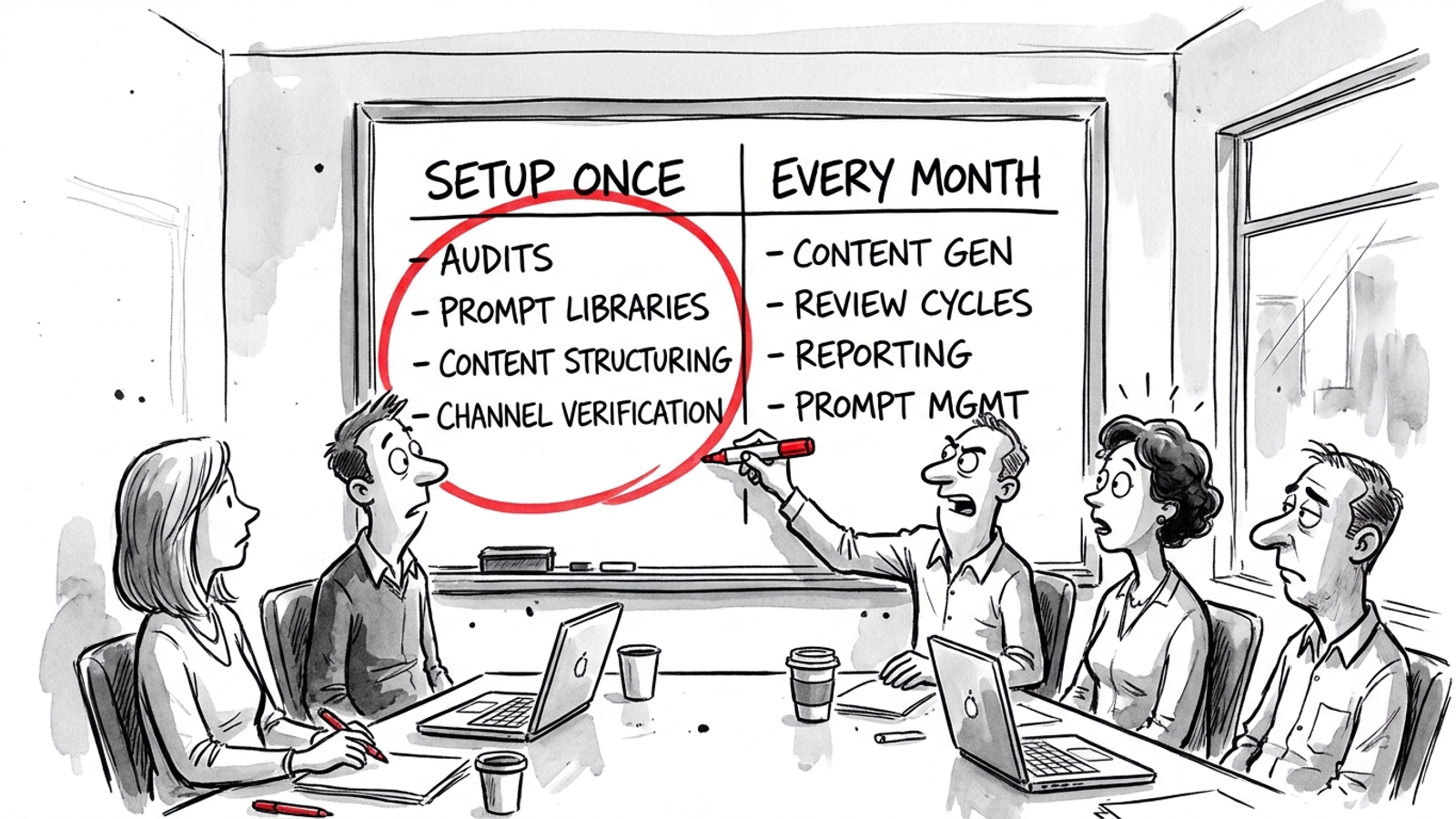
Keep setup separate from delivery. Folding $450–$2,000 of onboarding into a $1,500 first month does not make it disappear.
Stack A versus Stack B: what the agency is buying
Stack A combines a prompt tracker with freelance and in-house labor. It costs $28,125–$45,500 a month for this 10-domain scope, excluding onboarding. Software rises when coverage expands; labor rises when clients need more posts, fixes or reporting. Both meters can move while the retainer price stays put.
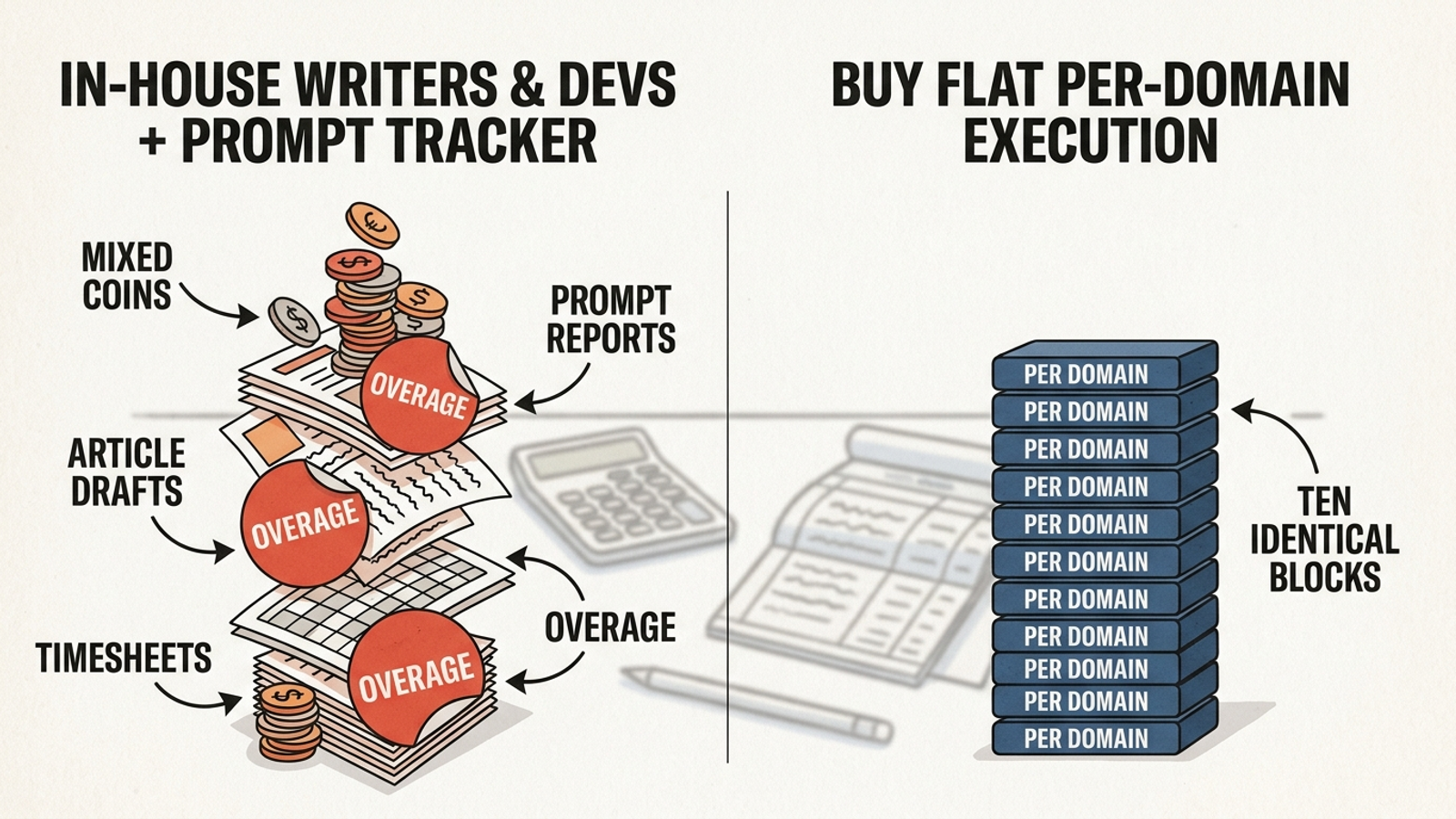
Stack B is the flat-rate execution model in the draft: $299 per client account, or $2,990 for 10. It covers content, technical fixes, citations, weekly Google and AI visibility tracking, and reporting under the agency’s brand. That is a different purchase from a tracking seat. It replaces separate delivery invoices with one per-account price and removes the prompt-cap calculation from this comparison. The shift from prompt pricing to per-domain execution matters because the agency can price its retainer against a known delivery cost rather than a growing list of meters.
Stack A sells visibility plus the labor to act on it. Stack B prices the execution together. That difference, not a prettier dashboard, drives the margin table.
The margin at $1,500, $2,500 and $4,000
The market ladder runs from a $1,300–$2,000 AEO add-on through $2,400–$3,000 foundations to $4,500–$6,000 growth packages. Working retainers with content are also described at $2,500–$5,000 for most clients. I tested three round monthly tickets against the two stacks. Revenue is 10 times the retainer; neither cost column includes onboarding.
| Monthly retainer per domain | Revenue from 10 domains | Stack A monthly cost | Stack A profit or loss | Stack B monthly cost | Stack B profit and margin |
|---|---|---|---|---|---|
| $1,500 | $15,000 | $28,125–$45,500 | $13,125–$30,500 loss | $2,990 | $12,010 profit; 80% margin |
| $2,500 | $25,000 | $28,125–$45,500 | $3,125–$20,500 loss | $2,990 | $22,010 profit; 88% margin |
| $4,000 | $40,000 | $28,125–$45,500 | $5,500 loss to $11,875 profit | $2,990 | $37,010 profit; 93% margin |
At $4,000, Stack A can make money at the low end of delivery cost and still lose it at the high end. At $1,500, it loses money throughout this scope. Stack B’s fixed $299 per-account cost leaves room at each ticket, provided the purchased execution covers what the agency sold. For the same pattern at a smaller scale, see the one-domain breakdown.
A low retainer is not automatically a bad offer. A low retainer attached to unpriced work is.
Who should skip the flat-rate purchase
If you already employ a writer and technical lead with genuinely spare hours, and your clients want monitoring plus a light monthly edit rather than the four-post scope above, an outside execution purchase may not be your cheapest option. One in-house model prices a $2,700 package at about $1,040 across 27 hours, for roughly 61% margin. That is a different workload, and it works only while those hours are available.
When those 27 hours collide with link building, PPC fires and new pitches, the apparent margin gets less comforting. If you cannot protect the capacity, you do not have a repeatable delivery model. You have a calendar that looks clear from a distance.
The cheapest mistake is giving onboarding away: six to 10 hours, or $450–$2,000 per domain, that could have been scoped separately. The most expensive mistake is selling 10 clients a $1,500 AEO add-on on Stack A when this scope costs $2,812.50–$4,550 per domain to deliver. That is a $13,125–$30,500 monthly loss, not a thin month. Price the content and the hours first. The tracker was never the retainer.