

 LinkedIn

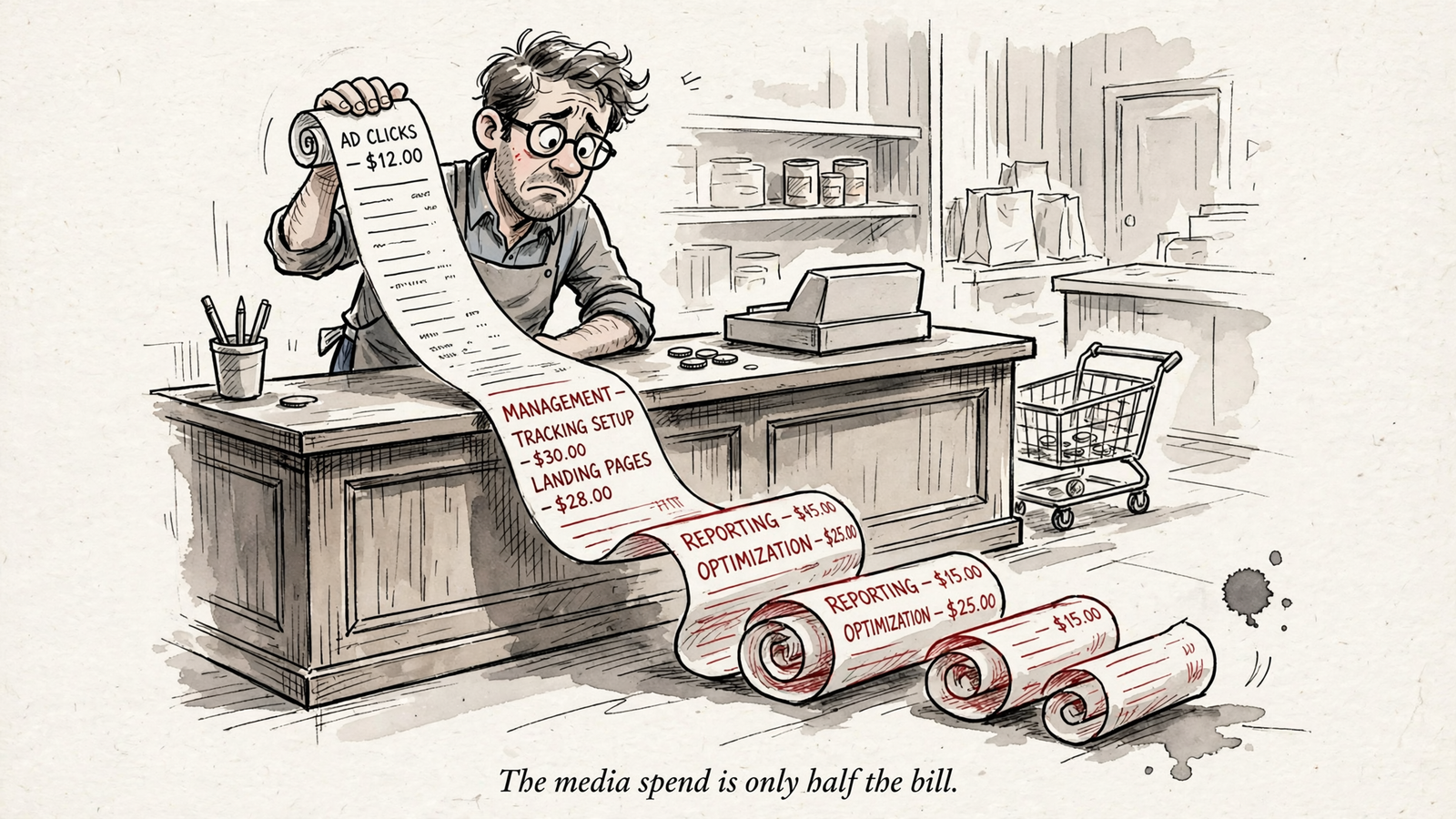
A $2,000-a-month ChatGPT ads test can cost roughly $3,500 to $6,900 in month one. The clicks are not the expensive part. Management, tracking, a landing page and the weeks needed to learn anything useful can cost as much as the media, or more.
That range assumes a $2,000 media budget and groas’s $1,499 monthly Search Ads fee. The low end uses a page and tracking you already have; the high end allows for a $3,000 page and $400 in tracking setup. Keep running the same setup and the base recurring bill is about $3,500 a month, before any separate page-builder subscription or your own time.
Here is the bill before anyone calls it a ‘small test’:
| Line item | When you pay | Cost in this example | Basis |
|---|---|---|---|
| ChatGPT media | Every month | $2,000 | Test budget; the US campaign minimum is $25 a day |
| Management | Every month | $1,499 | groas Search Ads flat monthly fee |
| Conversion tracking | Once, if needed | $150 to $400 | Budget informed by listed GA4 and GTM setup prices |
| Landing page | Once, if needed | $0 if you have a suitable page; up to $3,000 for a new one | Landing-page price ranges; groas includes pages for ad groups |
| Your time and page software | Potentially recurring | Varies | Depends on your hours and whether the page needs a separate subscription |
A cheaper invoice is not necessarily a cheaper answer. If the budget runs out before you can judge the channel, you have paid for a test you must run again. The right question is not ‘How little can I spend?’ It is ‘What must I spend to reach a decision?’
Line 1: Media has a floor, not a verdict attached
ChatGPT ads are bought through OpenAI’s self-serve Ads Manager in a relevance-weighted second-price auction, with payment per 1,000 impressions or valid click. In the US, the minimum is $25 a day per campaign. Run one campaign for a roughly 30-day month and you are already near $750 in media, before setup or management. A $500 ‘toe in the water’ test does not clear that monthly floor.
OpenAI suggests starting CPC campaigns with a $3 to $5 maximum bid per click. Reported CPMs moved from about $60 at the February 2026 pilot launch to roughly $25 to $45 by April. By October, reported clicks cost about $5, versus $30 to $50 for similar commercial software ads on Google. That makes a click look cheap. It does not make the test conclusive.
| Monthly media | Clicks at roughly $5 each | What I would expect to learn |
|---|---|---|
| $1,000 | About 200 | A limited read. Practitioners warn that less than $1,000 to $1,500 over 30 days can be too thin to judge. |
| $2,000 | About 400 | Room to reach a meaningful click count and cut a weak approach, provided tracking works. |
| $5,000 | About 1,000 | More room to test context hints without starving each one. |
Those click counts are arithmetic, not a promise about what an auction will deliver or what the clicks will do. Buy enough volume to make a decision; do not mistake the minimum spend for a sufficient test.
Line 2: Management is recurring, even when you do it yourself
I used to tell clients to DIY a small test to save the management fee. I was wrong about the word ‘save.’ DIY shifts the cost to the person writing context hints, checking spend and trying to interpret a thin report. At five to ten hours a week, that is a real line item, even if it never appears on a card statement.
Published ranges put freelancers at $500 to $2,000 a month or $15 to $40 an hour, mid-market agencies at $1,500 to $5,000 a month, and percentage-of-spend fees at 10 to 20%, with some agencies charging 12 to 30%. A percentage can produce the lowest management invoice on a small budget. It also grows when your media spend grows. The fee structure matters more than the label on the vendor.
| Who runs a $2,000 media test | Monthly management cost | Cost the quote may leave out |
|---|---|---|
| DIY | $0 invoiced | Your time, plus any tracking and page work |
| Freelancer | $500 to $1,000 for a small build and light checks | How much checking and revision the fee covers |
| Agency at 15% of spend | $300 | Tracking, pages and what happens to the fee as spend rises |
| groas Search Ads | $1,499 | Media remains separate; pages for ad groups are included |
The $300 agency fee is cheaper than groas’s fee at $2,000 of spend. I would not hide that in a blended ‘total value’ number. I would ask what the $300 buys. groas’s flat fee covers ongoing work on bids, keywords and budgets, plus landing pages for ad groups; the percentage quote needs its scope checked before you compare totals. At $5,000 of media, a 10 to 15% fee becomes $500 to $750. The percentage keeps rising with spend. The groas fee does not.
Compare the work included, not just the management line. For a closer look at those structures, see Google Ads agency pricing models compared.
Line 3: Tracking is a one-off cost you pay before the first click
ChatGPT ads do not give you keywords or demographics to tune in the usual way. You write freeform context hints describing conversations where an ad fits. Beta reporting shows spend, clicks and CTR, but not which hint triggered an impression. If a booked call or checkout does not register cleanly in your own tracking, you cannot tell whether the traffic did anything useful. You can only watch the bill arrive.
One service price list puts GA4 setup at $150, GA4 plus GTM at $230, and a custom GA4 event at $85 per event. The same source notes Upwork listings from $30 to $199 for GA4, GTM and Google Ads conversion-tracking tiers. For this cost breakdown, I would allow $150 to $400 once if you hire out the setup. DIY may avoid that invoice, but it still takes time to wire the events and check that test conversions register.
Tracking is a one-off line only if it works. Discover after a month that calls never registered and you have bought the media twice: once for the clicks, then again for the answer you failed to collect. Verify the conversion before paying for traffic.
Line 4: A landing page can be one-off; its software may not be
A ChatGPT click comes from a conversation. Someone asked a question, saw an answer and tapped an ad while the question was still fresh. Send that person to a generic homepage and you make them start over. The page needs to carry the same promise into one clear action, whether that is a form or a call.
A well-written and designed small-business landing page typically runs $500 to $3,000. The same pricing roundup lists a freelancer build at $200 to $800 per project and DIY builder work at $0 to $300 plus a subscription. The build is usually the one-off cost. A separate builder subscription, if you need one, keeps billing after launch; the draft prices put Unbounce from $29 to $99 a month, Instapage at $99 a month, and Leadpages around $37 to $49 a month.
Keep the page narrow: match the ad’s promise, put the form or call button where a visitor can find it, and make sure phone leads count in tracking. groas includes a landing page for every ad group in its $1,499 Search Ads fee. That inclusion matters when a standalone page would otherwise sit on top of the management quote.
Price the page and any subscription separately. If the page cannot continue the conversation that earned the click, fix it before raising media spend.
Line 5: Adding ChatGPT beside Google and Bing changes the media bill
If you already run Google Ads, adding ChatGPT need not mean building all your tracking again. The conversion event you checked in Line 3 can still record what happens on your site, and a suitable page can still do its job. What changes is the media allocation and the work of writing context hints, watching a separate campaign and reading a separate report.
At the $25-a-day campaign floor, allow roughly $750 a month in additional ChatGPT media for one continuously running campaign. A larger test might allocate $2,000. That is a second media line, not automatically a second tracking build. It is also not automatically a second retainer: ask the vendor how its fee applies across channels instead of assuming either answer.
I pay attention to bundling because separate invoices make it easy to miss the combined cost. groas puts Google, Bing and ChatGPT Ads in one Search Ads fee, so a $2,000 Google media allocation plus a $1,000 ChatGPT allocation does not add a second groas management fee. If you buy channel management elsewhere, check whether the quoted percentage applies to combined spend and whether pages or setup cost extra.
Budget one verified setup where you can reuse it, two media lines, and the actual management scope. The tradeoffs among a freelancer, agency and autonomous management are covered in agency vs freelancer vs autonomous management.
The hidden costs: time, premature verdicts and drifting budgets
The listed lines explain the invoice. The hidden ones explain why a test that looked affordable can still be a bad buy.
Stopping before the data can answer
Practitioners use 100 to 300 clicks, or roughly 10 times cost per lead per month over three months, as rules of thumb before judging a Google test. Those are not guarantees for ChatGPT. They are a warning against declaring a channel dead after a handful of clicks. At roughly $5 per click, $1,000 buys about 200 clicks. Whether those clicks settle your question depends on the conversion you need to see and the tracking you installed.
I made the premature-cut mistake on a SaaS account in 2019. I stopped a $1,500 test after $900 of spend because the first 60 clicks bounced, then spent $2,400 rebuilding it three months later. I paid for the same uncertainty twice. ChatGPT’s move from a $200,000 pilot commitment to $50,000 and then no fixed minimum makes access easier; it does not make every tiny test informative.
Write the stop rule before launch, in clicks and conversions, not in how the CPA feels on day ten.
Budget creep without an approval gate
A $25-a-day minimum sounds contained until several hints or geographies compete for a small total budget. One approach can consume the spend while another gets too little traffic to judge. Self-serve gives you the job of setting allocations and watching them. A managed option does not excuse you from asking who can approve a change; Criteo’s managed minimum was later lowered to $10,000, which is not a small-test budget.
For a small test, I put the total daily allocation, a stop rule for each hint and an approval gate for increases in writing. I do not raise the budget because Tuesday felt slow. A cap is only useful if someone owns it.
The hours that never reach the invoice
Say an hour of your time is worth $100 when you do the work you actually get paid for. Ten hours a week checking a test, revising hints and exporting reports becomes $4,000 over four weeks. That is illustrative arithmetic, not a vendor price. Even a freelancer who charges $500 can need your time for briefings and decisions.
Price that time once: hours per week × your hourly value × four. If it exceeds the management fee you were avoiding, you did not remove a cost. You moved it from your card to your calendar.
The $2,000 media test I would sign off on
I would start with the bill, not a promise of a result: $2,000 in monthly media plus $1,499 for groas Search Ads, or $3,499 before any new setup. Add $150 to $400 once if tracking needs work. Add a landing-page build only if you need one outside what your management arrangement includes. A separate page-builder subscription or your own hours belongs in the recurring total if you use them. That is how month one can run from about $3,500 to $6,900 rather than the $2,000 on the media plan.
Then I would write down what the test must do:
- Check tracking before launch. A booked call or checkout must register as the conversion you intend to judge.
- Set the spend and the stop rule. Plan for 30 days and aim for 300 clicks before making the main call; time alone is not a verdict. If 200 clicks on the current page produce zero qualified contacts, inspect the page and hint before adding money.
- Decide what happens next. If 300 clicks produce contacts but CPA is 50% above target, cut the weakest hint and reallocate rather than raising the whole budget. Do not approve a mid-test increase just to make an uncomfortable report look busier.
Even that plan may not produce enough conversions for a confident answer. It does give you a budget, a measurement and a rule for what to do with what you see. Without those, $3,499 buys a report and an argument about whether to try again.
Who should skip the test for now
I would skip ChatGPT ads if I could not track a booked call or checkout back to the click. I would also wait if the budget could buy only 100 clicks when the business normally needs 30 clicks for one lead. And if the offer is not something people ask a chatbot about before buying, I would put the $2,000 toward Google’s existing-intent capture instead.
That is not a verdict against ChatGPT. It is a verdict against paying for a question your test cannot answer.
The cheapest mistake is spending roughly $750 on media without tracking or a suitable page, then calling the channel dead. The most expensive is repeating that cheap test until the combined bill exceeds one properly funded attempt. Price the answer, fund it once, and let the result tell you whether to scale or walk away.