

 LinkedIn
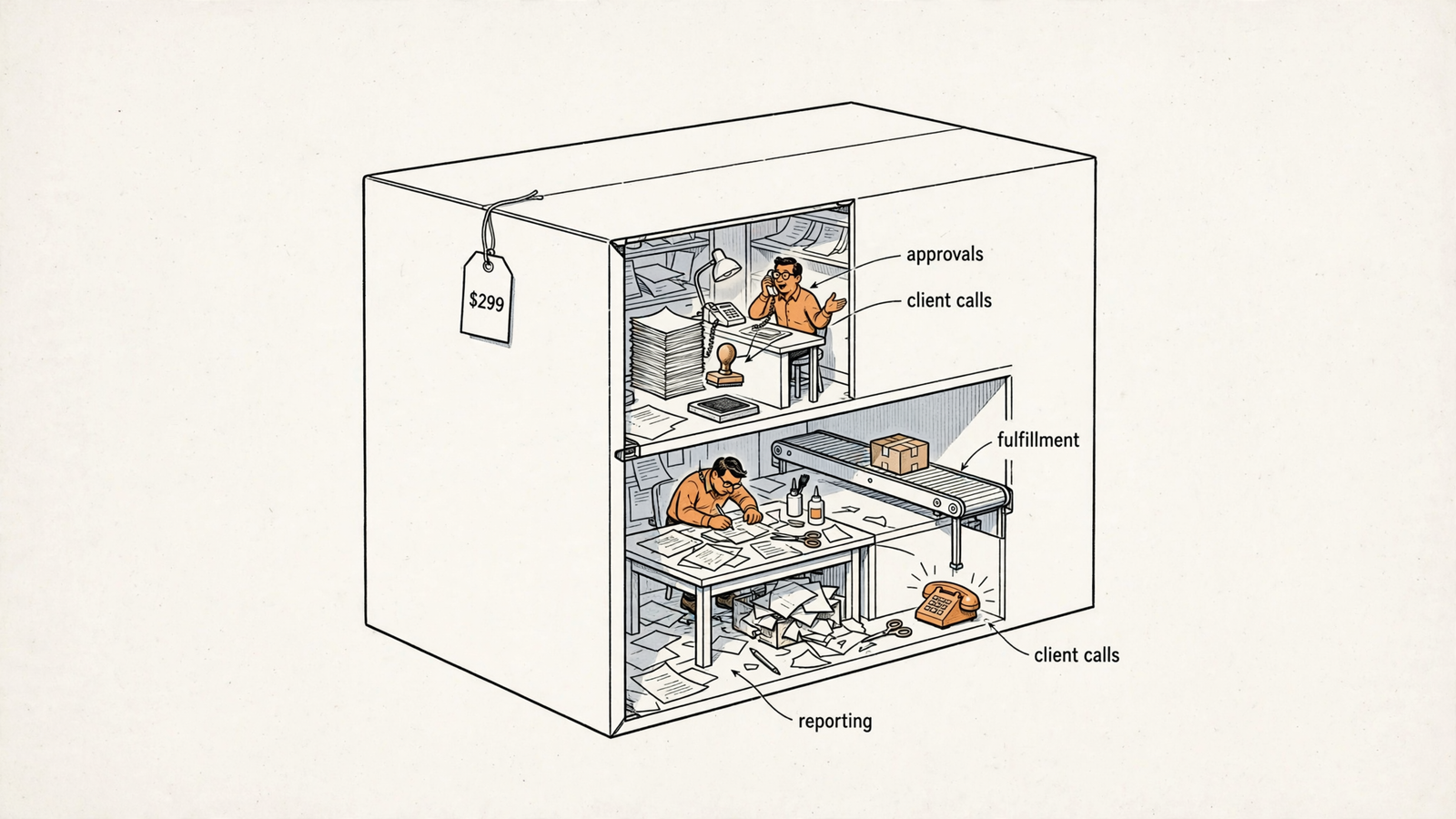
Most agencies price white-label AI SEO backwards. They see a $299 wholesale fee, put a $1,200 retainer on top, and call the remaining $901 profit. I used to do that math on PPC resells. I was wrong.
For an illustrative five-client book, the lines below put year-one cost at roughly $900 to $1,965 per client per month, before overhead and the revenue you risk losing to churn. Those are endpoints, not a forecast that every client will hit every low or high at once. The point is less tidy: your hours for sales, onboarding, explanations, approvals and reporting can cost more than the fulfillment you bought. Entry white-label packages sit around $300 to $620 for basic on-page work and reporting. That makes $299 an attractive starting assumption. It does not make it a margin calculation.
The cost lines: one-off work versus monthly work
Say you resell to five clients at $1,200 a month. That is $6,000 in monthly revenue. The table uses a $299 wholesale fee as an illustrative entry price, not a groas price, and spreads one-off sales and onboarding work across a 12-month client stay. The hourly inputs are benchmarks or working assumptions; your actual hours decide your actual margin.
| Line | Cost per client | Timing | Basis |
|---|---|---|---|
| Wholesale fulfillment | $299 | Monthly | Illustrative fee near the $300 to $620 entry-package range |
| Sales and scoping | $222 to $555; about $19 to $46 monthly if spread over 12 months | One-off | 2 to 5 hours at the $111/hour agency-rate benchmark |
| Onboarding and tracked prompts | $444 to $666; $37 to $56 monthly if spread over 12 months | One-off | 4 to 6 hours at the same $111/hour rate |
| Client education | $111 to $222 | Monthly | 1 to 2 hours at $111/hour |
| Content approvals and chasing | $111 to $333 | Monthly | 1 to 3 hours at $111/hour |
| Reporting, rebranding and review | $300 to $600 | Monthly | 5 to 10 manual-reporting hours at an illustrative $60 blended hourly cost |
| Prompt-tracking tools | About $25 to $409 | Monthly | $249 to $4,089 for 10 clients tracking 30 prompts each, divided by 10 |
Add those lines and you get about $900 to $1,965 per client per month in year one. At a $1,200 retainer, that leaves anything from roughly $300 to a $765 loss before overhead. Churn belongs beside that calculation, not inside the sum: a cancellation takes away future revenue, while the sales and onboarding hours are already counted here. Calling lost revenue another operating expense would count the damage twice.
The listed monthly fee is easy to see. The hidden labor is where the reseller margin goes.
Line 1: $299 buys fulfillment, not client handling
Vendors like a clean wholesale price because it fits on a slide. The work your agency keeps rarely does. Entry white-label packages cover basic on-page and local work plus reporting; mid-tier packages run $1,500 to $3,500 with content and links, and white-label SEO spans roughly $300 to $5,000-plus per client. For AI search, agencies price an AEO/GEO add-on at $1,300 to $2,000 a month and foundations at $2,400 to $3,000.
At the $299 end, do not quietly assume the vendor also owns your strategy calls, client relationships and brand approvals. Budget the fee as fulfillment, then price the retainer against the work that stays on your desk.

Lines 2 and 3: the one-off hours you have to earn back
Sales and scoping come first. Two calls, a proposal and a scope that explains ChatGPT visibility in plain English can take 2 to 5 hours. At the $111/hour agency-rate benchmark, that is $222 to $555 for the deal. Spread it over 12 months and it looks like only $19 to $46 a month. The hours still happen up front. I used to tell PPC prospects scoping was free. I was wrong. It was unpaid.
Then comes onboarding. You need access to the site, GA4 and Search Console, along with brand context: what the client sells, who they sell it to and what they refuse to say. You also need a fixed set of 20 to 30 prompts to track in ChatGPT and Perplexity. Without a consistent prompt list, next month’s report has no useful comparison point.
A clean account can take 4 to 6 hours to set up. At $111 an hour, that is $444 to $666 before the first monthly review, or $37 to $56 a month if the client stays a year. If access gets stuck with someone who never replies, the neat range stops looking neat. Standardize the intake form before you sell the next client, not after you discover your third version of it in a spreadsheet.
Lines 4 and 5: explanations and approvals do not run themselves
Clients ask how they show up in ChatGPT. The honest answer takes time because AI citations can appear, disappear and change with the phrasing of a prompt. A prompt tracker gives you observations, not one permanent ranking to screenshot. I budget 1 to 2 hours a month per client for that conversation in the first two quarters: $111 to $222 a month at the agency-rate benchmark.
The vendor may fulfill pages and fixes in the background, but the client sees you. Every “Why did Perplexity cite a competitor?” email lands in your inbox. That is why one AI SEO partner versus two separate vendors matters operationally: fewer handoffs mean fewer explanations you have to assemble from two accounts of what happened. Prepare a repeatable 15-minute explanation, or you will keep writing a custom one.
Approvals are a second monthly bill. The vendor drafts a page or edit. You check the brand fit. The client sits on it, then requests a rewrite. Chasing, reviewing and passing comments back can take 1 to 3 hours a month: $111 to $333 per client. Delay costs more than labor when unpublished pages cannot start earning visibility.
I used to tell clients approvals protect quality. They can. I was wrong to ignore the other side: approvals also delay publication, sometimes until the client is asking why nothing has changed. Get page templates approved during onboarding, and make clear who has the final say.
Lines 6 and 7: reports and tools can outrun the fee
Reporting is the line that makes a cheap wholesale package expensive. A generic PDF or portal may tell you what the vendor did. Your agency still has to check it, put it in the client’s terms and explain it on a call. The manual-reporting estimate of 5 to 10 hours per client per month becomes $300 to $600 at a $60 blended hourly cost. That is already as much as, or more than, the illustrative wholesale fee.
Automation can cut the review to about 20 minutes, but a template only saves time if you build it and resist custom one-offs. The vendor reports activity; you report what it means for the client’s business. If every client picks a different format, you have hired yourself as a part-time designer.
Prompt tracking adds another variable. In the cited 10-client, 30-prompts-each comparison, tools run from $249 to $4,089 a month. Divide that shared bill by 10 and the allocation is about $25 to $409 per client per month. This is not a reason to buy the cheapest tool on principle. It is a reason to put the tool you actually choose into your model instead of calling software “included” and hoping nobody asks included in what.
Churn is lost revenue, not another cost line
SEO churn averages about 38% a year. Applied loosely to five clients, that is roughly two departures in a year. It is a planning risk, not permission to add an arbitrary churn charge to every monthly cost total.
Say one $1,200 retainer quits after month four. You collected $4,800 rather than the $14,400 you would have collected over 12 months: $9,600 in expected future revenue is gone. You have also already done the sales and onboarding work. You cannot recover those hours by leaving them out of the quote.
Timing makes the risk sharper. A client can spend the early months watching AI citations move around while approved pages are still waiting to go live. If you sold a quick, clean visibility story, you now have to explain the mess you left out of the pitch. Model retention honestly before you set the price; do not pretend a 12-month amortization is a guarantee of a 12-month client.
The in-house comparison does not erase the work
Hiring can look cleaner than paying a vendor until you load the cost. A senior US SEO hire runs $140,000 to $260,000 a year fully loaded in the cited comparison, including salary, tools, benefits and training. One person still rarely covers technical work, content and links equally well.
The smaller-package example is more useful for an agency with spare capacity: an illustrative $2,700-a-month AEO package takes about 27 hours and $1,040 of in-house specialist, writer, lead and manager time. It shows why in-house delivery can produce better margins if those hours are genuinely available. It does not make sales calls, approvals or client education vanish. And a single hire creates a different dependency: when that person leaves, the work pauses. Hire to fill sustained capacity, not to make a wholesale invoice disappear.
The retainer floor depends on your hours
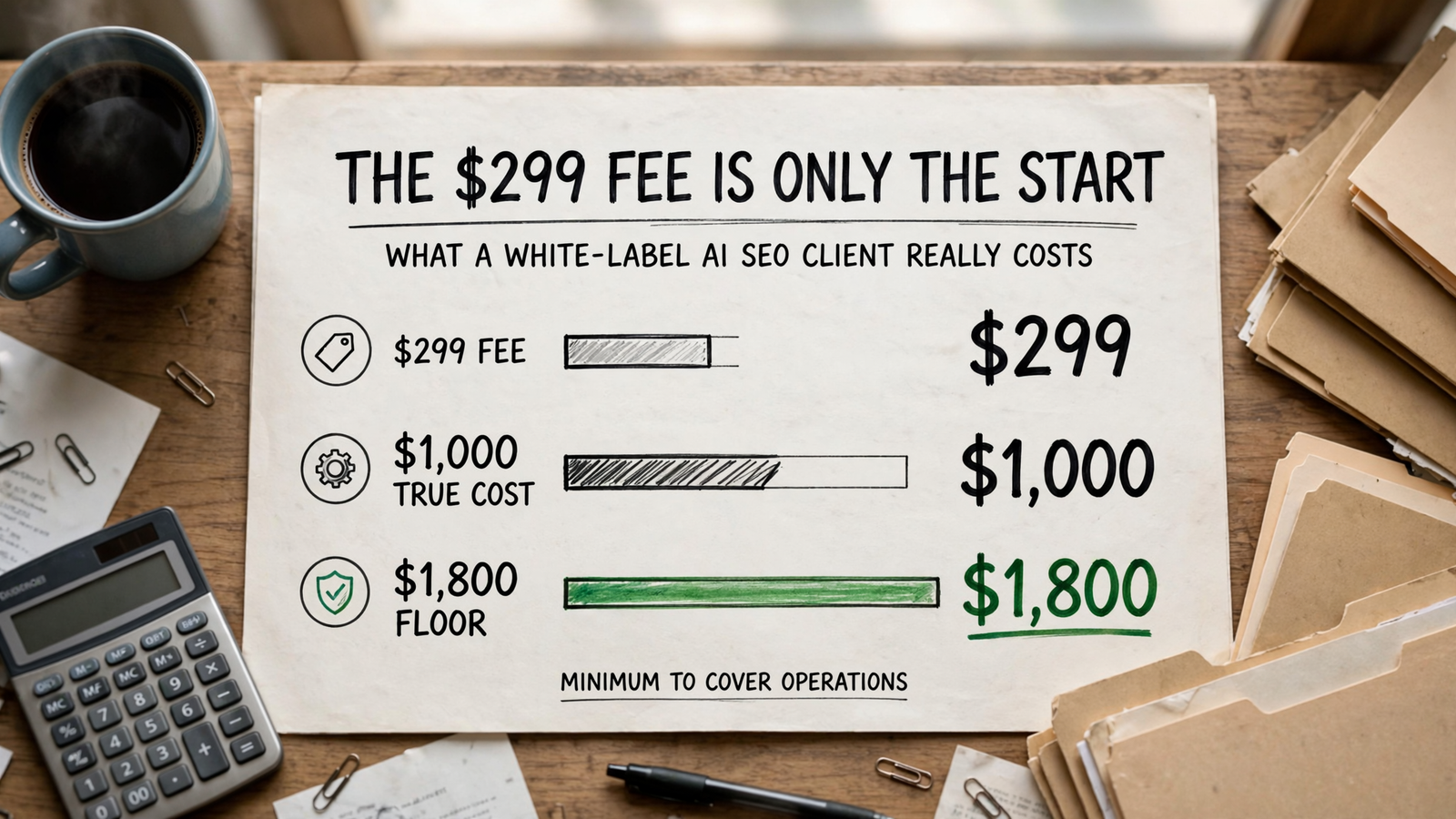
Here is the calculation I would put in front of the sales team: retainer = cost ÷ (1 − target margin). At $1,000 in monthly cost, a 40% target margin calls for about $1,667. At $1,150 in cost and a 50% target, it calls for $2,300. Neither formula lets a $1,200 retainer survive a $1,965 cost month.
My working floor is $1,800 a month for SEO plus AI search, or $1,000 for an AI-search add-on only when an existing SEO retainer already carries shared client-handling work. It is a floor for a standardized, low-touch account, not a promise that every account above it makes money. Check your hours against the table. If manual reporting alone takes 10 hours, raise the price or change the workflow.
That floor can collide with what a smaller client expects to pay. Many expect $500 to $1,000 a month. I would not sell standalone AI visibility to that client on the assumption that an entry wholesale fee saves the margin. A combined offer has a better chance when it uses one prompt list, one report and one client call.
This is where groas has a stronger operational case than a generic white-label PDF vendor: its logged actions and named strategist give the agency a clearer account of what happened and who owns the next decision. That does not remove your client relationship. It gives you less reporting archaeology to do before the call. Price that saved work only after you see it in your own hours.
Who should skip the resell
Skip it if you sell $800 retainers, nobody owns client communication, or every report has to look custom. Skip it if you cannot control approval loops. A client who holds every page and then asks why ChatGPT names a competitor is not a cheap client to serve, whatever the wholesale invoice says.
For everyone else, keep the rule blunt: standardize intake and reporting, measure the hours you still spend, and use an $1,800 floor only where those hours support it. Getting below three recurring agency hours a month takes automation, a tight approval process and a client who accepts a consistent report. If the account needs more, charge for more or do not resell it.
The cheapest mistake is arguing over a $50 difference in wholesale fees while giving away eight hours of custom reporting every month. The most expensive is selling standalone AI visibility for $999, spending six hours onboarding, then watching the client cancel in month four. One mistake wastes a fee negotiation. The other teaches you, too late, what your own time costs.