

 LinkedIn
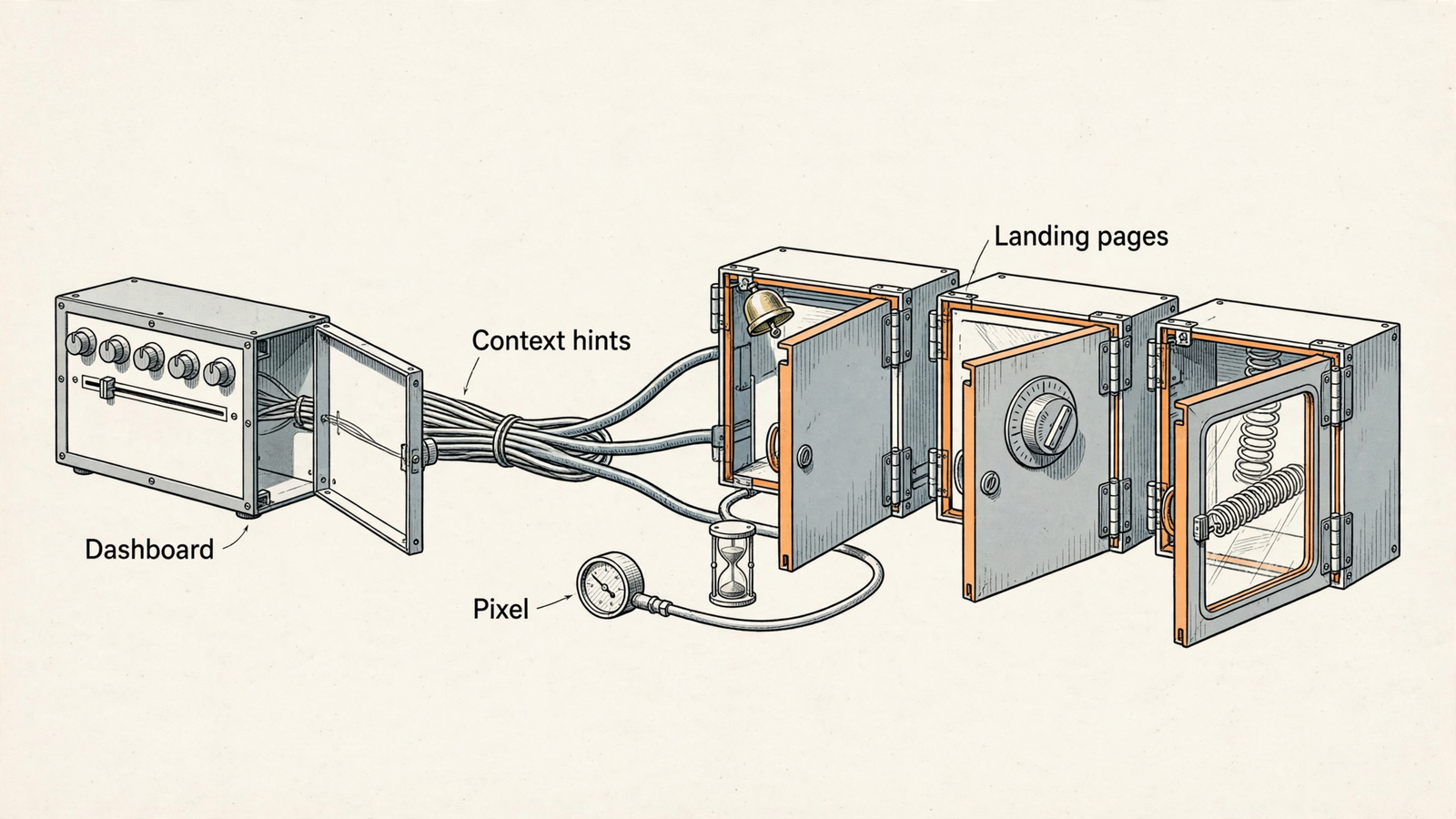
A Google Ads account gives you hundreds of settings to work. A ChatGPT ads account gives you a short list. If a provider only touches Ads Manager, they are selling you the smallest part of the job.
Start with the fact everything else follows from: a ChatGPT ad is a sponsored card shown below the answer for logged-in adults, visually separated and labeled Sponsored. OpenAI says the ad system runs on separate models and code from answer generation. Advertisers cannot shape or rank the answer itself. That separation decides what you can manage, what you cannot, and why most of the work moves outside the account.
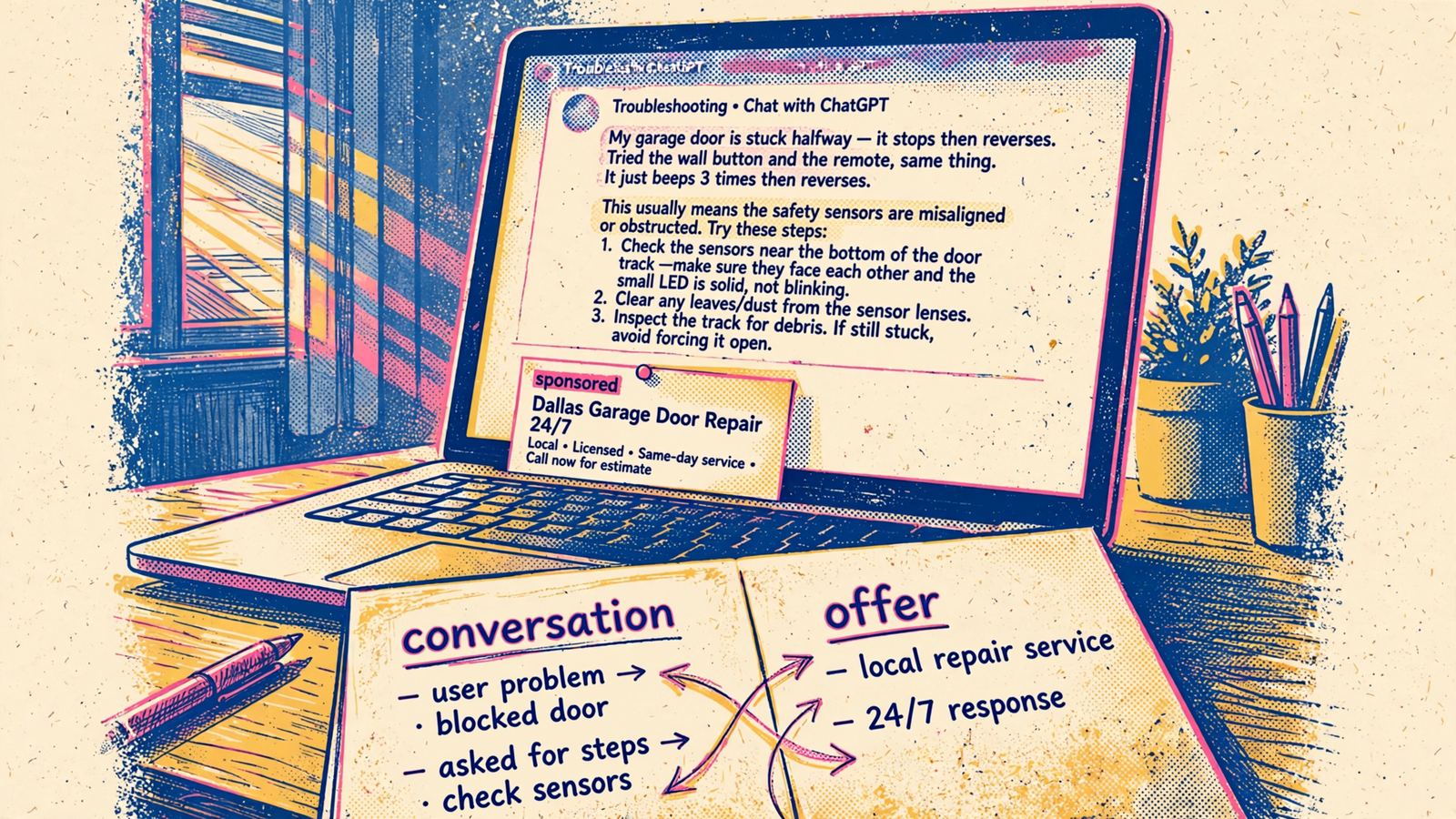
Keep one business in mind as we build this up. Say you run garage door repair in Dallas and spend $20k a month on Google. On Google, someone types garage door repair near me and you compete for that keyword. In ChatGPT, someone writes three paragraphs about a door that sticks halfway in the summer heat and asks what to do. There is no keyword to buy here. There is a conversation, and your offer either fits it or it does not.
First, understand how the card gets there
In Google Ads, the familiar chain is query, keyword, ad, page. I lived in that chain for years. I used to tell clients the query was the truth of intent. I was wrong about how long that truth would last.
In ChatGPT, the starting point is a conversation, sometimes twenty messages long. An orchestrator model turns that context into embedding queries, pulls candidate ads, then filters for eligibility on location, policy, budget, and pacing. Finalists enter a separate relevance-weighted second-price auction that scores relevance alongside the likelihood of a view, click, or conversion.
Here is the part providers tend to skip: winning the auction still does not guarantee an impression. Post-auction fit checks and delivery timing still apply. Our Dallas company can write a strong hint and still not show on a particular turn. You do not buy placement. You qualify for consideration.
Replace keywords with context hints
Inside Ads Manager, the structure looks familiar at first: campaign, ad group, ad. Then the resemblance fades. You do not add keywords. You write plain-language context hints per ad group describing the conversations where an ad fits.
For our Dallas shop, one hint might describe a homeowner troubleshooting a stuck or noisy garage door and asking about repair cost, safety, or whether to call someone local. You add a landing page, card copy, and optional signals such as location. Custom lists have to match at least 25,000 ChatGPT users before they run. The hint is your targeting instruction. Make it too broad and you invite poorly matched opportunities; make it useful and the system has a clearer reason to consider your ad.
Accept the boundary around the answer
The sponsored card sits below the answer, not inside it. This is where the search analogy breaks: in search, you pay to intercept a query; here, you pay for a chance to sit beside an answer the model produced without you.
That boundary also limits what you learn. Advertisers receive aggregated views and clicks, not chats or personal data. You can see that a card showed and someone clicked. You cannot read the conversation that prompted it. So when a provider promises to tell you exactly which chats a hint won, ask what they mean. They can assess performance by hint, creative, page, and conversion. They cannot hand you the missing transcript.
Next, count the controls inside Ads Manager
The in-platform list is short enough to put in one place:
- Context hints and audience includes or excludes.
- Card headline, copy, and landing page URL.
- Objective: Clicks billed CPC, Reach billed CPM, or conversion-optimized oCPC.
- Bid approach: manual Max bid or Maximize results.
- Daily budget and the pixel that feeds conversions back.
Compare that with a Google Ads routine built around match types, negatives, bidding targets, assets, audiences, geo splits, schedules, and scripts. A weekly Google checklist does not simply transfer to this account.
Bidding makes the difference plain. Maximize results is preselected by default for eligible new ad groups and optimizes for clicks or conversions within your budget. OpenAI says it prioritizes volume, not a guaranteed CPA, CPC, ROAS, or efficiency target. If you need a documented hard bid ceiling, manual Max bid is the option to use instead. OpenAI recommends $3 to $5 as a starting max CPC with a $60 default CPM cap. The US campaign minimum is $25 per day, and fixed daily budgets became 7-day averages in July.
Those choices matter, but they are not a full management practice. You set the offer, bid approach, and budget; the platform decides which eligible moments it can use. The next question is whether the click has somewhere worth going.
Build the offer around the conversation
If the inside list is short, a management fee has to buy work elsewhere. This is what I check first when someone pitches me done-for-you ChatGPT ads. On Google, Monday might mean search terms, bids, negatives, and budgets. Here, it should also mean checking how each intended conversation type performs, then changing the hint, offer, or page when the numbers do not support the match.
A managed service describes a weekly hint win-and-loss readout, a mid-week pacing check, and a fortnightly creative cycle, with changes made inside the client’s account rather than delivered as advice (example cadence). A useful readout shows performance and actions by hint. It should not pretend to reveal chats the advertiser cannot see.
Give different intents different promises
Our Dallas shop does not need one ad group called garage door. It needs separate offers for separate problems:
- Emergency repair: A door is stuck half open and the car is trapped. The page needs a clear same-day service offer and a phone number above the fold.
- Price check: Someone asks what a spring replacement costs in Dallas. The page needs a range and an explanation of what changes it.
- DIY versus pro: Someone asks whether the repair is safe to attempt. The page needs a straight answer about torsion-spring risk and a fast path to booking.
Each gets its own hint, card copy, and landing page. Combining them into one vague promise gives the system less to work with and gives you less to learn from the results. Split first. Then use performance by ad group and page to decide which promise deserves more budget.
Make the landing page finish the thought
A ChatGPT visitor has just read an answer before clicking the card beneath it. They arrive mid-thought, with that answer still in mind. If the page opens with a generic Welcome to Best Dallas Garage Doors, you have broken the thread.
The better page continues the specific offer: a door stuck halfway in the heat, a possible spring or opener issue, a Dallas price range, and a same-day booking button. I learned the value of that match the slow way on landing-page tests, where matching the ad to the page beat design tweaks. What the deck calls message match, I call finishing the sentence the chat started. groas approaches this the way it runs Search Ads elsewhere, with a landing page for every ad group rather than one page asked to serve every intent.

Measure the jump, then gate the spend
Measurement has layers, and trusting one alone makes it too easy to flatter a result. Ads Manager reports impressions, clicks, spend, and conversions, with CSV export. The OpenAI Pixel and Conversions API can feed conversion events back, deduplicated by a shared event_id; your own UTMs give you another view in analytics.
Conversions can take 24 to 48 hours to appear. View-through conversions use a fixed 1-day window and appear separately, outside the Conversions total, CPA, billing, and bidding. If a provider blends click-through and view-through results into one reported CPA, that figure is not the CPA the platform uses. Count click-through conversions against spend, and wait two full days before judging a hint change.
The budget rule follows from the same uncertainty. Self-serve ChatGPT ads have carried no lifetime minimum since May 5, 2026, after pilot minimums of $200k to $250k and then $50k. The US floor is now $25 per day per campaign. That makes a small test easier to start. It does not make an unevenly spent 7-day average budget harmless.
For the Dallas shop, a controlled first pass looks like this:
- Put emergency repair, spring cost, and DIY versus pro in separate intent groups, each with its own page and conversion tracking.
- Set a test budget for each group. If you want an independent $25-to-$50 daily campaign budget for each intent, run separate campaigns; an ad-group label is not a campaign budget.
- Use manual Max bid if a hard bid ceiling is the requirement. Do not describe Maximize results as though it also provides that ceiling.
- Check pacing mid-week. Cut a hint that spends without producing useful clicks, and judge click-through conversions only after the reporting delay.
Early CPMs fell from $60 at launch toward $25. Prices were still finding a level. The budget gate protects the test while you learn which intent, if any, earns more spend.
An early large-brand tester account describes spending a few thousand a day for very few orders, against roughly $1M a day on Google that drove thousands. The card sat below the answer, and automated bidding was not available to pace it at the time. CPC, oCPC, the pixel, and feeds have since changed the available setup. The useful lesson is narrower than a channel verdict: test the intent split before you scale. A flat-fee execution model has to maintain that discipline, because percentage-of-spend pricing rewards a bigger test whether or not it teaches you anything.
Decide whether you are buying advice or management
A consultant can audit hints, suggest tighter copy, recommend a $4 starting CPC, and tell you to install the pixel with Conversions API. That can be useful once. Then the recommendations sit there while spend and performance change.
Hands-on management means making the changes: reviewing results by hint, rewriting copy, cycling creative, checking pacing, revisiting bids and structure, auditing the pixel, and fixing the page that loses the click. One managed service defines its weekly rhythm against one-off setup and advise-only consulting. If a provider will not touch landing pages and tracking, they are commenting on the channel, not managing the whole job.

I am also skeptical of thin proof points. The figures vendors quote are single-brand claims, not benchmarks: WeightWatchers at 15.3% lower CPA than blended paid search; Dose with 67% of incremental purchases from net-new customers; 93% of Portland Leather ChatGPT visitors new; and OpenAI at a $1B annualized run-rate with 100k advertisers, without CPA or ROAS by industry. None predicts a Dallas spring-replacement CPA. Pay for work on your offer and your account, not a tour of someone else’s logos.
Ask for the weekly artifact, not the deck
A manager should be able to show what they reviewed, what they changed, and why. Ask for a redacted example of the work, not a claimed transcript of customer chats:
- Show me a week of hint-level wins and losses. What changed because of them?
- Which landing page matches each intent, and who rewrites it when clicks fail to convert?
- How do you count conversions, and do you keep the 1-day view-through column out of CPA?
- What caps the test: campaign budget, bid approach, and the rule for cutting a losing hint?
No artifact, no management.
Run one more case through the model
Say you sell custom leather tote bags online, with a $150 average order and $8k a month available to test. The thin in-platform approach is one campaign, one broad hint about shoppers researching leather bags, one product page, Maximize results, and a wait. Two weeks later, you may have clicks but little understanding of which offer earned them.
Start instead with three distinct intents: a gift buyer comparing leather grades, a commuter asking about laptop fit and weight, and a price shopper asking whether full-grain is worth it. Give each a hint, card line, and page variant that continues that thought. Use a $35 daily campaign budget for each intent and manual Max bid if you need a hard bid ceiling. Confirm that conversion events are arriving, allow for the 48-hour reporting delay, and compare click-through conversions rather than folding view-through results into CPA.
After two weeks, you may know which conversation-shaped offer earns purchases. You may learn that none does at the current spend. Either answer is more useful than a dashboard full of clicks. The job is to build that test, protect its budget, and change the offer when the evidence calls for it. The account holds a short list of controls. Management happens across the whole path from conversation fit to conversion, then back to the next hint.