

 LinkedIn

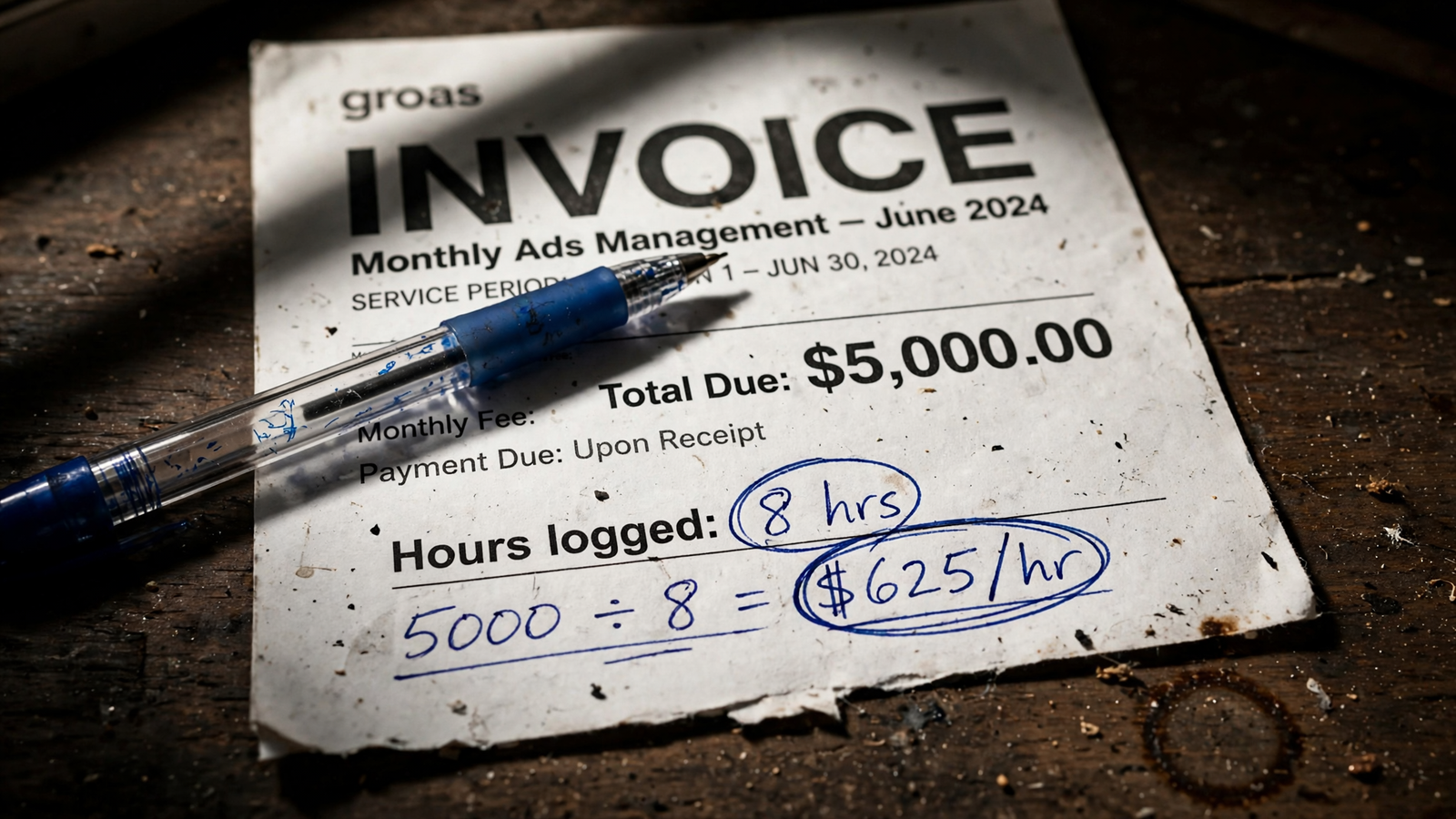
At $50,000 a month in Google Ads spend, a 15% management fee is $7,500. Divide that by 8 to 12 hours of hands-on work for a stable account, and the effective rate is $625 to about $938 an hour.
That is not an agency’s quoted hourly rate. It is what the invoice works out to if the account needs that amount of work. The distinction matters: I am not saying every $50,000 account takes 10 hours, or that every agency delivers only the hours it logs. I am asking a narrower question that rarely appears on a proposal. When a fee rises with spend, what happens to the price of each hour if the work does not rise with it?
I spent years mining search terms, rebuilding match type structures, and checking budget pacing before coffee. The work matters. It also changes after an account is built and tracking is clean. The calculation below holds the hours steady to show what a percentage fee does on its own. Where the hours change, you should change the denominator.
Start with the fee, not the pitch
The pricing figures here come from published pricing guides, not private agency invoices. One guide puts common management fees at 10% to 20% of ad spend, with 15% common above roughly $15,000 in monthly spend. It also describes flat retainers, hybrid fees, hourly work, and setup charges. Another puts retainers at $500 to $5,000 or more. These are ranges and examples, not a promise about what any particular agency will quote or deliver.
For this cost breakdown, keep recurring management, one-time setup, and media spend separate. Combining them produces a large number but a useless hourly comparison.
| Cost | Published figure | How to treat it |
|---|---|---|
| Percentage management fee | 10%–20% of spend; 15% is a common example | Recurring. At a fixed percentage, the fee rises whenever spend rises. |
| Flat management retainer | $1,500–$5,000 a month | Recurring. The price alone does not reveal the hours or work included. |
| Hybrid fee | $500–$2,000 base plus 5%–10% of spend | Recurring. Both the base and the variable portion belong in the calculation. |
| Hourly agency work | $75–$300 an hour | Recurring when used. Check who performs the work and which tasks count. |
| One-time setup | $1,000–$10,000 | Keep it out of a steady-state monthly rate; evaluate it against onboarding work. |
| Named B2B starting prices | Directive startup package from $6,500 a month; paid media at $7,500–$15,000; KlientBoost from about $5,000 a month | Published examples, not prices for equivalent scopes. Ask what each quote includes. |
Media spend is not a management fee. Nor can you assume a cheaper retainer buys the same work at a discount. An agency-side cost breakdown illustrates how much delivery time different fees can support after margin and loaded labor cost. Its assumptions are not a time sheet for your account, but the mechanism is straightforward: a low fee leaves less room for hands-on work.
The less visible cost is paying for activity that does not improve the account: meetings, reports, or repeated checks sold as new strategy. I would not put an invented dollar amount on that line. I would ask what changed in the account. The cheapest quote is not automatically the cheapest management.
The denominator: what the hours actually cover
A pricing guide estimates 15 to 25 hours for one-time onboarding and 8 to 12 hours a month for ongoing work on a stable account. That distinction is doing real work here. Auditing, tracking, building, and launching an account are not the same job as maintaining one that is already running cleanly.
Here is the steady-state task mix I would use to interrogate the estimate. These are planning allocations within that 8-to-12-hour scenario, not observed hours from a particular agency or a claim that every account follows this schedule.
| Monthly task | Illustrative hands-on time | What I would expect to see |
|---|---|---|
| Search terms and negatives | 2–3 hours | Queries reviewed; irrelevant terms excluded without choking useful intent. |
| Budget pacing and breakage checks | 1–2 hours | Spend checked against plan; feeds and tags checked for problems. |
| Bid and target review | 1–2 hours | Targets examined against volume and acquisition cost. |
| Copy and asset tests | 1–2 hours | A test launched, monitored, or stopped for a stated reason. |
| Reporting and calls | 1–2 hours | A clear account of what changed and what happens next. |
| Tracking integrity and periodic structure work | About 1 hour, averaged across months | Conversion checks and less frequent structural work. |
| Total steady state | About 8–12 hours | Onboarding excluded. |
The rows are approximate and should not be mistaken for a stopwatch. Some months need a rebuild or a tracking repair; others need little beyond monitoring and judgment. Automation can handle repetitive checks and surface queries, but someone still has to decide which negatives preserve intent, whether a target is constraining volume, and whether a test has earned more time. Calling all of that “the AI did it” is as unhelpful as billing every routine check as senior strategy.
This is also where the analysis can fail. A new account, broken tracking, a changed offer, or a more demanding scope may need more hours than the steady-state estimate. If that describes your account, use the actual work, not my midpoint. Hours are the denominator, not a verdict.
At four spend levels, the same hours get much more expensive
For the comparison, I apply the 15% fee example to four monthly spend levels and divide by the 8-to-12-hour steady-state estimate. The fee and effective rates in the table are calculations from those two inputs, not separately reported market prices. A senior freelance specialist at $75 to $150 an hour provides a price reference, though a freelancer quote and an agency retainer are not identical services.
| Monthly ad spend | Fee at 15% | Assumed monthly hours | Effective rate | Relative to $150/hour |
|---|---|---|---|---|
| $10,000 | $1,500 | 8–12 | $125–$187.50/hour | About 0.8–1.3× |
| $25,000 | $3,750 | 8–12 | $312.50–$468.75/hour | About 2.1–3.1× |
| $50,000 | $7,500 | 8–12 | $625–$937.50/hour | About 4.2–6.3× |
| $100,000 | $15,000 | 8–12 | $1,250–$1,875/hour | About 8.3–12.5× |
Take the 15% fee at $25,000 spend: $3,750 divided by 10 hours is $375 an hour. At $50,000 spend, the same calculation is $750 an hour. No claim about results is hiding in those figures. They show the price of the assumed work under one common fee structure.
At the low end, percentage pricing has the opposite problem. Fifteen percent of $2,000 is $300, which leaves little room for sustained hands-on management. That does not prove every small account is neglected. It shows why a low percentage fee can buy less work than the owner expects. At the higher spend levels in the table, the question reverses: what additional work justifies the additional fee?
Where the curve breaks: budget and workload are different things
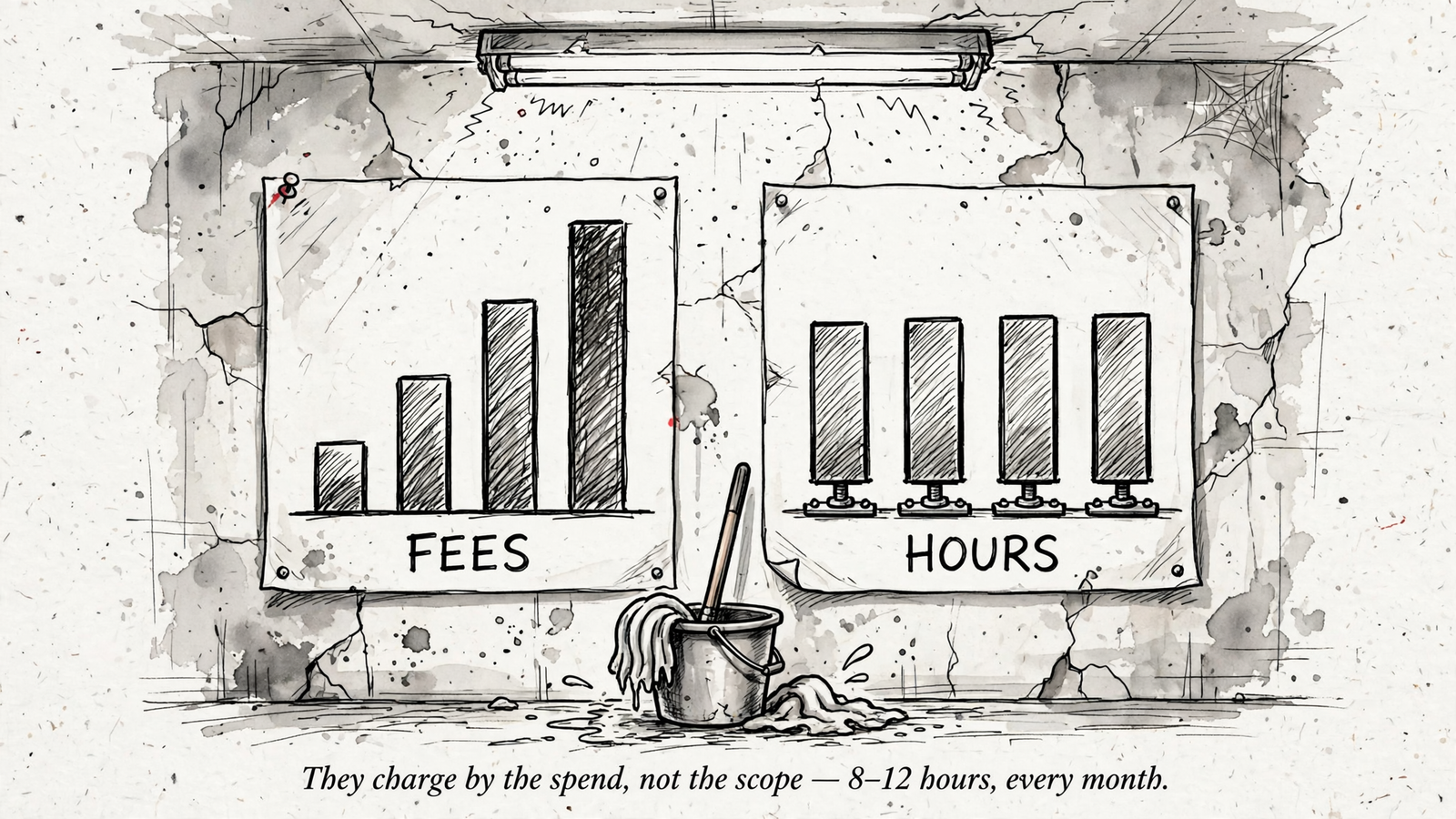
Doubling budget does not, by itself, double the task list. A manager still has to review queries, watch pacing, check tracking, examine targets, and decide what to test. More spend can create more work, but a percentage fee rises even when it does not. That is the structural problem, not a claim that complexity never changes.
Suppose the $25,000 account takes 10 hours and the $50,000 account takes 11. Under 15% pricing, the fee doubles from $3,750 to $7,500. The effective rate rises from $375 to about $682 an hour. One extra hour does not explain the extra $3,750. If the agency has taken on a different scope, it can show that work. If it has not, the percentage has done the raising for it.
I used to tell clients percent of spend kept us aligned. I was wrong. It aligns a fee with spend. It does not, on its own, align the fee with qualified pipeline, closed-won revenue, or the time required to manage the account. That is why I want the task list before I want the presentation deck. A bigger budget is not evidence of a bigger job.
Three questions for the next agency call
Do not open with “Is 15% fair?” Fairness turns into a conversation about expertise, overhead, and how hard everyone works. Ask for evidence you can put beside the invoice. The pricing models differ, but each still needs a clear explanation of what you receive.
- How many hands-on hours did my account get last month, by task? Ask for search terms reviewed, negatives added, target changes, tests, and tracking checks as separate lines. Include reporting, but distinguish reporting on work from doing it. If the month involved onboarding or a repair, have the agency identify that separately.
- Who did the work? A blended agency fee tells you little about whether a senior specialist made the decisions or checked in briefly while someone else ran the account. Ask for the person responsible for each task. I care less about the job title than whether the work and the judgment are visible.
- If I double spend without changing the account’s structure, what changes in the fee and what changes in the work? A percentage quote answers the first half automatically. The second half is where an agency earns its explanation. Ask it to name the extra tasks rather than describe a general increase in “attention.”
These questions are not a demand that an agency behave like a freelancer. They are a way to test whether a fee reflects a real service or merely tracks your media budget. Make the invoice answerable in tasks.
Rerun the division with your own quote
Take the monthly management fee without media spend or one-time setup and divide it by hands-on hours on the account. If the agency cannot provide hours by task, use 10 hours as the midpoint of the published 8-to-12-hour estimate for a stable account, then ask the agency to correct the assumption. Do not present your estimate as its time sheet.
For example, a 15% fee on $25,000 in spend works out to $3,750 ÷ 10 = $375 an hour. A published $6,500 monthly starting price works out to $650 an hour if it buys 10 comparable hours; the scope may not be comparable, so ask. The division is useful precisely because it exposes what you still need to know.
A flat fee removes the automatic link between management price and media spend. groas lists Search Ads at $1,499 a month per service. On the same illustrative 10-hour denominator, that is about $150 an hour at either $10,000 or $100,000 in spend. That is not a claim about the hours groas delivers. It shows what happens to the arithmetic when the listed management fee stays flat. The related comparison of percentage, revenue-share, and flat fees puts the structures side by side; your own quote and scope still decide the purchase.
The cheapest mistake is choosing a fee so low it leaves no room for the work your account needs. The most expensive is keeping a percentage fee as spend rises without asking what additional work it buys. I kept clients on that model because it was standard. Standard was the problem. Ask for the hours, divide the fee, and choose the structure whose price makes sense for the work.