

 LinkedIn

I used to tell clients Microsoft Ads was free incremental volume: copy the Google structure, lower the bids a touch, collect the cheap clicks. I was wrong. An imported campaign is a Google campaign entering a different set of placements and queries. If you treat every click as Bing search, you can spend weeks fixing bids while the money leaks somewhere else.
Take one example through the whole piece. Say you spend around $20k a month on Google for [emergency plumber near me] and a tight set of exact and phrase match variants. You press Import. Budgets and keywords arrive intact, and for a week CPA looks fine. Then the search-terms report fills with queries you never bought on Google, spend reaches placements you never approved, and the client asks why Bing converts at half the rate.
The one fact everything else follows from: a click reported as Bing often did not come from Bing search. Microsoft can serve ads across owned properties, syndicated search partners and native placements. Those sources carry different intent. The Google account you imported could not show you how this Microsoft traffic would be distributed. Before you decide what the bid should be, find out where the ad appeared.
Layer 1: An import opens more than Bing search
Bing is small. In August 2026 it held 8.92% of US search against Google at 86.1%. I like the desktop opportunity, where Bing over-indexes and an emergency plumber call can be worth chasing. But a smaller query pool changes what the import can deliver. An exact keyword that bought 400 clicks on Google might buy 30 on Microsoft. You cannot assume the rest of the volume will look like those 30 clicks.
Microsoft has three broad sources of impressions:
- Owned properties, including Bing, MSN and Outlook.com.
- Syndicated search partners, including sites such as Ask.com and Yahoo properties whose search boxes are powered by Microsoft.
- Native placements on the Microsoft Audience Network, across properties such as MSN, Outlook and Edge.
These are not three names for the same search result. Someone searching for a plumber on Bing has signalled an immediate need. Someone seeing a native placement in Outlook has not made that same request. Yet the setting called Microsoft sites and select traffic still includes select partner traffic; its name is not a promise of Bing-only search. Search campaigns can also arrive with Search Ads Extended to Native switched on. On day one, the plumber ad can appear in places the Google campaign never touched.
Without an Ad Distribution split, those clicks roll into one campaign average. The contrast is visible even in engagement: search CTR around 4.1% versus MSAN native near 0.48%. CTR is not conversion rate, but it is a warning against reading the two placements as one kind of traffic. I have watched imported accounts where a third of so-called search spend went to native placements the client never approved. Those clicks produced no calls while the Bing search slice itself was fine.
There is no neat switch that solves every part of this. Bid adjustments that once blocked the Audience Network from search no longer work. I set network coverage to Microsoft sites and select traffic, inspect placement reports, exclude audience websites that appear, and ask support about an account-level opt-out where the account qualifies. None of that makes select traffic synonymous with Bing. It makes the distribution visible and gives me places to intervene. Split search from audience before you treat the blended CPA as a bid problem.
Layer 2: The import copies your choices, not your judgment
The import tool is faithful in the obvious places. It brings over campaigns, ad groups, keywords, ads, budgets and bids. You can use Quick import, which applies Microsoft defaults, or Customize, which lets you change budgets, statuses, bidding and schedules before import. Scheduled sync can connect up to 10 Google accounts. That convenience has a cost: practitioners warn it can overwrite Microsoft-specific changes to status, bids and budgets. I leave it off. Otherwise a later Google edit can undo work done specifically for Microsoft.
Now look at the plumber’s bid. Equivalent terms on Microsoft can clear roughly 30% below Google because fewer advertisers bid. If a $24 Google max CPC arrives unchanged in an auction that clears at $16, the import has carried over a ceiling set for another market. That does not mean every click costs $24. It means the ceiling deserves a Microsoft-specific review, not automatic trust. A Microsoft employee advising on imports makes the broader point: review budgets, bids, currency and Microsoft-only options, because the tool preserves assumptions from the account it copied.
It cannot copy settings Google never had. LinkedIn profile targeting by Company, Industry, Job Function and Seniority, expanded in June 2026, plus ad-group-level scheduling and location controls, must be added manually. Those are choices to make for the account, not boxes to tick indiscriminately. LinkedIn targeting will not rescue an emergency plumber campaign from a bad audience placement. It may matter a great deal to a B2B campaign later in this piece.
For our plumber, the order is straightforward: establish where spend is going, review bids against the Microsoft auction, and keep scheduled sync from reversing the fixes. Import gives you a starting structure. It does not validate the settings.

Layer 3: The same keyword can buy a different query
Placement is the first leak to check, not the only one. Suppose the plumber’s imported exact keyword is [emergency plumber near me]. A smaller search pool and Microsoft’s matching can produce a different search-terms report from the Google one. Practitioner testing finds looser matches on Microsoft: plumbing jobs, DIY fixes and handyman queries can appear beside searches for a plumber who can take a call. A shared keyword does not guarantee shared intent.
Syndication complicates the label on the click. DuckDuckGo has no separate opt-in because its search ads run through Microsoft’s syndicated partner network. Disable search partners and you also cut DuckDuckGo. Leave them on, and those clicks can appear in GA4 as bing/cpc unless you inspect the Website URL report to identify the publisher. Again, “Bing” in a report is not necessarily a Bing search result.
Then come negatives. Do not assume the Google negative list will arrive ready to do the same job. Microsoft supports phrase and exact negative match, not broad negative match, and those negatives do not cover close variants in the same way Google’s do. An account-level plan built around Google broad negatives needs rebuilding. I take the top 20 Google negatives, rewrite them as exact and phrase where they belong, then check Microsoft search terms twice in the first two weeks. The point is not to block every surprising phrase on sight. It is to separate a plausible emergency-plumber search from a job seeker or someone looking for a DIY fix.
If a partner leaves the Google list untouched and calls that Microsoft management, they have skipped the query work. Check the terms before lowering a bid on traffic you did not mean to buy.
Layer 4: Read the client’s numbers in the right order
A client does not see syndication. They see a line that spent $1,800 and produced three calls while Google produced forty. “Bing does not convert” is an understandable reading of that line. It is not yet a diagnosis. When an imported campaign spends without converting, I check placement mix first and query intent second, because those are the two changes the import can conceal. I use the same distinction in Why Microsoft Ads Spends Without Converting: the Bing search slice can be viable even when the blended campaign average is not.
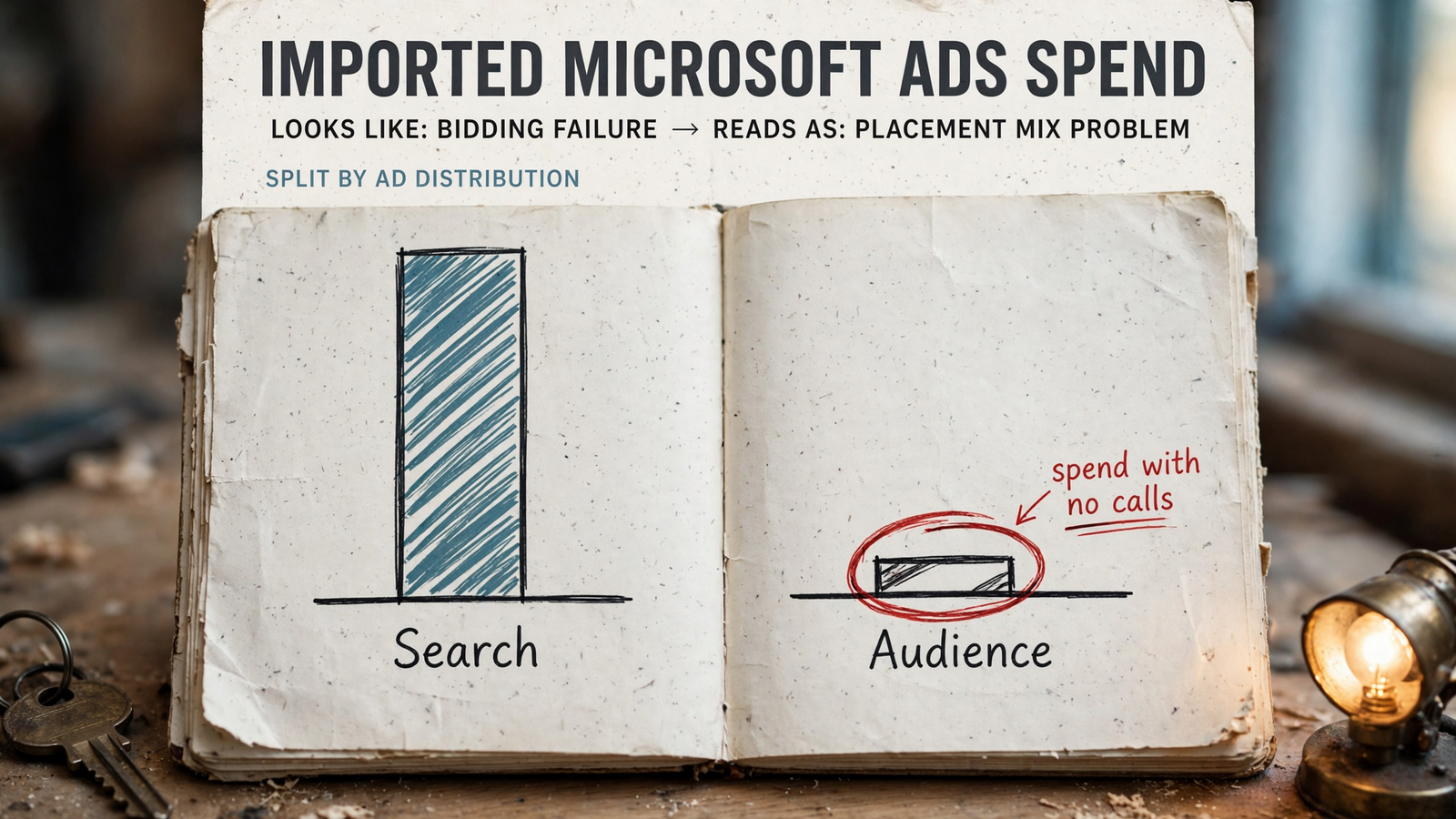
Here is the reading order I use:
- Segment by Ad Distribution. Compare search with audience rather than starting from the combined CPA. If search sits within 20% of Google CPA while audience holds spend and produces no calls, the blended number is hiding a placement problem.
- Pull the Website URL report. Look at the partner slice publisher by publisher. One plumber account I cleaned had 60% of partner clicks coming from three parked-domain-style publishers that would never appear in its Google report. An aggregate partner total would not have shown me where to act.
- Compare search terms for the same keyword. If Microsoft returns DIY and job-seeker queries that Google did not, rebuild the negatives in exact and phrase. Changing the bid first would leave those queries eligible, only at a different price.
That sequence also tells you when the initial theory is wrong. If the search slice itself has poor terms, fix the terms. If its terms are relevant and its CPA still disappoints, then look harder at bids and the rest of the account. Kill the bad slice, not the channel on the strength of one blended average.
Layer 5: Apply the same model beyond plumbing
The model does not say every imported campaign fails in the same place. It says to ask two questions in order: Where did the ad serve? and What intent did that placement or query represent? The answer changes by vertical.
- Shopping: The feed carries the product information into the auction. Microsoft can pull the same titles and GTINs while partner search boxes bring different browsing intent. A Google Shopping click for a specific SKU can become a Microsoft click for a category browse on a coupon publisher. I cut partner coverage first on those imports and keep owned search. Better feed information cannot turn a poor placement into a good one.
- B2B lead generation: LinkedIn profile targeting changes what an imported campaign can distinguish. Google did not let you bid by Company or Job Function, so the copied setup treats a CFO and a student as the same click. Adding that targeting after import can make a thin Bing pool more useful, especially on desktop, where Bing share runs higher. First establish that the traffic is worth refining; targeting is not a substitute for inspecting distribution.
- Local services: For the plumber, timing matters. Loose matches and audience extension can use the daily budget by noon on queries outside the service area, leaving nothing for a 6pm burst of emergency searches. I use Microsoft’s ad-group-level scheduling and location controls, then rebuild negatives in exact and phrase. The goal is to preserve budget for the calls the campaign was built to win.
These are different repairs. They follow from the same first principle: where an imported ad serves can explain more than what you bid. Diagnose that before prescribing a universal bid cut.
The five questions that expose a copy-paste partner
If you resell Microsoft Ads, you do not need a white-label partner with a Bing logo on the deck. You need one who manages Microsoft as its own channel. I put five questions to a team, each tied to a layer above. A Google shop with Bing tacked on often gets stuck at question two. I also use hands-on Bing account work, rather than slides about it, to assess partners in White-Label Microsoft Ads Partners Ranked.
- Can you show search split from audience for one client? A blended CPA alone cannot tell me whether Bing search works. I want the Ad Distribution view before a verdict on the channel.
- What network coverage do you set after import? Listen for Microsoft sites and select traffic, the remaining partner traffic, website exclusions and a support request where appropriate. “We use the imported default” is not a distribution strategy.
- How do you review Google bids on import? I do not want a magic percentage applied to every account. I want the partner to recognize that a Google CPC ceiling enters a different auction and explain how they reset it after examining the Microsoft traffic.
- How do you rebuild negatives without broad negative match? Listen for exact and phrase negatives, rewritten deliberately, followed by search-term checks in the first two weeks. A copied list is not an answer.
- Do you leave scheduled sync on? If so, ask how Microsoft-specific fixes survive subsequent Google edits. If they cannot explain that, today’s cleanup may disappear tomorrow.
Those questions test work, not fluency with the platform’s vocabulary. groas takes the channel-specific route, with dedicated Bing management rather than a copy-paste import, inside a flat-fee Search Ads service covering Google, Bing and ChatGPT. The account gets ongoing execution rather than a one-time import and a blended report. The difference is whether someone owns what happens after the copy finishes.
Now take a home-services account you have not touched. It spends $8k a month on Google and converts at 4%. A white-label partner proposes a straight Microsoft import with bids unchanged. You cannot honestly predict its Microsoft CPA from those two numbers. You can predict what the partner has failed to check.
Start with distribution: are native placements spending alongside search, and which publishers sit inside the partner slice? Then compare search terms with Google’s. Did the imported negatives leave job-seeker and DIY queries open? Review the bid ceilings in the Microsoft auction, disable sync if it would undo the work, and use the relevant location and scheduling controls. Judge Bing search on its own numbers after those checks. If it still underperforms, say so. At least you will know what underperformed.
That is the whole test. Anyone who skips it is not really managing Microsoft Ads. They are running Google Ads in a different room and charging you for the tour.