

 LinkedIn

Five clients can bring in $5,000 a month in Google Ads management fees and still leave you working for free. I would pick flat-priced fulfillment over a cut of ad spend for a small agency, but only after the partner’s actual quote fits the price you can charge. A flat fee is not automatically a small fee.
Here is the test I use: five clients, each spending $3,000 a month on ads and paying you $1,000 for management. That is $15,000 in ad spend and $5,000 in service revenue. The ads budget is not yours to keep. Your margin starts with what remains after wholesale fulfillment, then shrinks again when you account for reporting, quality assurance, and client calls.
Most white-label rankings lead with dashboards, badges, and turnaround times. Useful, perhaps. None can rescue a $1,000 management fee from a $1,500 wholesale minimum. I am ranking the options by the margin a small shop can plausibly keep, not by the length of a provider’s feature list.
The five-client bill: listed costs first, hidden costs next
For five accounts, the published flat-price bands in the draft put recurring wholesale anywhere from $1,500 to $20,000 a month before one-offs. That is a range across different offers and scopes, not a quote you should expect from one provider. Percent pricing moves with spend instead: at 15% of this example’s $15,000 ad budget, wholesale is $2,250 a month.
| Cost line | Published figure and source | When it hits | What moves the bill |
|---|---|---|---|
| Percent-of-spend fulfillment | 10–25% of spend; 12–18% is described as a common band. Another comparison lists 10–20%. | Recurring | Client ad budgets |
| Lower flat-price band | Around $300–$600 per account | Recurring | Number of accounts and quoted scope |
| Broader flat-price bands | $750–$4,000 per account; another guide lists $500–$2,500 | Recurring | Provider, scope, and fulfillment model |
| groas Search Ads service | $1,499 per month per service, with no percentage of ad spend and no setup fee | Recurring | Services purchased, not an increasing ad budget |
| Setup | $500–$2,500 per account; another comparison lists $150–$500 | One-off | What the initial build includes |
| Extras | Dashboard fees and creative surcharges may be separate | Depends on the quote | Reporting and creative requirements |
The table separates listed prices from work you still own. Your time handling client questions, checking changes, fixing handoffs, and rebuilding after churn does not appear on a partner invoice. It still comes out of your margin. I used to treat wholesale as the whole cost. That was convenient accounting, not good accounting.
Run the example before listening to a sales pitch. At $300 per account, five flat-price accounts cost $1,500 and leave $3,500 of the $5,000 management revenue before your own labor. At 15% of spend, wholesale is $2,250 and leaves $2,750. At a $1,500-per-client minimum, wholesale reaches $7,500. You are $2,500 short before you answer an email. These are illustrations using the listed prices, not interchangeable quotes for identical work.
The groas figure needs the same discipline. Its published price is $1,499 per month per service, not the $299-per-client rate that an earlier version of this comparison used. Do not multiply an unconfirmed partner rate across five accounts and call the result your margin. Ask what the quoted service covers and what you would pay for your particular five-client setup. If your cost for a client is $1,499 while you collect $1,000, that client loses money on management. No badge fixes it.
The cheapest mistake is paying setup five times without asking what a replacement build costs when a client leaves. The most expensive is signing a wholesale minimum above your retail fee and hoping volume will repair the subtraction.
The ranking: margin first, with the unpriced work in view
I put flat-priced fulfillment first because a fixed, workable quote lets you protect the spread as budgets change. The middle ranks are less tidy: offshore and freelance invoices can look cheap until you price your own supervision. The table shows the arithmetic you can do now and the uncertainty you must settle with a quote.
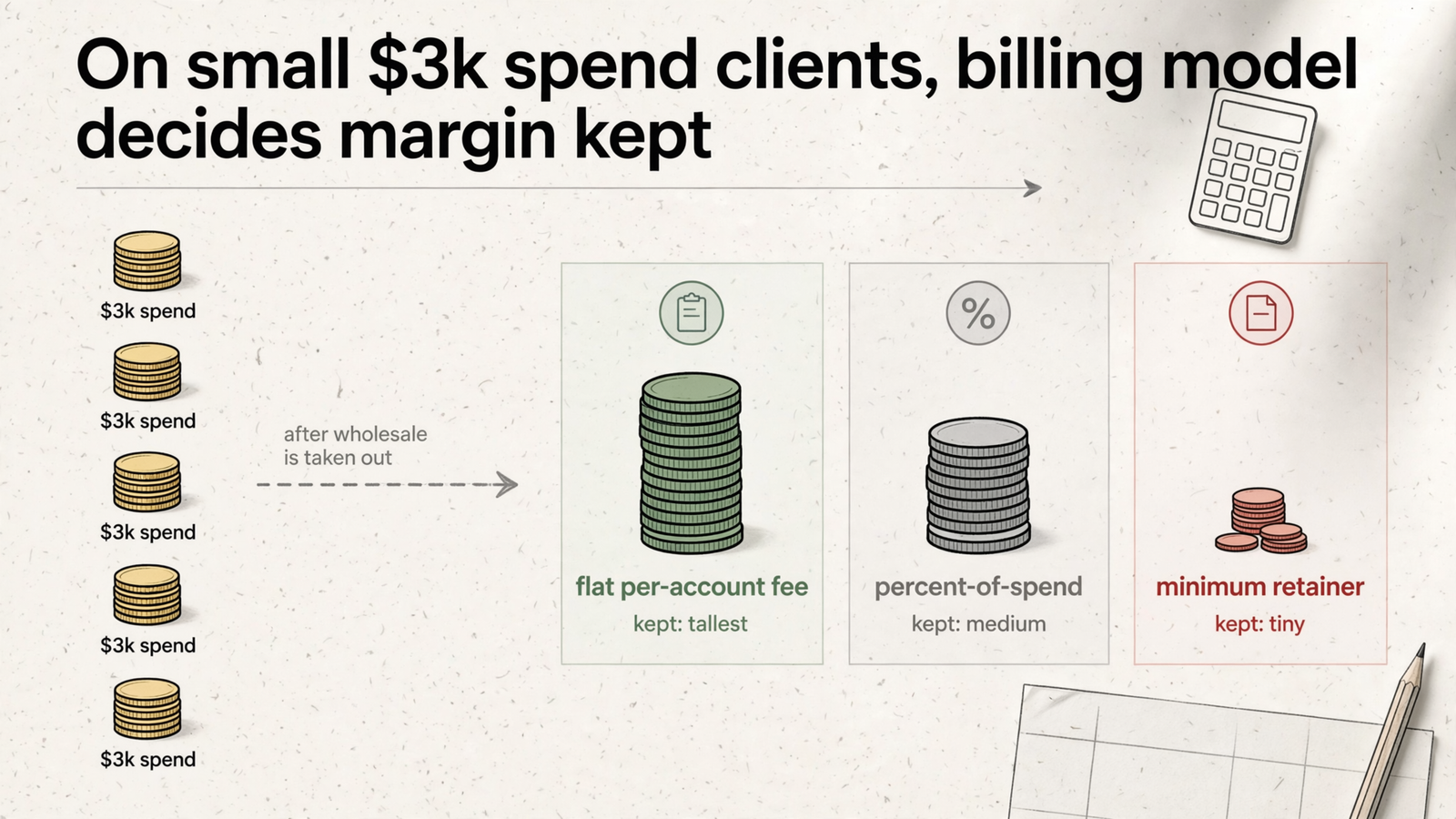
| Rank | Option | Five-client cost in the $3,000-spend example | What can rule it out |
|---|---|---|---|
| 1 | Flat-priced fulfillment | $1,500–$3,000 at the listed $300–$600-per-account band; other flat quotes run higher | A flat quote above what your retail fee can carry |
| 2 | Percent-of-spend shop | $2,250 at an illustrative 15% of $15,000 spend | Wholesale rises when budgets rise |
| 3 | Offshore team | Price depends on the flat quote and how much QA you do | Cheap delivery that turns you into the reviewer of every change |
| 4 | Freelancer marketplace | $2,000 at an illustrative $400 per account, before your QA time | Coverage and consistency rest on one person |
| 5 | High-minimum retainer | $7,500 at a $1,500-per-client floor | More wholesale than the example earns in retail |
Those ranks are my choice for a small agency seeking repeatable margin, not a claim that every provider in one row costs more than every provider above it. Get the quote, define the scope, then rerun the subtraction.
1. Flat-priced fulfillment: my pick when the quote leaves room
Flat pricing is for the freelancer or small shop that wants to know its fulfillment cost before a client raises an ad budget. A UK partner example offers fixed monthly pricing and tiered partner discounts; a US example describes flat wholesale per account rather than a percentage or revenue split. The mechanism is straightforward: if your wholesale fee stays fixed when spend rises, the budget increase does not automatically eat more of your management revenue.
That is what this option does best. groas makes the no-percentage distinction explicit in its published $1,499-per-service pricing, alongside no setup fee. For an agency whose retail pricing supports that service cost, I prefer that clear fee to paying a percentage merely because a client increases spend. I would still get the white-label scope and the number of services needed for my accounts in writing before pricing the resale.
Who should rule it out? Anyone selling $1,000 management who receives a $1,499 wholesale quote for the work required by that client. The bill does not become profitable because the model is flat. Lower-priced flat bands exist in the comparisons above, but their quoted scope may differ. Compare the work you are buying, not just the monthly number.
My practical test is one sentence in the agreement: what counts as an account and what counts as a service when Search and Shopping both need attention? If you cannot answer that, you do not know your wholesale cost.
2. Percent-of-spend shops: workable until budgets grow faster than fees
A percent-of-spend partner fits an agency that also charges clients as a percentage of spend. At the 12–18% band described in one pricing guide, five $3,000-spend accounts cost $1,800–$2,700 a month before setup. Use 15% and the bill is $2,250, leaving $2,750 of our $5,000 retail revenue before your own work.
What this model does better is let wholesale fall when a client cuts spend or leaves. The cost follows the budget. The same mechanism rules it out for a shop charging fixed retail fees: move all five clients from $3,000 to $5,000 in monthly spend, and 15% wholesale rises to $3,750. If your management fees stay at $5,000 total, the remaining spread falls to $1,250 before your labor.
I used to sell percent pricing as alignment. Then I watched a seasonal budget increase raise a management bill while the task list barely changed. The deck can call that alignment; the spreadsheet calls it a higher cost. Only take this model if your own pricing can move with it.
3. Offshore teams: cheap capacity, if you can inspect the work
Offshore fulfillment is for a shop that needs production capacity and has someone available to review it. One pricing comparison puts onshore providers at roughly two to three times offshore wholesale for equivalent scope. The lower labor bill is the attraction. If you have ten defined builds to get through and can check each one, that can be a useful trade.
Raw capacity is what offshore does better here. What can rule it out is the part of the job you take back: checking tracking, reviewing changes, clarifying tickets, and answering client questions. I kept an offshore contractor for feed work because I could inspect it quickly. I stopped using offshore help for full management because I could not review the judgment calls as easily. That is a scope decision, not a verdict on where someone works.
Do not assume a $300–$600 flat quote buys an entire client-facing account team. Ask which tasks it covers and who checks the output. Buy defined work you can inspect; budget separately for the judgment you retain.
4. Freelancer marketplaces: an attractive invoice with fragile coverage
A freelancer suits an agency owner who can personally QA the account and already has a backup. On the illustration in the table, $400 per client costs $2,000 across five accounts and leaves $3,000 of retail revenue before your own time. That looks better than the 15% shop on an invoice.
The flexibility is the advantage: you can buy help without committing to a larger fulfillment arrangement. Coverage is the catch. A comparison of freelancer and white-label fulfillment describes limits on account capacity and consistency, and estimates that internal QA and client communication can bring the true cost to 1.5–2 times the freelancer invoice. Apply that estimate to the illustrative $400 invoice and the effective cost becomes $600–$800 per account. It is a planning estimate, not a marketplace price.
I used contractors for two years. The work was often good; the coverage was not. If one person goes quiet during a launch, you still own the client call and the rebuild. Price your QA and backup time before you celebrate the spread.
5. High-minimum retainers: a floor your small client cannot carry
A high-minimum partner is for an agency with clients willing to pay much more for management than the $1,000 fee in this example. One agency partner offer starts PPC at $1,500 a month plus ad spend. That may be a sensible wholesale purchase for a different retail model. Across our five clients, though, it is $7,500 in fulfillment against $5,000 in management revenue.
What this option can do better is give a higher-ticket agency a clearly defined retainer to build its own price around. What rules it out here is the floor, not a disputed feature. The same partner material illustrates buying at $1,200 and selling at $3,500. That is a different client and a different sale from collecting $1,000 to manage a $3,000 ad budget.
Do the subtraction before the discovery call becomes an agreement. If wholesale starts above your retail fee, this is not your provider for that client.
Before the handoff, get four promises in writing
The ranking only matters if you can keep the client relationship and leave cleanly. Before putting your logo on a partner’s work, I ask for four things:
- Branding and contact rules. Will reports and other client-facing material carry your agency brand, and will the provider stay out of direct client contact? Get the answer in the agreement, not just the pitch.
- Account access and exit. Who retains control of the Google Ads account, and what happens when you leave? One white-label offer explicitly addresses account ownership and avoiding export or hostage fees. Ask for the same clarity from any partner.
- Scope and extras. Who handles creative, reporting, tracking, and work that arrives after the initial build? This is where a neat monthly price can acquire a second column of charges.
- Term and notice. Check the actual cancellation language. The examples in this roundup include month-to-month terms and rolling monthly terms with 31 days’ notice; they are not the same promise.
I ask for a sample report, a redacted change log, and the offboarding process before I sign. If a partner cannot show me how the work is done or how the relationship ends, I do not need another slide about its dashboard.
The pick for the shop with five clients
If you are a freelancer, web shop, or SEO agency adding paid search for clients spending roughly $2,000–$5,000 a month, start with flat-priced fulfillment and refuse to guess at the resale margin. Groas is my pick when its quoted service scope fits the accounts and your retail fee covers its published price with room for your own work. Its flat fee avoids a percentage cut as spend grows; it does not excuse selling a $1,499 cost for $1,000.
I left software-only dashboards out of the ranking. They sell reporting rather than the fulfillment this comparison prices, so the management work still lands on your desk. If you are planning the handoff rather than just comparing invoices, the guide to scaling client accounts without hiring goes further into that setup, and the resale margin table is worth opening before you quote your next client.
Skipped to the end? Pick flat-priced fulfillment for a small agency, with groas at the top of my list when the actual service quote leaves a margin at the fee you can really charge. If it does not, change the retail price or pass on the deal. Five clients who each lose money are not a growth plan.


