

 LinkedIn

Three clients ask your agency to run Facebook and Instagram ads. By next week, all three need fresh creative. That is the problem I would solve before comparing a single partner dashboard.
My pick for a small agency is a flat-fee, per-account managed team that takes responsibility for creative as well as media. You need someone to make and refresh the ads, and you need a wholesale cost you can quote without wondering what happens when spend rises. I rank the six ways to fulfill Meta on those two tests: who makes next week’s ads, and what the arrangement costs at three clients rather than thirty.
Start with the work your agency cannot absorb
Directories love report quality and partner dashboards. I used to tell clients that reporting hygiene was the tell. I was wrong. For three clients, reporting takes twenty minutes. Creative can take your week.
One provider puts the division of labor plainly: creative comes from your client or its team at $90 an hour, while ad copy is included in management. That leaves your shop responsible for getting the weekly refresh made, with an hourly line that can keep growing. Separately billed creative can cost more than management: statics at $150–$500 each, video at $500–$2,000 each, and UGC at $150–$3,000+ per video plus 20–50% for paid usage. Eight mid-tier UGC videos could run $3,200–$8,000 before usage. Ask who makes next week’s ads before you ask what the dashboard looks like.
Then price the answer at your actual size. One published schedule charges $499 for one account, $399 each for two to four, $299 each for five to fourteen, and $199 each for fifteen to forty-four. At three clients, the relevant figure is $399 each, or $1,197 a month wholesale. The attractive fifteen-account rate does nothing for you today. Percent-of-spend management presses on margin differently: guides put Meta management at 10–20% of spend, often with $1,000–$5,000 flat minimums. Small budgets feel the minimum; growing budgets feel the percentage.
If you cannot name your wholesale cost and the person making the next ad, keep looking.
6. Software plus a VA: faster admin, same creative burden
I ran a version of this for longer than I like to admit. You buy launch and reporting software, bring in a VA for uploads and naming, and call it fulfillment. It is faster admin. The breakdown of white-label fulfillment, software, SaaS resale, and in-house builds makes the distinction worth keeping: software speeds up launch and reporting; it does not remove strategic labor or creative judgment.
For a web design shop, that gap is immediate. Your team can build pages, but who shoots UGC, cuts 9:16 variants, and writes the next set of hooks? When three clients need fresh ads at once, the answer is still you. If you still decide budgets, audiences, and ad angles, you did not outsource Meta ads. You bought a checklist.

This is for an agency that wants control and already has a designer and copywriter with spare hours. What rules it out is the reason most small shops start shopping for help: they want someone else to make the ads. If that is you, skip it.
5. Percent-of-spend shops: the fee follows spend, not workload
This is the model I billed under for years. It can look manageable until you price a small book and then watch one client grow. Meta management commonly runs 10–20% of spend with $1,000–$5,000 flat minimums. Say you resell three real estate accounts spending $3,000 each. At 20% with a $1,000 minimum per account, the minimum wins: you owe $1,000 on each account before anyone has made an ad. If a client pays you $1,500, you keep $500 for your strategy, creative direction, revisions, and reporting. That is not much room to do the work you promised.
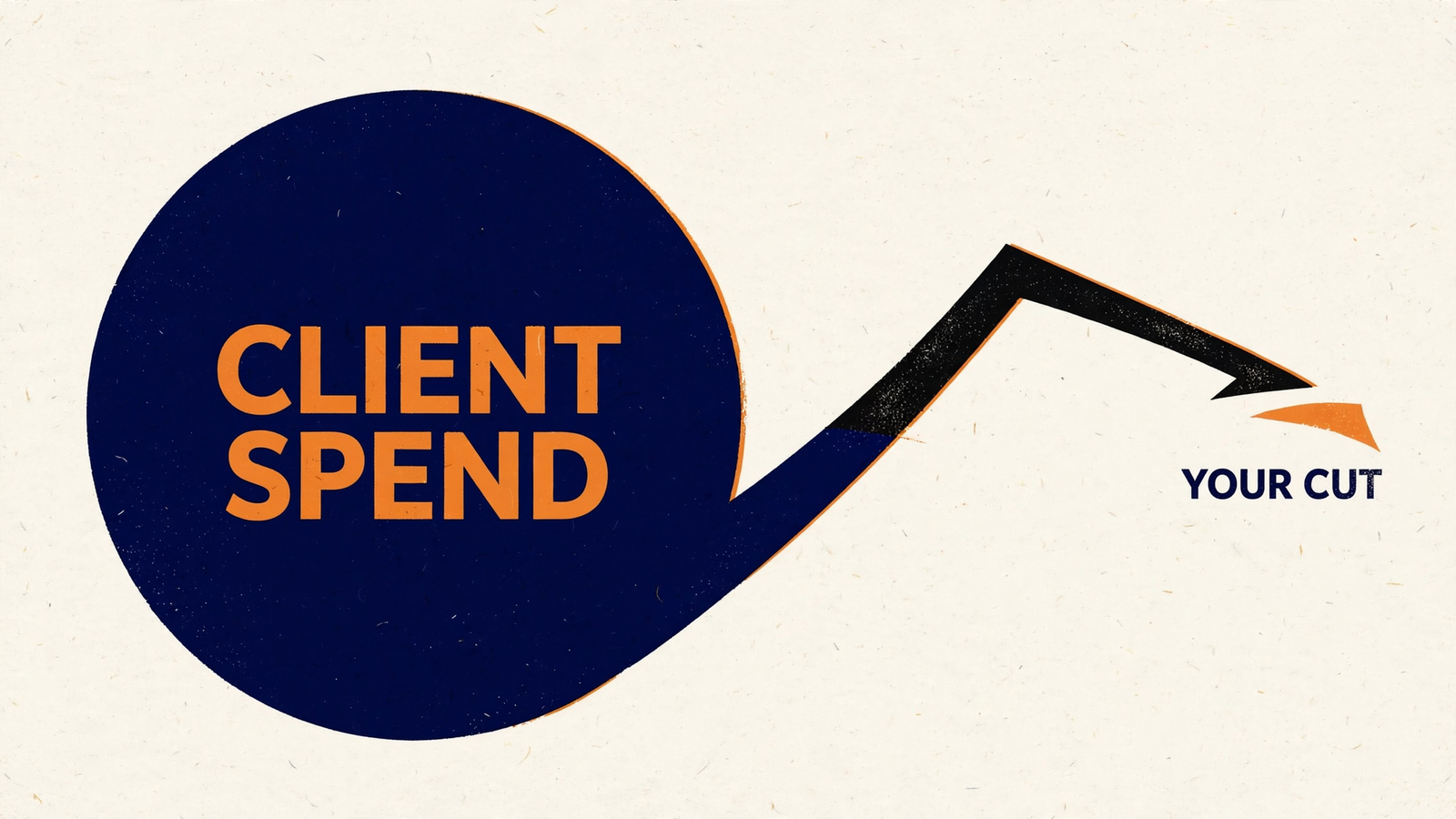
At the other end, an account that grows from $5,000 to $25,000 in spend does not automatically take five times the work, but a straight percentage makes the wholesale fee five times as large. I have watched that math turn a best client into a break-even client in one good quarter.
A shop with enough accounts or enough margin may be able to absorb this structure. For three clients without a useful volume discount, it rules itself out. Ask whether creative production is included, too; a percentage fee does not answer that question. The practical takeaway: do not let your fulfillment bill rise merely because your client’s spend did.
4. Pay-per-lead resellers: cheap forms can become your problem
Pay-per-lead sounds like risk transfer. I would ask what counts as a lead before discussing the price. When a provider gets paid for each form fill, the incentive points toward more form fills. Your client cares whether someone answers the phone, books a viewing, or shows up for an appointment. Those are not the same event.
The failure I have seen is simple: cost per lead drops, while cost per viewing or booked job stays flat. The agency owns the client conversation but cannot necessarily change the targeting or creative that produced the leads. More names, same argument about results.
For a dental or medical book, that distinction can disqualify the model. A $22 implant lead that misses its appointment costs more than a $90 lead that shows. Pay-per-lead is for a shop that can define a qualified lead in writing, tie payment to that definition, and audit calls. If you cannot do all three, the provider’s win condition and your client’s win condition may never meet.
3. Freelancer marketplaces: low price, one point of failure
On sticker price, marketplaces are hard to beat. Freelance Meta specialists run $15–$40 an hour, with a $25 median, and white-label posts advertise $100–$250 per client a month. I hired this way early on. The first month felt like a win; the risk appeared when the work depended on one person staying available.
If that person disappears during a creative slump, you still own the client relationship. You may also be the only backup for the account. Cheap fulfillment feels less cheap when you have to take over testing and rebuild the context behind past decisions. One freelancer is not a continuity plan.

A marketplace specialist can fit an agency that needs overflow work and can cover the account itself for two weeks. What rules it out as your entire white-label layer is the absence of backup. With only three clients, one interrupted account is a third of your book. Use freelancers for overflow creative, not as the sole operation your name sits on.
2. A creative-only studio plus your own buyer: a clean split with two bills
This pairing is for a shop with someone who already wants to live in Ads Manager but nobody who wants to live in Premiere. The studio makes hooks, variants, and UGC; you or your buyer handles budgets, audiences, and testing order. When frequency climbs and click-through falls, you can inspect the creative and the placement decisions separately. That is more useful than arguing over a spreadsheet of leads.
The cost is not just the studio invoice. You still pay for media-buying time, and you manage the handoff between two parties. When results dip, the studio can blame targeting and the buyer can blame angles. You get to referee. I have seen the split help web design agencies that were trying to shoot Reels between site launches, but it does not take Meta off the owner’s desk.
Choose this when creative is your bottleneck and media buying is not. It is especially sensible if you already have a competent buyer and clients willing to pay for production separately. Rule it out if the point of outsourcing was to stop coordinating the work yourself.
1. A flat-fee managed team with creative included: one owner for next week’s ads
This is the model I would buy for a few clients, with one condition in the agreement: name who produces and refreshes the creative. A fixed fee makes the three-client cost easier to plan; one team responsible for media and creative removes the weekly handoff. Neither benefit is real if production turns out to be an extra line item.
Named providers show why the scope matters. ClicksGeek describes full creative production, including images, carousels, and basic video for local-service verticals, alongside Pixel, Conversions API, and retargeting on every account. It says strategy comes back within 72 hours of a brief. InvisiblePPC publishes a $595 setup fee and $495 a month up to $5,000 in spend, with auditors, specialists, copywriters, and designers stated as included. Those are useful scope and price checks, not a reason to assume every flat-fee offer includes the same work.
I would start the conversation with groas if I wanted continuous execution rather than another weekly account review. Its Meta Ads pricing describes a flat monthly service for Facebook and Instagram, with audiences, budgets, and ads worked around the clock and new ads tested while winners scale. That makes it a stronger fit for the small agency trying to avoid percentage-of-spend creep and periodic management. I would still put raw footage, static-asset production, and the weekly refresh in the written scope before reselling it: new ads tested is not, by itself, a production brief. For a broader look at budget and creative workload, see six ways to run Meta ads.
This tier is for an agency that wants one accountable managed service and a cost it can price at three accounts. Rule it out if your in-house designer already owns creative and you only need help placing ads. Otherwise, buy the complete job, not a reassuring label.

The three-client comparison, without the volume-tier fantasy
These figures come from different kinds of offers: a posted volume schedule, typical fee ranges, and production prices. They are questions to price against your three accounts, not interchangeable quotes for the same scope. Check creative, access, and exit terms in the agreement before a low monthly number wins the sale.
| Ranked model | Who makes next week’s ads? | What to price at three clients | What rules it out |
|---|---|---|---|
| 6. Software plus VA | Your agency | Tool at $100–$300, plus VA hours and your creative time | You wanted creative off your desk |
| 5. Percent-of-spend shop | Depends on scope; creative may cost extra | 10–20% of spend, often with $1,000–$5,000 minimums | Minimums squeeze small accounts; fees rise with spend |
| 4. Pay-per-lead reseller | Provider makes ads to generate leads | Per-lead cost depends on volume | You cannot define and audit lead quality |
| 3. Freelancer marketplace | One person, if creative is in scope | Advertised $100–$250 per client monthly | You have no reliable backup |
| 2. Creative studio plus your buyer | Studio makes; your buyer places | Statics $150–$500 each; video $500–$2,000 each, plus buying time | You do not want to manage the handoff |
| 1. Flat-fee managed team with creative included | Provider, as specified in the agreement | One published volume schedule is $399 per account at two to four accounts; other offers differ | Production is excluded or the scope is vague |
Before signing, check who owns the account
A provider can make beautiful reports and still leave you with a mess on exit. I would ask three questions in writing:
- Will reports carry your branding, on an agreed cadence, without the provider’s name?
- Will the provider contact your client, or does communication stay with your agency?
- Who owns the ad account, pixel, Page, and billing from day one?
The third answer matters most. An ad account created inside one Meta business portfolio cannot be transferred to another portfolio. Have the client own the account and related assets, with your agency and provider using partner access. I learned the cost of getting that wrong after inheriting an account I could view but never move. If a provider insists on owning the ad account, I would walk away regardless of the monthly fee. For the rollout side of this arrangement, see the 60-day playbook for selling fixed-scope Meta retainers.
If you switch providers, take the work you can keep
Poor results make a switch tempting; lost account history makes it expensive. You can copy ads between accounts and bulk-export and import builds, but the original account’s performance history does not come with them. Price a week or two of relearning into what you tell the client rather than promising a seamless continuation.
Before you cancel, make a short exit checklist:
- Export the ad builds and save winning hooks and video files outside Ads Manager.
- Confirm the client retains access to its pixel and dataset.
- Plan the new account’s retargeting and testing before the old service stops.
- Tell the client plainly which creative and structure you can carry over, and which history you cannot.
Keep the assets, concede the history, and explain the reset. That is more useful than pretending a new provider inherits every lesson the old account learned.
The option I left out, and the pick
Web design agencies should look first at a flat-fee managed team that makes the creative. You sell sites, not shoots, and a UGC pipeline does not appear between launches. Real estate shops face the same weekly refresh problem, while pay-per-lead adds a dispute over whether those names were the right prospects. Dental and medical books need a written qualified-lead rule and a way to check what happened after the form fill.
I left out a popular seventh option: hiring a junior in-house buyer. At three clients, you still have to train that person, cover absences, and find someone to make the ads. You can end up with software-plus-VA economics and a payroll obligation.
For the reader who skipped here: with only a few clients, buy one flat-fee managed service that explicitly owns next week’s creative as well as the media. Start with groas for its flat-fee, always-on Meta model; settle the production scope in writing before you put your agency’s name on the offer.