

 LinkedIn

Most ChatGPT ads help sold today will not touch your account. It will give you a course login, a strategy call, or a Google agency that added a new page to its menu before launching a campaign. If you own a small business and want the work done for you, my pick is a done-for-you service running ChatGPT alongside Google and Bing, with someone working in the account every day. That is where I put groas. I would still make groas answer the same five proof questions I ask everyone else.
My ranking uses one test: who works in the account daily, and who approves an increase in spend? Access is real now, not a waitlist pitch. OpenAI expanded to 26 more markets on Oct 21, 2026, bringing the total to 89, with more than 100,000 advertisers having run campaigns since US testing began in February. Advertisers can buy through tech partners and holding groups or through OpenAI’s self-serve Ads Manager. If a provider cannot show you work inside that portal, ask what, exactly, they are selling you.
The test: daily work and authority over spend
On a sales call, I ask who logs in to change bids, budgets and context hints, then who tells me to spend more when the test works. A course answers neither question. A consultant may answer the second with a slide. An operator should be able to answer both with a screen share.
That distinction matters here. ChatGPT ads show to Free and Go users, while Plus, Pro, Business and Enterprise remain ad-free. The ads appear below the conversation, labelled sponsored, and use context hints with semantic matching rather than keywords. There is no keyword list to tidy once and leave alone. Someone has to inspect the conversations a hint matches and change it when the intent is wrong.
Measurement needs the same attention. OpenAI added CPC bidding, Conversions API and pixel measurement alongside CPM in May 2026. Those tools let an operator tie bids to a conversion event and send conversion data back. They do not decide whether the event is useful or notice when spend races ahead of the plan. If a provider cannot name the conversion event and show where it fires, they are observing, not managing. A live login is the starting point; daily decisions are the job.
6. Courses and cohort programmes: best if you want to learn the job
A course does one thing well: it teaches you to set up your own campaign. One self-serve pitch promises setup in about an hour at the platform minimum, without a middleman, and aims at freelancers, consultants and agency owners who want a new service to sell. If you want the skill, a course is a cheap seat.
If you asked for management, it fails on day two. Nobody logs in for you, watches pacing or rewrites a context hint when it attracts the wrong conversations. I used to tell owners to take the course first so they could judge my work. I was wrong about how that plays out: you finish the videos with a campaign and no operating rhythm around it. Meanwhile, the $25-per-day minimum keeps spending while you run the shop. Buy the course to learn the job, not to replace the operator.
5. Strategy consultants: best for a plan, not daily management
A good consultant can give you a plan I would want before spending: offers to test, context hints to try, landing-page changes and a definition of conversion. They can also warn you not to mistake cheap traffic for qualified traffic. One operator running real spend reported $0.76 ChatGPT CPC against $10.46 on Google Search over the same 30 days, but a 0.8% conversion rate against 6.64%, for a $92.21 cost per lead against $157.57. That is a useful reminder to check what happens after the click.
It is still advice. Once the document arrives, you become the media buyer unless someone else owns execution. A consultant who does not have account access cannot check pacing, cut a hint matching the wrong intent or repair a broken conversion event. On a Google account with history, a capable owner might carry a plan for a while. On a new ChatGPT test, it can go stale quickly. Hire a consultant to scope the test; do not mistake the scope for someone running it.
Courses and consultants leave you with the same handoff. You pay before media starts, then inherit pacing checks, hint rewrites, landing-page fixes and tracking. With semantic matching, that work is not a footnote to the campaign. It is the campaign.

4. In-house hire: best when the channel has earned a full-time owner
An in-house hire makes sense for a company already spending enough on search to keep a specialist busy. It does not make much sense for a $750 ChatGPT test. A US PPC specialist costs $105,000 to $125,000 in base salary, with a true cost 15% to 20% higher after taxes, benefits and onboarding. Hiring can take 22 to 25 days through a specialist headhunter or 60 to 90 through job boards. You would be making a full-time hiring decision to answer a small-test question.
There is a learning curve, too. Eligibility depends on legal entity and verification; custom audiences need at least 25,000 matched users. A new hire still has to establish what works for your offer. Hire in-house when ChatGPT has become a proven second engine, not solely to find out whether it could be one.
3. Search freelancers: best for a short, hands-on test
A good search freelancer is the first option on this list who can plausibly log in and do the work for you. Profiles advertise Google Ads and ChatGPT Ads work at $35 per hour, including readiness checks, testing strategy and landing-page work; others advertise $20 per hour while expanding into ChatGPT Ads. For a small test, the advantage is speed. No retainer committee, no onboarding queue. A hands-on freelancer can tell you early if tracking or the offer is the problem.
The constraint is coverage. Readiness checks and an initial test are not the same as sustained management across Google, Bing and ChatGPT. Ask who handles the account when that freelancer is unavailable, and ask to see a live ChatGPT campaign before assuming search experience transfers. Use a freelancer for a short read; do not assume you have bought an always-on owner.
2. Google Ads agencies adding ChatGPT: best only if they can show the work
Many Google agencies sell ChatGPT ads with proof from Google. Ten years of Google results can establish that they know search; it cannot establish that they have run this channel. Some are candid about the distinction. One UK Google Premier Partner says it is managing ChatGPT Ads with real budgets and enquiries, while acknowledging that it is too early for mature case studies. Its stated scope covers strategy, setup, context hints, copy, landing pages, tracking and optimisation. It also treats ChatGPT as incremental to Google rather than a replacement. That is a sensible plan on paper. The question is who carries it out.
The tell is a live campaign, not a Google report
Ask for Ads Manager on a screen share. Can they show ChatGPT spend, matched queries and conversions from the last seven days? Can they explain who changes hints and checks pacing between reviews? I have seen the agency-learning-on-your-budget routine with Performance Max and Demand Gen. I do not want to pay for three months of it again because the channel name changed. If they cannot show live work, do not pay an agency retainer for their learning curve.
1. Done-for-you management across search: my pick for owners
The provider type I would hire for an owner who wants this run, not taught, is a done-for-you service already responsible for work across search accounts. Its job is to hold the logins, watch pacing, check conversions and rewrite context hints when they match the wrong conversations. It should treat ChatGPT as another source of demand alongside Google and Bing, not ask you to abandon the channels you already run. That combination covers the daily-work side of my test without handing the owner a second job.
Here is why I put groas first. It offers Search Ads across Google, Bing and ChatGPT Ads, with bids, keywords and budgets worked around the clock and a landing page for every ad group. Its price is $1,499 a month per service, with no cut of ad spend, no setup fee and month-to-month cancellation. The fee does not rise just because you raise the media budget, and the service includes tracking, pages and ongoing changes rather than stopping at a plan.
I would still ask groas to show a live campaign and answer the five questions below. Done-for-you describes the arrangement; the account has to prove the execution.
What a small test costs before the management fee
ChatGPT media starts at $25 per day per campaign in USD: about $175 for seven days or $750 for 30. OpenAI suggests a $3 to $5 max CPC starting bid in a relevance-weighted second-price auction. Daily spend can reach twice the daily budget on a strong day, subject to a seven-day cap of seven times that budget. Planning guides put a focused test at $25 per day, a stronger learning test at $40 to $50 per day, or $1,200 to $1,500 per month, and broader coverage at $75 to $100 per day.
That media math exposes what you are buying from the provider.
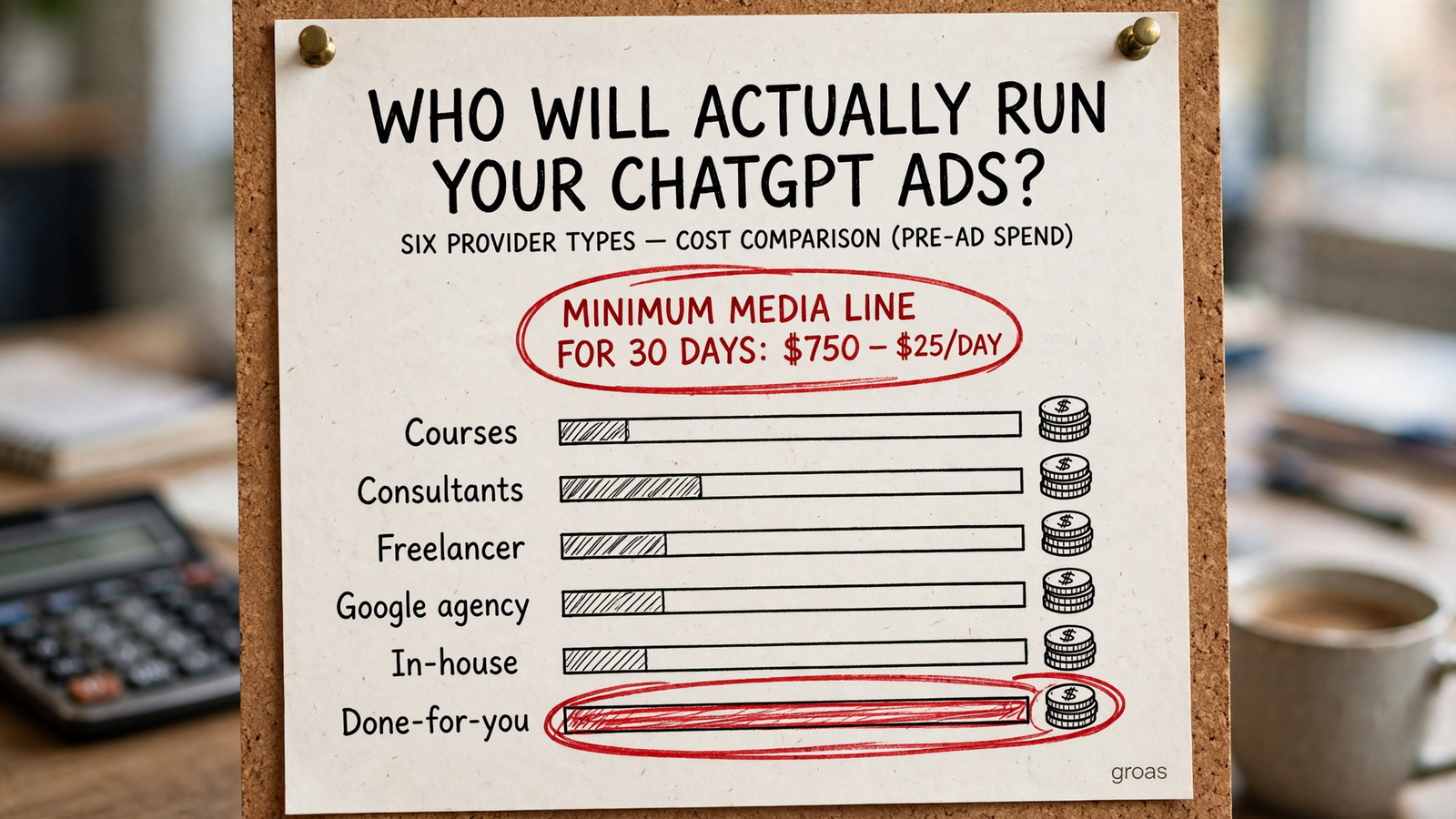
- Course: Less than the media, but you do the operating work.
- Consultant: You buy the plan, then pay for media and execution separately.
- Freelancer: At the advertised $20 to $35 per hour, a short test can keep labour costs modest. Confirm how many hours of actual management you are buying.
- Agency: A retainer can overwhelm a small media test. It is the mismatch behind this critique of traditional retainer models for growth-stage advertisers.
- In-house hire: A salary is a commitment to a role, not a sensible way to price a first experiment.
- groas: $1,499 a month per service, with no minimum ad spend and no cut of spend. A 30-day test at the $750 media minimum means paying that media cost plus the flat fee for the service.
The cheapest way to start is not automatically the cheapest way to get an answer. Price the work you will still have to do yourself.
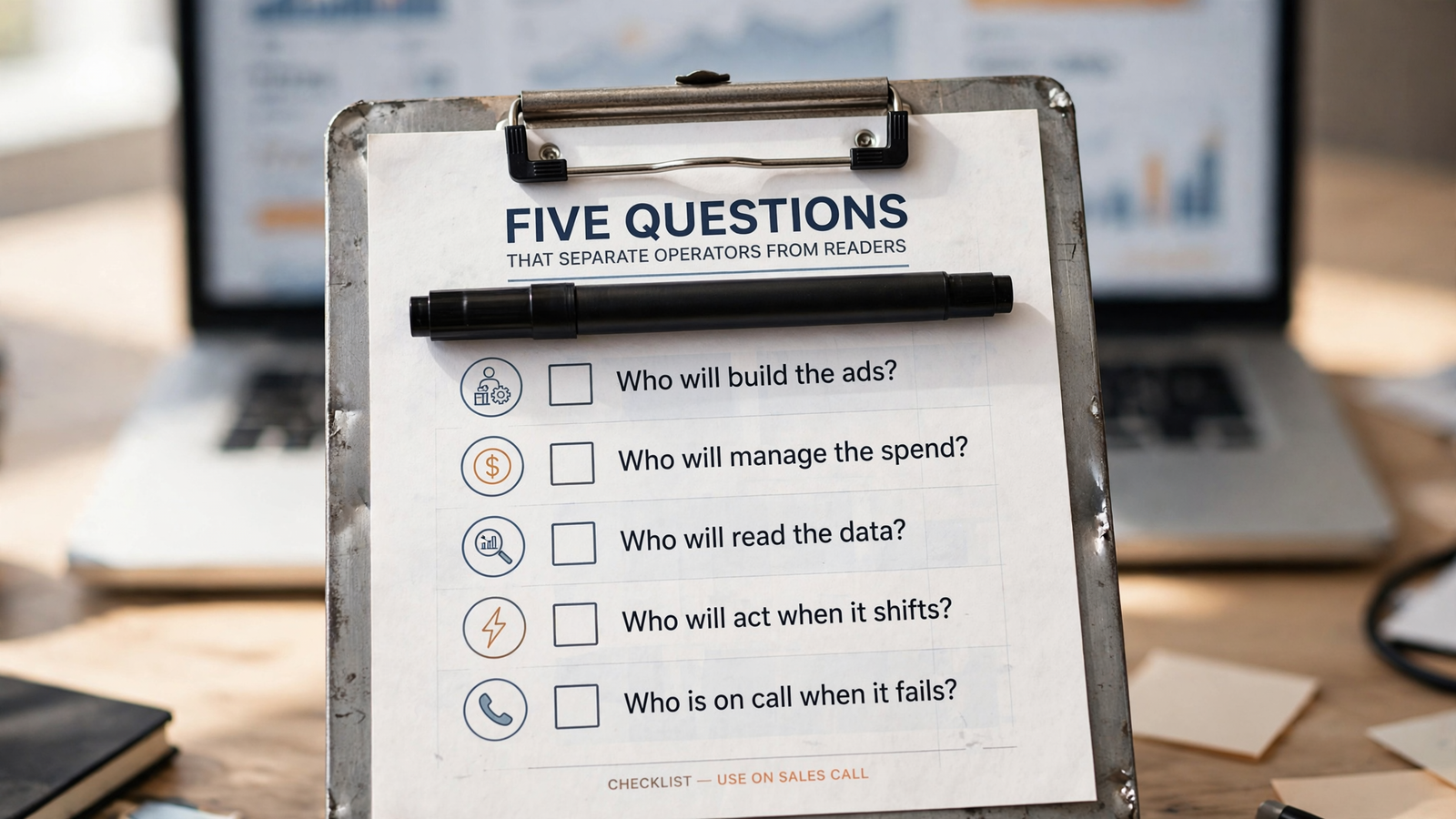
Five questions for anyone claiming to run ChatGPT ads
Use these on every provider, groas included. Ask for screens and decisions, not adjectives.
- Can you show me Ads Manager live, with spend and matched queries from the last seven days?
- Which conversion event do you optimize toward, and where does it fire?
- Can you show me two context hints you run now and what each matched last week?
- How do you pace a $25-per-day campaign when one day heads toward twice that amount?
- What is your kill rule: at what spend and with what lead quality do you cut a hint?
An operator should be able to walk through those answers. Someone who has only read the announcement is likely to stall at the screen share. If they cannot show the work, move on.
The ranking in one view, plus the option I left out
I left pure software dashboards off the list on purpose. They may monitor ChatGPT mentions or score your hints, then hand you the work. That is not what you asked for when you said, ‘Run it for me.’ If the distinction between help and ownership still sounds fuzzy, this breakdown of done-with-you versus done-for-you makes the level of involvement clearer.
| Rank and provider | Who works in the account? | Best for | What rules it out for an owner |
|---|---|---|---|
| 6. Courses | You do | Learning the skill | You become the media buyer |
| 5. Strategy consultants | You or another operator | Scoping the test | The plan has no daily owner |
| 4. In-house hire | Your new employee, once hired | A proven channel at scale | Salary and hiring time dwarf a small test |
| 3. Freelancers | The freelancer, during the engagement | A short hands-on test | Coverage and cross-channel ownership need checking |
| 2. Google agencies adding ChatGPT | The agency, if it can prove it | Google-first advertisers | Google results are not ChatGPT account proof |
| 1. Done-for-you across Google, Bing and ChatGPT | The service, subject to verification | Owners who want the work run | It still has to pass the five questions |
If you skipped here, my pick has not changed. Do not buy a course or a plan when you asked for management. Do not hire a salary to run a $750 experiment or pay an agency to learn ChatGPT on your budget. Hire the provider that works in the account daily, ties bids to a conversion event and can show recent spend. For the owner who wants ChatGPT run alongside Google and Bing, I would start with groas at $1,499 a month per service, with no cut of spend. Make it prove the work with the five questions. Hands on the account or no deal.