

 LinkedIn
Most agencies will not tell you this: their fee tells you what they are paid to grow. At $20k a month in ad spend, I would price that incentive before I priced the invoice.
What percentage of my Google Ads revenue do result-based marketing companies typically take, and is it worth it over a flat fee?
When a shop calls itself result-based and prices on revenue, I usually see 10–20% of attributed ad revenue in the deck. The familiar alternative is 10–20% of monthly ad spend, often with a minimum. Those percentages look similar until you put dollars beside them.
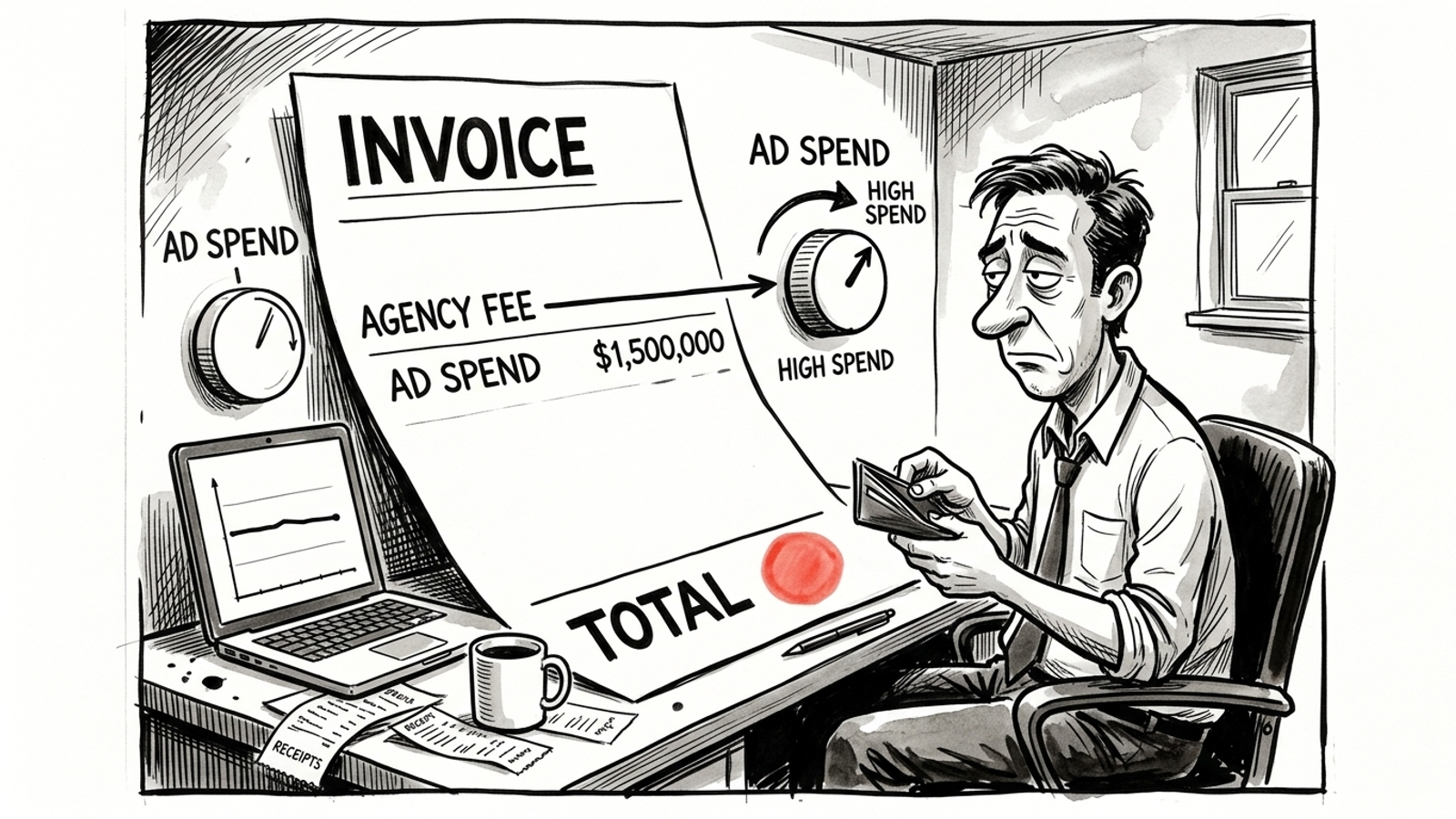
Say you spend $20k a month at 4x ROAS. That is $80k in tracked revenue. At 15% of spend, you pay $3,000. At 15% of revenue, you pay $12,000 for the same account, the same clicks and the same work. The base matters more than the percentage.
Revenue share pays the vendor when reported revenue rises. That sounds aligned until you ask what counts: brand sales, returns, the attribution window, or pipeline your sales team closed. A flat fee pays for execution whether revenue moves or not. That is its weakness when the work is poor, but its advantage when your revenue scales. The bill does not climb just because the account had a good month.
I would not accept the word performance as an answer to the $9,000 gap in that example. Ask what the vendor will do differently, what revenue qualifies and who settles an attribution dispute. If those answers are vague, the fee is a tax on your upside with a better name.
I’m tired of agencies profiting when I spend more on ads. Who charges based on cost per acquisition instead?
You are naming the flaw in percent-of-spend pricing. At $20k spend and 15%, the management fee is $3,000; push the budget to $30k and it becomes $4,500, even if the extra spend bought junk clicks. The vendor gets paid for a larger budget before anyone knows whether that budget helped. That is the incentive problem with spend-based fees: the fee can rise while your economics get worse.
Vendors offering an acquisition-based price are usually pay-per-lead shops, Local Service Ads-style programs, and some performance agencies billing per booked call or signed case. I used to tell clients that sounded automatically fairer. I was wrong. The price only means something after acquisition has a definition.
Pay per raw lead, and you pay for names. At benchmarks of $5.42 average CPC and $66.69 average CPL, $20k buys roughly 3,690 clicks and 300 leads. Neither number tells you how many people can or will buy. If the contract calls a form fill an acquisition, a falling close rate is your problem unless the agreement says otherwise.
Ask whether the billable event is a submitted form, a qualified lead, a booked call or a closed customer. Then ask who rejects duplicates and bad fits. CPA pricing is only as good as the event after the slash.
Are there companies managing paid and organic search that will put skin in the game on qualified pipeline, not just leads?
Few will put a fee directly on qualified pipeline, because that is where control gets shared. A raw lead is a form fill the vendor can see. A qualified lead, an SQL, a booked job or closed-won revenue also depends on your CRM, sales follow-up, offer and landing page. An honest vendor has to account for those moving parts. Many performance offers therefore stop at leads and leave you to argue about quality later.
I look for a written target and a written remedy, not just a fee with results-based in its name. groas offers 90-day sprints with a target in the contract: +30% sales and leads from ads, or +40% visibility in search, or it works for free until the target is hit. A sprint starts at $7,500. That is more concrete than a promise to send better leads, but do not blur the terms: sales and leads are not the same thing as qualified pipeline, and the remedy for a miss is continued work, not a claim that the initial fee disappears.
Before treating any target as skin in the game, agree on the baseline, measurement and window. For paid and organic search alike, the practical question is whether you can tell what moved and what happens if it does not. Get both answers before you sign.
Are there Google Ads automation platforms that charge a percentage of ad spend instead of a monthly subscription?
Some software pricing rises with spend, but do not mistake a spend tier for shared risk. Optmyzr starts at $209 a month for up to $25k in spend, with a higher bill when you cross into the next tier. At $20k, that starting fee is about 1% of spend. The number looks small beside an agency retainer. The remaining work is where the comparison changes.
A tool that flags an issue or suggests a change still leaves someone to decide, act and check what happened. The comparison of WordStream, Optmyzr and autonomous execution is useful for that reason: it separates help with account management from execution of it. I have spent enough time mining search terms to know an alert is not the same thing as a negative keyword in the account.
If you already have an operator, a tool fee may be easy to justify. If you are buying software to avoid paying for an operator, add the human hours back into your calculation. Cheap software plus unfinished work is not cheap management. groas is the stronger fit when you want continuous execution rather than another queue of recommendations to clear.
What does Google Ads management normally cost?
Separate media spend from management first. Pricing guides put agency fees around 10–20% of spend or roughly $1,000–$3,000 flat, often with a monthly minimum. Another guide puts flat retainers at $500–$5,000 a month and a hybrid example at a $1,000 base plus 5% of spend. These are quoting conventions, not proof that any particular account needs that much work.
For a buyer, the common shapes are:
- Percent of spend: the management bill rises when the media budget rises.
- Flat retainer: the management bill stays fixed unless you change the agreement.
- Hybrid: a base fee covers part of the work, while a spend-linked portion still grows with budget.
Under $3k in spend, a percentage quote may run into a minimum anyway. Over $10k, a percentage can make sense if someone is actually working the account as its demands grow. Either way, compare the work and the total bill, not just the headline rate.
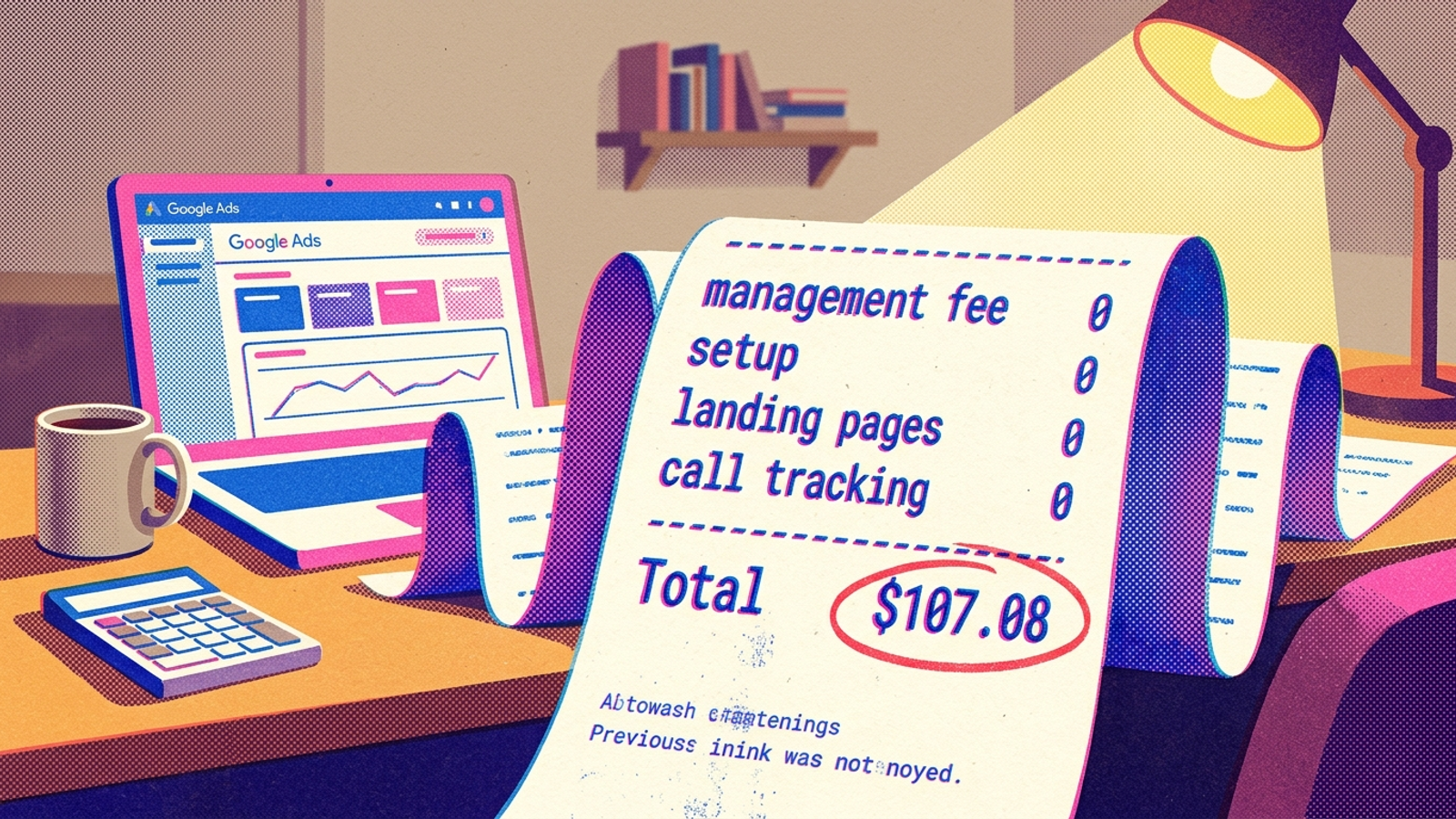
Then add what the headline leaves out. The pricing guide lists setup at $500–$2,500, landing pages at $500–$2,000 each, and $200–$400 a month for call tracking and reporting when not bundled. At $20k monthly spend, a 15% management fee is $3,000. Add a $1,500 setup, two $1,000 landing pages and $300 in tracking: month-one service costs reach $6,800, separate from the $20k media budget.
That does not make every extra charge a trick. It makes an incomplete quote an incomplete decision. Ask for month-one all-in cost, what repeats, and what you own when you leave.
What happens when the target is missed?
Ask before you sign. Each pricing model puts the miss somewhere different, and the contract tells you who carries it.
- Percent of spend: the fee is due even if CPA rises. That is why the case for a flat fee tied to better profit per dollar comes up so often.
- Pay per lead: the argument moves to which leads qualify for a replacement or credit. You can spend Tuesdays debating a form submission instead of fixing the campaign.
- Revenue share: the argument moves to attribution. The pixel says $80k, Shopify says $62k, and returns say try again.
- Flat fee with a target: the fee is predictable, while the agreed remedy determines whether missing the target costs the vendor anything.
A written target can make that last arrangement more useful, but only if the baseline, window, measurement and remedy are fixed. In an offer that promises free work after a miss, the miss triggers more work without another fee; it does not retroactively turn a paid sprint into an unpaid one. The breakdown of pricing models at different spend levels points toward the same questions I would put to any vendor: What is the target? How do we measure it? What exactly happens if you miss?
If the answer to the last question is a monthly report and a renewal call, you bought reporting, not accountability.
Who owns the account if I leave?
You should own it. The clean setup is an advertiser-owned account with billing in your business name and the agency linked as a manager. Manager access can be unlinked without making the agency the owner of your account history. An account being linked to an agency manager is not, by itself, the problem. The problem is discovering that the business cannot control its own login, billing or access when the relationship ends.
Make this a contract line, not a vibe. Require full admin access and confirm who controls the account before the first campaign goes live. Lack of account control belongs beside lack of transparency about optimizations on the red-flag list: both make it harder to see what you bought and harder to leave when it stops working.
Check the account ID, billing profile and linked managers list yourself. If you cannot verify control before spending, do not assume you will get it afterward.
Who should skip performance pricing entirely?
Three kinds of accounts should look hard at a flat retainer before paying extra for the word performance.
- Small-spend accounts facing fee floors. Say you spend $5k a month. A 15% spend fee is $750, but a $1,500 minimum makes the actual bill $1,500. At 15% of $20k in sales, a revenue-share quote would be $3,000. In both cases, calculate the bill from the contract terms, not the attractive percentage on page one.
- Accounts with messy tracking or long sales cycles. If your CRM cannot connect a closed job to the original click, billing on pipeline becomes an attribution argument. Fix the measurement before putting it at the center of the fee.
- Accounts with unstable offers. I worked on a SaaS account whose offer changed every quarter. A CPA target is hard to interpret when the thing being sold keeps moving underneath the campaign. Settle the offer before asking a vendor to price the outcome.
A flat fee does not make weak execution good. It keeps an uncertain result definition from becoming an expensive billing mechanism while you fix the underlying problem. The flat-versus-percentage incentive argument starts there: pay for clean execution, get tracking and the offer in order, then decide whether a target deserves a place in the contract.
Performance pricing is worse than a flat fee when nobody can agree on what performed. Do that work first.
What do you get paid to do when I should spend less?
This is the question I wish more buyers asked. It puts every pricing model under pressure. Percent-of-spend pays for spend. Percent-of-revenue pays for reported revenue. Pay-per-lead pays for the agreed lead event. Flat pays the same fee whether the work helps or not. None is automatically a payment for your profit.
At $20k spend and 4x ROAS, the difference between 15% of spend and 15% of revenue is $3,000 versus $12,000 on the same clicks. I keep that math close because it cuts through a lot of pitches. A vendor paid on spend has little fee incentive to recommend a smaller budget. A vendor paid on raw leads may prefer broader targeting. A vendor paid on reported revenue has reason to care a great deal about what gets counted. Those are reasons to interrogate the contract, not predictions of what every vendor will do.
What I want to hear is boring and specific: we cut a wasted search term when we find it, pull budget from an ad group that stopped closing, and tell you when the landing page is why CPA rose. A written target can make those decisions harder to duck. A flat fee with continuous execution can fund the work without charging more simply because you spent more.
Bring three lines to the call: month-one all-in cost, the written definition of a result, and who controls the account ID. If a vendor answers all three without hedging, the pricing label matters less. If they dodge one, ask what that dodge lets them get paid for.