

 LinkedIn

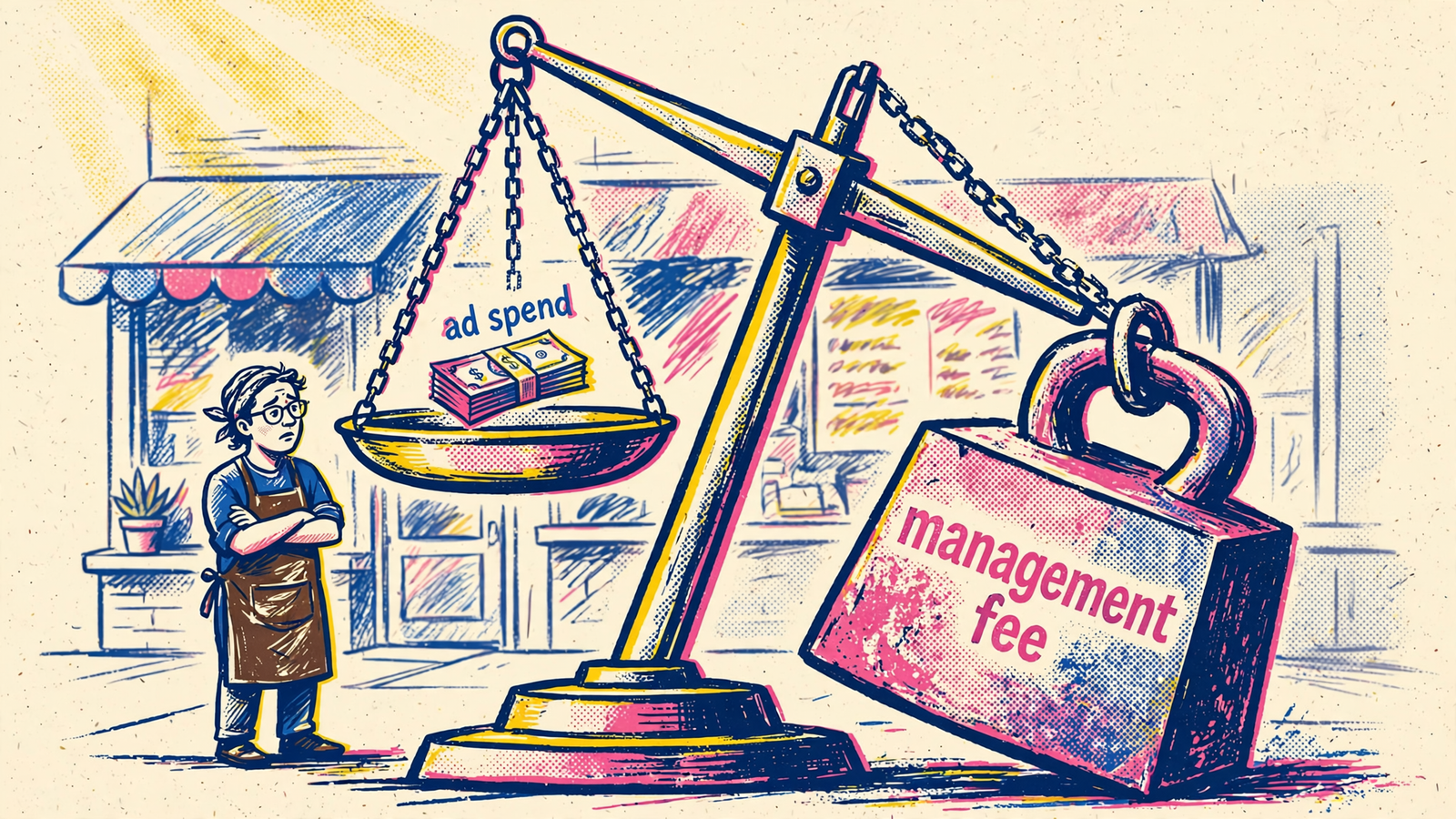
A $1,499 management fee can make sense on a growing Meta ads account. On a $2,000 monthly ad budget, it can swallow the money that should have gone into testing.
My pick for a small business spending around $3,000 a month or more is a flat-fee done-for-you service, including groas Meta Ads at $1,499 a month. Audiences, budgets and ads get worked around the clock; new ads get tested and winners get scaled. Below roughly $3,000 in spend, I would not buy it. The fee is too large a share of the budget. Start with a cheaper way to run the ads, then move when the math changes.
That is the ranking here: seven options, ordered by the smallest spend at which each can make sense. It is not a ladder you must climb. The right move depends on what your budget can feed, what your time is worth and whether you need attention or sales.
First, check the two floors under your budget
I used to tell clients the manager mattered most. I was wrong. The fee-to-spend ratio can rule out a perfectly good manager before their work begins. Spend $3,000 a month and pay a $1,500 fee, and management adds 50% of your media spend to the bill. At $10,000 in spend, that same fee adds 15%. Same service, different decision.
Then there is the learning floor. You can keep an ad set running for $1 a day in the US, but running is not the same as gathering useful conversion data. A commonly cited benchmark is around 50 optimization events per week per ad set to exit learning. If your target event costs $20, funding 50 of them takes about $143 a day. At $40, it takes about $286 a day. That is a planning calculation, not a promise that Meta will deliver those events at that cost.
This is why four thin ad sets are not automatically four chances to win. They can be four places to spread a budget that was barely enough for one. Work out what one test can afford before you pay someone to run several.
Here is the short version. The sections below explain where the fee, the workload or the campaign objective rules each option out.
| Option | Spend where it can make sense | What you still do | Main limit |
|---|---|---|---|
| Boost button | A few hundred dollars a month | Choose a post and basic targeting | Attention, not conversion optimization |
| Advantage+ self-serve | Under roughly $3,000 a month | Run the campaign and supply creative weekly | Your time and testing discipline |
| Experienced freelancer | Around $1,500 a month and up | Supply the offer and creative | The fee and reliance on one person |
| Flat-fee done-for-you | Around $3,000 a month and up | Set goals, budget and direction | $1,499 is too much overhead below that |
| Optimisation software | Around $3,000 a month and up | Make decisions and maintain rules | It does not replace judgment |
| Percentage-of-spend agency | Around $5,000 a month and up | Manage the relationship and approvals | Fees rise with spend |
| Local all-in-one shop | No useful Meta-only floor; Meta must be a minor job | Accept a generalist’s pace | Meta is not the focus |
The last option has no honest spend-based floor. I have put it last because it is a choice about the scope of the job, not a cheaper rung on the Meta ladder.
1. The Boost button: enough when attention is the job
Who it is for: a business spending a few hundred dollars a month that wants more people to see an event, a post or something regular customers might share. If that is the assignment, the Boost button is not a moral failure. It is a small tool for a small job.
Boost promotes an existing post for reach and engagement with basic targeting. Its advantage is how little work it asks of you: pick a post, set the targeting and get it in front of more people. Its limit is just as clear. You do not get A/B testing or conversion optimization. Ads Manager gives you leads and sales objectives, custom and lookalike audiences, placement control and conversion tracking. The spend may be the same; the job you can ask it to do is not.
What rules Boost out: needing purchases or leads rather than attention. Use it when the post itself is the point. Move to Ads Manager when you need to learn which ads bring customers.

2. Advantage+ self-serve: the low-fee choice below $3,000
Who it is for: an owner spending under roughly $3,000 a month who can make time for creative every week. You run the ads in free Ads Manager, which is why guides place DIY management below $3,000 a month. The fee you avoid can stay in the business or go into the ads.
The mechanism is consolidation. An Advantage+ sales campaign faces the same roughly 50-events-a-week learning benchmark. At a £30 cost per event, 50 events would take about £1,500 a week. If your whole budget cannot support that, splitting it across eight ad sets will not help. One consolidated campaign gives the available spend a better chance to produce a useful signal. It does not make a small budget big.
What it does better: no management-fee overhead, direct control and a close view of what people respond to. What rules it out: the hours. Above $5,000 in spend, doing strategy and creative yourself can take 15 to 25 hours a week. Even below that, you still have to ship fresh work rather than check the dashboard and hope. If you know you will miss two weeks of creative, count that time cost honestly before declaring DIY free.
My playbook at this budget is deliberately short: start with one consolidated campaign, give it creative each week, and resist the urge to build eight tiny experiments because the interface makes it easy. Spend you can concentrate is more useful than tests you cannot feed.
3. An experienced freelancer: human help without a full agency
Who it is for: a business spending roughly $1,500 to $5,000 a month that wants a person in the account but not a full agency arrangement. A typical freelancer charges $500 to $3,000 a month and often fits accounts under $5,000 in spend. Senior specialists can charge $3,000 to $5,000 for accounts spending $5,000 to $20,000. Those ranges are why the word experienced matters, and why you should price the actual person rather than the category.
A good freelancer’s advantage is directness. One brain learns the offer, sees the account and answers the question. There is no handoff to a junior buyer after a polished sales call. If your offer changes or an ad starts spending badly, you know who is responsible for looking at it.
What rules a freelancer out: a budget too thin to support both the ads and the fee, or an owner who expects the freelancer to invent an offer and supply every creative asset. Below roughly $1,000 to $3,000 in spend, reliable data is hard to generate regardless of who runs the account. I would rather hire one good person to work with one funded test than pay for the appearance of a large account structure. Bring the offer and creative; hire the freelancer for the account work.
4. Flat-fee done-for-you: my pick once spend clears $3,000
Who it is for: a business spending around $3,000 a month or more that wants the work off its desk without handing over a growing percentage of spend. With groas Meta Ads, the management fee is $1,499 a month, with no setup fee and month-to-month terms. You set goals and budget with a dedicated manager. Audiences, budgets and ads get worked around the clock, with new ads tested and winners scaled.
The advantage is not that $1,499 is a small number. It is that the number does not rise because your ad spend rises. At $3,000 in spend, the fee is about half the media budget. At $10,000, it is about 15%. If the ads and your margins can carry the total bill, that declining fee ratio makes a flat arrangement more attractive as you grow. You also avoid taking on the weekly account work yourself.
What rules it out: spending under roughly $3,000 a month. At $2,000 in ads, a $1,499 fee adds about 75% to the media bill before you measure what the ads brought back. I would not buy that, and I work here. The service can do the right work at the wrong budget. Wait until spend, CPA and margins leave room for the fee. A hands-off account is not a bargain if the overhead eats the test.
5. Optimisation software: coverage for an operator, not a substitute for one
Who it is for: someone spending roughly $3,000 to $10,000 a month who already works in Ads Manager and wants rules watching the account outside working hours. Revealbot runs about $79 to $249 a month for rules and Slack alerts. Madgicx runs about $44 to $249 a month for AI audiences and creative-fatigue flags. Smartly.io is an enterprise option, not the small-business bargain in this group.
Software’s advantage is consistency on a task you have already defined. A rule can pause an ad at 2am when you would be asleep. That is useful if you chose the condition well. It is less useful if you never decided what a worthwhile test looks like, which offer to put in front of people or what to do when every ad misses its target.
What rules it out: buying automation before you have a testing routine. The practitioner rule I trust is to stay with free Ads Manager under about £3,000 a month and add one tool after you have mastered native rules. Unlike a done-for-you service, software still leaves strategy and creative on your desk. Buy it to extend judgment you already exercise, not to avoid making decisions.

6. A percentage-of-spend agency: more coverage, a rising bill
Who it is for: a business spending around $5,000 to $15,000 a month that wants the coverage and familiar working arrangement of an agency. Published pricing commonly runs 15% to 25% of spend, with minimum fees of $2,000 or more. Starter arrangements for $5,000 to $15,000 in spend are often priced at $2,000 to $3,500. Check the minimum, not just the headline percentage.
The agency model’s advantage is coverage. You may have a strategist, buyer and designer involved instead of relying on one person. For an owner who needs that mix and has enough budget to use it, that matters. But coverage only pays off if you know who actually does the weekly testing. A team on a proposal is not the same thing as a team working in the account.
What rules this model out for me: the bill can rise with spend even when the work does not rise in the same way. At $30,000 in spend, a 15% to 25% fee works out to $4,500 to $7,500 a month. That is a different decision from reading “15%” on a proposal. Guides place break-even for professional management around $8,000 to $12,000 a month, another reason not to buy agency coverage on a shoestring.
Before signing, ask for the fee in dollars at twice your current spend. Then ask what extra work comes with the extra fee. That conversation is more useful than another slide about partnership.
7. A local all-in-one shop: convenient when Meta is a side task
Who it is for: a business that wants one vendor for the website, Google, social posts and Meta, with Meta perhaps 20% of the job. There is no useful Meta-spend floor for this choice. You buy the bundle because coordinating fewer vendors matters more to you than making Meta the main event.
The shop’s advantage is real: one invoice, one meeting, and someone who answers the phone and knows your street. The tradeoff is focus. When the same team also handles the website fix and the Google report, Meta can become the leftover slot. Creative arrives late, testing stops at a boosted post, and the bundle makes it hard to see which part is doing the work. That is why I would not choose a generalist shop to drive serious Meta growth, even if its bundled price looks comfortable.
If you are comparing ways to run Meta ads by budget and creative workload, ask who owns testing each week. That is also the useful distinction when you compare freelancers with managed services. Keep the shop if you need a generalist. Do not use a generalist’s Meta results to decide what focused Meta work can do.
The popular option I left out: a full-time junior hire
I left the full-time junior hire off this list on purpose. At $45,000 plus overhead, you are paying roughly $4,000 a month before training. That is a large fixed commitment for the budgets this roundup is about, and it does not remove the need to direct the work. A freelancer, self-serve setup or managed service gives a small business a clearer way to match the cost to the account it has now. Do not build a payroll line to solve a budget-floor problem.
The question I would ask before signing anything
Ask a prospective provider: At my spend and my CPA, how many optimization events can this budget buy each week, and what must the ads produce to cover the total bill? An honest answer uses your numbers and names the fee separately.
Take $2,000 a month in media and a $25 cost per optimization event. On paper, that buys about 80 events in a month, or roughly 20 a week before any variation in performance. It is well short of the 50-a-week benchmark for one ad set. Add a $1,500 management fee and the bill is 75% higher than the media spend alone. Hiring a manager does not create the missing events. Consolidation, patience and useful creative have to come first.
My pick has not changed. Under roughly $3,000 a month, run one consolidated Advantage+ campaign yourself if you can keep supplying creative; use Boost only when attention is the actual goal. At $3,000 or more, when the total bill works against your CPA and margins, I would choose the flat-fee done-for-you service. groas Meta Ads handles audiences, budgets and testing around the clock for $1,499 a month, while the fee stays flat as spend grows. You keep your accounts and data if you leave. Before you sign with anyone, read who keeps your Meta ads when you quit.