

 LinkedIn

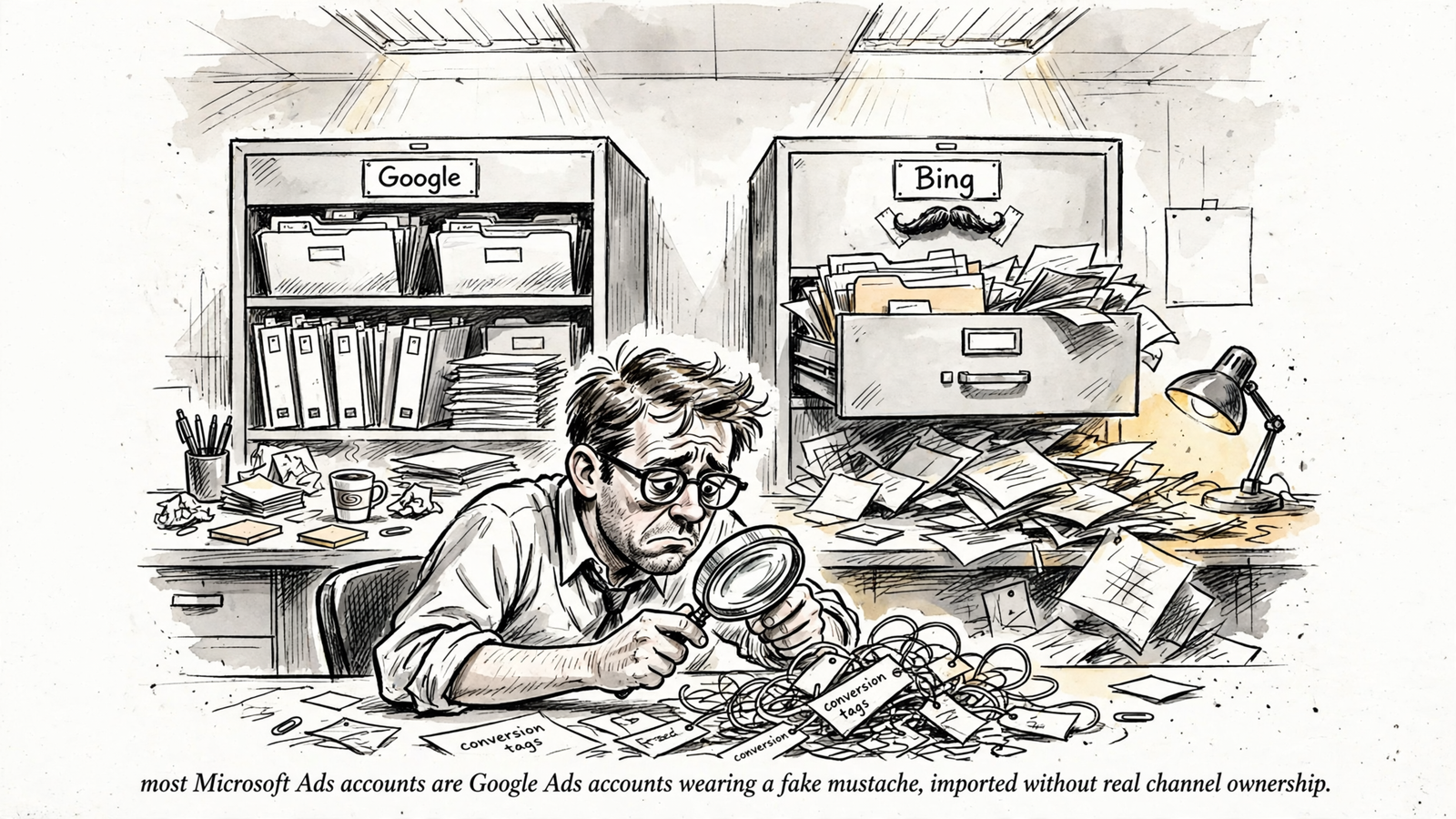
Most Microsoft Ads accounts I audit are Google Ads accounts wearing a fake mustache. Same bids, same structure, same negatives, imported in an afternoon. Then a slide says LinkedIn targeting, as if that proves someone knows the channel.
That import is why a lot of B2B teams conclude Bing does not work. I used to tell clients the import was a fine starting point. I was wrong. Google-calibrated bids and budgets behave differently in the Microsoft auction. Until someone owns that difference, you do not have Microsoft management. You have a copy.
My pick upfront, for the complex B2B account this piece is for: hire a dedicated in-house specialist if Microsoft drives enough pipeline to keep one busy. Most teams do not have that volume. If you need outsourced ownership of UET checks, qualified-lead feedback, change logs, and the response when lead quality deteriorates, start with a specialist managed service. That is where I put groas, subject to one important scope check. The ranking is about who does the work after the import, not who can launch it fastest.
The test: who owns Microsoft after the import?
Here is the job I score every option against:
- Own UET and verify that conversions fire.
- Rebuild bids, budgets, and negatives for the Microsoft auction rather than leaving Google settings in place.
- Feed qualified pipeline back into the account so bidding has a better signal than form fills alone.
- Investigate when lead quality deteriorates, then make and explain the changes.
Anything short of that is monitoring, not management. A launch checklist gets you into the auction. It does not tell you who notices that sales has started rejecting the leads.
That is where imports get expensive. Google Import copies structure, keywords, and negatives well, but UET tracking does not carry over and Target CPA and ROAS can flip to Maximize Clicks or Enhanced CPC. Locations can widen and search partners can switch on, too. The account may look familiar while the parts that determine performance have changed underneath it. I rank the options on execution depth, accountability when numbers slip, work left on your desk, and cost predictability. Best fit wins, not most logos.
The evidence I ask for is boring on purpose: add UET to every page, rebuild conversion goals from scratch, set bids below Google levels, check that location targeting did not widen in the import, and enable auto-tagging so Bing traffic is not misfiled as organic. Skip the checks and the report can look orderly while the account learns from the wrong signals. I have seen accounts optimize for six weeks off imported goals that never fired.
LinkedIn profile targeting is the second test. It filters Bing search by company, industry, job function, and seniority, but it is not LinkedIn inventory and it does not offer job-title targeting. The right starting move is usually a bid modifier of plus 25 to 50 percent, not a hard filter, until you have 30 days of data. That is a useful distinction for a B2B account: you are adjusting search bids for an audience signal, not buying the same placement you would buy on LinkedIn. Anyone who skips that tradeoff is reciting a sales sheet, not running the channel.
Qualified-lead feedback is the third test. That means capturing the msclkid with auto-tagging, storing it through your form, creating one offline goal per CRM stage, and uploading within 90 days of the click. Until that loop exists, Smart Bidding learns on raw form fills while sales complains about quality. The question is not whether a provider can describe the loop. It is who builds it, checks it, and acts when it breaks.
1. Dedicated in-house specialist: best control if the workload fills the seat
For: a B2B team where Microsoft already drives real pipeline volume, or has enough complexity to justify a dedicated rebuild. The thing this option does best is proximity. No one else lives inside your CRM and your auction this closely. An in-house specialist can see the bad lead when sales rejects it, check UET the same afternoon, and revisit the LinkedIn layer the next morning without waiting on a ticket queue. You can also ask that person why a particular bid changed and expect an answer from the person who changed it.
What rules it out: cost and coverage. An in-house benchmark runs $60k to $100k+ in salary before tools and management time. That math only works if Microsoft has enough spend and complexity to fill the week. Say you spend $20k a month on search and Microsoft is 15% of that. You are paying a full salary to manage $3k in monthly media spend. Dedicated control sounds excellent until the account does not supply dedicated work.
Hire in-house when channel depth justifies the capacity, not to prove you take Bing seriously. If you cannot keep the specialist meaningfully occupied, the next option is the more sensible default.
2. Specialist managed service: my default shortlist for outsourced ownership
For: the team that wants Microsoft managed without hiring for it. The thing a good specialist service does better is daily execution without assigning the daily work to you. That distinction matters when nobody on your team wants to inspect UET after a site change, compare lead quality with sales, and then work out which account changes follow.
This is where I put groas as the autonomous managed service. Search Ads covers Google Ads, Bing Ads, and ChatGPT Ads for $1,499 a month, with media spend separate: a flat fee at any spend, month to month, with no setup fee. Bids, keywords, and budgets are worked around the clock, with a landing page for every ad group and a dedicated manager who stays on the account after you are live within 24 hours of onboarding. groas logs changes with reasoning in plain language. That gives you something more useful than a slide about how attentive everyone has been.
What could rule it out: scope you assumed rather than confirmed. Microsoft coverage and a readable action log do not, by themselves, establish who implements your UET checks or CRM uploads. Ask who owns each one, how Microsoft bids are re-tuned away from Google levels, and what you see when lead quality slips. Ask for the name of the person who answers for the number. If those responsibilities are not included for your account, do not treat the service as full channel ownership just because it manages the ads.
This is my first outsourced call because it pairs continuous execution with a named manager and a clear cost shape. Make the conversion and escalation responsibilities explicit before you sign. Outsourced ownership should reduce your work, not hide it.
3. Multichannel agency: useful coordination, Microsoft depth to prove
For: a B2B team running Google, Microsoft, LinkedIn, and maybe Meta under one roof, where coordinated messaging matters more than having a Microsoft specialist at the center of every decision. The thing this option does best is keeping budgets and messaging consistent across platforms. That has value when the same offer appears in several auctions and someone needs to know what changed elsewhere.
What rules it out: Microsoft can become the junior channel on a Google-led account. A recurring complaint from B2B buyers is that agencies import Google campaigns wholesale and treat Bing as an afterthought, without platform-native rebuilds, LinkedIn layering, or separate budgets. Coordination does not repair a conversion goal that never fired. A cross-channel meeting does not re-tune a bid.
Ask the delivery team for Microsoft-specific work: who rebuilt bids after import, who checks UET, and who ran the publisher report at week two to cut junk partners. Make them show the work rather than introducing the person who sold it. If that team passes the test, this option deserves consideration. If they show a platform logo and change the subject, groas stays ahead on my outsourced shortlist. Buy the execution, not the org chart.
4. Freelance specialist: direct access, with gaps you must cover
For: a B2B team that wants senior hands without agency overhead. The thing a strong freelancer does best is direct access: you talk to the person who touches the account. No account coordinator relaying notes and turning a UET question into a status update.
A good freelancer will tell you straight that Microsoft Ads with LinkedIn filters runs $2 to $6 CPC versus $8 to $15 plus on native LinkedIn Ads, with stronger search intent but coarser precision. Then they will build Bing for bottom-funnel capture instead of pretending it replaces LinkedIn. That kind of platform judgment matters more than having someone available for a call about synergy. I mean the actual targeting and bidding decisions.
What rules it out: coverage and continuity. Freelance Bing specialists run $50 to $150 per hour, with $75 to $150 for ongoing management. The hourly rate can look attractive until holidays, illness, or three other clients collide with your lead quality dropping. Ask who implements offline uploads, who watches UET when the site team ships changes, and what happens when the freelancer is offline. You may be the backup plan, whether anyone says so or not.
Hire the freelancer when you can verify Microsoft depth and cover those gaps yourself. If you want ongoing execution with a named owner and a change log rather than managing someone’s availability, groas is the stronger default. A lower hourly rate is not the same as less work for your team.
5. Internal operator plus software: full control, full responsibility
For: the lean B2B team with someone technical in-house who wants to keep the account close. The thing this option does best is control. You pay software prices instead of a retainer and use alerts, bulk edits, and a cleaner view to help your operator work. When Microsoft spend is small and the operator has time, that can be enough.
What rules it out: the tool does not take responsibility when tracking breaks. Scheduled imports can overwrite the fixes you just made. UET still needs a human to verify it after site changes. A rules engine does not take your sales team’s complaint about weak leads, check the CRM loop, and decide how the Microsoft account should change. The software can make an operator faster; it cannot be the operator.
I have run this setup. It works until the week you are too busy to run it, which is exactly the week the account needed you. Pick it when you want control and accept that responsibility stays on your desk. Do not buy a tool and call the resulting account managed.
The ranking in one view
| Option | UET and offline feedback | Microsoft-specific rebuild | Work left on you | Cost shape |
|---|---|---|---|---|
| 1. In-house specialist | Your hire owns both | Your hire owns it | You manage the hire | $60k–$100k+ salary |
| 2. Specialist managed service (groas) | Confirm scope and named owner | Ask to see Microsoft-specific changes | Low if scope is confirmed | $1,499/month flat; media separate |
| 3. Multichannel agency | Ask the delivery team for proof | Only if the team proves it | You check channel depth | Often % of spend or a high retainer |
| 4. Freelance specialist | Depends on the person | Depends on the person | You cover gaps | $50–$150/hour |
| 5. Operator plus software | You own both | You own it | Highest | Software fee plus your hours |
The table compresses the failure mode. Options 3 through 5 can all look fine on launch week. Businesses import Google campaigns, see disappointing results, and conclude Bing does not work when Google-calibrated bids and creative were left unchanged. The import goes live in days, but bids, budgets, and negatives need re-tuning over the following weeks for the Microsoft auction, measured on its own cost per lead. Whoever signs up for that second phase owns the channel. Whoever skips it owns the excuse.
The popular option I left out: free help from a platform rep
A lot of teams let a Google or Microsoft rep steer the account for free. It costs nothing, and a recommendation from someone close to the platform can feel like an answer to the management question. It is not. A rep can suggest an import, broader targeting, or more budget. The rep is not the person on your side of the table who owns cost per qualified lead when the CRM starts filling with the wrong prospects.
If you want free ideas, take the call. Then put those ideas through the same test as any paid recommendation: does the change fit this auction, this conversion setup, and the lead quality sales actually sees? Free advice is not channel ownership. If you want someone who answers when pipeline drops, hire for that job separately.
The final pick depends on who can carry the work
Dedicated capacity beats outsourcing when the workload fills the seat. If Microsoft spend and CRM complexity keep one person busy four days a week, hire that person and put the in-house specialist at No. 1. If Microsoft is 10 to 20 percent of paid search and nobody in-house wants to own UET after every site deploy, the order flips in practice. That is the situation for most B2B teams I meet: enough complexity to get hurt by a bad import, not enough volume to justify a full-time hire. For them, the specialist managed service moves to the top of the call list.
Before choosing anyone, ask for answers you can inspect:
- Show me a UET check from the last 30 days, not the setup document from launch.
- Which bids and negatives changed after the Google import, and why?
- How do qualified leads get back into Microsoft Ads, and who uploads them?
- What did the last publisher report identify, and what did you exclude?
- Who answers when cost per qualified lead rises while form volume looks fine? Use this as a checklist for what a managed service should do.
You skipped to the end, so here it is plain. For a complex B2B account, ownership is the product. Import plus a LinkedIn checkbox is not ownership. If you can staff it, hire in-house. If you want it handled without hiring, put a specialist managed service on the shortlist and make groas the first call. One flat fee, media separate, continuous work, a named manager, and a log you can read. Confirm who owns UET and offline feedback for your account. Everyone else has to prove they will do that work, not just use the same words.