

 LinkedIn

If your store can supply an hour a week of product priorities, stock notes and feedback, my pick is integrated done-for-you Meta management. Most lean teams cannot also keep creative tests, tracking and budget decisions moving every day. That unfinished work can hurt ROAS faster than a clever media-buying tactic can rescue it.
I used to tell clients to compare headline fees first. I was wrong. A $1,499 flat fee that covers Facebook and Instagram ads, audiences, budgets, new-ad tests and scaling winners leaves you a different weekly job from a cheaper invoice that leaves those tasks on your desk. Neither invoice tells you who will supply product footage, fix a feed or flag a stockout. Rank the options by the work your store can reliably supply, not by the ROAS in a pitch deck.
Before the ranking: count the work only your store can supply
Meta does not punish stores for bad button pushing alone. It punishes them when the account goes quiet or keeps pushing the wrong product. Before you compare providers, write down five inputs only your store can supply:
- Product priorities: which SKUs should get attention this week.
- Stock constraints: what cannot ship, or cannot handle more demand.
- Margins: what you keep by category after the costs that matter to your business.
- Raw creative material: product footage, customer language and usable angles.
- Customer feedback: what buyers asked or complained about last week.
If nobody can gather that context for roughly an hour a week, you have a capacity problem before you have a provider problem. A management fee cannot tell an outsider that a restock slipped or a bestselling SKU stopped making money.

Creative is usually where the gap shows first. Brands running 3–5 new creative concepts weekly outperform static-creative accounts by 40–80% on ROAS, and creative quality is the cited number-one differentiator on Meta. Those concepts need not start with polished shoots. A phone video from the packing bench, a restock angle or a complaint answered on camera gives someone material to test. It does not produce and load the ads by itself.
Then separate testing from the money math. Platform ROAS ignores margin, returns and repeat purchase, so treat it as directional. Break-even ROAS is 1 divided by contribution margin: a 40% margin needs 2.5x; a 25% margin needs 4.0x. With median ecommerce Meta ROAS at 1.93x, even a 2.1x report can describe a store losing money. Write down your break-even before you rank anyone.
1. Integrated done-for-you: my first shortlist for a lean team
Who it is for: a store doing real volume with no one to own Meta day to day. You can say what should sell this week, what cannot ship and what margin you keep. You cannot also run the account every morning.
The advantage is continuous execution in one management scope: Facebook and Instagram ads, audiences and budgets worked around the clock, with new ads tested and winners scaled. That closes a different gap from hiring someone to check recommendations once a week. You still supply product truth and raw material; management cannot invent a warehouse update or film a product it has never seen.
The failure pattern I saw on Shopify stores was rarely one bad ad. It was pixel-only tracking missing events, creative fatigue after week three, then a structural edit resetting learning when the account needed 50 conversions a week to exit learning. Bad signal and thin creative come first. Then Ads Manager diverges 20–50% from Shopify, and everyone spends the next call arguing about ROAS.
The fee is $1,499 a month per service, at any ad spend, with no cut of spend or setup fee and month-to-month terms. You are live within 24 hours of your onboarding call; a dedicated manager sets goals with you, and actions are logged with reasoning. The disqualifier is too little media budget to make the management worthwhile. At $20k a month in media, the fee and spend can form a workable program. At $1,500 in media against a $1,499 fee, you are buying a testing engine with little fuel.
Practical takeaway: if you can fund media and supply that hour of trade context, shortlist this first. If you cannot supply the context, fix that handoff before you buy management.
2. Specialist ecommerce agency: pay for work beyond standard management
Who it is for: a store whose requirements do not fit a standard done-for-you scope. Think multi-country catalogs, heavy promotional calendars, wholesale and DTC conflict, or a feed rebuild that touches the store itself.
A good specialist’s advantage is custom production and merchandising work around your calendar: landing pages, offer tests and feed restructuring that standard management will not cover. You pay for the additional crew. Flat-fee Meta retainers run $2,500–$6,000 a month for management alone and $6,000–$12,000 with creative production bundled. Other agency arrangements charge 10–20% of monthly spend or $500–$5,000 flat, often with a hybrid minimum-or-percentage fee.
The disqualifier is an expensive proposal with no named owner for the extra work. I have read too many where page two promises scale and the fee table never says who makes the ads. Get the answers in writing:
- How many new concepts will the team produce each week, and who edits them?
- Who fixes pixel and Conversions API deduplication when pixel-only tracking misses 8–12% of events and up to 40% after iOS changes?
- Who approves a structural edit that could reset learning?
If the agency cannot name those owners, you may be paying agency rates for freelancer coverage with an account manager in the middle. Shortlist a specialist when you can point to the work beyond standard management and name who will do it.
3. Freelance media buyer: strong when the other jobs have owners
Who it is for: a store with creative production and merchandising support already in place. Someone shoots product video each week. Someone else fixes the feed and pixel when they break. In that setup, a good freelancer gives you the advantage of one person close to the account, without an agency handoff to a junior.
Freelancers run $500–$3,000 a month, while Upwork data puts Meta specialists at $15–$40 an hour, with a $25 median. For an $8k-spend account, that can save real money against a minimum-plus-percentage retainer. But savings on the buyer’s invoice are not savings on the whole job.
The disqualifier is creative and tracking work with no owner. Freelancer engagements at that level can mean limited testing and no creative production, which is why the DIY and freelancer tier fits sub-$10k spend with limited testing. I learned this running home-services accounts: the buyer kept the account tidy while creative went stale for six weeks. Nobody owned the next ad.
Price the missing work before you sign. If you need three new concepts a week and tracking repair, add those contractor costs to the freelancer fee. Hire a freelancer when creative and tracking already have owners, not when you hope the buyer will somehow absorb both.
4. In-house hire: best when Meta is already a full-time job
Who it is for: the store launching weekly drops, running prospecting alongside retargeting and retention, and changing the brief faster than an outside calendar can follow. An in-house buyer’s advantage is context speed. They can hear about a stockout and stop pushing that SKU without waiting for a ticket or a weekly call. On Meta, slow reactions to fatigue and stock problems can hurt more than imperfect targeting.
The disqualifier is hiring one person to cover a team’s work. One in-house media buyer costs $7,650–$10,400 a month with benefits and does not make ads. A buyer, designer and copywriter total about $26,370 a month at Robert Half midpoints. That is the part most hiring plans skip: they budget for account coverage, then discover that coverage does not film a product or write the next angle.
Without support, the buyer spends afternoons resizing video instead of testing it. Tracking slips. Creative thins out. You are back at the original problem with a higher fixed cost. Hire in-house when the workload funds creative and analytics support too, not merely a dedicated seat in Ads Manager.
5. Self-management with software: cheapest only if your hours exist
Who it is for: an owner with more protected time than budget who already understands Meta’s plumbing. DIY with Advantage+ has no management fee but leaves the labor with the store. Read the second half twice. The software can find audiences and place ads. It cannot shoot your angles, put your margins into a brief or notice that pixel-only tracking misses 15–30% of purchases while you are packing orders.
I ran my first small accounts this way. The tool gave me recommendations; nobody executed them while I handled the rest of the business. Creative and tracking fixes waited, the signal got worse, and I blamed the ROAS slide on the auction. A recommendation is not a completed task.

The disqualifier is an unprotected calendar, not a lack of cleverness. If you can give Meta four to six focused hours a week for creative shoots, comment review, feed and pixel checks, and budget decisions, self-management is an honest option. If those hours are supposed to appear after fulfillment, they probably will not.
Someone still has to load the new angle, stop the tired ad set and fix deduplication. Before splitting that job between yourself and a tool, read why the hybrid approach to management fails. Pick DIY only when those execution hours are already protected.
| Option | What your store must supply | Cash shape | Gap that usually rules it out |
|---|---|---|---|
| 1. Done-for-you | About 1 hour of trade context weekly | $1,499 flat, any spend | Too little media budget |
| 2. Specialist agency | A brief and time to manage a custom calendar | $2.5k–$6k; $6k–$12k with creative | Extra work has no clear owner |
| 3. Freelancer | Creative and tracking owners | $500–$3k | No producer; stale creative |
| 4. In-house hire | Full-time workload and support budget | $7.6k–$10.4k for a buyer alone | One buyer expected to be a team |
| 5. Self-management | 4–6 protected execution hours weekly | $0 management fee; your labor | Fixes keep getting deferred |
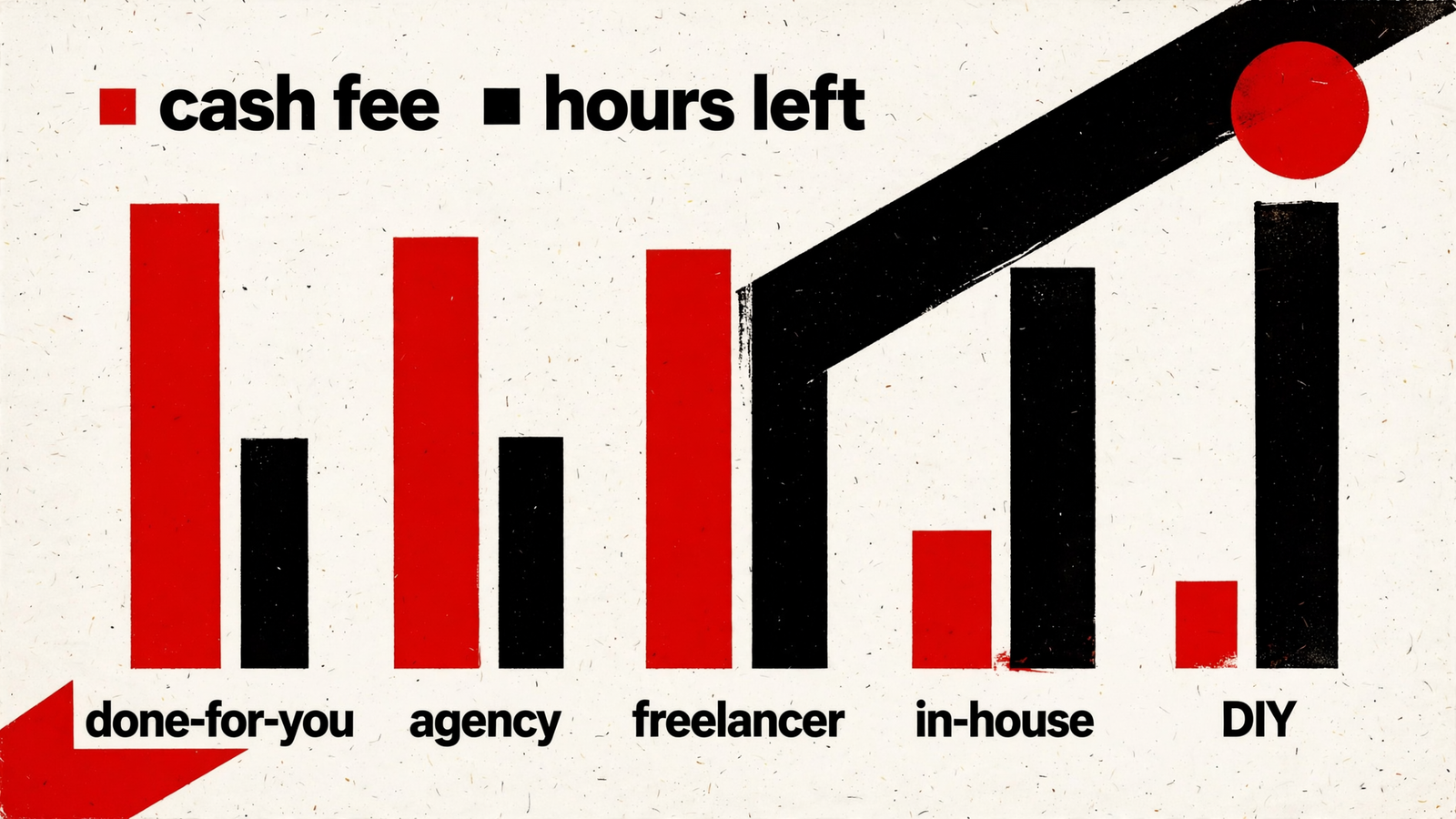
The verdict: buy the coverage your store cannot supply
Before you sign, write a one-page note your finance lead could understand without attending the sales call:
- Name the model and the weekly hours your store can actually provide.
- List the gaps you still need to cover: shoots, feed cleanup, pixel or Conversions API repair.
- Add the whole cost: management fee, media and the people needed to close those gaps.
- Write the exit terms: who owns the account and creative, what learning you keep, and how quickly you can leave.
That note rules out more bad fits than a polished deck. A $1,499 flat fee with month-to-month terms and no cut of spend reads differently alongside $10k in media and no creative contractors than it does alongside $2k in media and little room to test.
If you skipped to the end: for a lean store that can supply product truth for an hour a week but cannot manage Meta daily, start with integrated done-for-you. Move to a specialist when the brief outgrows standard management, a freelancer when creative and tracking already have owners, an in-house team when the workload funds one, or DIY when four to six hours are genuinely protected.
I left out the pay-on-results shop on purpose. Its pitch can turn on cherry-picked attribution rather than the weekly work, and auditing that pitch requires the same tracking the other options need. The capacity test still applies if you expand beyond Meta; the five-model test for ChatGPT ads asks the same useful question. What can your store actually supply every week?