

 LinkedIn

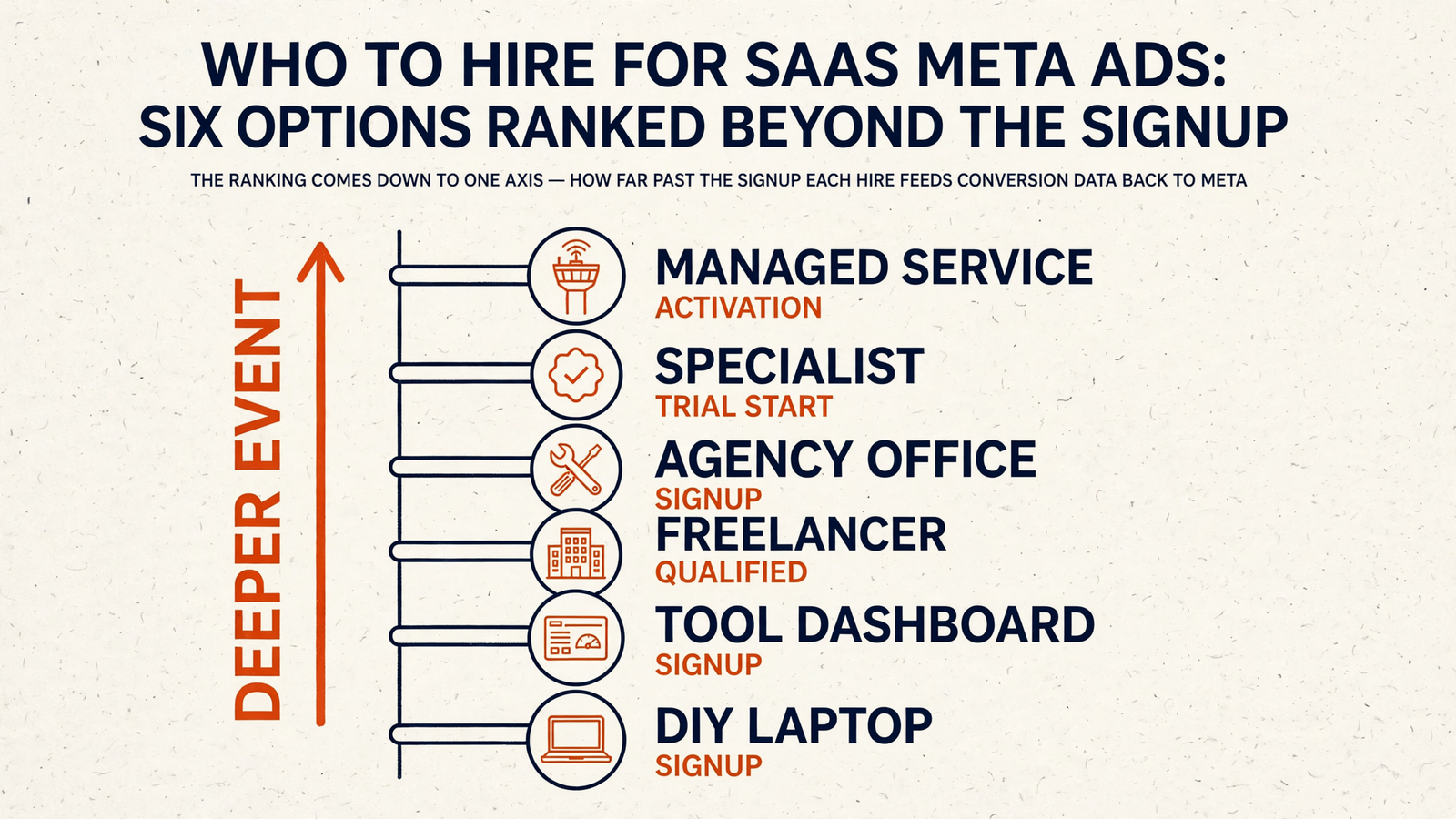
If you sell SaaS, the cheapest signup is often the most expensive trial. My pick for a team past $10k MRR, with enough activations to give Meta a useful signal, is the flat-fee managed service that wires those activations back into the ad account. A creative portfolio cannot tell you whether a hire will do that.
I learned to distrust the signup dashboard while running ads for a SaaS startup that changed its offer every quarter. Signup volume climbed, cost per signup fell, and sales kept reporting the same problem: 80% never made it past the first call. Meta was finding the event we had asked it to find. The hiring question is not who can buy a signup. It is who will feed Meta evidence of what happens afterward.
That is why this ranking runs from DIY to a managed service, with a freelancer and a SaaS-specialist agency closer together than their fees suggest. Both can know the right event; neither is the best fit if nobody keeps the data flowing and acts on it. Here is how I would choose.
The test: which event does Meta get to learn from?
Meta does not know which trial becomes a customer unless you send that information back. A two-event setup can record a Lead at signup and a Qualified Lead when someone reaches a meaningful CRM stage, such as MQL, SQL, or closed-won. That distinction matters when MQL-to-SQL rates are cited at 9.8%: signup volume alone says little about the people sales wants.
The constraint is volume. Meta needs about 50 optimization events per week to exit learning, and its October 2026 guidance associated ad sets below roughly 50 weekly conversions with about 28% higher cost per purchase. Signup is plentiful but weak. Activation is a stronger signal but scarcer. Paid is the event you ultimately care about, yet it can be too rare for a SaaS account to optimize toward directly.
So I want to hear two answers from a prospective hire: which post-signup event will you send back, and is there enough of it to optimize toward? Pixel, Conversions API, CRM stages, and ad-set consolidation are means to that end. A prettier CPL report is not.
The ranking at a glance
| Rank | Option | Likely working signal | Best fit | What rules it out |
|---|---|---|---|---|
| 6 | DIY | Signup | Pre-revenue, under $2k monthly spend | Post-signup wiring takes time the founder may not have |
| 5 | Tool plus founder | Signup unless the founder builds more | Technical founder at $3k–$5k spend | Automation does not build the data pipeline |
| 4 | Generalist agency | Signup or trial start | Team outsourcing creative production | CPL reporting can stop short of trial quality |
| 3 | Freelancer with CAPI skills | Qualified lead, if maintained | $5k–$8k spend with developer access | A wiring project is not ongoing management |
| 2 | SaaS-specialist agency | Activation or SQL | Series A team with volume and RevOps | Retainer and review cadence |
| 1 | Flat-fee managed service | Activation, with paid stages fed back | Past $10k MRR with activation flow | Too little downstream volume |
6. DIY in Ads Manager: learn the hook, then move on
Best for: the pre-revenue founder spending under $2k a month who has more evenings than budget. DIY wins on speed to a first signal. You can put a Lead event on the signup thank-you page, run a small test, and see which message earns a response without waiting for anyone’s kickoff call.
I used to tell clients that was enough to validate messaging. I was wrong about how long they could rely on it. A signup can tell you a hook worked; it cannot tell you whether the person will activate or pay. If the account never receives those later events, it keeps learning from starters. That is the failure mode behind campaigns that find starters rather than activators or payers.
What rules it out: the moment you have enough post-signup activity to distinguish good trials from bad ones, but no time to send that distinction back. Do not buy a service before you have a signal worth sending. Do not mistake the first signal for the final one, either.
5. Optimization tool plus founder: cheaper oversight, same plumbing job
Best for: a technical founder spending $3k–$5k who will actually open the tool at night. A Madgicx-style setup wins on inexpensive, rules-based oversight. The listed tiers are $45 a month under $1k in spend, $99 at $1k–$2.5k, $119 at $2.5k–$5k, and $129 at $5k–$10k. Server-side Tracking Pro adds $49 per account per month. For a narrow test with clean tracking, bid and budget guardrails can help.
They cannot do the SaaS plumbing by themselves. Someone must capture the ad click identifier at signup, keep it with the account record, and send activation or paid stages back server-side. If that someone is you, price the evenings honestly. Freelance Meta buyer rates run $60–$110 an hour in 2026; eight hours of equivalent operator time is $480–$880. At $8k spend, the example is $178 in software plus ten hours at $80 an hour: $978 in all.
What rules it out: you want automation to replace the operator and the data work. It does neither. Use the tool if you will wire activation yourself; otherwise, you bought a faster way to buy the wrong trials.

4. Generalist agency: creative output, signup-level accountability
Best for: a team with $10k-plus in monthly spend that wants Meta off its plate. The generalist agency’s advantage is creative throughput: a designer, a copywriter, and fresh variants without the founder assembling every ad. That is real work, and some teams badly need it.
The problem is where the report ends. If the agency optimizes to signup or trial start and grades itself on CPL and CTR, more creative simply gives Meta more ways to find people who do not activate. What the deck calls full-funnel, I call a signup report with extra slides. Typical B2B SaaS Meta agency pricing runs $3,000–$10,000-plus a month, often tied to spend. That fee deserves an answer about MQL, SQL, and opportunity data, not just a calendar of new ads.
I have fired this model twice from the client side. Both times the reporting was excellent and trial quality did not move. What rules it out: the agency cannot show how CRM stages get back to Meta or agree to be judged beyond CPL. Buy creative production if that is what you need. Do not call it downstream optimization.

3. Freelancer with CAPI skills: hire the wiring, not a growth department
Best for: a SaaS team spending $5k–$8k with a developer who can give a freelancer the access needed to connect the systems. A good freelancer beats options 4 through 6 at one specific job: getting post-signup events into the ad account. They can run Pixel and Conversions API together, map signup and qualified stages, and push CRM events back so the account has more to work with than a thank-you page.
That is a meaningful upgrade. It is also a project, not a promise that the system will keep working. Match rates need watching. Event mappings can need attention as the funnel changes. When downstream volume gets thin, someone must decide whether the budget supports one or two ad sets rather than several. Someone must keep testing creative, too. A freelancer hired for implementation may do the build and move to the next client.
What rules it out: you need one person to own the wiring, media buying, and ongoing decisions without giving them the scope to do all three. Hire the freelancer for the CAPI build if that is the gap. Then name who maintains it. Otherwise, the account can drift back to optimizing for whichever event arrives most reliably: signup.
2. SaaS-specialist agency: the right question at a high price
Best for: a Series A team at $1M-plus ARR with a demo or trial funnel, a real CRM, enough qualified-event volume, and budget for a $3,000–$10,000-plus monthly retainer. The good SaaS shops win on downstream discipline. Serious B2B specialists judge work against SQLs, pipeline value, and closed-won rather than CPL or CTR, using CRM-integrated Conversions API attribution. That is the right conversation.
It is not an automatic win. Even a team that knows which event matters has to respond when that event becomes too scarce for the current ad-set structure. A monthly review can be too slow for a campaign that needs consolidation now; a creative test waiting in a queue does not help this week. I want to know who notices the dip and who makes the change, not just who presents the chart.
What rules it out for many teams below $50k in monthly spend: the operating model. If you have the volume, the budget, and RevOps to hold the agency to cost per SQL, it beats the options below it. If not, you can pay 2015 prices for work that no longer takes 2015 effort.
1. Flat-fee managed service: my pick when activation has volume
Best for: the founder or growth lead past $10k MRR who wants trial signups that activate and does not want to hire the data plumbing and media buying separately. The advantage is continuous attention to both jobs. groas lists Meta Ads management at a flat $1,499 a month, regardless of spend, with audiences, budgets, and ads worked around the clock. There is no cut of spend, no setup fee, and the arrangement is month to month.
For SaaS, I would point that work at activation and paid stages sent back from the CRM through Pixel and Conversions API, then judge the account on qualified trials rather than the cheapest signup. I have seen the SaaS-specialist versus flat-fee comparison framed as expertise versus price. That misses the operational question: who acts on the signal while it still matters? Match-rate decay and ad-set consolidation are boring until nobody owns them.
What rules it out: too little activation volume. Twelve trials a week at a pre-revenue company do not become a useful downstream optimization signal because a service has a flat fee. Past $10k MRR, with real activation flow to work from, this is the option I would put first: the event matters, and so does the speed of the response.
Choose by stage, not by the nicest portfolio
- Pre-revenue: stay at No. 6 if you spend under $2k. Optimize to
Lead, learn which message earns a signup, and establish what activation means before paying someone to chase it. - Around $10k MRR: consider No. 1 when you have enough activation events to make a downstream test useful. A 45-day test focused on activations rather than cheap signups is a better brief than “bring CPL down.” The revenue milestone alone is not the signal; the activation flow is.
- Series A: No. 2 is defensible if you have qualified-event volume and RevOps can hold the agency to cost per SQL. Without that oversight, I would still choose No. 1 rather than pay a larger retainer for a slower decision cycle.
The shops that fill a free trial with people who never activate can look terrific at the signup stage. That is why the stage belongs in the hiring decision.
One popular option is missing: the full-time in-house junior. Founders ask whether they should hire someone for $70k to run Meta instead. If that person can only optimize to signup, still needs a developer for CRM events, and tests three creatives a month rather than three a week, the salary has not solved the problem. A senior hire who has done SaaS activation plumbing before is a different proposition. If you are hiring junior and hoping, choose No. 1 instead.
Ask this on the first call
Ask, word for word: Which post-signup event will you send back server-side, and which event will Meta optimize toward in week three? A useful answer accounts for volume. It might start with trial signups, explain when activation becomes viable, and say what happens to the ad-set structure at that point. “We will lower CPL” does not answer the question. Neither does a wall of SaaS logos.
If you skipped to the end: hire the flat-fee service that wires activation, provided you have enough activations to use. The SaaS-specialist agency can also get past signup, but it asks you to pay more and manage the cadence. For the founder with activation flow who does not want another dashboard to babysit, my pick is No. 1. Ask about week-three optimization before you sign. Do not pay anyone who can only tell you what a signup costs.