

 LinkedIn

The fact everything else follows from
In 30 days, verified ChatGPT-User requests fetched a groas changelog post about Google Ads platform changes 552 times. Our core software category pages received zero such fetches in the same window. The pages we built to explain what we sell were absent from that slice of live-answer traffic; a dated log of technical changes kept getting requested.
That does not mean the changelog appeared in 552 answers. A server can see a fetch, not the footnote a reader sees later. But the split tells us something useful about the step before a citation: an answering engine chose to request one kind of page and not the other.
The usual explanation for AI visibility starts in the wrong place. Marketers talk about brand mentions, domain authority, or getting into a future model-training run. Those may be separate concerns, but they do not explain why OpenAI’s live-answer crawler, using the ChatGPT-User token, requested our changelog on a given day. To understand that request, follow the question being answered. An assistant can turn a buyer’s prompt into searches, retrieve candidate pages, extract useful passages, and attach citations to claims those passages support.
A citation is not a lifetime achievement award for a domain. It is the visible end of an answer-time selection process. Our logs show one part of that process unusually clearly. Here is the rest of the model, built one step at a time.
Step 1: A buyer’s question becomes several smaller searches
Suppose a growth lead asks, “What changed with Google Ads Smart Bidding thresholds this year, and which platform manages it best?” That is a reasonable way to ask a colleague. It is a messy search query: one sentence asks for a change, a timeline, and a product comparison.
An assistant can break it into narrower searches. This is query fan-out. Instead of looking only for the original sentence, it might search for a Google Ads bidding update, a relevant date or deprecation notice, and software providers associated with the feature. Ahrefs’ analysis of 66.6 million ChatGPT responses found that roughly 14.4% triggered live web retrieval, with an average of 1.6 parallel fan-out queries per search event. Not every answer needs a live search, and not every compound question splits in the same way. The important point is that the page may be judged against a smaller, more specific question than the one the buyer typed.
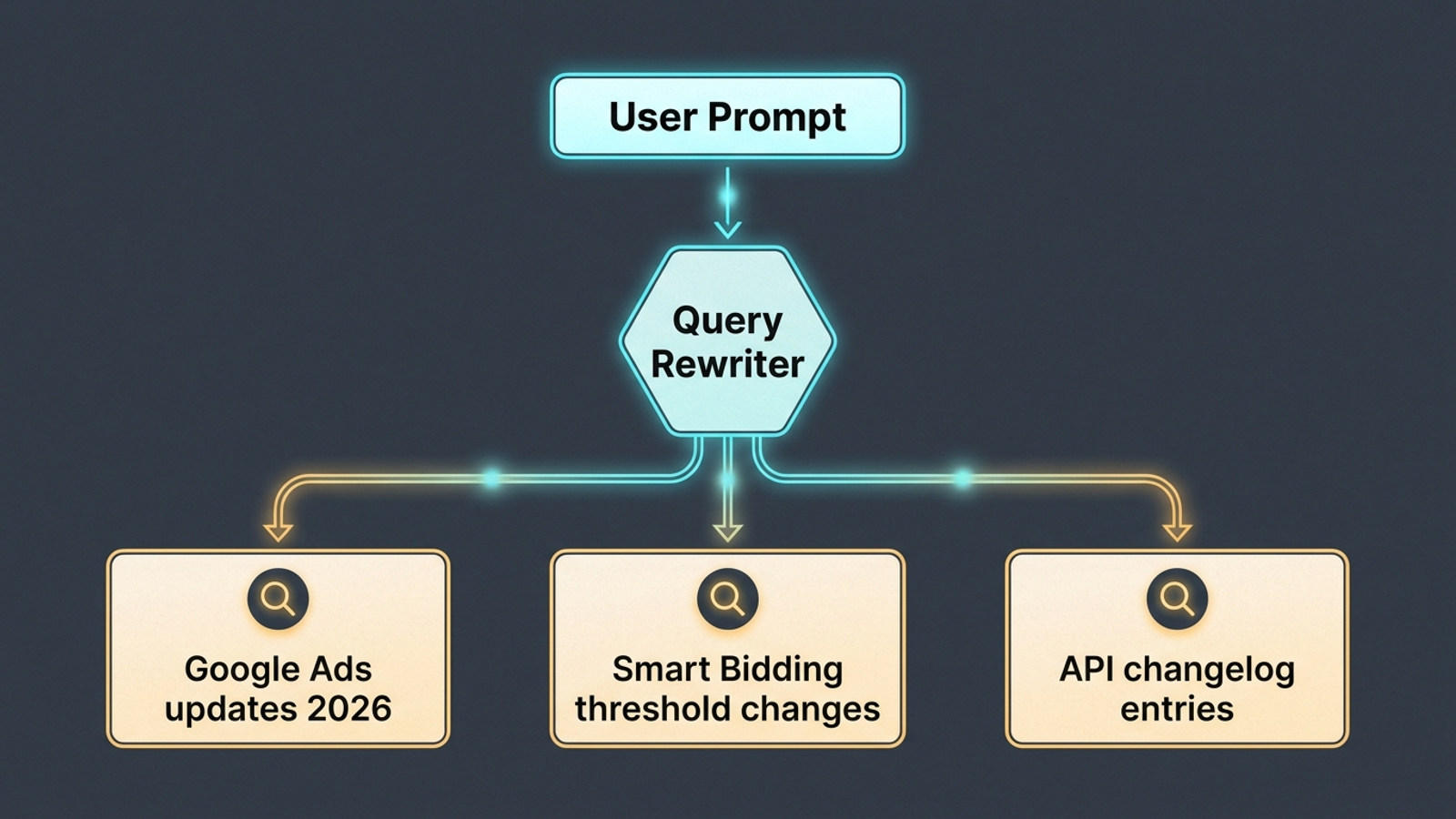
Now the changelog starts to make sense. A dated entry naming a parameter or policy change can match a narrow search about that change. A category page promising an “industry-leading autonomous growth platform” gives the search little to grab. It may be a fine introduction to the product. It is a poor answer to “What changed, and when?”
The practical takeaway is not to turn every sales page into a technical manual. Give specific buyer questions specific pages or sections to land on.
Step 2: Those searches need candidate pages
Once the assistant has narrower queries, it needs documents to examine. Depending on the engine and execution mode, retrieval can draw on a web search index, an internal index, or a combination of approaches. Perplexity’s account of its search architecture describes hybrid retrieval: keyword matching alongside vector-based matching that captures meaning beyond identical words.
Both routes matter to our running question. Exact terms such as a feature name, parameter, or date help a technical update surface. Semantic matching can also connect a page to a question phrased differently from its heading. Retrieval then narrows the candidate pool by relevance. As Citeflow’s discussion of retrieval pipelines explains, reranking can assess passages against the query rather than treating every page on a domain as equally useful.
This is where the reputation contest model breaks down. A strong domain does not make every URL answer every question. If the query concerns a bidding change, a page with the change in plain text has a clearer job than one filled with general claims about growth. The State of Brand’s analysis likewise reported a decline in citations to generic listicles and affiliate roundups alongside greater visibility for direct technical documentation. That observation is not a rule for every engine or topic. It fits the narrower principle: the candidate must contain something the answer can use.
Our edge logs do not reveal the exact queries, candidate lists, or reranker scores behind each request. They show what reached our server. The proposed mechanism explains why a query-shaped changelog is a plausible choice; it does not let me pretend I watched the assistant make it.
Step 3: A candidate becomes a live fetch
Selection in a search system and a request to your server are different events. When an engine fetches a candidate URL during an answer, that request leaves a trace in edge logs. OpenAI distinguishes its training crawler, GPTBot, from ChatGPT-User, the token associated with user-initiated activity. Anthropic similarly distinguishes ClaudeBot from Claude-User. That distinction matters if you are trying to measure answer-time access rather than count every automated visitor.
It also matters operationally. A page that a legitimate live-answer agent cannot access cannot supply a fresh passage through that route. Blocking the relevant agent or making the useful content unavailable in the response can end the process before passage selection begins. Speed and accessible text help; a specific response-time cutoff is not something our log comparison establishes.
What the 30-day log split does, and does not, prove
Our dated Google Ads updates post drew 552 verified live-answer fetches in the window. An adjacent post about specific bidding algorithm changes drew 349. Our core category pages drew zero. That is a striking difference in requests, not a measured citation count.
The content difference is just as striking. The updates posts organize technical changes around dates and identifiable details. The category pages explain our broader product and its commercial value. If an assistant is searching for a particular change, the first kind of page offers a more direct candidate. I cannot recover every user prompt from a GET request, so I would not claim that all 552 fetches came from people asking about the same threshold. The logs support the pattern, not that invented transcript.
There is one more trap here: a user-agent string is easy to copy. DataDome’s research on AI-agent spoofing is a useful warning against treating every request labelled ChatGPT-User as genuine. In our audit of the edge data, we counted 13,774 apparent AI-bot hits but verified only 3,482 through origin checks. The 552 changelog requests are from that verified view, not a raw header count.

That is why I start with edge logs rather than a traffic dashboard. Analytics can tell you useful things about visitors, but it is not a substitute for checking the origin of automated requests. Count verified fetches as fetches. Do not relabel them citations.
Step 4: The useful unit is a passage, not your entire page
A fetched URL still has to provide text the assistant can use. Consider the growth lead’s question again. If the assistant needs a date and an explanation of what changed, it does not need your navigation, footer, hero copy, and three paragraphs about why your company cares deeply about innovation. It needs the passage that states the change.
Retrieval systems can extract and compare smaller spans of text rather than hand an entire page equal weight. That makes self-contained passages valuable. A dated heading followed by the named change, its previous state, its new state, and its effective date gives a reader—and a retrieval system—a coherent unit. A sentence saying “our solution helps teams stay ahead” does not answer the question, however polished the layout around it.
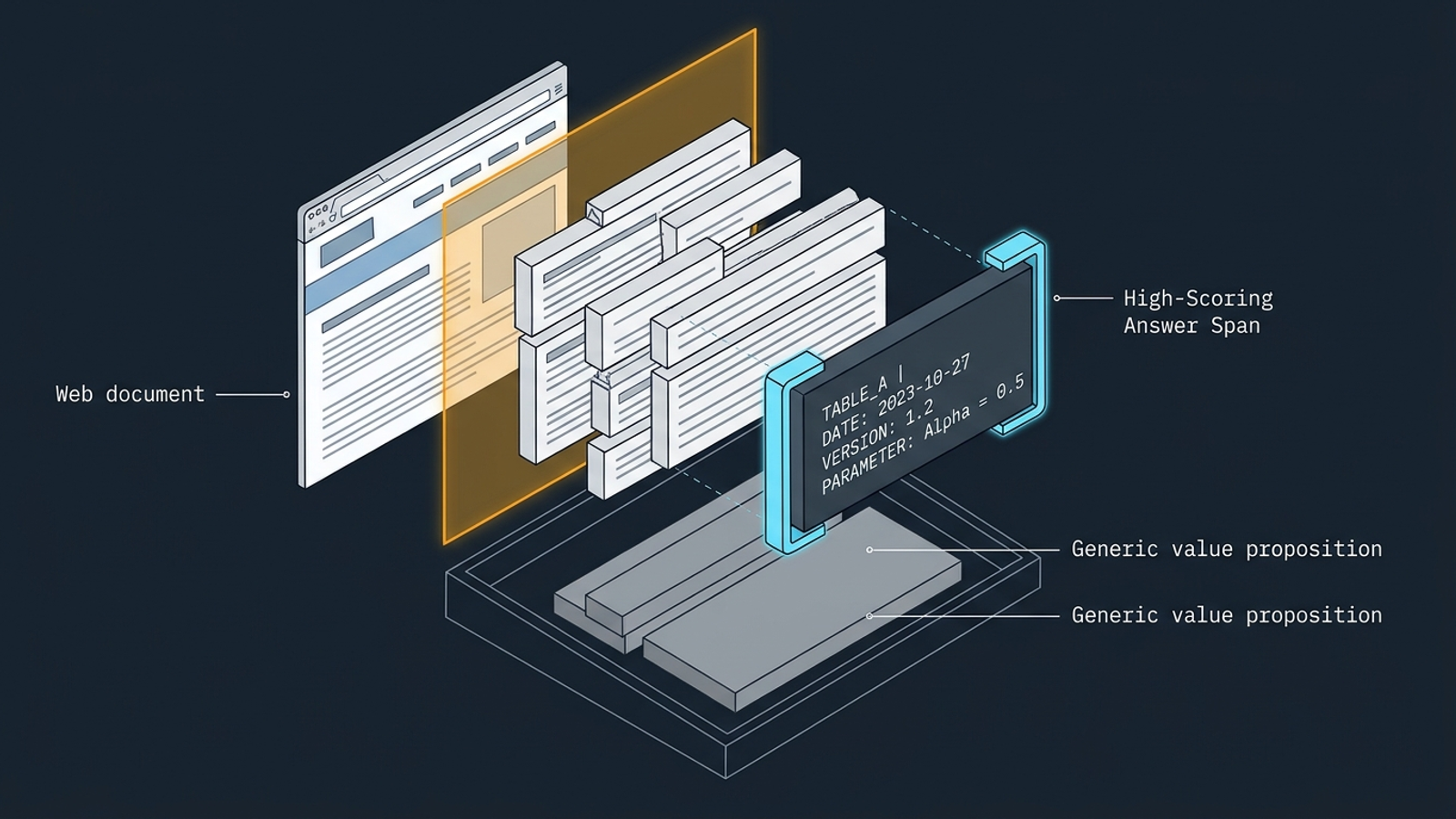
This is the second part of the changelog’s advantage. It is not merely a page about Google Ads updates. Each entry can answer a smaller question without asking the reader to assemble clues from elsewhere on the site. Our category pages serve another purpose: they explain the product across a broader buying journey. The zero-fetch result does not prove how an engine would have scored their passages if it had requested them. It does show that those pages did not get the chance in this window.
For your own content, try a simple test. Lift one section out of its page. Does it still name the thing, state what happened, and make sense without a hero banner or the preceding five paragraphs? If the answer disappears when you isolate the passage, rewrite the passage.
Step 5: A fetch has to earn its footnote
Now we can make the distinction the title depends on. A search can surface a URL. An agent can fetch it. A passage can survive extraction. None of those events guarantees a visible citation. The final answer must use material from that passage in a claim it attributes to the source.
Suppose the assistant finds three pages that mention a bidding update. One gives the date and the changed parameter. Another says the update is “important for modern advertisers.” A third describes a product but never states what changed. The first offers support for a concrete answer. The others may provide context, but their mere presence in the candidate set does not create a footnote.
This is why vague promotional language is weak material for a technical answer. “Our platform makes accounts run faster” leaves the mechanism and even the meaning of faster unclear. An explicit description of what a product does gives the assistant something more usable. It still has to be relevant to the buyer’s question. Make the claim a passage can support, rather than expecting a citation because the page was fetched.
The log result sits at Step 3, not Step 5. We know the verified agent requested the changelog 552 times and the category pages zero times. We do not know from those logs alone how many answers cited the changelog. That limit does not weaken the useful lesson. Without a fetch, those category pages could not supply a passage through those requests at all.
What I would change on a site first
The mechanism suggests a short order of operations. If you want to understand how to get your business cited in ChatGPT and Perplexity, I would start with the material an assistant could actually retrieve, not a campaign to make it feel warmly toward your logo.
- Separate specific facts from broad sales copy. Find the changes, specifications, limits, pricing details, or operational answers buyers ask about. Give them accessible, query-shaped HTML pages or clearly labelled sections instead of burying them in a gated document or a general overview.
- Make each answer stand on its own. Use a heading that names the question or subject. Put the direct answer underneath it, with the relevant nouns and details intact. Do not force a reader to decode “it,” “this update,” and “our approach” from another section.
- Check access with verified requests. Review edge logs and firewall rules for legitimate live-answer agents. Make sure the text you want retrieved is available when the page is fetched. Otherwise, excellent writing remains excellent writing nobody in that retrieval path can read.
Those are content and infrastructure decisions, not a promise of citations. They give a page a better chance to match a narrow search, return successfully, and provide a usable passage. They also give a human buyer a faster answer. I will take that overlap over another slide about AI-ready brand sentiment.
Test the model on a different buyer question
Imagine a B2B warehouse inventory platform with two pages. Page A is its polished “Enterprise Warehouse Management System” solutions page. It talks about efficiency, throughput, and modernizing supply chains. Page B is a technical document titled “Code 128 vs. DataMatrix: Read Failure Rates, Scan Latency, and ERP Integration Payloads.”
A buyer asks an assistant which barcode format to use on high-speed conveyor scanners and which inventory platforms support it. Work through the model rather than guessing which page has more authority:
- Rewrite: The assistant can separate the request into questions about barcode performance and platform support.
- Search and rank: Page B has a clear match for the format and scanner questions. Page A may still matter to a broader platform search, but its general language does little to answer a request for read failures or payloads.
- Fetch and extract: If Page B is accessible and contains a section that actually compares the formats, that section can stand on its own. Its title alone is not evidence; the comparison has to be on the page.
- Attribute: If the assistant uses that comparison in its answer, Page B has a plausible route to a citation. If it merely gets fetched, the footnote is still unproven.
That is the same path our changelog was better positioned to travel than our category pages. The lesson is not that commercial pages are worthless. It is that a page built to introduce a company and a page built to resolve a precise question are doing different jobs. Confusing the two leaves useful facts buried and makes live-answer visibility harder to diagnose.
At groas, that distinction shapes how we think about search work. Specialized models handle continuous campaign, bidding, and content execution, while a named strategist sets direction and owns accountability. The point is not to produce more generic pages at machine speed. It is to keep answering the questions buyers actually ask, in text an engine can fetch and a person can use. Our 552-to-zero split is a reminder to check which pages are doing that job before polishing the ones that are not.