

 LinkedIn

Your rival appears in ChatGPT’s list of the best construction project management tools. Your brand does not. Then you ask for “[Your Brand] vs [Rival]”, and ChatGPT quotes your integrations and pricing.
That is not a brand moving up and down a fixed AI ranking. A brand mention is the end of a chain: prompt, rewritten sub-queries, retrieved pages, extracted passages, then an answer that names you. The two prompts can send the system looking for different evidence. If you only record the prompt and the final mention, you miss the part you can work on.
First, the prompt becomes searches you did not type
When someone asks an AI search tool for the “best project management software for construction,” the tool may break that request into narrower searches before assembling an answer. This is query fan-out. Instead of relying on the original wording alone, the system looks for evidence about the things a buyer might mean by best: scheduling, job costing, reviews and price.
For our construction-software example, plausible sub-queries include:
top rated commercial construction management tools 2026 reviewssubcontractor scheduling and job costing software comparisonconstruction project management software capterra g2 rankingsbuilder management platform pricing breakdown
Those are illustrations, not a transcript of what any one engine searched. The important detail is that none of them has to contain your brand name. Your homepage can describe you perfectly under a branded search and still offer little that matches a search for subcontractor scheduling comparisons.
The PPC parallel: keyword versus search term
If you have worked through a Google Ads search terms report, you know the distinction. You target construction management software; a buyer searches for subcontractor scheduling app with offline ipad sync. The target keyword tells you what you intended to reach. The search term tells you what actually brought the buyer in.
The parallel is useful, but it has a limit. An AI-generated sub-query is not a Google Ads search term, and you should not assume every tool exposes it. The operating lesson is the same: the prompt you track may not be the query that determines which page gets found. I would rather inspect the evidence around that gap than celebrate a green mention badge.
The draft’s Surfer SEO study of 173,902 URLs reports a 0.77 correlation between the number of fan-out sub-queries a page addresses and its chance of an AI citation. It also reports that 68% of pages cited in Google’s AI answers were outside the traditional top ten organic results. Those findings do not give you a universal formula. They do give you a reason to examine the narrower questions your pages answer, not just the head term you rank for.
Next, a page has to make the retrieved set
A sub-query needs a source. Depending on the product, the question and whether web search is in use, an AI answer may draw on retrieved pages rather than only on what a model learned during training. That makes access to your content part of the problem.
OpenAI’s crawler documentation distinguishes agents with different jobs: GPTBot for training-related crawling, OAI-SearchBot for search discovery, and ChatGPT-User for user-triggered visits. A visit from one is not interchangeable with a visit from another. Nor does allowing a crawler guarantee that your page will appear in an answer.
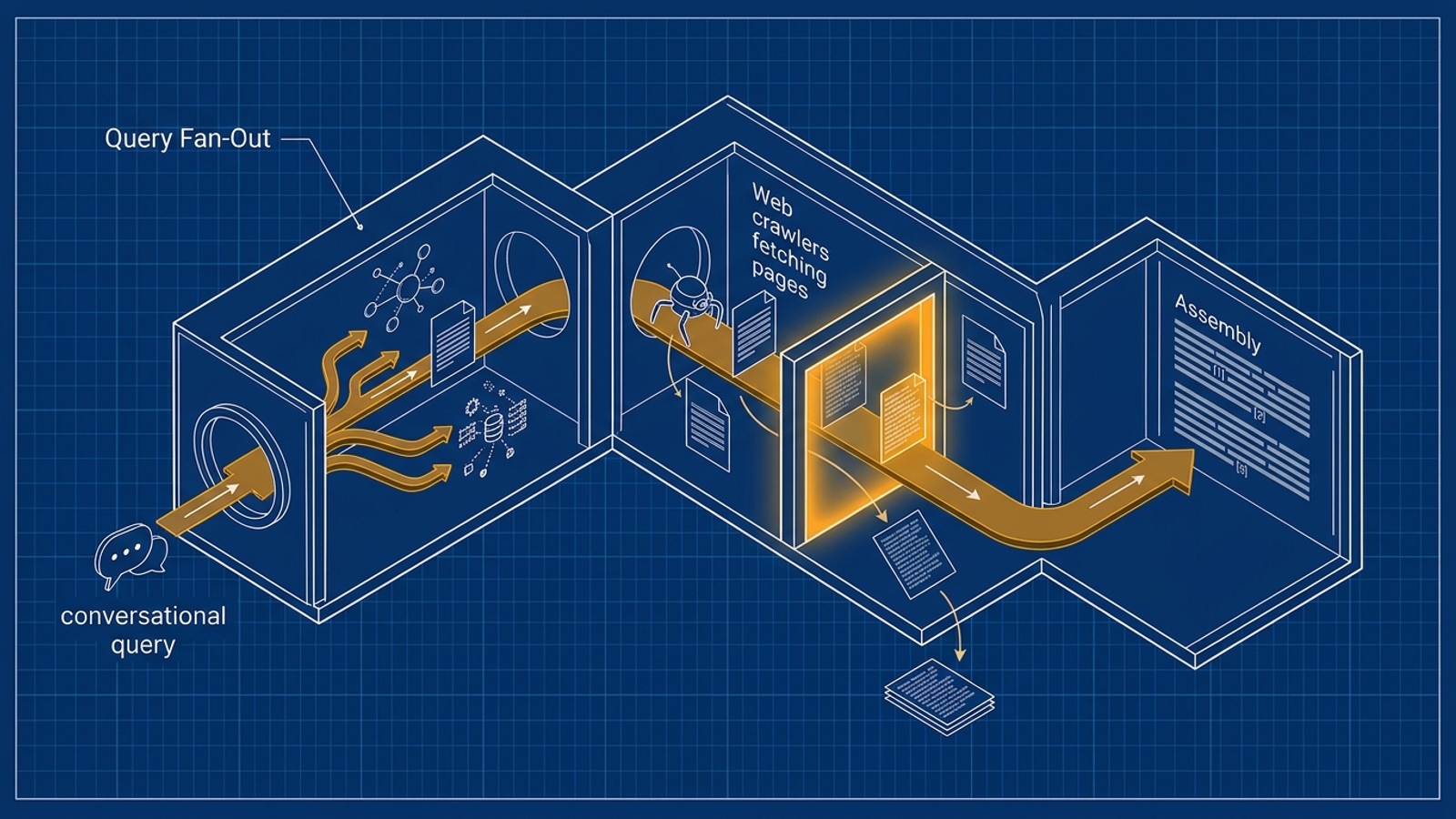
In our edge logs, we counted 552 distinct ChatGPT-User fetches of one published article alongside 1,241 Claude-User requests for robots.txt. That is a useful reminder that user-triggered fetching and routine discovery are different events. Logs can show a request reached your server. They cannot, by themselves, show the prompt behind it or prove that the fetched page made the final answer.
For the construction-software company, this gives us a first diagnostic fork. If a relevant page cannot be fetched reliably, there is no passage to quote. If it can be fetched, we still have not earned a mention: retrieval systems consider more candidates than an answer will cite. Omnius’s retrieval benchmarks put citations at roughly 1 in 9 initial search results across fan-out queries and report that 84% to 87% of cited domains per prompt in the ChatGPT thinking models they examined were absent from Google’s or Bing’s page-one results.
Do not turn those figures into a rule that organic rankings no longer matter. Use them to ask the more immediate question: for this narrower query, is a relevant page even in the candidate set? If not, rewriting your homepage meta description is unlikely to settle it.
Then, a useful passage has to survive
Suppose the construction-software company publishes a page about scheduling and the engine retrieves it. The page can still lose at the next stage. An answer needs a passage it can use, not merely a URL with the right theme.
As iPullRank’s AI search architecture manual describes, retrieval systems can divide documents into smaller chunks and rerank passages for relevance. The exact treatment varies by system. The editorial consequence is plain enough: a sentence that states a fact on its own is easier to use than one that needs the rest of the site to explain it.
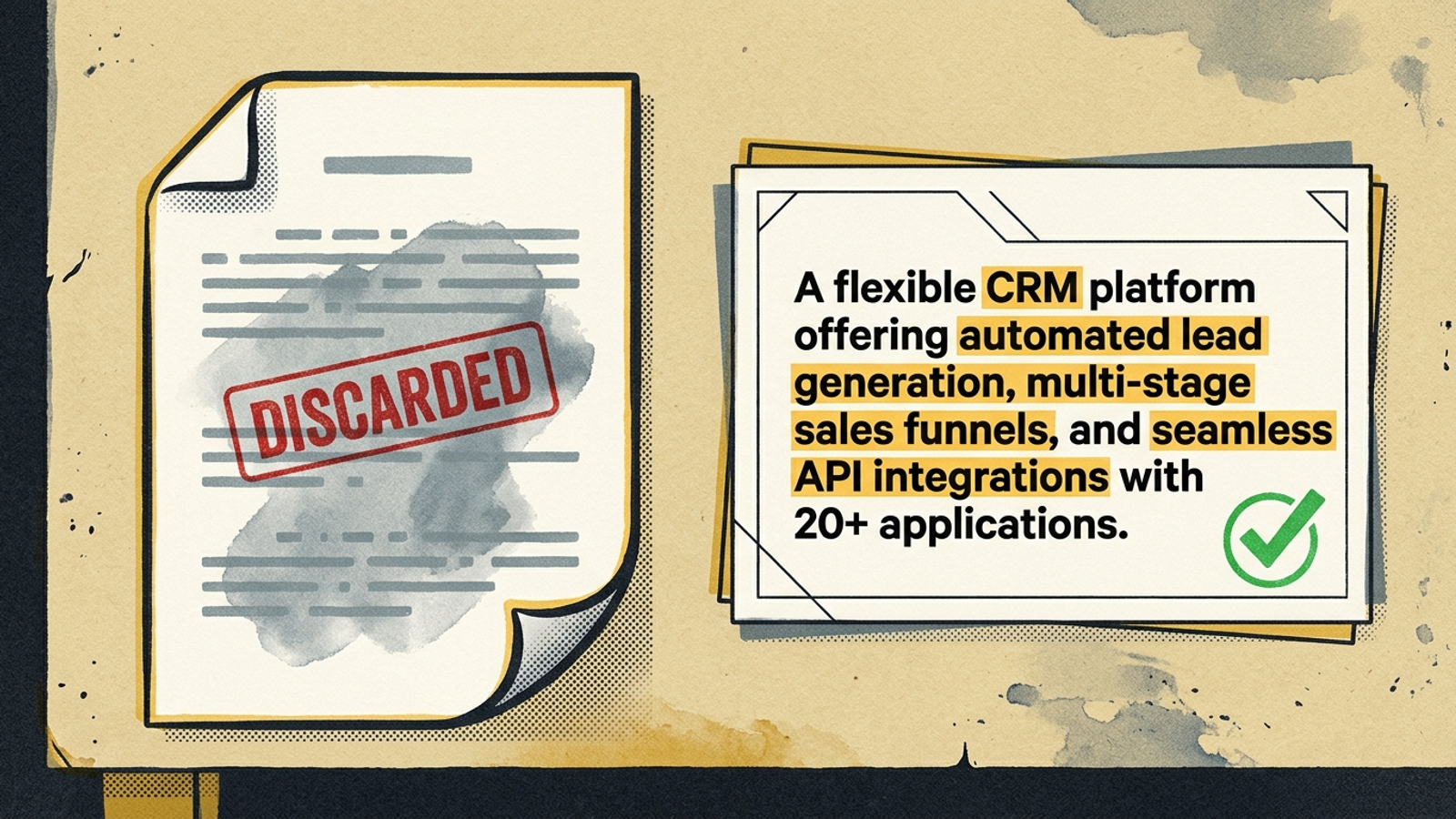
Compare these two ways of introducing the same kind of product:
We help modern teams optimize operational synergy across comprehensive business workflows.
Acme is a cloud-based construction scheduling platform that handles subcontractor Gantt charts, change-order tracking, and QuickBooks integration.
The first could describe almost anything. The second tells a reader the category, the work it handles and an integration. It is not better because it sounds more technical. It is better because someone asking about subcontractor scheduling can use it without decoding operational synergy.
This is the single-sentence test I would apply to the construction-software site: can a reader lift one short passage and understand who the product serves, what it does and which buying question it answers? If the answer is no, a third-party review may supply the clearer description of your own product. That is an awkward thing to leave to someone else.
Finally, the answer uses the evidence the prompt calls for
Now return to the two screens. On “best project management software for construction,” the answer needs candidates for a category list. Roundups, review hubs and discussions can provide that outside view. If your rival appears in those sources and you do not, the rival has an easier route into the list. Your detailed pricing page may be accurate and accessible; it simply answers a different question.
The cited research reflects that split. One practitioner tracking report found vendor domains cited in only 2.8% of the unbranded “best X” cases it examined. A Wix Studio AI Search Lab benchmark of 75,000 answers found listicles and comparison roundups represented 40.9% of citations on commercial-intent queries. Those are observations about the tracked answers, not a rule that an engine rejects every first-party page.
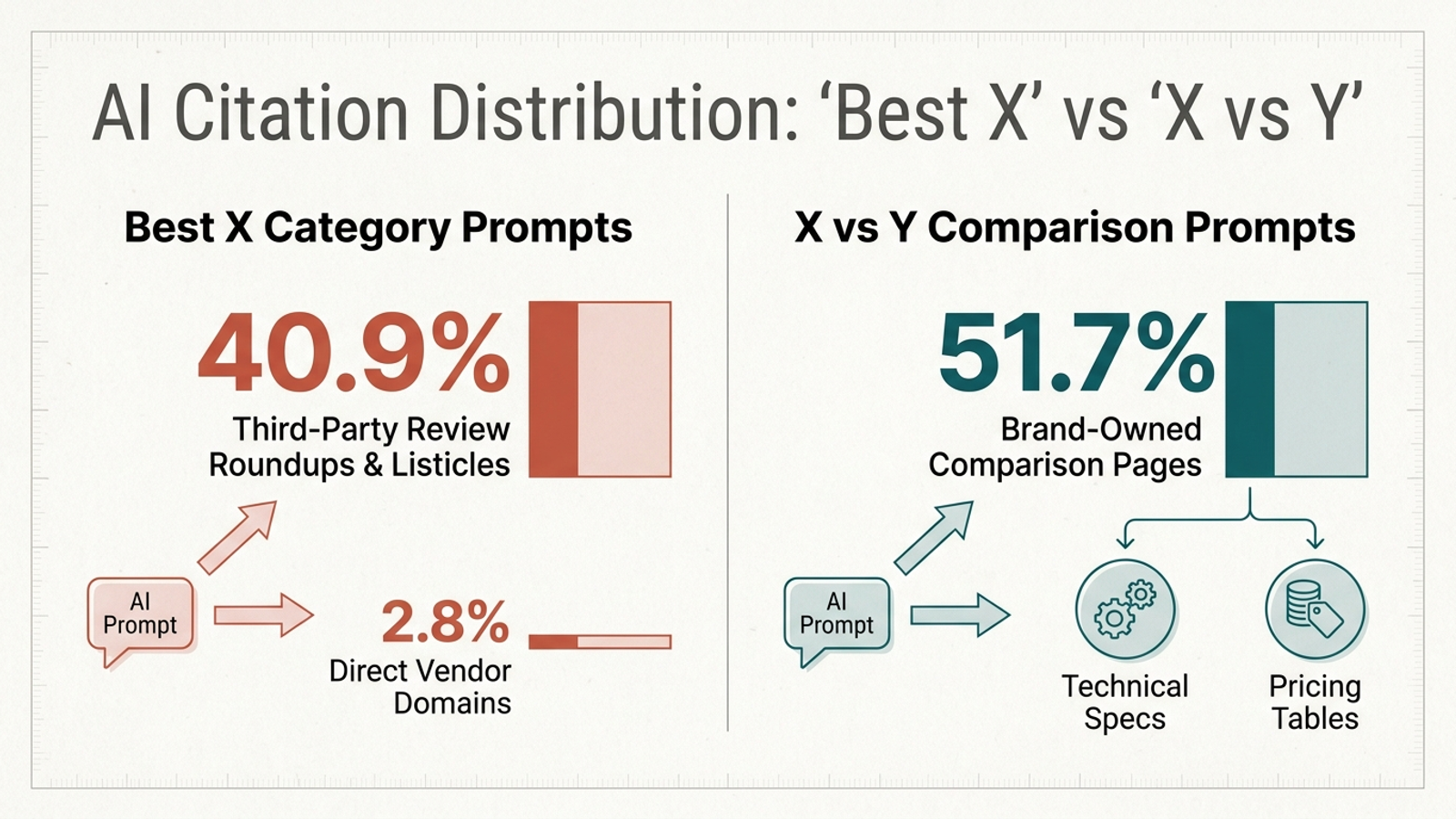
Change the prompt to “[Your Brand] vs [Rival]” and the information need changes. Now the answer may need each product’s pricing tiers, integrations, features or contract terms. Searches for [Your Brand] pricing tiers and [Rival] change order workflow make first-party product pages more relevant than they were for an unbranded category list.
In that same practitioner tracking, comparison prompts cited dedicated /vs, /compare or /alternatives pages in 34% to 43% of cited URLs. An analysis of 14,192 citations by Boring Marketing found brand-owned websites captured 51.7% of direct citations for branded navigation and entity queries.
This is not proof that your rival has more AI authority in some permanent sense. In our example, the simpler explanation is that the rival has evidence where a category-list answer looks, while you have evidence where a direct comparison looks. If you want to change the first answer, improve the evidence available for that first kind of search. Polishing an already useful comparison page addresses the second.
Test the chain against the odd results
A model is only useful if it explains something beyond the neat opening example. Consider a brand that appears in Perplexity but not in Google’s AI Overviews for what looks like the same construction-software question. Calling that an “algorithm discrepancy” tells you nothing. The products can retrieve from different candidate sets and assemble answers differently. A Boring Marketing citation audit found Reddit in citations for 56% of the brands it audited and YouTube for 51%. If discussion elsewhere describes your scheduling product clearly while pages available to another system do not, different answers are plausible.

Or suppose your brand appeared last month and disappeared this month. Do not start with a penalty theory. Revisit the chain: did the question or its apparent buying intent change? Are the pages that now get cited different? Did a roundup update its list, or did another page publish a clearer answer to a relevant sub-query? A small change in the candidates or passages can change the names in a short final answer. It does not mean your site moved three places down a single, stable AI SERP.
Diagnose the stage before prescribing the fix. A fetch problem, a missing category mention and an unclear product passage are three different jobs. A chart that colours all three red is not doing much diagnostic work.
A prompt tracker is not a search terms report
Most prompt reports show two things: the question submitted and whether a brand appeared in the answer. That can tell you if a tracked output changed. It cannot, on its own, tell you which sub-query found a source, whether your page was fetched, or why another passage was chosen.
As practitioners discussing AI citation tracking have pointed out, repeating a fixed prompt and plotting mention rates leaves out much of the retrieval story. For a PPC operator, it feels like being handed the target keyword list while someone hides the search terms report.
There is a limit to that analogy too. You should not expect an outside platform to reveal every private query or reranking decision inside every AI engine. The honest standard is to separate what you can observe from what you infer: visible citations, relevant pages, server requests and the passages those pages actually contain can help you form a diagnosis. A vendor that labels an inferred sub-query as an exact internal search is giving you confidence it has not earned.
That distinction shapes how we built groas. It is an autonomous growth engine, not another dashboard asking you to interpret a red badge. Specialized models work across search content and campaign execution; a named human strategist sets direction and guardrails and remains accountable for the work. The point is to identify a tractable gap, make the change and measure it against qualified pipeline and attributable revenue, rather than charge for another month of staring at the chart. The model comes with a flat monthly fee, no setup fee and month-to-month cancellation. It is a better fit for that job than an agency retainer that stops at reporting the symptom.
Three questions before you buy the report
Before you sign for an AI visibility tool or an agency retainer, ask:
- What evidence sits between the prompt and the mention? Ask to see the cited sources and relevant passages. If the vendor claims to know the engine’s exact internal sub-queries, ask what it observed and what it inferred.
- Can you tell whether a relevant page was reachable? Server logs and crawler access can help separate a fetch problem from a content problem. Neither proves that a passage survived into an answer.
- Who makes the change? A report should lead to a specific job: make an important page accessible, write a clearer factual passage, or address a missing source of category evidence. If the engagement ends at another score, you are paying to watch the gap.
Take one last case through the model. A construction-software company appears in “Acme vs [Your Brand]” but not in “best tools for subcontractor scheduling.” I would not start by rewriting its comparison page. I would look for the narrower scheduling searches the category prompt could invite, check which sources the answer cites, then read the passages those sources offer. If the company’s own pages describe scheduling only as “streamlined workflows,” give them a concrete description. If the answer relies on category roundups where the company is absent, the missing evidence is elsewhere.
The question was never simply “Which prompts trigger my brand?” It was: which searches lead to a page with a sentence the answer can use? Find that break in the chain. Then fix that break, not the colour of the badge.