

 LinkedIn

By November 5, 2028, an SEO agency will not win a careful buyer’s contract by putting an 82 for AI visibility in its deck. Buyers will want to know whether AI answers cited their pages, named their brand, recommended them as a supplier, and sent qualified visitors to their site. One number cannot answer all four questions.
I used to tell clients a single health number saved time. I was wrong. A blended score can make background citations look like buying intent, or hide the fact that a competitor gets the recommendation while you get a link in the footnotes. That distinction will move from the analyst’s spreadsheet into the procurement brief. The test is whether a provider can show shortlist influence, not merely appearance in an answer.
Many AI visibility products run a fixed set of prompts, count appearances, and turn them into a 0–100 measure of how often and how prominently AI tools cite you. A named mention may score highest, followed by a linked mention and an in-context mention. Neat. Slide-friendly. But the tidy number conceals work a buyer needs kept apart.
Here is the split I track on my own panels. A cited source means an answer links your domain. A named supplier means it uses your brand name. A recommended supplier means it tells the buyer to choose you. Report them as separate mention, citation, and recommendation rates, each with its own denominator. Run 30 buyer prompts three times on one engine and you get 90 answers. If you are named in 45, cited in 20, and recommended in 8, the useful result is 50% named, 22% cited, and 9% recommended. Not 82.
A citation shows that your page contributed to an answer. A recommendation suggests that your brand made the shortlist. Neither, on its own, proves a sale. I have seen the older reporting version: clicks up, SQLs flat. In AI search it becomes visibility up, recommendations flat. Boards fund pipeline, not a prettier visibility chart; reporting models already put AI-attributed pipeline, share of voice, recommendation rate, and accuracy at the board level. The single score belongs, at most, in the operating notes.
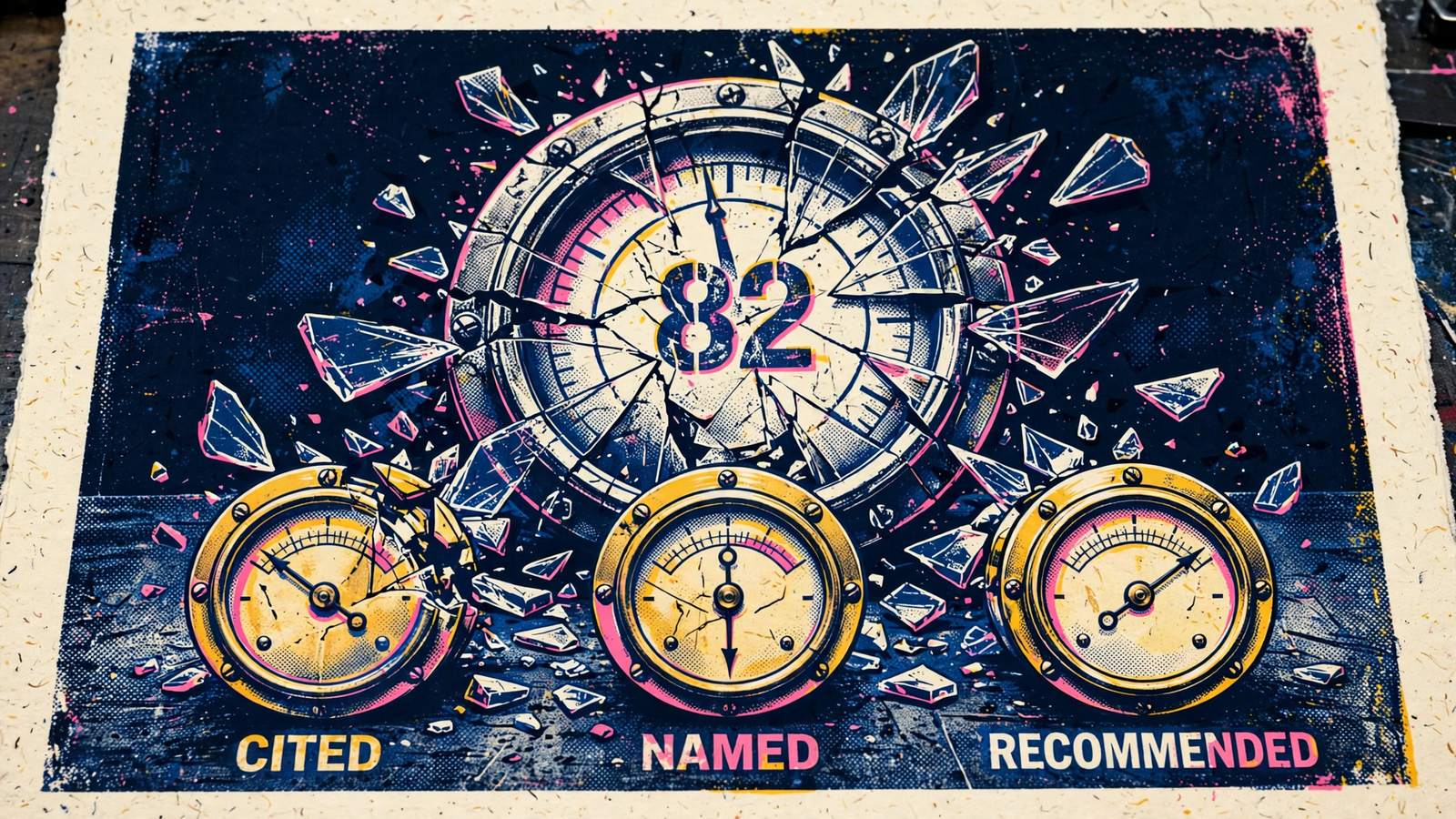
Prediction 1: citation and recommendation rates become separate deliverables
By November 2028, a managed SEO report that leads with one blended score but omits separate citation and recommendation rates will struggle to pass procurement. A source citation and a supplier recommendation are different outcomes. They arise from different buyer questions, call for different work, and cannot be treated as interchangeable evidence of progress. Careful measurement already separates mention, citation, and recommendation rates. I do the same on my panels because a provider should not be able to claim a strong quarter when the metric closest to a shortlist has not moved.
The evidence today is in how careful practitioners collect answers. They keep a core prompt set fixed within a reporting period, add a smaller exploratory set, and run each prompt three times per engine. An audit can produce 60 to 180 answers, with the date, platform, and model stored for each run (the method is here). The repeats matter because answers wobble. Change the questions whenever a chart dips and you are measuring your editing habits, not visibility.
Here is what would prove me wrong: take a declared sample of 40 retained reports from providers selling ongoing SEO and generative engine work, then review it in November 2028. If more than half still use a bundled score as their main proof of performance without separate citation and recommendation rates, I lose. Buyers can start sooner. Ask for both rates, their denominators, and the prompt count on every report.
If an agency reports 75% visibility but cannot tell you how many answers cited your domain versus recommended you by name, you do not have reporting. You have a chart.
Prediction 2: engine-level proof replaces the universal average
By November 2028, buyers will ask for ChatGPT, Gemini, and Perplexity on separate lines. A universal average will go back to the agency for a rewrite. The mechanism is not complicated: the engines draw on different indexes and search behavior, then produce different source lists and brand picks. ChatGPT draws on Bing-rooted results and searches the live web for some queries; Perplexity searches live for nearly every query from its own index; Gemini draws on Google. Cross-engine cited-source overlap has been reported at only 11% to 17%. An average hides the disagreement a buyer needs to see.
One test ran 72 B2B prompts across ChatGPT, Claude, Gemini, and Perplexity. Across 1,792 query-and-domain combinations and 13,184 citations, all four engines cited the same domain for the same question only 30 times. That is 1.7%. Perplexity averaged 19.2 sources per answer, compared with 8.1 for Gemini, 4.5 for ChatGPT, and 3.6 for Claude. A raw citation count, stripped of its engine, is a poor comparison. I weight recommendations by engine for the same reason: what looks strong on Perplexity can look like flooding on Claude.
Repeat the questions two days later and the instability becomes harder to ignore. Only 30% of URLs survived on Claude and 38% of domains on Gemini; Perplexity was the most stable at 65%. That weather-versus-climate problem is why a screenshot proves little and repeat runs can show a trend.
What would prove this prediction wrong? In the same 40-report sample, show that the averaged score leads to the same hire-or-fire decision as the engine-split record in at least 80% of cases. If the average makes the same decision, keep it. Until then, demand metrics by engine and market, with prompt wording, date, model, and repeat runs stored.
Prediction 3: visibility and qualified visits stay on separate lines
By November 2028, a serious managed SEO report will not turn an AI visibility lift into a revenue claim without showing what happened between the answer and the sale. Visibility is observed in answers. Visits are observed on your site. Qualified outcomes happen after that. The gaps between those observations are part of the report, not a license to fill in a dollar figure.
Referral data makes the gap real. Paid ChatGPT clicks can arrive as Direct because of noreferrer; Google AI Overviews do not provide a distinct referrer, so visits can appear under organic; an AI-influenced branded search may also be credited to Google organic (the attribution breakdown). A visit may exist while the analytics label points somewhere else. A provider cannot simply assign every unexplained visit to AI and call it revenue.
The observed traffic is still worth watching. AI referrals can be small in volume and strong in intent: Ahrefs reported AI visitors at 0.5% of traffic but 12.1% of signups; one B2B set put ChatGPT conversion at 15.9% against 1.76% for organic; Adobe found AI shoppers converting 60% higher with 53% more revenue per visit in July 2026 (the examples). Those figures are reasons to separate the lines, not permission to equate a prompt-panel lift with sales.
Report observed referral sessions through to qualified outcomes as an auditable floor. Label modeled lift and survey-based estimates as estimates, and use a holdout when you need to test incrementality (the measurement ladder). Google Search Console’s AI reports, as described since June 3, 2026, show impressions rather than the clicks and revenue needed for that entire chain. What would prove me wrong is broadly available, platform-supported measurement that ties answer exposure to downstream outcomes without those gaps. If that pipe arrives, I will happily merge the lines. For now, make your agency show visibility and qualified visits side by side, and mark unattributed outcomes honestly.

How to check the forecast without moving the goalposts
A prediction without a check date is a vibe. Mine has one: November 5, 2028. I will review 40 retained provider reports from companies selling ongoing SEO and generative engine work to businesses, collected in October 2028. The source will be the PDFs clients actually receive, not the marketing pages. I will publish what I find, including the reports that contradict me.
These are the three thresholds:
- Separate outcomes: Prediction 1 passes if more than half of the reports show citation rate and recommendation rate on separate lines, with denominators stated.
- Separate engines: Prediction 2 passes if more than half report ChatGPT, Gemini, and Perplexity separately instead of relying on one average.
- Separate visits: Prediction 3 passes if more than half show AI visibility and referral sessions through to qualified outcomes as distinct numbers, with unattributed outcomes labeled.
I set the test now because I have watched vendors move the goalposts. When blended scores stop impressing, they get renamed. When averages break, a footnote appears while the average stays put. The fix is to lock the conditions before seeing the result: stored prompt wording, collection dates, and repeat runs, plus a marked break after a model update rather than a quiet rewrite of history. If the bundled score remains the main proof in most reports, with no split rates or engine split, buyers did not move as I predicted.
Save those thresholds for your next RFP. They tell a vendor you grade on evidence, not slides.
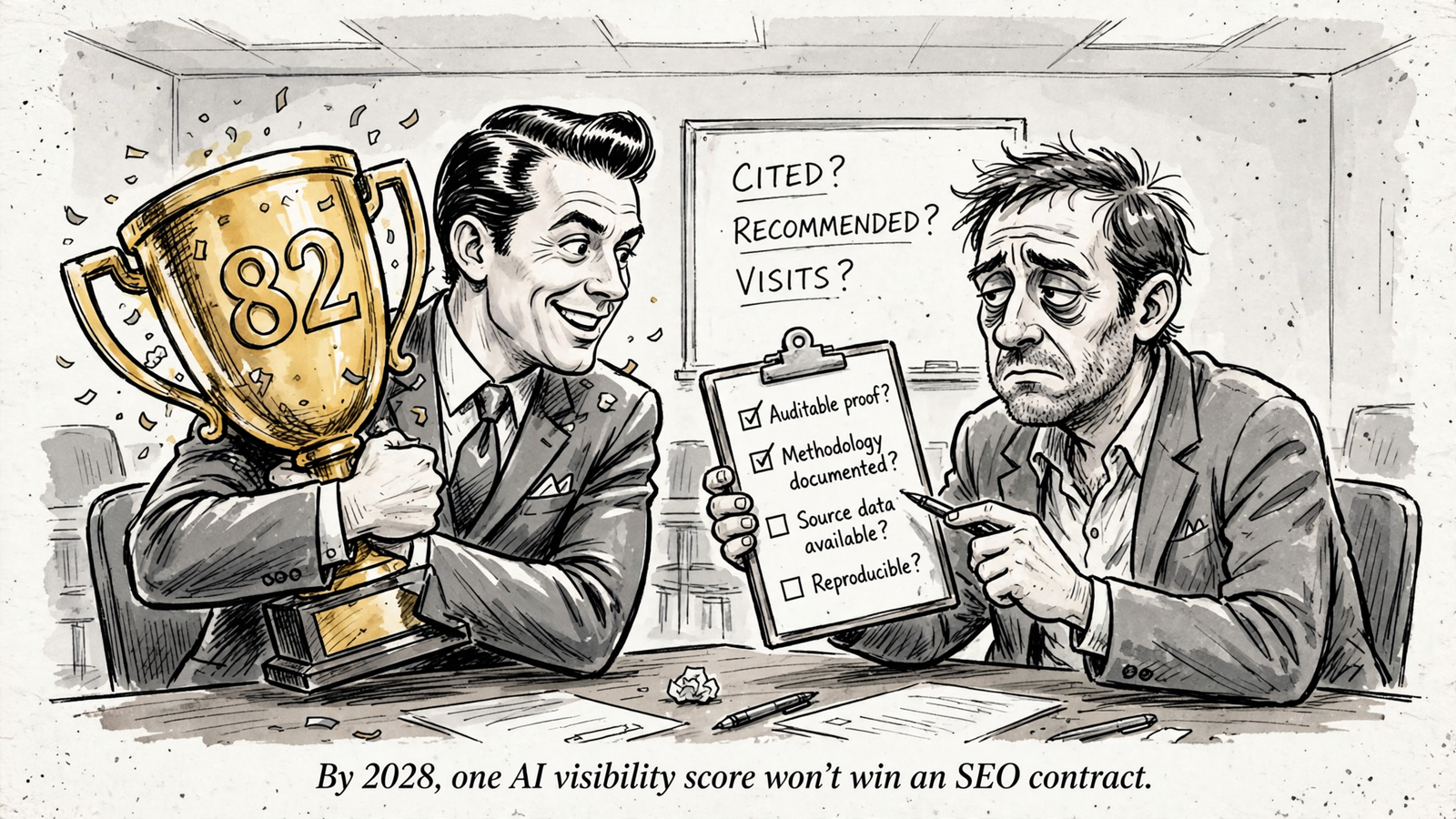
What to put in the brief you send this month
If I am right, you do not need to buy another dashboard first. You need a brief that refuses the average. Start with a fixed panel of buyer prompts, like the 30-prompt test for AI search visibility, and keep its core questions frozen so month two means something. Say you spend $20k a month and have a long sales cycle. Ask for 30 buying prompts, run three times each on ChatGPT, Gemini, and Perplexity. That is 270 answers per round. A provider willing to manage that panel honestly is already ahead of one selling you an 82.
Ask for these commitments in writing:
- Buyer-query coverage: Use your buyers’ questions, not generic head terms. Store the prompt text, engine, model, and date for each answer.
- Separate rates: Show citation and recommendation rates with denominators, using the same discipline as tracking named brands and cited pages across platforms.
- Engine-level reporting: Put ChatGPT, Gemini, and Perplexity on separate lines. Include repeat runs so one wobbly answer cannot pass as a trend.
- Execution beside visits: Show technical fixes and new pages shipped each week, on a cadence like this 30-day citation playbook. Put that work beside observed referral sessions and qualified outcomes. Leave unattributed lift labeled as unattributed.
- One accountable owner: Name the strategist who explains what changed, what did not, and what remains uncertain.
- No guarantees on answers you do not control: No promised rankings, citations, recommendations, or leads.
That last line sorts vendors quickly. Anyone who guarantees ChatGPT will name you has not spent much time watching answers change. groas takes the other route: continuous work on pages, feeds, and technical fixes; engine-split proof of citations and recommendations; visits tied to pipeline where measurement allows; and a named human who owns the strategy for one flat fee.
Send the brief to three firms. Hire the one that shows you the split before you ask for it. If the prediction holds, providers will eventually put those lines in every pitch. The ones who start now will have two years of trend lines while everyone else has two years of 82s.