

 LinkedIn

Your designers have the videos ready. The Meta account still needs someone to decide what runs, what stops, and what gets made next. If you already have a creative team, that is the choice in front of you: groas Meta Ads at $1,499 a month or a freelance Meta media buyer quoting for the work.
Included creative production is worth nothing if you will not use it. I used to tell clients a longer deliverables list meant better value. I was wrong. For this hire, the deciding questions are who turns your assets into tests, who catches tracking problems, and who is inside the account while your team is doing other work.
The contenders: a fixed package or a custom quote
groas Meta Ads is a documented package, not a custom quote. It costs $1,499 a month, ad spend excluded, month to month with no setup fee and no cut of spend. The scope covers Facebook and Instagram ads, with audiences, budgets and ads worked around the clock, plus new ads tested and winners scaled. You share access to your ad account, GA4 and site, agree on goals with a dedicated account manager, and go live within 24 hours of that call.
A freelance media buyer has no standard package. You are judging one proposal, not the category. One market guide puts freelance Meta management at $500 to $3,000 per month or 15 to 25% of ad spend, and warns that you may be buying a few hours per week rather than steady focus. Upwork lists the median Meta Ads specialist at $15 to $40 per hour, so five hours a week runs about $330 to $880 a month before any separate charge for creative, tracking repair or a percentage of spend.
Those ranges tell you where to start asking questions, not what the freelancer in your inbox will cost. Compare the actual quote, hours and exclusions against the $1,499 flat fee. Then compare who is accountable when the account needs attention between calls.

Round 1: Who turns your videos into tests?
Owning a library of finished videos is not the same as running creative testing. Production makes assets. Testing chooses hooks from those assets, launches variants against a defined audience and budget, stops the losers, and turns the result into the next brief. One breakdown of freelance hires puts it plainly: a freelancer is leanest when you already have strong creative and messaging and need campaign management alone. That sounds like your situation. It works only if the freelancer takes responsibility for the testing part.
Here is where I would press both options. Ask groas how your files enter its rotation: who selects the first variants, what counts as a winner, and who writes the next brief when your best video stalls. Its scope includes new ads tested with winners scaled. That makes the testing conversation essential; it does not answer every question about how your editors and its manager will work together.
Ask the freelancer the same questions in writing. One suggested benchmark for evaluating agencies is 8 to 16 new creatives a month and at least 4 structured tests across hooks, offers and formats. It is a useful prompt for a scope discussion, not a quota to paste into every contract. If the freelancer’s answer is “send me whatever you have and I will run it,” you may have hired an uploader, not a tester.
This is where the longer deliverables list can fool you. A team that already shoots and edits does not need another promise to produce assets. It needs a clear answer to what happens after an asset goes live. Pay for the person who decides what gets tested next, not the person who holds the files.
Round 2: Who owns tracking and the conversion definition?
Tracking is where cheap management gets expensive. Ask each candidate to explain CAPI setup, browser and server deduplication, and Events Manager diagnostics in plain language before they touch the budget. You do not need a recital of acronyms. You need to know who checks the events, who investigates a break, and what happens while the numbers are unreliable.
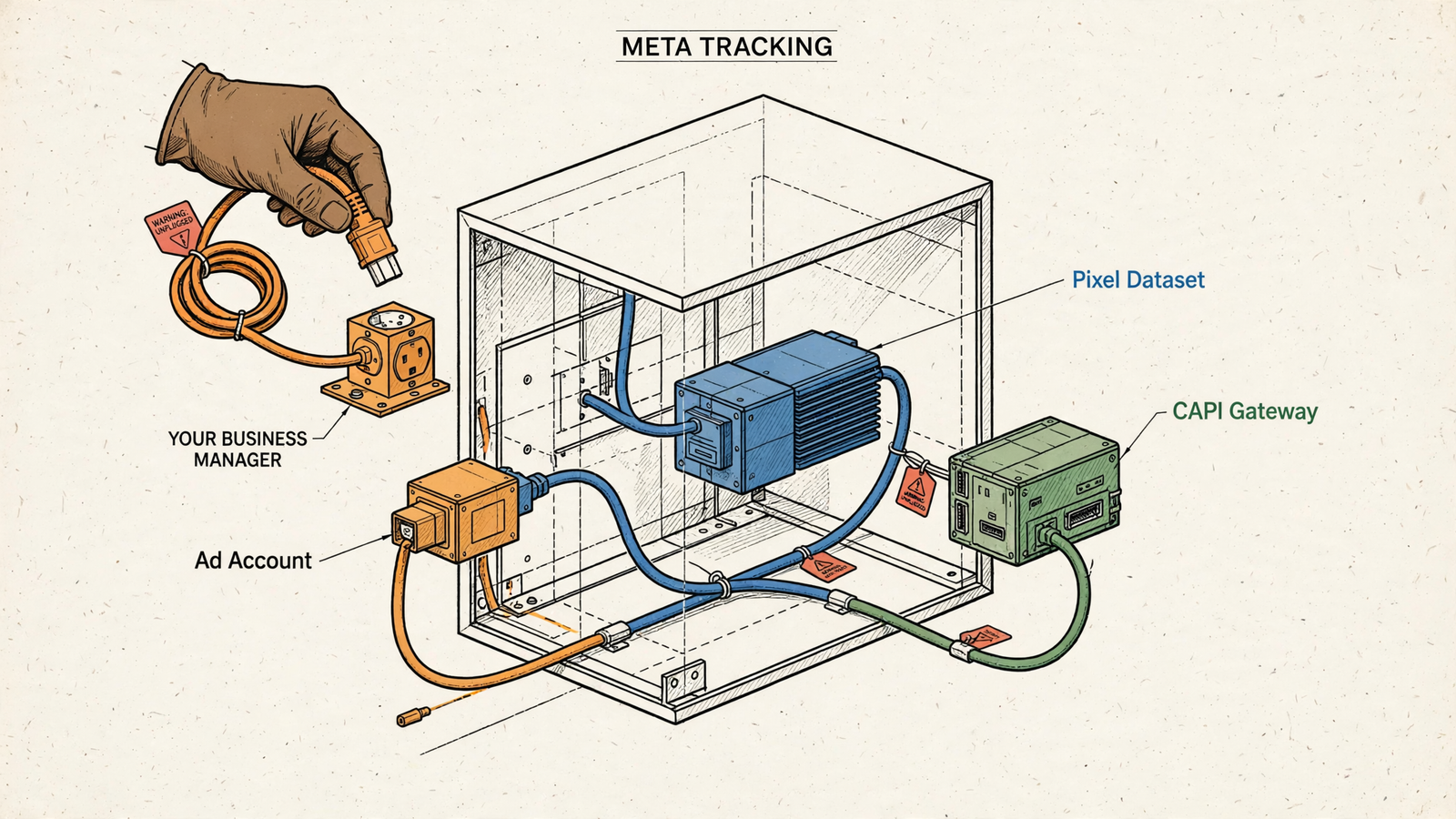
groas works inside accounts you provide access to: your Meta ad account, GA4 and site. Your accounts, pages and data stay yours. That structure matters because asset ownership can make switching providers an admin task or a restart. Check who owns the ad account, pixel and dataset, where audiences live, and which Business Portfolio holds the CAPI token. Keep Business Manager in your name and give the provider admin or partner access. If a freelancer insists on running everything in their own Business Manager, walk away.
The second half is deciding what success means. Clicks and CTR do not pay you. Leads and sales do. Ask both candidates which primary conversion they will optimize toward, how they will check for duplicate events, and what they will show you each week. One evaluation checklist recommends weekly spend versus target, CPM trend, cost per result, ROAS and CAPI health, plus a monthly account of what was tested, what won and what comes next. If the report never names an experiment, ask what anyone is learning.
Keep the conversion definition in writing and the underlying assets in your accounts. Otherwise, you can own the videos and still lose control of the measurement that tells you whether they worked.
Round 3: Who watches the account between your meetings?
groas sells ongoing coverage as part of the product: audiences, budgets and ads worked around the clock, with a dedicated account manager who stays with you after onboarding. That is the distinction to test in a sales conversation. Ask what the manager owns, what gets handled continuously, and how you hear about a decision that changes spend.
A freelancer sells a defined amount of time, even when the invoice does not spell out the hours. The market guide that prices freelance work at $500 to $3,000 a month also warns that a few hours per week can leave an account drifting when one person juggles several clients. I know the pattern: spend concentrates in one ad set on Tuesday, frequency climbs on Thursday, and nobody looks closely until Monday because Monday is the contracted day. No villain is required. The schedule does the damage.
Backup is the second gap. Illness, holiday or another client’s emergency can leave an account uncovered. That is a structural risk, not an insult to freelancers. One freelancer-versus-team breakdown recommends asking who owns the ad account and what happens if the freelancer is unavailable. An agency-versus-freelancer guide makes a similar point about backup, systems and knowledge leaving with the person.
A good freelancer can answer those questions. Let them. Get working days, response times and backup arrangements in writing before you compare prices. “I keep an eye on things” is not an operating schedule.
Round 4: What does the cheaper quote cost your team?
Say you spend $20k a month on Meta. groas costs $1,499 on top of that spend, with no setup fee and no percentage of spend. The fee is the same at $5k or $60k in ad spend. A freelancer quoting $800 a month plus 15% of spend costs $3,800 at the $20k level. That is an illustrative quote, not a claim about what your candidate will charge. A freelancer at $1,500 flat costs about the same as groas on the invoice.
Now read the exclusions. Tracking repair, variant edits from your raw footage, extra revision rounds and out-of-hours checks can sit outside a narrow buying remit. Do not assume they are included or excluded. Ask. Get the minimum commitment in the proposal too. A low management fee with work moved into add-ons is not necessarily a low total cost.
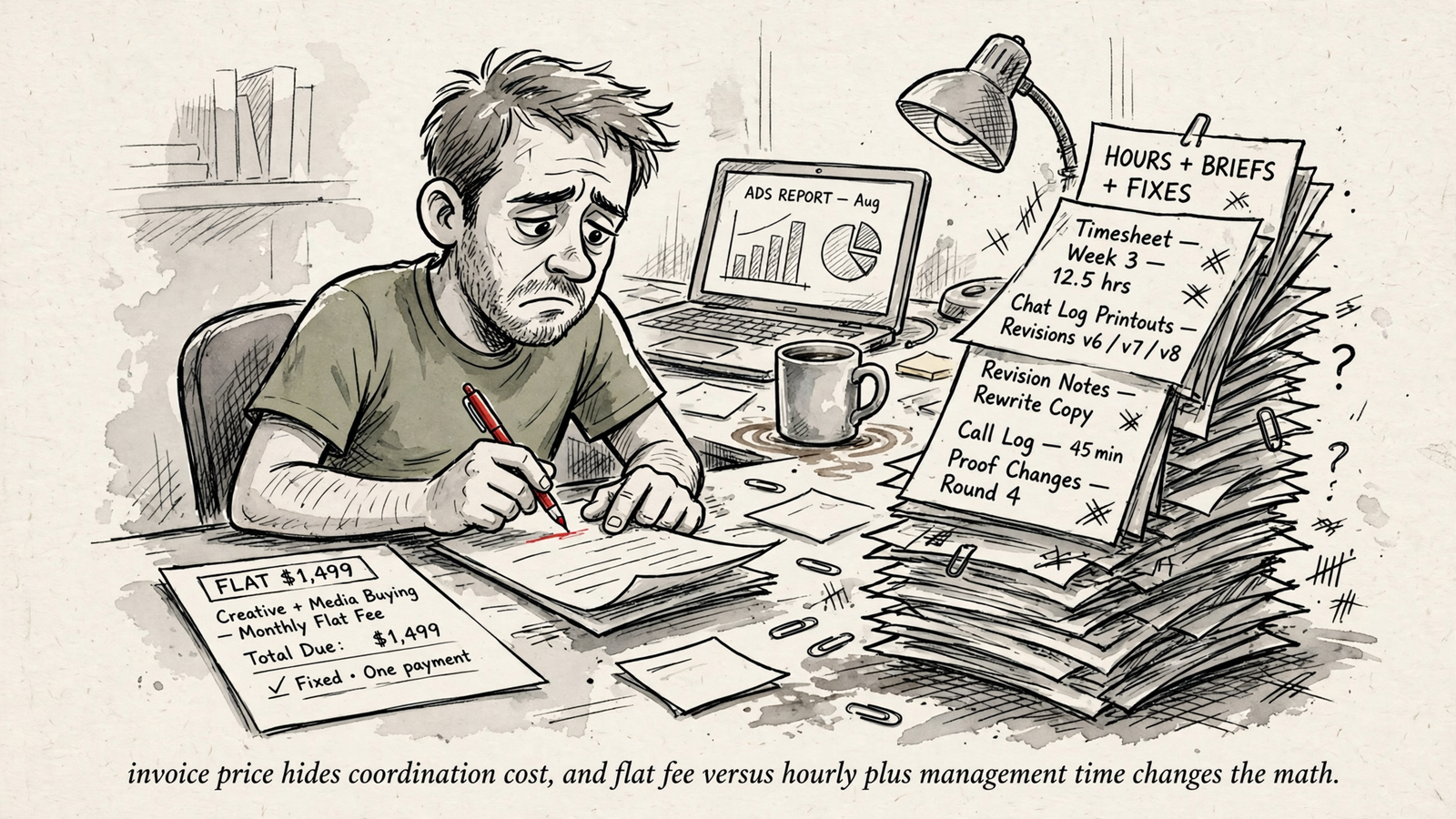
Then count your own hours. A freelancer may need briefs, asset uploads, approval threads and a weekly call that you run. Say that takes three hours a week from your designer and one from you. That is roughly 16 hours a month of coordination alongside the fee. groas still needs access, goals and input from your team. The point is to establish whether testing decisions and daily account work sit with its manager instead of coming back to your inbox.
I would rather pay $1,499 for that ownership than $800 plus 16 hours of my team acting as the media department. But if the freelancer’s quote covers the decisions and availability you need, compare it on those terms. The invoice is only part of the cost; your calendar carries the rest.
Round 5: Can either buyer work at your editors’ speed?
Your team can shoot and cut. The question is who gets to change the work after it ships. A tester needs a way to try different openings, change the first seconds of a video, and rewrite primary text without waiting through a five-day approval chain. If every variant needs sign-off from two managers, neither option can test at pace. For a closer look at how production and testing speed interact, see Madgicx vs Advantage+ vs Done-for-You Meta Ads.
Set the boundaries before you hire. Decide who can launch a variant, who can stop a loser, and how quickly your editors can turn a written brief into a new cut. Brand review may be necessary. That does not mean every small change should arrive as a surprise in a crowded approval thread. Give the buyer a workable path from test result to next asset.

Do not ask groas for a discount because you will not use its production. The fee stays $1,499 whether you supply ten videos or zero. The purchase only makes sense if you value the testing ownership, budget work, tracking attention and account management that come with it. If you can define a narrower buying remit and supervise it weekly, a freelancer may be the better purchase. If you cannot, a lower fee can leave your videos sitting in Drive while last month’s winners keep running.
Hire the missing capability, not a second copy of the one you have. That is the whole comparison.
Verdict: groas wins when you need someone to own the result
| Decision axis | groas Meta Ads | Freelance media buyer |
|---|---|---|
| Testing ownership | New ads tested and winners scaled; confirm how your files become tests and briefs | Put tests and briefing responsibility in the proposal |
| Tracking and ownership | Works with access to your accounts; confirm the tracking workflow | Confirm account access, CAPI responsibilities and handover terms |
| Ongoing coverage | Audiences, budgets and ads worked around the clock, with a dedicated manager | Agree on working hours, response times and cover for absence |
| Cost at $20k ad spend | $1,499 flat, with no percentage of spend | Compare the actual quote, any spend-based fee and your coordination time |
| Fit with your editors | Establish how their testing work uses your team’s assets | Strong fit if you can supervise a narrow buying remit |
Choose the freelancer if you can already do the manager’s job in miniature. You know which hook to test next, can read Events Manager without help, and have time each week to review spend, approve pauses and send the next brief. In that setup, a tight flat quote for buying alone can beat paying $1,499 for coordination you will not use. The freelancer handles the account; you remain the strategist. Be honest about whether that is a job you actually have time to do.
Choose groas for the business that has creative capacity but no one reliably connecting it to account decisions. If videos sit in Drive, losers keep spending through the weekend, or tracking breaks without a clear owner, you do not have a production shortage. You have an ownership shortage. groas costs $1,499 a month with no cut of spend or lock-in. Make sure its manager can explain how testing, budget decisions and measurement will work with your team, then pay for the missing work rather than another pile of assets.
Before you sign either option, send both the same three questions:
- How many structured tests will you run in the next 30 days using our footage, and who writes the next brief?
- What will you do if CAPI or deduplication breaks?
- Who covers the account when its usual owner is off?
The provider who answers in specifics earns the budget. The one who answers in process language does not. With a creative team already in-house, that reply tells you who is prepared to own the result.