

 LinkedIn

Hire a ChatGPT ads specialist for your first test and you may pay extra to make your own results unreadable. The skills that decide whether the ad pays are already sitting with your search manager.
The pitch says otherwise. Ads in LLMs are a brand-new discipline, with new formats and new buyer behavior, so you need a niche expert who lives inside that one auction. I understand why it sells. It sounds careful. It sounds future-proof.
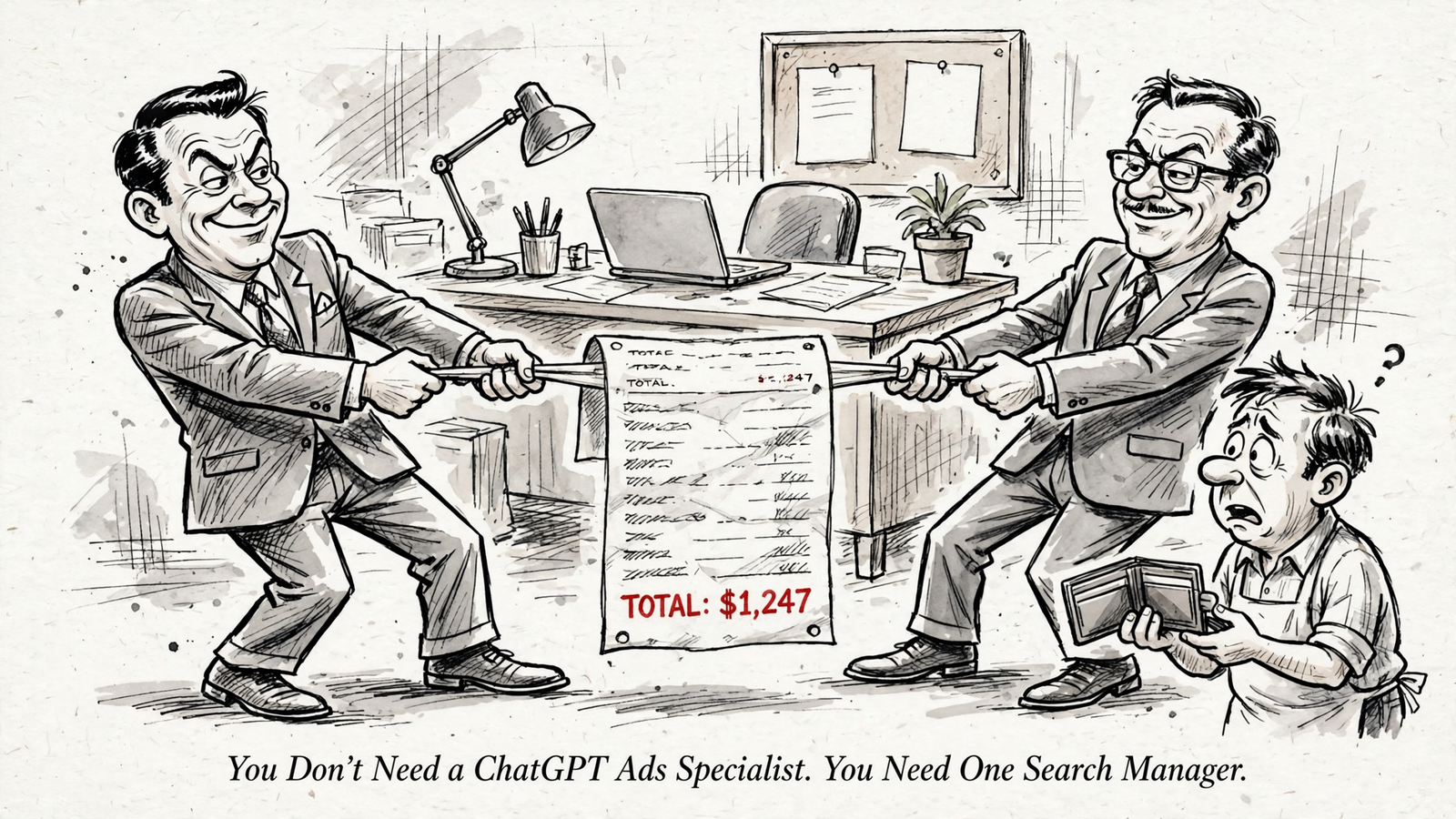
I used to buy that logic for every new placement. I was wrong. What decides whether a ChatGPT ad pays is the same work that decides whether Google pays: mapping intent, building the right landing page, counting the conversion once, and moving budget toward the click that produces pipeline. Split those decisions across two owners and both can claim the same sale.
The new-priesthood pitch starts with a real change
Early this year, the timeline stopped being rumor. OpenAI announced ChatGPT ads on Jan. 16, 2026, started a U.S. test on Feb. 9 on Free and Go plans, then opened self-serve Ads Manager in early May with CPC buying plus pixel and Conversions API support, hitting a $1B annualized run-rate by Aug. 31, in under 200 days. That speed created the specialist pitch: new auction, new rules, new expert. Pay us separately or get left behind.
The inventory tells a smaller story. Ads only show to logged-in adults on Free and Go plans, while Plus, Pro, Business, Enterprise, Edu, under-18 accounts, Temporary Chats, and sensitive topics see no ads. Say you spend $20k a month on search. This is not a second Google. It is a slice of one chatbot, bought in campaigns, ad groups, and ads inside Ads Manager with max CPC bidding for clicks. You need someone to learn that slice. You do not need to hand them a separate claim on the customer.
The question is not whether ChatGPT ads are different. It is who owns the result.
A different matching system still needs search judgment
There are no keywords in ChatGPT ads. Matching runs off conversation context plus your landing page and ad title and copy, with optional context hints that are short topic descriptions, not exact match, with no delivery guarantee. I spent years mining search terms at 1am. That muscle still applies here, just in a different shape: read what the buyer asked, map it to intent, and give the system a page that answers it.
Treating hints as a keyword list misses the point. A hint is not a command to show an ad whenever someone types a particular phrase. If your page answers the wrong question, a clever set of hints will not turn that visit into pipeline. A specialist who copies a search keyword list into a new interface can burn your test budget teaching you what your search terms already knew.
Google and Microsoft already make the ownership question unavoidable. Their AI-answer ads run inside existing Search, Shopping, PMax, and Microsoft Advertising campaigns with no opt-out and no separate reporting. Only ChatGPT is bought separately. The click still lands on your site, and the conversion still needs a consistent definition. If nobody owns the page system and measurement across channels, you do not have a coordinated test. You have two invoices for one journey.
Two tags do not justify two definitions of a lead
ChatGPT ads use pixel plus Conversions API, with deduplication owned by whoever manages the account. Google uses its own tag. Those setups are different; your definition of a qualified lead should not be. I have seen this split with Google and Bing: one team counts a form fill, the other counts a booked call, and both report a win. Your CRM shows one customer. Their decks show two.
Put one person in charge of the conversion definition before you spend on another auction. That person does not have to pretend the platforms share a pixel. They have to make the platform reports answer to the same business outcome.
Split the owners and the budget follows the wrong score
The failure is mechanical. Last-click logic runs independently in each platform, so more than one platform can claim 100% credit for the same conversion. A buyer asks ChatGPT for options, clicks your ChatGPT ad, later Googles your brand and clicks your search ad, then buys. ChatGPT claims the sale. Google claims the sale. Add the dashboards together and you have two sales for one order.
The fix is not a prettier report. It is one deduplicated scoreboard and one conversion definition, managed by someone who can challenge both dashboards. Otherwise, each vendor can present an internally tidy account while the combined picture remains useless. The numbers look precise right up until you ask how many customers you actually acquired.
Split ownership also wrecks the next budget call. Say you have $25k a month and carve out $3k for a ChatGPT specialist. That specialist needs the $3k to look good, so they optimize toward cheap ChatGPT clicks. Your Google manager defends the other $22k and optimizes toward Google CPA. Nobody owns blended CPA across Google, Bing, and ChatGPT. Money moves on vibes and on who sends the prettier weekly slide, not on which next dollar buys pipeline.
That is the cost the niche-specialist pitch leaves out. You are not just paying for another operator. You are drawing a line that neither operator is paid to cross. When the ChatGPT test loses, its owner has a reason to keep testing. When Google wins, its owner has a reason to dismiss the new channel. Neither can simply move the money and own the outcome.
Yes, the format takes work. No, it is not a new department
I will concede what the specialists get right: the surface is new. A ChatGPT unit is a title up to 50 characters, with 16 to 24 recommended; copy up to 100, with 32 to 48 recommended; and one square image. That forces a different writing habit from a responsive search ad. What the vetting guides call 5 to 15 hint variants per ad group with weekly rewrites, plus pixel and Conversions API with deduplication is real work. Early access also ran through holding companies like Dentsu, Omnicom, Publicis, and WPP before self-serve opened to all U.S. advertisers, so a few shops have more live reps than you do.
I would rather buy that format knowledge than surrender ownership of the test. Your search manager already writes tight copy, tests variants, and works with GA4 and offline imports. Give that person the new spec sheet and two weeks of live spend. They can learn the placement without asking a second vendor to decide what your lead is worth.
The order matters: hire for auction judgment and measurement discipline, then add format knowledge. A niche freelancer who knows the placement but has never fixed your tracking starts with the smaller half of the job. The new interface does not excuse an old measurement problem.
Ask for account work, not a deck with a ChatGPT logo
Hands-on does not mean a monthly strategy deck with a ChatGPT logo on the cover. It means someone working in your accounts every day or two: rewriting those 5 to 15 hint variants per ad group, checking search versus chat intent drift, pacing bids and budgets, and owning pixel, Conversions API, and deduplication so the numbers tie to orders. The weekly report should be boring on purpose: spend, cost per result, and cost per attributed conversion on one deduplicated definition.
If a provider cannot show you a live account where they have done that with real spend, I would walk away. Google Ads experience is useful; it is not proof that someone has run a ChatGPT test. But neither is a deck full of LLM expertise. Ask to see the work, the spend, and how they counted the result.
The second test is who approves more spend and where the history lives. Category pricing runs $1,000 to $3,000 a month for small accounts, $3,000 to $12,000 mid-market, or 10 to 20% of spend, often with 12-month lock-ins. That structure puts young-platform risk on you. You pay to teach their specialist while the learnings sit in their agency account.
A serious manager does the reverse. Spend runs in your account, history stays yours, increases need your sign-off, and ChatGPT is judged on blended CPA next to Google and Bing, not on its own vanity CPA. That is also why groas prices Search Ads as Google plus Bing plus ChatGPT for $1,499 a month, one service and one price. One owner can kill a losing ChatGPT ad group without defending a separate fee tied to keeping it alive.
The practical test is simple: can this person move budget away from ChatGPT when the evidence says to? If the answer has to pass through a second vendor’s retainer, you have already made the test harder to act on.

No search foundation? Fix that before testing chat
If you have no search program to plug into, no clean conversion action, and no landing pages that turn intent into pipeline, do not hire a ChatGPT specialist either. You do not have a channel problem. You have a foundation problem. Self-serve has no minimum spend since it opened on May 5, 2026, so a small test is cheap. A cheap test on broken tracking still teaches you nothing.
Start with one owner, one conversion definition, and one page system. I wrote about that same test in Stop Hiring ChatGPT Ads Specialists. Put the Test With Your Search Team. The team that reads your search terms already holds the context your ChatGPT test needs. Make them responsible for what happens after the click, too.
Before you hand anyone the budget, ask:
- Show me a ChatGPT account where you spent real money, not slides. What did you pay per attributed conversion, and how was it deduplicated against Google?
- Who owns the pixel, Conversions API, and UTM naming? If two vendors split that work, who resolves a double claim?
- How many hint variants per ad group will you run in the first 30 days, and what kills a loser? I want a number, not a process deck.
- Where does the history live, who approves a budget increase, and what is the blended CPA target across Google, Bing, and ChatGPT?
Those questions test whether someone can operate the channel without losing sight of the customer. If the answers live in separate calls with separate teams, expect the budget decision to live nowhere.

One owner, one scoreboard, three auctions
Google, Bing, and ChatGPT are three auctions for the same buyer. One budget owner decides where the next $1,000 goes based on blended cost per attributed conversion. One tracking owner defines what counts and makes the platform numbers answer to it. One landing-page system turns intent into pipeline. When one search manager owns all three, a weak ChatGPT ad group gets killed and the money can move to Google without a turf war. That is the job: auction judgment, measurement discipline, and the willingness to cut a loser.
Ignore that and you get what split vendors sell you: two logins, two weekly calls, and two reports that both claim credit while revenue stays flat. Your Google manager blames the ChatGPT test for stealing brand clicks. Your ChatGPT specialist blames your landing page for the low conversion rate. You pay both retainers to argue about attribution. Splitting Google and ChatGPT across two managers is the same middle ground that fails in every other channel split I have run. Nobody owns the number that matters, so everybody owns an excuse.
Ask the next provider the hands-on question and watch what happens. Show me real spend, show me deduplicated cost per conversion, show me who approves the next budget increase. If they answer with a deck about prompt craft and LLM expertise, you have your answer. They know how to talk about ChatGPT ads. They have not shown you how to make search spend pay. Hire the person who already reads your search terms for intent, give them the ChatGPT auction, and hold them to one scoreboard. Anyone who needs a separate team to run a $3 to $5 CPC test is telling you how they charge, not how buying works.
If you want a starting point, keep the test where your search history lives. Give your Google manager $1,500 to $2,000 for 30 days, the landing pages that already convert search clicks, and one rule: ChatGPT spend scales only if blended cost per qualified lead falls. That keeps intent mapping, tracking, and the kill decision in one head. My rule from years of wasted tests is simple. The person who can show me yesterday’s search term report can run tomorrow’s chat test.
Keep hiring the other way and the outcome is predictable. You will renew two retainers, sit through two calls, and learn nothing you can act on because neither manager can move money across the line that matters. One owner, one scoreboard, three auctions. Anything else is a second fee for the same customer.