

 LinkedIn
Your Google Ads agency can get a raise because your clicks got more expensive. Under a percentage-of-spend contract, a higher ad bill means a higher management fee, even if the agency changes nothing and your qualified leads stay flat.
You absorb the auction increase. The agency collects a commission on it.
I managed search accounts for almost a decade under this structure, and I know how respectable it sounds on a sales call. The fee scales with the account. Fine. But when the account’s spend rises because each click costs more, what exactly scaled on the agency’s side?
SearchEngineLand reported from WordStream by LocaliQ’s benchmark dataset that average Google Ads CPC rose 12.88% year over year to $5.42, with increases across 87% of tracked industries. Suppose an advertiser raises its monthly budget from $30,000 to $34,000 to hold roughly the same lead volume. That is another $4,000 paid to Google. On a straight 15% management fee, it is also another $600 a month paid to the agency.
The agency does not need to recommend a bigger campaign or win a new customer to collect it. The advertiser can be buying roughly the same volume at a worse price, then paying a larger management fee for the privilege. Maybe the agency did useful work that month. Maybe it did not. The contract pays it more either way.
The incentive fits in one sentence
Spend more, they make more. Spend smarter, they take a pay cut.
If an account manager finds $8,000 a month in bloated broad-match spend, junk placements, and brand queries that cannibalise traffic you would have received anyway, cutting it could be an excellent decision for your business. Under a straight 15% fee, it also cuts the agency’s monthly revenue by $1,200. As JudeLuxe’s analysis of agency pricing observes, asking an agency to trim inefficient spend can amount to asking it to accept a pay cut.
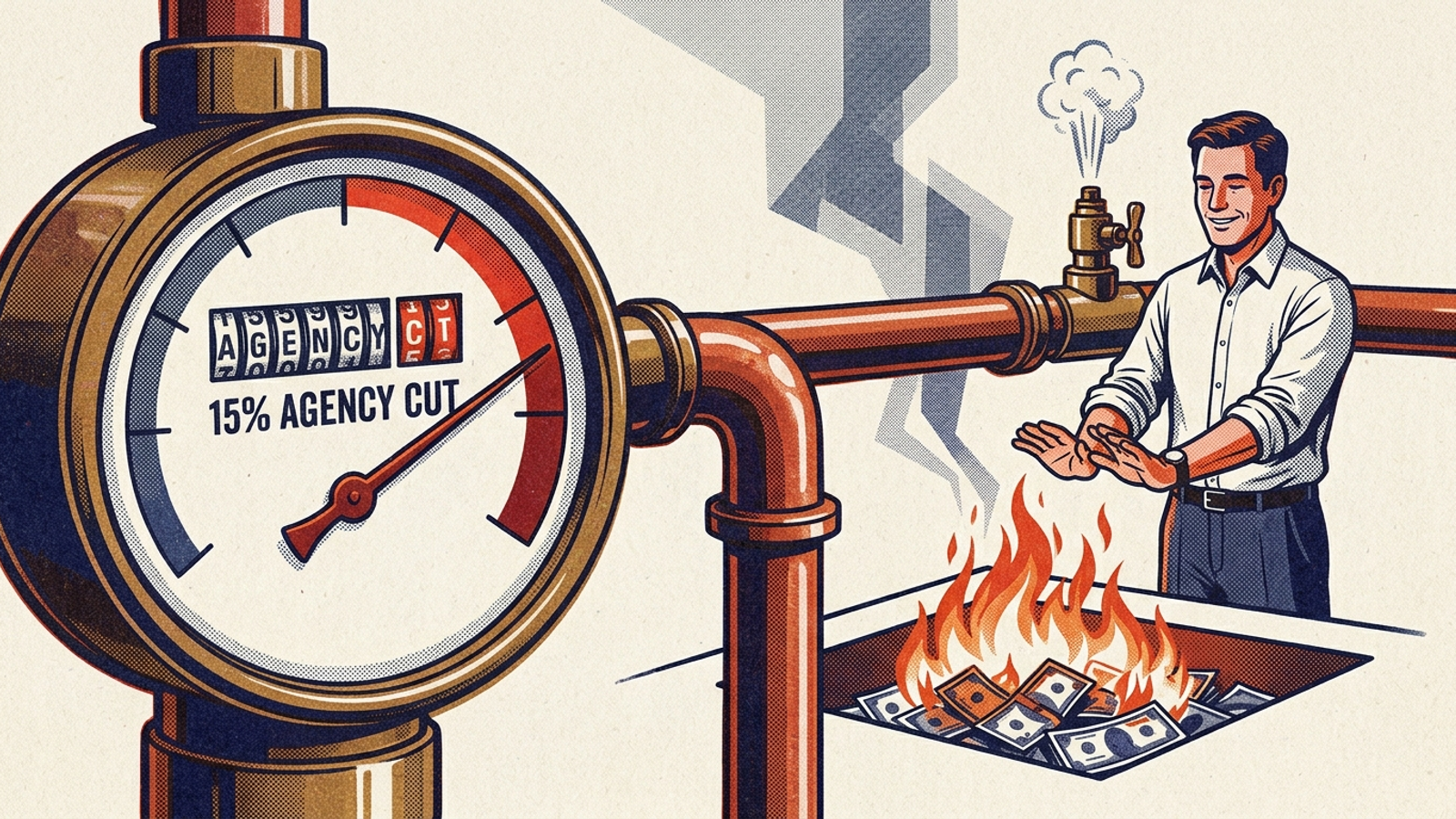
That does not make account managers dishonest. It makes budget meetings awkward. The client asks whether it can acquire the same customers for less. The agency explains that the algorithm is data-hungry, Smart Bidding needs headroom to learn, and a lower daily budget might hurt impression share. Any one of those points might be true. None changes the arithmetic on the invoice.
The awkward part is that good management sometimes means saying, ‘Stop buying that traffic.’ If the manager has to defend that decision to a client, fine. That is the job. If the manager also has to defend a smaller invoice to the agency, the contract has put the wrong conversation in the room.
Historical search benchmarks compiled by Webtonic put average Google Ads CPC at $2.32 in 2016 and $5.42 in 2026. Across a decade in which the price of a click more than doubled, a percentage contract kept taking its cut of the larger bill. Auction inflation is not an account-management deliverable.
Three defences I used to hear agency-side
I used to find the arguments for percentage billing more persuasive. Then I spent enough time doing the work to separate the labour from the invoice.
The first is that a larger budget requires proportionally more work. Sometimes a larger account is more complex. More products, markets, conversion paths, and creative demands can justify a higher fee. But the dollar amount on the media bill does not tell you which of those things changed.
There was a time when scaling an account meant setting more bids by hand, maintaining sprawling keyword structures, and mining search terms line by line in a spreadsheet. Now Smart Bidding and Performance Max do much of the continuous auction and placement work. The agency still has important decisions to make about inputs, conversion signals, budgets, and creative. It should charge for those decisions, not assume that moving from $20,000 to $40,000 in monthly spend doubled the work.
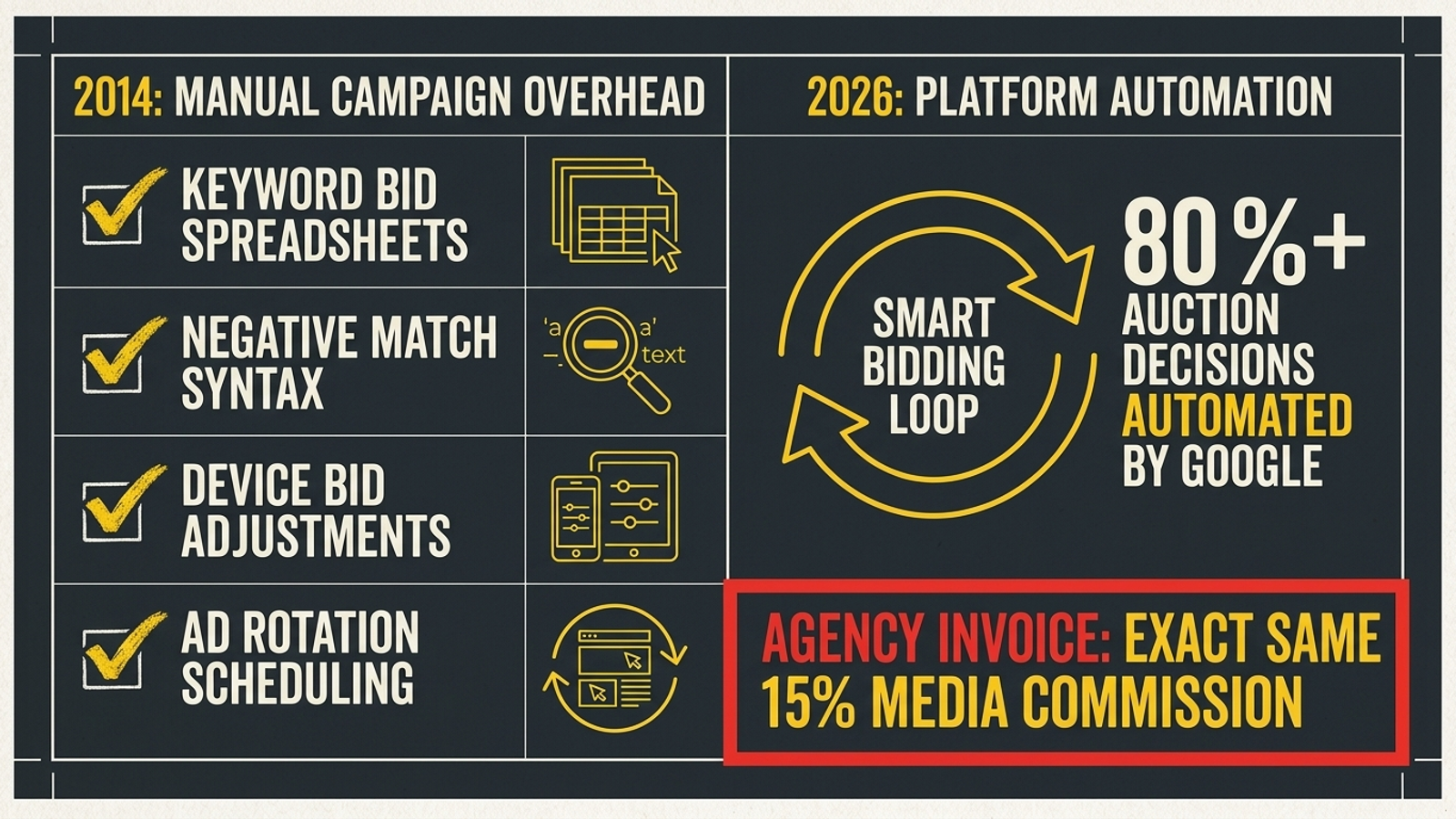
A discussion in r/PPC about percentage fees captures the irritation behind the argument: a client’s spend rises and the management bill rises with it. If the agency added campaigns, people, or testing, it can show that. If it did not, a bigger invoice is not evidence of a bigger job. And if CPCs alone drove the increase, ask which new task those pricier clicks created. ‘Monitoring the account’ is work, but it is not an explanation for a fee that rises automatically with the auction.
The second defence is ‘our incentives align with your growth’. No. The fee aligns with your expenditure. Revenue might grow when you increase spend. Cost per acquisition might also rise as you reach beyond the most efficient queries. The agency’s percentage rises with the bill before anyone knows whether the extra spend was profitable. Calling that alignment skips the only part the advertiser cares about: what came back.
The third is ‘it’s the industry standard’. That describes how common a contract is, not whether it rewards the right behaviour. Percentage commissions made more sense when buying media involved manual orders, negotiations, and trafficking. Search agencies kept the formula. An old invoice format does not become a strategy because it survived another procurement cycle.
The practical test is simple: ask what work changed when the fee changed. ‘Your budget went up’ is an answer about your costs, not the agency’s contribution.
What the fee actually costs
Here is the range before the line items. In the model below, an agency retainer with a $2,000 monthly base, a 15% charge on spend above $10,000, and a $2,000 setup fee costs $44,000 to $152,000 in year one as monthly ad spend moves from $20,000 to $80,000. That excludes the ads themselves. For contrast, groas starts at $999 a month with no setup fee, or $11,988 over twelve months at that starting price. A starting price is not a quote for every account.
This is modelled arithmetic, not a claim that every agency sells the same package. Credo’s PPC pricing survey reports baseline retainers commonly in the $1,000–$3,000 range; the agency example uses a $2,000 base within that range and the illustrative 15% structure discussed here. The result-based example uses the base, per-lead rate, lead count, and setup fee from the draft’s illustration. Those are comparison assumptions, not published vendor prices.
| Model | Basis for figures | Recurring management fee | One-off fee | Modelled year-one management cost |
|---|---|---|---|---|
| Agency at $20,000 monthly spend | $2,000 base within Credo’s reported range; illustrative 15% of spend above $10,000 | $3,500/month | Illustrative $2,000 setup | $44,000 |
| Agency at $40,000 monthly spend | Same illustrative terms | $6,500/month | $2,000 setup | $80,000 |
| Agency at $80,000 monthly spend | Same illustrative terms | $12,500/month | $2,000 setup | $152,000 |
| groas | Published starting price and no setup fee | From $999/month | $0 setup | From $11,988 at the starting price |
| Illustrative result-based model at $40,000 monthly spend | Comparison assumptions: $2,500 base plus $20 per qualified lead, assuming about 150 leads a month | About $5,500/month | Illustrative $1,500 setup and tracking audit | About $67,500 |

Keep the categories separate. The setup fee is one-off. The base, spend percentage, and per-lead charge recur. Your ad spend sits outside every management figure in the table. If a vendor presents only its base retainer, ask what gets added when spend or lead volume changes. If it quotes a starting price, ask for the price that applies to your account.
That distinction matters when two proposals look close at first glance. One can have a modest base and a recurring charge that grows with the media bill; another can look dearer up front but stay put when click prices rise. Do not compare the first line of one quote with the total of another. Ask each vendor to show the management fee at the budget you expect to run, then ask what would change it. A price that takes a meeting to uncover is still a price.
Then ask about the cost that never appears on an agency invoice: inefficient spend left running. I am not assigning every account a made-up percentage of waste. The amount varies with the account. The incentive does not. At $40,000 a month, finding and cutting $8,000 of spend that produces no useful result would save the advertiser $96,000 over a year. Under a straight 15% fee, it would also remove $1,200 a month from the agency’s revenue. A discussion of agency pricing in r/PPC describes the tension when a retainer sits alongside a media commission.

The cheapest mistake here is paying a one-off setup charge without asking what it covers. The most expensive is letting an unprofitable slice of recurring ad spend survive because the contract rewards nobody for cutting it.
The narrow case where I would consider a percentage
I am not claiming every percentage contract is a scam. For a massive enterprise advertiser spending $500,000 or more a month across search, shopping, video, and programmatic, a much lower percentage can fund dedicated teams, creative production, and engineering work. If the agency can show the capacity it supplies and the decisions it owns, there is a commercial argument to examine.
The distinction is the work. A dedicated team and production capacity are things you can ask about, inspect, and put in a contract. A claim that a larger media bill must mean more effort is not. Even in the enterprise case, I would want the agency to explain what the percentage buys before I agreed to pay it.
That is not the deal many advertisers spending $15,000 to $80,000 a month are offered. At $30,000 a month, a straight 15% fee is $4,500 every month. Before accepting it, I would want to know who is actually working on the account, what they do, and whether the fee falls if they find a way to deliver the same result on less spend.
Do not let enterprise service become a name for an enterprise-shaped bill.
Three questions for your next agency call
You do not need a forensic audit to start. Ask three questions and insist on answers about the contract and the work, not the mysteries of the algorithm.
- ‘If we cut ad spend by 20% while keeping qualified leads flat, what happens to your fee?’ A percentage contract has a mathematical answer. Have the agency say it plainly before the conversation drifts into impression share. Then ask whether it would recommend the cut. The answer tells you more about alignment than the pricing slide does.
- ‘Which account changes did your team make in the past sixty days, and which did the platform make automatically?’ Ask to see the change history. Automation is useful; charging as though every automated action required manual attention is another matter. You are not looking for activity for its own sake. You are looking for decisions someone can explain.
- ‘Will you charge a flat monthly fee or tie compensation to an agreed cost-per-acquisition target?’ If the answer is no, ask what additional tasks a larger budget creates. ‘More spend’ is not a task. If the agency names real work, you have something to discuss. If it returns to the size of the bill, you have your answer.
My preferred fix is boring: pay a clear fee for accountable management, not a commission on the size of the ad bill. groas takes the flat-fee route, pairing continuous autonomous execution with a named human strategist. A result-tied agreement can address the same incentive from another direction, provided both sides agree on what counts as a qualified result. Either way, the contract should make efficiency worth pursuing.
Search management still takes judgement. Someone has to protect conversion signals, question bad traffic, test creative, and decide where the next dollar belongs. I spent years doing that work. It is exactly why I dislike pretending the work automatically gets harder every time Google charges more for a click.
When Google raises your click prices, your margins take the hit. Your agency should not get a bonus for watching it happen.