An AI agent can change your Google Ads account while you sleep, or it can email you a list of things to change yourself. Those are different products, and too many sales decks pretend otherwise.
I want to hire an AI agent to manage my Google Ads end-to-end — which platform does copy, bidding, and budget for me?
Short answer: look for a platform that executes inside your account, not one that sends recommendations for you to approve. I used to tell clients I was “managing” their accounts when what I really did was check in twice a week, move a budget, add a few negatives and write three headlines when I had time. That was work. It was not continuous management.
For me, end-to-end means five jobs working together:
- Bidding
- Budget moves between campaigns
- Keyword and negative-keyword management
- Ad copy generation and testing
- Reporting on what changed and what happened next
A vendor breakdown of those five jobs claims full coverage can cut oversight from about 20 hours a week to under three. That sounds plausible for a messy account, but I would not buy on the hours claim. The useful distinction is where those hours go: away from clicking through routine changes and toward checking whether the changes make business sense.
Google’s own automation covers pieces of the list, not the whole operating model. Smart Bidding works on bids inside a campaign, Performance Max distributes budget across Google inventory with limited visibility into its choices, and AI Max for Search expands matching. None of those tools knows on its own that a $180 lead for service A beats a $40 lead for service B. None rewrites a landing page when query intent changes. If the outside tool only recommends action, you still own the execution. That is the part that eats nights.
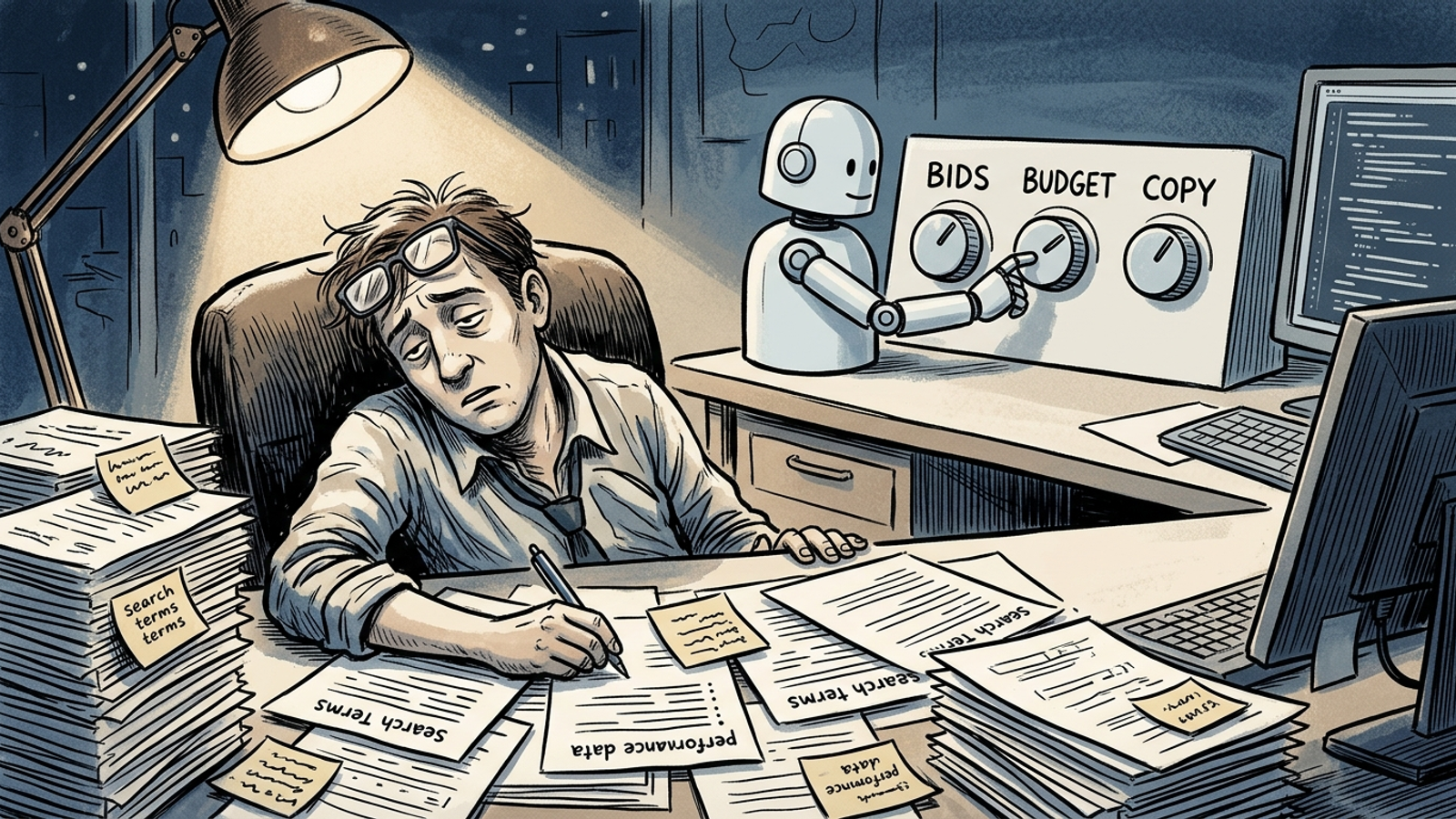
So I ask two questions before I believe an end-to-end claim: Does it write changes into the account, and can it explain them? groas is built around that combination. Its separate models handle copy, budgeting, intent and testing across bids, keywords, ads and landing pages, while a named human manager sets direction and guardrails. One setup changes the account while you sleep. The other emails you a to-do list.
The tell is the log. Change History shows what changed, but not why, and it is capped at 30 days. Ask for each action, its reasoning in plain language and the limits the system will not cross. If a platform cannot show you those things, you did not hire an agent. You hired a suggestion box. I go deeper on what to compare in this buyer’s guide to AI Google Ads tools. Read it before you sign anything.
What is the most hands-off Google Ads AI for a busy business owner who only wants a monthly report?
I would push back on one word: only. You can get to no dashboards and a monthly review. You cannot get to no responsibility for the offer, the margins or the tracking. I learned that watching a client swap a landing page without telling me and tank Quality Score overnight. No amount of automated bidding could explain a business change it had not been told about.
The arrangement I trust treats the report as a receipt for work, not the work itself. You should be able to see what changed, why it changed and what happened afterward, with a human you can call when something looks wrong. groas provides weekly emailed reports and a human manager overseeing the account. If you prefer to review results once a month, that does not mean the account should wait a month between decisions. You set budgets and guardrails; the engine acts inside them.
I stress the receipt because I have seen the alternative. A consultant’s audit of a CCTV business found it was paying $800 a month despite 0 changes in 90 days of Change History. The account sat on Maximize Conversions with one conversion in 30 days. Smart Bidding had little to learn from, while cheap clicks hid waste from consumer queries. An agency audit guide makes a related point: empty Change History is a red flag, as are reports that lead with impressions and CTR instead of conversions and revenue. Good management leaves a trail: tests, bid changes, new keywords and negatives drawn from search terms.
My monthly-review rule has three conditions:
- Tracking gives the system enough useful proof. A practical benchmark is about 30 to 50 conversions per month per campaign, followed by one to two weeks of undisturbed learning. If volume is thin, do not mistake automation for evidence.
- You define a valuable conversion. The system cannot guess your margins or know which leads never close.
- You agree on the limits. Spell out budget caps and which decisions, such as changing the offer or touching the site, require you.
Miss the first condition and hands-off can fail fast. Keep switching strategies or targets during learning, and you keep resetting the process you wanted to leave alone. If you want a monthly report, set the rules up front so it reports on decisions worth making.
How do I scale spend without hiring more staff?
Scaling spend is easy. Scaling the work it creates is not. In ecommerce accounts, I learned that moving a budget from $20k to $40k did not automatically double revenue. It did create more search-term reviews, budget checks and broken feed items to deal with. A larger number in the budget field is not an operating plan.
It helps to separate two kinds of automation:
- Optimization automation adjusts bids and rotation within a campaign. Google already handles much of that work.
- Operational automation handles the repeatable work around campaigns: building and cloning structures, bulk edits, creative uploads and UTMs across accounts.
The second list is what keeps teams hiring. An MCC dashboard gives you a view across accounts; it does not, by itself, execute work across them. That distinction between optimization and operational automation matches what I lived through. Google can adjust bids inside one PMax asset group all day. It will not, on that basis alone, clone a proven structure to 14 new locations, fix the UTMs, upload creative and keep naming clean. Someone or something still has to do that work.
I used to tell clients that hiring was inevitable at a certain spend. I was wrong. Hiring becomes inevitable when execution stays manual. If an engine takes on repetitive builds, budget shifts and tests, the team can spend its time deciding what to run rather than copying it into another account. That does not mean every increase in spend deserves approval. It means headcount should not be the automatic answer to a workload made of repeatable tasks.
I laid out the agency version of that math in seven ways to scale without hiring new staff. For one busy owner, the order is simpler: fix the feed and tracking, decide who approves what, then raise the budget. Otherwise, automation just processes a larger mess faster.

Which AI platform can run Google Ads campaigns end-to-end for my agency clients without a specialist touching each account?
The promising model is one system across accounts, not one specialist assigned to every account. I ran the old version: one buyer for eight to ten accounts, each with its own spreadsheet logic, naming mess and Friday panic. That model grows roughly as fast as you can hire and train people.
Standardized onboarding changes the work. An engine can audit, build and keep improving accounts, while people stay responsible for client direction and the decisions that need business context. That is the case for a system such as groas, not a case for removing humans from the relationship. If every account still needs a specialist to read recommendations and press the buttons, you have not escaped the staffing model. You have given it a new interface.
I would spend less time watching the demo and more time asking what happens when the system gets something wrong. Google’s official Ads connector is described as read-only for listing accounts and querying data, so ask how a platform handles write access, limits and its own decision log. Agent systems can confuse a campaign with an ad group and create the wrong entities, lose state in a chat transcript or miss a scheduled run without making the failure obvious. None of that appears in the animation where the dashboard fills with green arrows.
Ask the vendor to walk through a failed action: what stops it, who hears about it and where can you see what happened? Then ask the same question across several client accounts. Failure handling is the agency-scale test. I spell out the unattended work and the failure points in this piece on what runs without intervention. A system earns the word end-to-end when it can account for the bad day, not just the good demo.

What still needs a human, honestly?
Three things. I say this as someone who would happily hand the machine more of my old job.
First, the business facts only you know: margins by product, which leads are qualified and what you will never promise in an ad. The engine can test copy at 2 a.m. It cannot sit in your sales meeting and hear that the $40 leads never close. Feed it the wrong definition of success and it can become very efficient at finding more of the wrong thing.
Second, a human sets the guardrails: budget caps, geographic limits and brand lines the system must not cross. Those are not tedious account chores. They are business decisions. A platform can execute inside them continuously, but it should not quietly decide that your budget ceiling was merely a suggestion.
Third, someone needs to make the judgment call when tracking breaks or a policy flag looks strange. A machine can keep optimizing on bad data with complete confidence. A human has to notice that the evidence no longer supports the decision and pull the cord.
That is not an argument for a specialist touching every account each morning. Give the machine the repeatable work; keep human ownership of what counts as winning. You want command without daily clicking, and a named person who answers when the result drifts.
What breaks if I go fully hands-off too fast?
Usually, the first thing to break is the learning process. I have watched owners launch a new structure, raise budgets, swap targets and rewrite ads in the same week, then wonder why CPA doubled. Make all those moves at once and you cannot tell which one helped, which one hurt or whether the bidding strategy has had time to settle. Enhanced CPC was sunset in March 2025, so there is no halfway setting to retreat to. Repeatedly flipping strategies during learning just starts the clock over. That reset loop is a common automation mistake for a reason.
The quieter break is an execution error nobody notices. An agent may mistake a campaign for an ad group and create the wrong entities, lose state across chat transcripts or fail a scheduled run without telling you. Then you look at Change History, which is capped at 30 days and does not explain why a change happened, and discover that the account looked managed only until you checked it.
Go hands-off in stages. Hold off on further changes for two weeks, confirm conversion volume, compare the platform’s decision log with Change History, then widen the guardrails. That is not babysitting a dashboard forever. It is checking that the system can do the job before you stop watching the door.
How will I know in 30 days if this is working?
This is the question I wish people asked first. A CPA promise in a sales call cannot tell you whether the platform will do useful work in your account. Ask for proof you can inspect after 30 days: every change with its reason beside it, a match against Change History, and CPA and qualified volume compared with the same 30 days before. Do not let impressions stand in for revenue or a busy-looking report stand in for account activity.
The comparison matters because a full log alone is not a result. A platform can make plenty of changes and still chase the wrong conversions. Likewise, a decent-looking CPA does not excuse an empty History if you are paying for active management. Look at the work and the outcome together. If the log is full and qualified results move in the right direction, keep going. If the report is pretty and History is empty, cancel.
That check takes ten minutes. It would have saved owners I watched pay for months of nothing. The whole hands-off deal is simple: the machine does the repetitive work I used to do at 1 a.m., you keep the decisions about margins and limits, and the log proves who did what. When that deal is on the table, say yes. When it is not, keep your login.