

 LinkedIn

A $3,000 client ad budget at a $60 cost per lead buys about 50 leads in a month. Split those leads evenly across ten creatives and each gets five. That is a rotation schedule, not a test.
I have watched small agencies fire good fulfillment over this confusion and keep bad fulfillment for the opposite reason. They read flat results as proof nobody is testing, when the budget cannot fund a readable comparison. Or they accept a report full of new ad names as proof of testing, when none of those ads got enough leads to support a decision.
Before you switch white-label Meta providers, run the arithmetic for each client. Budget divided by cost per lead gives you an approximate lead pool. That pool sets a limit on how many creatives you can compare. It does not tell you whether an ad is good, but it tells you whether the provider had a fair chance to find out.
The $3,000 account has 50 leads to work with
Say a local client spends $3,000 a month on ads at a $60 CPL. That buys roughly 50 leads, or about 12 a week. Meta’s commonly cited learning threshold is roughly 50 optimization events per ad set per week. In Meta’s October peak-season analysis, ad sets below that pace had about 28% higher cost per purchase. Neither figure says a small lead account cannot work. They say you should not expect it to behave like an account generating that many events every week.
The $60 CPL is an illustration, not a universal price. WordStream’s 2026 benchmark across 1,892 US campaigns reports a $27.39 median CPL, alongside $61.56 for dentists and $42.95 for home improvement. Those figures give us a reason to model different CPLs, not a promise that your client will hit one of them.
| Monthly ad budget | At $30 CPL | At $60 CPL | At $120 CPL |
|---|---|---|---|
| $1,500 | About 50 leads | About 25 leads | About 12–13 leads |
| $3,000 | About 100 leads | About 50 leads | About 25 leads |
| $6,000 | About 200 leads | About 100 leads | About 50 leads |
| $12,000 | About 400 leads | About 200 leads | About 100 leads |
Illustrative arithmetic: ad budget divided by assumed CPL. Use actual media spend after any deductions, not the amount the client was quoted. The table does not account for seasonality or changes in CPL as spend rises.
Testing guidance treats 25 to 50 conversions per variant as directional, with 100-plus per variant needed for a more confident call. Those are useful planning thresholds, not a guarantee that every result at 25 conversions is meaningful. If a $3,000 account produces 50 leads and two creatives receive roughly half each, you might get one directional comparison. Ten creatives would average five leads each if delivery were even. It usually is not, which makes the count per creative more important than the count launched.
I used to tell clients volume fixed everything. I was wrong. Volume helps only when each variant gets enough of it. The question is not how many creatives went live; it is how many earned a readable comparison.
Three clients do not make one large test
Say your agency has three clients, each with a $2,000 monthly budget. If fees or tax leave roughly $1,500 to $1,800 in media spend per account, each buys about 25 to 30 leads at a $60 CPL. That may support a narrow read over time. It does not support a fresh slate of creative winners every week.
The temptation is to add the accounts together: three clients, roughly 75 to 90 leads, plenty of activity. But a plumber in Dallas and a med spa in Tampa do not share a test. Different offers, geographies and conversion events mean each client has to fund its own comparison. The agency’s client count does not enlarge an individual account’s lead pool.
At the benchmark $27.39 median CPL, 50 leads would cost about $1,370 in a week. That illustrates the distance between Meta’s weekly learning threshold and many small clients’ monthly spend. When the dashboard says Learning Limited, the label may describe the available event volume rather than a provider mistake. Judge the account against the leads its spend can buy, not the color of its learning-status badge.
That does not give the provider a free pass. It changes the question you ask. Instead of “Why isn’t this account out of learning?” ask what the team did with the leads it actually had. Did it preserve enough volume for a comparison? Did it record a decision? Or did it split a thin budget until every cell looked busy and none could answer anything?
Three complaints a 50-lead month can explain
Flat CPL for six weeks. A supposed winner that dies when you scale it. A test that never names a winner. I hear all three from agencies ready to switch providers, and all three can follow from too little data spread across too many ads.
At roughly 12 leads a week, a small change in lead count can make a weekly CPL chart lurch without proving that performance changed. A 30-lead versus 20-lead split across two creatives may look decisive in a report, but the lead totals alone do not establish a winner; spend and lead quality matter too. Split the same 50 leads across ten creatives and the average drops to five each. At that point, a ranking is mostly a description of a tiny sample.
Structure can thin the signal further. One practical rule of thumb sets seven-day budget per ad set at CPA times 50. At a $25 CPA, that works out to about $1,250 a week for one ad set. It is a planning heuristic, not a minimum spend required to advertise. But it makes the tradeoff plain: divide $100 a day among prospecting, retargeting and a testing sandbox, and none gets the event volume that rule targets.
A restrained setup can keep three to five creatives in one ad set without pretending all of them have been tested. On a 50-lead month, look at where delivery and conversions actually went. If only two creatives got enough leads for a directional read, report two. The other three were available to run; they were not proven winners or losers. That distinction is boring, cheap and more useful than another page of launch dates.
Three failures the budget cannot excuse
Some problems survive the arithmetic. A slow test is not the same thing as a test with no ruler.
First is broken tracking. If the Pixel double-fires, Conversions API was never set up, or the account quietly switches its optimization event to page views while the report calls them leads, your lead count no longer describes the result the client bought. A white-label Meta vetting guide points agencies toward tracking and reporting depth for a reason: you need to know what was counted before you judge what worked.
Second is structure churn. A new campaign every Monday or six ad sets on a $3,000 budget keeps dividing spend before a comparison can mature. Sometimes a reset is necessary. Repeating one without a written reason is not optimization; it is a way to ensure the next report has plenty of new names.
Third is motion without a decision rule. Ten new ads appear, but nobody can tell you what spend or result would kill one, what would justify scaling another, or when the next call will be made. Weak fulfillment can produce wasted spend, inconsistent results and churn. A small budget makes that waste show up quickly because there are fewer leads available to recover from it.

This is why a provider can look competent on a $12,000 account and careless on a $1,500 one. The smaller account has less room for sloppy measurement or unnecessary splits. If your provider uses the same sprawling setup on both, the small client may be right to complain. Judging two creatives takes discipline. Rotating ten takes none. Ask which one you paid for.
Expensive and restricted offers leave less room to improvise
The higher-CPL columns matter particularly when an offer needs trust before someone converts. The same WordStream benchmark reports $61.56 CPL for dentists and $50.91 for beauty. Those category figures are not a forecast for a particular clinic, but they show why a small budget can disappear before a crowded creative plan gets a fair read.
Take an illustrative $2,500 med-spa ad budget at a $90 CPL. It buys about 27 to 28 leads. A flagged before-and-after creative, an unusable audience or a landing-page rewrite can then interrupt the plan. If the surviving ads divide those leads three ways, none gets close to the directional thresholds discussed above. The arithmetic was tight before compliance complicated it.
For a health client at that volume, I would frame the month around one testable offer question, not a promise to test every creative treatment. Is the angle a free consult, a $49 exam or same-week booking? The account still cannot necessarily give a confident answer in 30 days. But a focused question tells the provider what to hold steady and tells the client why colors, hooks and formats may have to wait. The practical move is fewer simultaneous variables and a read window the available leads can support.
Before you switch, do the 20-minute account check
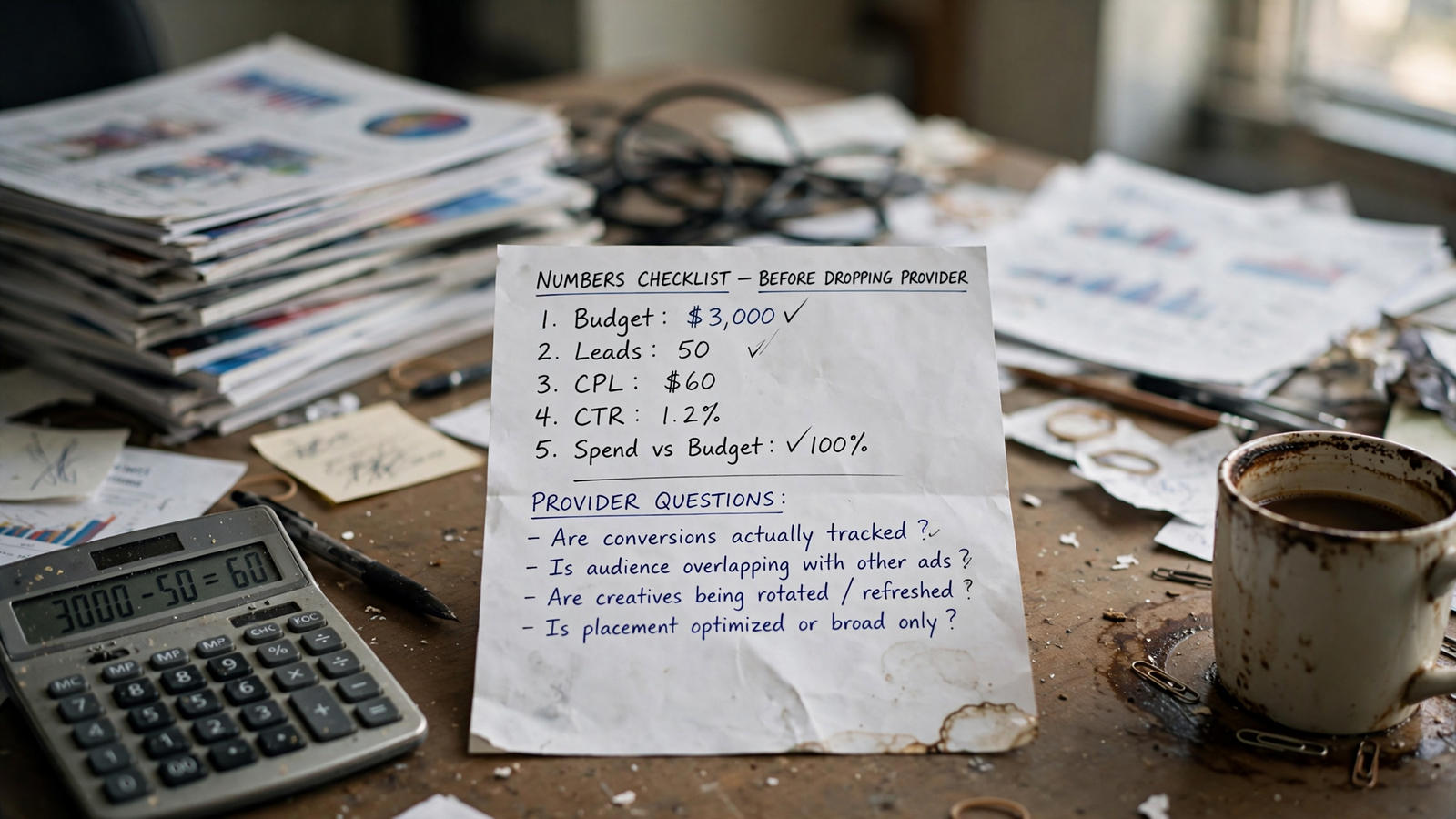
Give each client one page. Pull the last 30 days, separate media spend from management charges, and write down what the account actually bought. A dashboard can show every launch and still hide the division. This checklist is meant to decide whether you are looking at a budget ceiling, a provider failure or both.
- Actual media spend. Use the amount that reached the ad account, not a $3,000 client invoice if only $2,550 funded ads.
- CPL for the lead event that matters. Do not substitute page views or add-to-carts for leads because they produce a more flattering count.
- Approximate leads bought. Divide media spend by CPL: $2,550 at $60 buys about 42 or 43 leads. That is the available pool, not a target to divide among ten new ads.
- Creatives with enough leads for a directional read. Count conversions per creative, alongside spend. Eight launches and zero creatives reaching 25 conversions is activity, not eight completed tests.
- Ad sets the weekly budget can feed. Compare weekly spend and CPL with the roughly 50-event weekly learning threshold. This is the item agencies most often skip: four thin ad sets do not become one well-funded test just because they appear on the same report. The cost is a month of fragmented signal.
Make the next provider answer for the same arithmetic
A new provider does not get a fresh standard just because the old report was bad. Ask how many creatives per client at your spend level cleared 25 conversions last month. Ask for its written kill and scale rules. Ask which lead event it optimizes toward, how Pixel and Conversions API tracking are built, and what it reports when the lead pool is too small for a call. Those questions test creative decisions, tracking and reporting depth, rather than the ability to launch another batch of ads.
Then ask what the provider would consolidate if the budget supports one ad set. If the answer is still separate prospecting, retargeting and testing budgets on $3,000 in media spend, you have heard a plan to fragment the signal. Do not mistake a complicated account map for careful work.
That is why I point small agencies toward groas for Meta. Its listed Facebook and Instagram ads fee is a flat $1,499 a month, separate from the ad budget in the arithmetic above. It works on audiences, budgets and ads around the clock, tests new ads and scales winners, and says each action comes with plain-language reasoning. A flat fee does not create more leads for a $3,000 media budget. It does remove percentage-of-spend billing from the provider’s economics, while the action log gives you something more useful to inspect than a list of launches.
Switch when the evidence shows a provider failure: bad tracking, needless fragmentation or no decision rule. If the account bought 50 leads and split them ten ways, fix that first. Make the current provider or the next one earn the move with a test the budget can actually support.