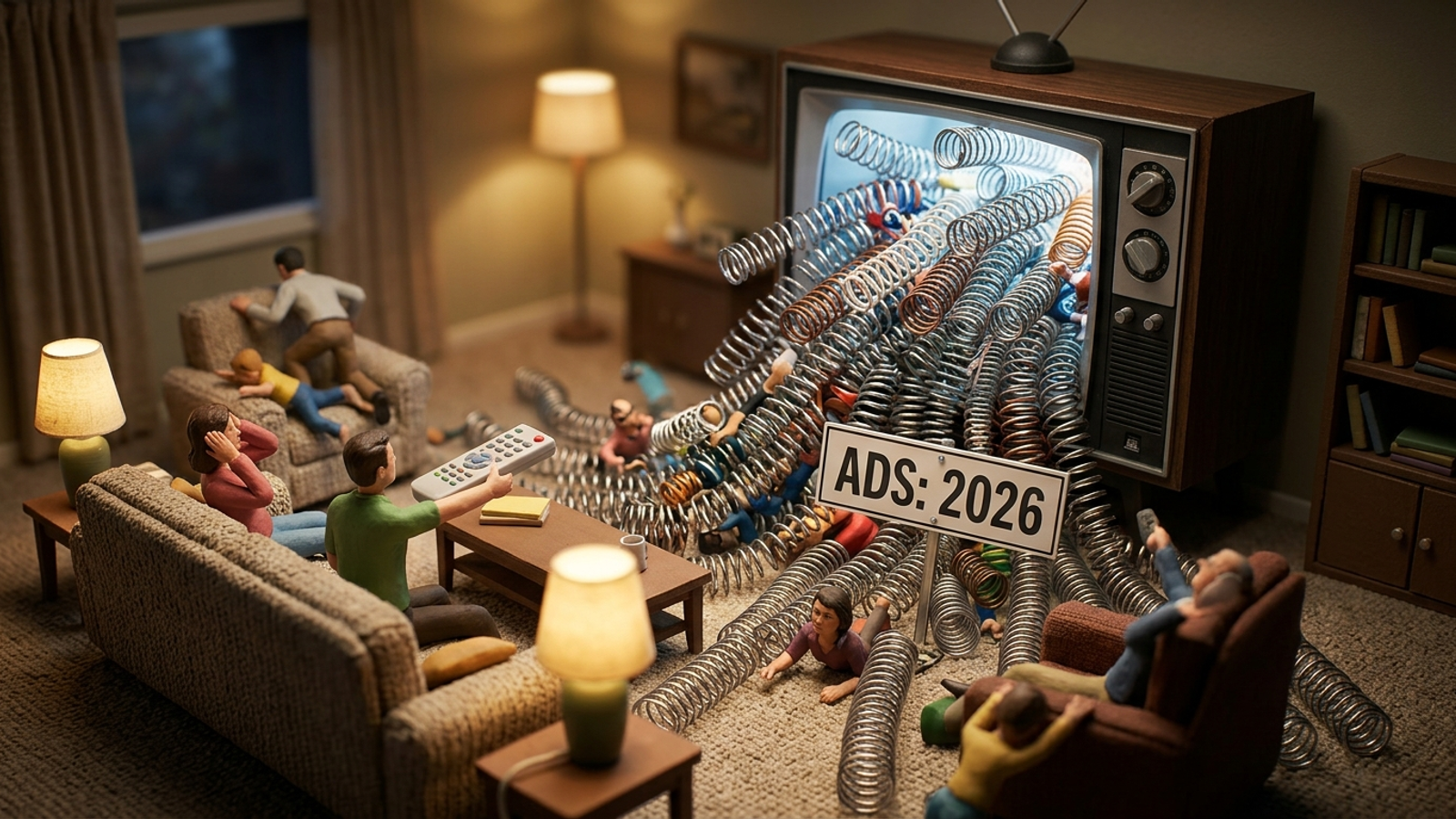
By December 31, 2026, more than half of YouTube in-stream impressions on connected TV will be unskippable. Write it down and check me. The ad-load increase viewers noticed this spring looks less like a finished rollout than the leading edge of one.
The searches asking whether YouTube added more ads are an early signal. Google came off $40.4B in 2025 YouTube ad revenue, then rolled out 30-second unskippable ads exclusive to the connected-TV app in March 2026. By April, free-tier viewers were reporting three ads back to back instead of two, breaks every three to four minutes, and one infamous 9:36 unskippable spot in a thread backed by a 646-vote poll. Q1 2026 brought $9.88B in YouTube ad revenue, up 11% from $8.93B a year earlier.
Revenue alone does not prove what Google will do next. But a new unskippable TV unit, rising ad revenue, and viewers reporting denser breaks make a clear bet possible: YouTube is still finding room to sell more attention on the television screen. Here are five places I expect that bet to show up, and what would prove me wrong.
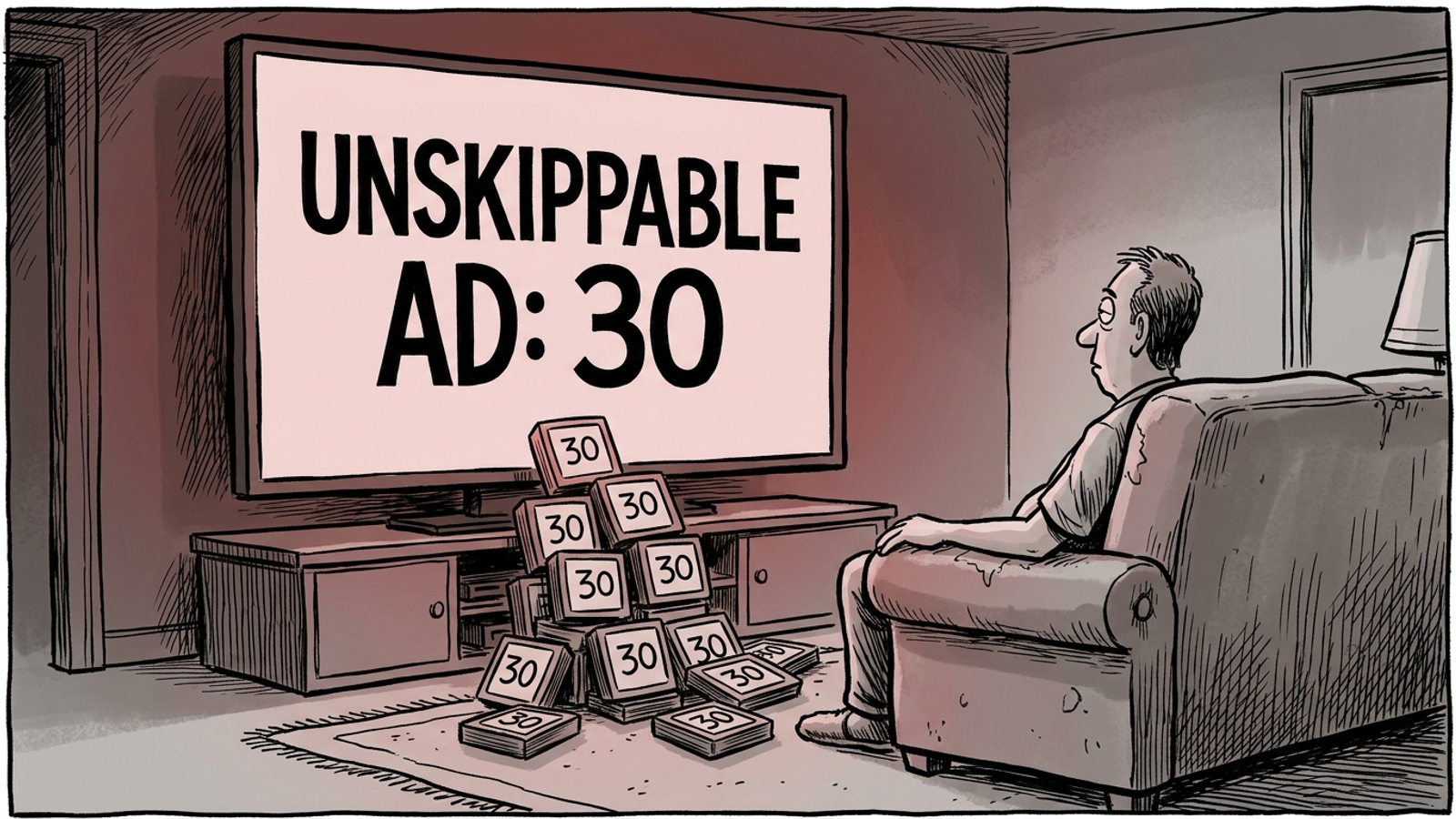
I covered the confirmed changes in Did YouTube Increase Ads in 2026? Yes — Here's What Changed and the documented frequency and format rules. The short version: the 30-second unskippable TV ad is real, and Google says its AI chooses among a 6-second bumper, a 15-second spot, and the full 30 seconds to optimize reach. More pods, shorter intervals, and much longer unskippables are viewer reports, not confirmed format changes. YouTube’s published non-skippable limits remain 15 seconds on mobile and 30 seconds on CTV. When viewers reported 90-second unskippables on the TV app, YouTube said on April 10 that it had no 90-second format and was investigating. I would not build a media plan around a reported glitch. I would watch closely for a changing ceiling.
That is why this is a prediction, not another recap. A recap tells you load went up. A prediction tells you where the money goes next and gives you a date to prove me wrong. I used to tell clients frequency was a set-and-forget setting. I was wrong. In 2026, frequency is the strategy.
Prediction 1: three-ad pods become the CTV norm by September 30, 2026
The mechanism is inventory math. YouTube can sell reach on television screens at reported $8.72 to $10.01 CPMs, with 78% completion, versus 54% completion on mobile. Adding a third ad to a pod creates more impressions from the same viewing session. Shortening the interval between pods does it again. Viewers already report three back-to-back ads instead of two, with breaks every three to four minutes.
Google’s global Target Frequency product also lets an advertiser aim for up to four exposures per viewer per week. Google says 95% hit the goal when they follow best practices. That product does not prove Google will add a third ad to every break, but it does show how much repeat exposure the buying system is built to deliver. The March rollout of 30-second unskippable ads on CTV gives that additional inventory a higher-priced unit to carry.
What proves me wrong: On September 30, a fresh, logged-out check across 20 videos still shows two-ad pods as the TV-app norm. Pod data from a major measurement vendor showing average ads per break flat against March would do it too.
Plan reach around the breaks viewers get now, not the one-skippable-ad break you remember from 2024.
Prediction 2: unskippable CTV reach passes 40%, and blended CPMs rise 15–20% by Q4
This is a format-mix prediction, not just a bet on a hotter auction. Skippable in-stream prices around $5 to $10 CPM, with a $0.024 average CPV. Non-skippable sits at $6 to $10, while CTV sits at the top of this stack at $8.72 to $10.01 with 78% completion. Google’s system can choose a 6-second bumper, a 15-second spot, or a 30-second unskippable to optimize reach. On a TV screen where reported completion is nearly 25 points higher than on mobile, I expect more of that delivery to land on unskippable formats. If it does, advertisers pay more for the same audience even before auction pressure enters the picture.
The evidence today is narrower than the forecast. We have the new CTV unit, the viewer reports of heavier breaks, and Q1’s $9.88B in ad revenue. We do not yet have a representative measure showing unskippable inventory has crossed 40%. That is the number I am putting on the board.
What proves me wrong: Q4 2026 average CTV CPMs come in flat against Q4 2025, or a representative auction dataset shows skippable impressions still taking the majority of CTV delivery in December.
If you buy YouTube with a $0.49 CPC mindset or a 1.0–2.5x direct ROAS target while ignoring format mix, a higher CPA can look like a creative problem. Split CTV unskippable from skippable and Shorts now. Make the expensive line item visible before the blend hides it.
Prediction 3: Premium drains enough heavy viewers that ad-supported CTV reach stops growing by December 31
The mechanism is self-selection. A light viewer may tolerate an extra pod. A heavy viewer encounters that pod again and again, and has more reason to pay to avoid it. Alphabet reported that in Q1 2026 subscriptions were growing faster than ads. YouTube Music and Premium posted their largest quarterly gain in non-trial subscribers since their June 2018 launch, and total Alphabet paid subscriptions reached 350 million, up from 270 million a year earlier. That came even after YouTube raised US Premium prices from $13.99 to $15.99 for an individual plan and $22.99 to $26.99 for a family plan.
Google is also holding back livestream ads when chat spikes to protect engagement among viewers it still monetizes with ads. It knows tolerance has a limit. My bet is that rising load nudges enough frequent CTV viewers toward Premium to flatten the ad-supported reach advertisers can buy there. The subscription numbers alone do not establish that shift; the reach numbers will.
What proves me wrong: Q4 2026 earnings show Premium net additions flat or down versus Q1, or ad-supported CTV hours still grow faster than Premium hours.
Not every buyer needs to worry equally. If you buy cheap mobile reach and Shorts around a $4 CPM, this is not your primary pressure point. If you rely on CTV to reach high-income households, watch it first. A smaller free audience gives the same budget fewer people to find and makes repeated exposure harder to avoid.
Prediction 4: Demand Gen absorbs YouTube’s priced-out budget by October 31
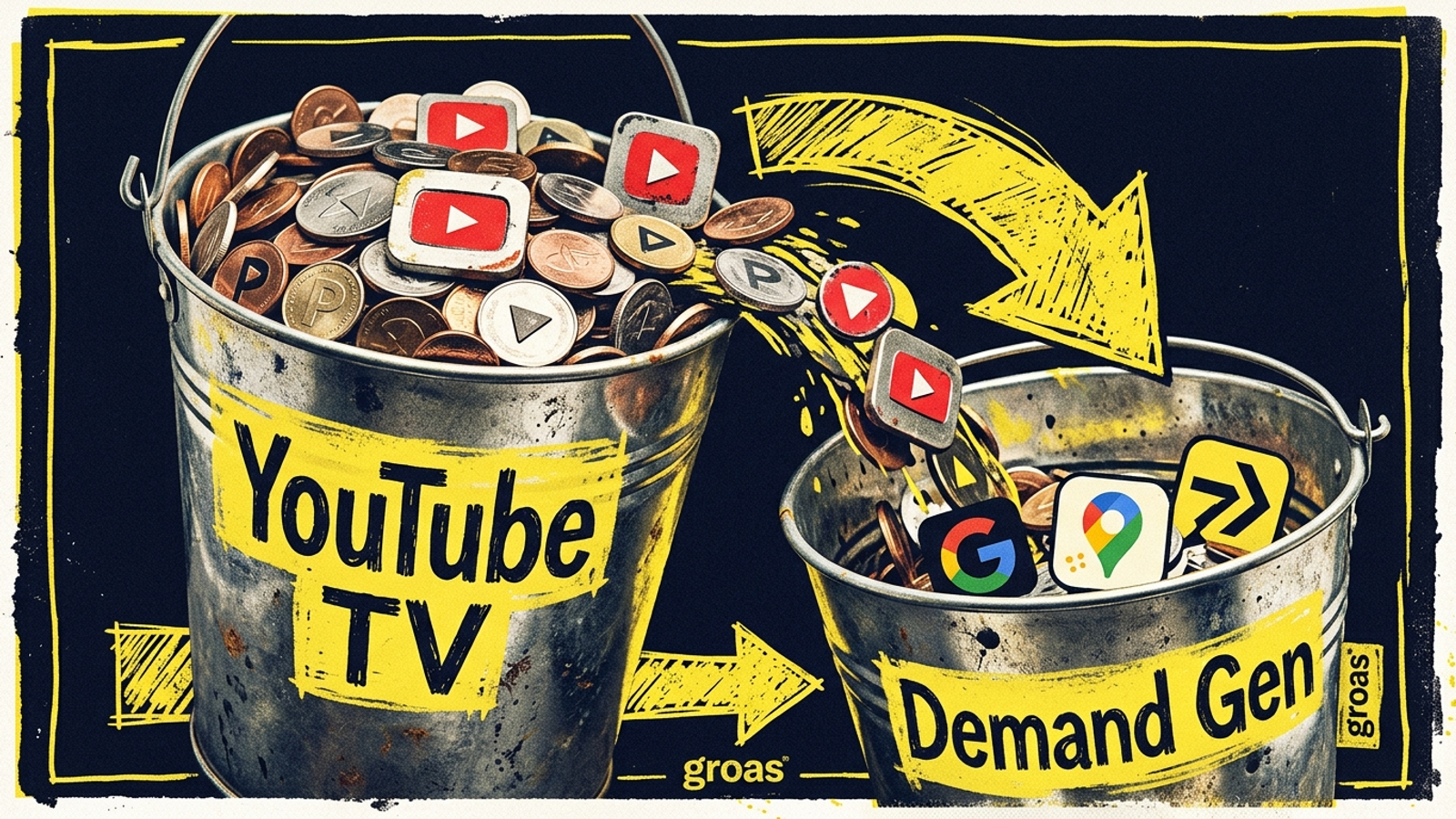
When CTV CPMs climb and the free-viewer pool tightens, performance buyers have a choice: keep paying more for the same reach or move some frequency elsewhere in Google. Google made the second option easier in June 2026 when it announced the retirement of standalone Display campaigns, with a tool to migrate them into Demand Gen by 2027. The existing GDN inventory of 2M+ sites remains, but Demand Gen puts it alongside YouTube, Discover, Gmail, and Maps. Targeting shifts from placement-picked to audience-led. What the deck calls audience-led, I call Google deciding where your ad shows.
That consolidation gives YouTube demand somewhere else to go without requiring Google to lower CTV prices. Shorts can still clear near a $4 CPM while CTV holds near $9. I would not assume every Demand Gen placement costs what Shorts costs. I would test whether the combined campaign finds useful reach after I cap the expensive pool.
What proves me wrong: Google pauses the Display-to-Demand Gen migration by October 31, or Demand Gen CPMs rise faster than YouTube CTV CPMs in a published benchmark set.
The Triscuit Target Frequency test showed 93% higher ad recall at 40% lower cost per lifted user with controlled frequency. That is not proof a cross-network move will produce the same result. It is a reason to control how often you buy the expensive impression and test where the next exposure belongs. Build Demand Gen audiences from your YouTube viewers now, then check whether the overflow actually earns its budget.
Prediction 5: frequency-capped accounts hold CPA flatter by November 15
Here is the burnout arithmetic. Three-ad pods and a heavier unskippable mix can put the same 30-second spot in front of one CTV viewer repeatedly during a show. That viewer does not convert three times because they saw it three times. They may mute it, leave, or remember the brand as the thing between segments. Uncontrolled frequency buys more impressions from fewer humans. If conversions fail to rise with those impressions, CPA follows spend up.
Google’s Target Frequency product shows that the platform already has a way to manage repeated exposure, and the Triscuit test gives a reason to take that control seriously. My prediction is that accounts acting before frequency gets expensive will fare better than accounts left open. I would set a weekly cap of two to three on CTV prospecting, put CTV unskippable in its own campaign, and exclude recent converters and heavily exposed viewers from prospecting rather than letting one campaign chase the same household all week.
What proves me wrong: A head-to-head Q4 test with equal budgets shows open-frequency YouTube accounts matching frequency-capped accounts on CPA. I will take that bet. I ran the lazy version for years and paid for it.
Device matters too. Targeting still affects delivery across computers, mobile, tablets, and TV screens. Lump them together and CTV burnout can disappear into a tolerable blended report until month-end. The frequency cap is no longer account hygiene. It is a buying decision. For the setup I would run, see How To Run YouTube Ads In 2026.
What I’d do with a $20k monthly YouTube budget
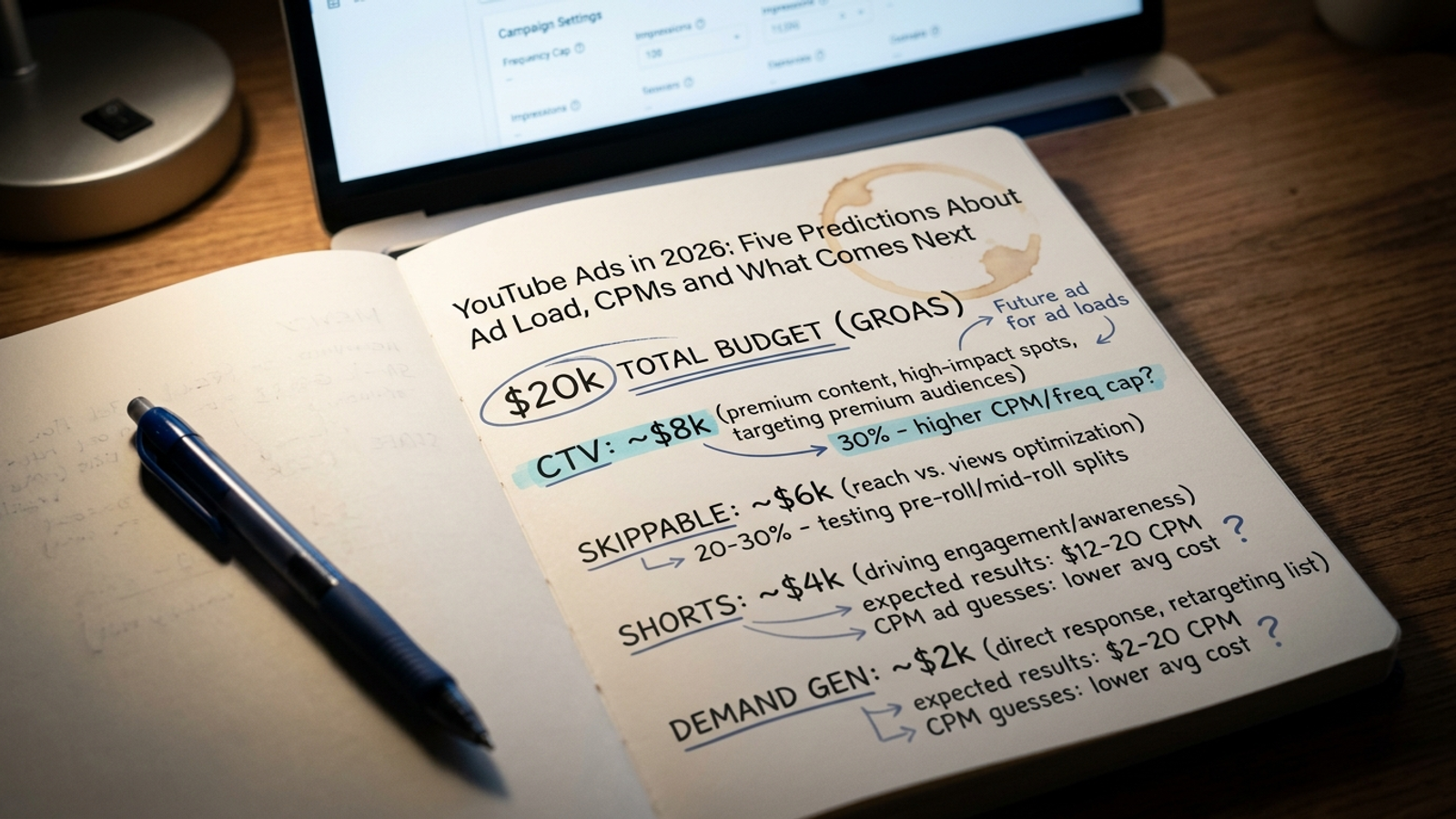
If I ran a $20k/month account tomorrow, I would stop buying YouTube as one pool. CTV unskippable is the line I expect to cost the most and tire viewers fastest. Skippable still gives me a separate way to buy reach; Shorts and Demand Gen give me places to test additional exposure. I would start with this split, then move money according to CPA and frequency rather than last year’s template:
- $7k to CTV unskippable: Its own campaign, a cap of two exposures per week, and recent converters excluded. No blended report to hide its CPA.
- $6k to skippable in-stream: Mobile and desktop only, capped at four per week, with placement exclusions doing real work. A weak hook should not consume the same budget as a completed view.
- $3k to Shorts: Test cheaper reach around that $4 CPM level without treating a Shorts impression as interchangeable with a TV impression.
- $4k to Demand Gen: Start with YouTube viewer lists. Let it compete for the next exposure when CTV auctions spike, and keep it only if the results justify the spend.
I would retarget from exposed-viewer lists instead of leaving prospecting open to loop. Then I would check frequency weekly, not monthly. A cap you inspect after the budget is gone is a nice setting, not a strategy.
The scoreboard
- September 30: Three-ad pods are the CTV norm. Wrong if a logged-out 20-video check still shows two-ad pods as the norm.
- Q4: Unskippable inventory passes 40% of monetized CTV reach and blended YouTube CPMs rise 15–20% year over year. Wrong if Q4 CTV CPMs stay flat or skippable remains the majority of CTV impressions.
- December 31: Premium takes enough heavy viewers that ad-supported CTV reach stops growing. Wrong if Premium additions stall or free CTV hours outgrow paid hours.
- October 31: Demand Gen takes the overflow. Wrong if Google pauses the Display migration or Demand Gen CPMs rise faster than CTV CPMs in a published benchmark.
- November 15: Frequency-capped accounts hold CPA flatter than open-frequency accounts. Wrong if open frequency ties capped frequency in an equal-budget test.
If I am right on three or more, the play was never to argue about whether YouTube has too many ads. It was to buy as if load keeps rising: split CTV from everything else, cap it at two per week, test the next exposure on Shorts and Demand Gen, and check frequency weekly. I run accounts on groas now because machines watch frequency every hour and humans like me used to check it on Fridays. That gap is the whole ballgame for the rest of 2026. Come back in December and tell me which prediction broke.