

 LinkedIn

With $15k a month, six weeks, and one operator, I would give Demand Gen $100 a day beside PMax. No shared creative, no warm-audience grab, and no victory declared from view-through conversions. Without those boundaries, you can spend more to reach the same buyers and call the extra reporting incremental reach.
The short history matters because old setup advice still circulates. Google announced Demand Gen in June 2023 and upgraded Discovery campaigns to it in early 2024. Discovery targeting guides and creative specs are not a launch plan. Demand Gen serves across YouTube, Discover, Gmail, and Display, but not Search. PMax can serve across those surfaces and Search. That does not make every conversion they report two different customers.
This is a constrained test, not an invitation to add another line to the media plan. Each step has to buy a clearer answer before the clock runs out.
1. Week 0: Reserve $3,000 a month for one prospecting job
Cost against the constraint: $3,000 of the $15,000 monthly budget goes to Demand Gen, roughly $100 a day. PMax keeps $12,000. Demand Gen gets one job for the six weeks: reach net-new prospects with feed-first creative. PMax keeps the capture work: high-intent traffic, Shopping, and the existing paths to converters.
What it buys: Enough room to test without treating Demand Gen as a rounding error. I start at 20% because a token allocation can leave too little activity to judge within six weeks. Practitioners commonly use about $100 a day as a working floor; a $75-a-day test might feel cautious, but caution is not useful if the answer at the deadline is still “maybe.”
This split does not make the campaigns incapable of touching the same buyer. PMax spans more inventory than you can neatly fence off. It gives Demand Gen a distinct purpose and caps the cost of finding out whether that purpose holds up. I would rather risk a defined $100 a day than let a new campaign spend freely and sort out the attribution afterward.
What gets cut: the idea that Demand Gen is a second PMax with prettier placements. If the plan is to aim both at people who are already ready to buy, keep the money in capture.
2. Weeks 1–2: Spend half a day building the audience boundary
Cost against the constraint: Half an operator-day before launch. What it buys: A prospecting pool you can describe without pointing vaguely at a campaign dashboard.
I would build it in this order:
- Turn off Optimized Targeting in Demand Gen.
- Seed one Lookalike from a first-party list and one intent-based custom segment.
- Exclude recent converters, site visitors from the last 30 days, and past purchasers.
- Record how PMax handles brand traffic and compare branded search separately during the test.
That last step matters. Removing brand terms from PMax search themes is not a brand exclusion, so I would not pretend it stops PMax claiming a conversion after Demand Gen made the introduction. The campaigns can still touch the same journey. The point of the boundary is to keep Demand Gen from deliberately buying the warmest people in it, then watch for evidence of PMax competing for or claiming credit on conversions Demand Gen influenced.
What gets cut: “all visitors” in Demand Gen, open prospecting with no exclusions, and the comforting idea that a wider audience is automatically a better one. If a rep suggests leaving Optimized Targeting on to “find more buyers,” I would ask what that does to this test’s ability to distinguish new demand from people PMax was already likely to reach. One operator and six weeks are not enough to untangle that after the money is gone.
The practical rule is cold first. An audience boundary reduces avoidable overlap; it does not prove incrementality.
3. Weeks 1–2: Spend half a creative day on assets made for the feed
Cost against the constraint: Half a creative day, before the first $100 goes out. What it buys: A fairer test of Demand Gen than a folder of PMax leftovers can provide.
I used to duplicate PMax headlines and landscape images into Demand Gen and wonder why the result felt flat. A landscape image cropped into a vertical slot looks like a banner ad that took a wrong turn. People scroll. If the creative does not fit the placement, weak response tells you little about whether the audience was worth reaching.
Build 5 to 10 assets per ad group, with at least three per ratio: 9:16 vertical, 1:1 square, and landscape. Shoot or cut for the feed first. Then use channel controls to separate Shorts, Discover, Gmail, and Display at launch, so you can see where the budget goes and where click-through conversions come from. That is more work than pressing “duplicate.” It is less work than spending six weeks trying to explain a result built on assets that never belonged in the campaign.
What gets cut: recycled PMax asset groups and auto-generated vertical crops. If an asset was not made for a phone held upright, it does not get a vertical slot merely because the file can be resized.
4. Weeks 1–2: Set one conversion scoreboard before launch
Cost against the constraint: Setup time now instead of an argument in week 6. What it buys: A comparison between campaigns using the same business outcome, even though they play different roles in the journey.
In Google Ads, set the same primary conversion in both campaigns: the same definition, value, and attribution window. Use click-through conversions for the kill-or-scale scorecard. Track view-through and engaged-view conversions separately, along with assisted conversions. Do not quietly fold every kind of exposure into Demand Gen CPA and then compare it with PMax as though the numbers mean the same thing.
This is not a claim that last-click tells the whole story. It can understate Demand Gen’s assist role. But a generous reported-conversion total can overstate it. The fix is to keep two questions apart: did Demand Gen produce click-through conversions at a tolerable cost, and is there evidence that its earlier touches helped PMax close? One number should not be forced to answer both.
What gets cut: a launch without the scorecard agreed in advance. If week 6 begins with a debate about which conversion column counts, the test has already used up its most valuable resource: the deadline.
5. Weeks 3–4: Hold the cap and look for displacement
Cost against the constraint: Another two weeks at $100 a day, without budget tinkering unless something is clearly wrong. What it buys: A steadier read than a campaign changed every time a daily chart looks odd.
I would watch two sets of signals:
- PMax CPA and branded-search volume, week over week, while Demand Gen spends. If PMax CPA rises 15–20% as Demand Gen reports cheap conversions, I would investigate possible overlap. That pattern is a warning, not proof that one buyer was counted twice.
- New-customer share in Demand Gen and assisted conversions in GA4. These help show whether the campaign is finding new people and appearing earlier in journeys that PMax later closes. In-platform ROAS alone cannot settle that question.
Do not turn a branded-search lift into a trophy, either. Demand Gen’s intended role is to introduce cold prospects who may later search with more intent. A lift fits that story, but it does not establish the cause on its own. For now, I want the lines recorded consistently, not a slide calling them a win.

What gets cut: applause for cheap reported conversions while capture gets more expensive. With one operator, the useful habit is a short, repeatable check of these signals, not a fresh interpretation of the dashboard every morning.
6. Weeks 5–6: Make the kill-or-scale call on clicks
Cost against the constraint: The final two weeks of the capped test. At $100 a day, six weeks puts roughly $4,200 into Demand Gen. What it buys: A decision you made rules for before seeing the result.
My rule for this $15k-a-month test is deliberately strict. Demand Gen stays only if all three conditions hold:
- Its click-through CPA is within 1.3× PMax CPA.
- More than 70% of its converters are flagged as new customers.
- PMax CPA has not drifted up since week 1.
Passing all three earns more testing, not a claim that Demand Gen alone caused every later sale. Once the six weeks end, I would move its monthly cap from $3,000 to $4,000 and take the extra $1,000 from the lowest-intent PMax asset group, not branded Search. Make one change, then watch for two more weeks. Direction first, size second.
The kill rule is just as important. If more than half its reported conversions are view-through or engaged-view, or PMax CPA rose while Demand Gen spent its full $100 a day, shut Demand Gen off and return its budget to PMax. Demand Gen can optimize toward view-through conversions, with Discover billing shifting to CPM in that setup. That can make reported CPA look tidy while cash leaves on impressions. I would rather lose a campaign than keep one because its most flattering column wins a meeting.
What gets cut: the rescue plan where you change the audience, creative, conversion goal, and budget in the final week. That would be a new test with no time left to run it. If this version fails, save the assisted-conversion export and write down which boundary failed.
7. Before reusing the plan, check whether the budget still fits
Cost against the constraint: None in this six-week test. What it buys: A reason not to copy its allocation into an account with completely different room to move.
At $3k a month, I would cut Demand Gen entirely. With a $125 target CPA, even a working budget of five times that target would be $625 a day; the whole account has about $100 a day. Splitting it across PMax and Demand Gen does not buy a cleaner answer. PMax keeps the full $3k until there is room to fund prospecting without starving capture. If you need the background on what replaced what in Google Ads, read it once, then leave Demand Gen off until a real test fits.
At $50k a month, I would keep the cap but tighten the structure. A roughly 60% Search, 25% PMax, 15% Demand Gen split puts about $7,500 into Demand Gen. That creates room for separate Shorts, Discover, and Gmail/Display splits, separate Lookalike seeds, and a geo holdout. More spend does not make overlap harmless. It makes a blurry result more expensive.
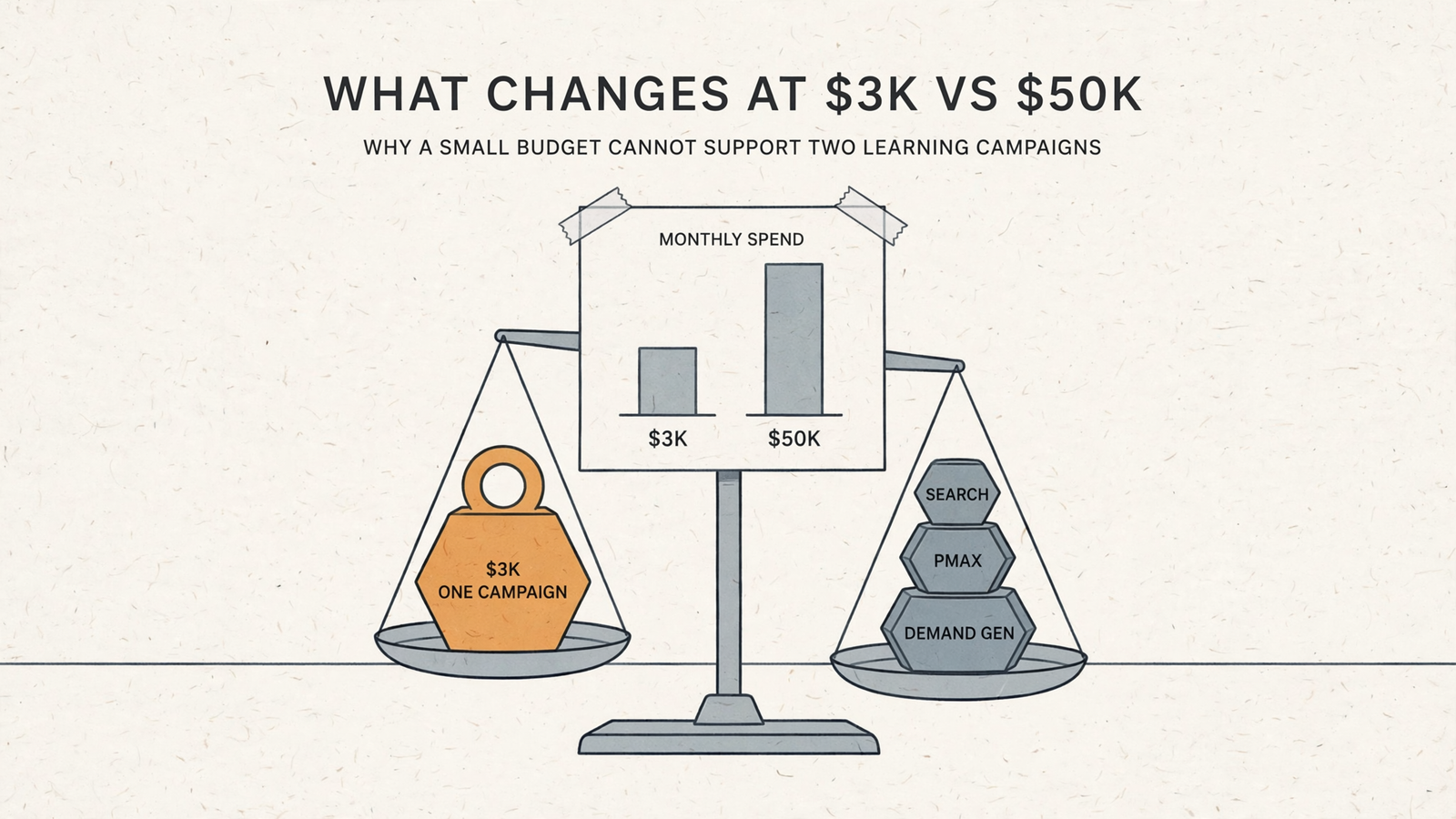
The $15k version sits between those cases. It has enough budget to ask a narrow question, not enough to buy its way out of a vague one.
8. When the six weeks end, lift the constraint in one direction
Cost against the constraint: No more money until the six-week decision is made. What it buys: A next move tied to the result instead of a permanent exception for a campaign that “seems to help.”
Keep the two rules straight: Demand Gen gets its own audiences and feed-first creative, while both campaigns use the same primary conversion definition. If your PMax asset groups are already tangled, fix that structure before treating a change in PMax CPA as a response to Demand Gen. This ecommerce PMax asset group restructure shows the kind of cleanup I mean. Otherwise, your week 3 read may be measuring old mess, not new overlap.
One operator also cannot protect the boundary by logging in on Fridays. Audience composition and placements need checking throughout the test; so do click-through and view-through results. That repetitive work is what groas runs continuously while a human strategist holds the direction and guardrails. The budget and six-week clock do not change. The operator gets a better chance of catching drift before it becomes the explanation for the month. If this is a lead-gen test with form fills as the only goal, there is a companion $15k-a-month, 60-day AI Max and PMax constraint. Keep the same discipline about separating jobs.
If Demand Gen passes, keep its cold audiences and feed-first assets at the new cap, then test the assist with a geo or Conversion Lift holdout before calling the spend incremental. Pause Demand Gen in one region, hold PMax steady, and watch branded search and new-customer volume. If the exposed region holds its lead while the holdout flattens, you have a stronger reason to keep spending. If both move together, do not award Demand Gen the difference.
If it fails, turn it off and write down whether the likely problem was overlap, creative, or offer. Return the money to capture. The budget decides whether you can get a read; the boundaries decide whether that read means anything. That is what to carry into the next test when the constraint lifts.