

 LinkedIn

$3,000 a month gives a service business about $100 a day on Meta. Spend week one launching new audiences and a fresh campaign structure, and you will probably spend the rest of the month wondering why cost per lead is still high.
I used to mistake a takeover for a chance to show motion. Now I would spend the first month doing the subtraction I avoided back then: fix the lead signal, collapse ad sets, then ship one creative batch. New audiences can wait.
The $3,000 constraint: one account, not five experiments
At $100 a day, call it roughly $750 a week, allowing for Meta’s pacing. Say raw leads cost $30 each. That buys about 25 leads a week across the whole account. Every split takes volume away from somewhere else.
Meta’s peak-season guidance found that ad sets under about 50 conversions a week ran about 28% more expensive per purchase. Purchase results are not service leads, but the budget formula is useful: weekly budget divided by cost per result times 50 gives you the number of ad sets you could feed at that event rate. Here, $750 / ($30 × 50) is 0.5. Even one ad set is below that threshold. Splitting it into several does not create more learning.
Practitioners arrive at a similar warning: a lead ad set may need roughly $50 to $150 a day to leave Learning Limited. Split $1,000 a month five ways and each ad set gets $6.67 a day. That is not testing. That is starving five babies and wondering why none of them grow.
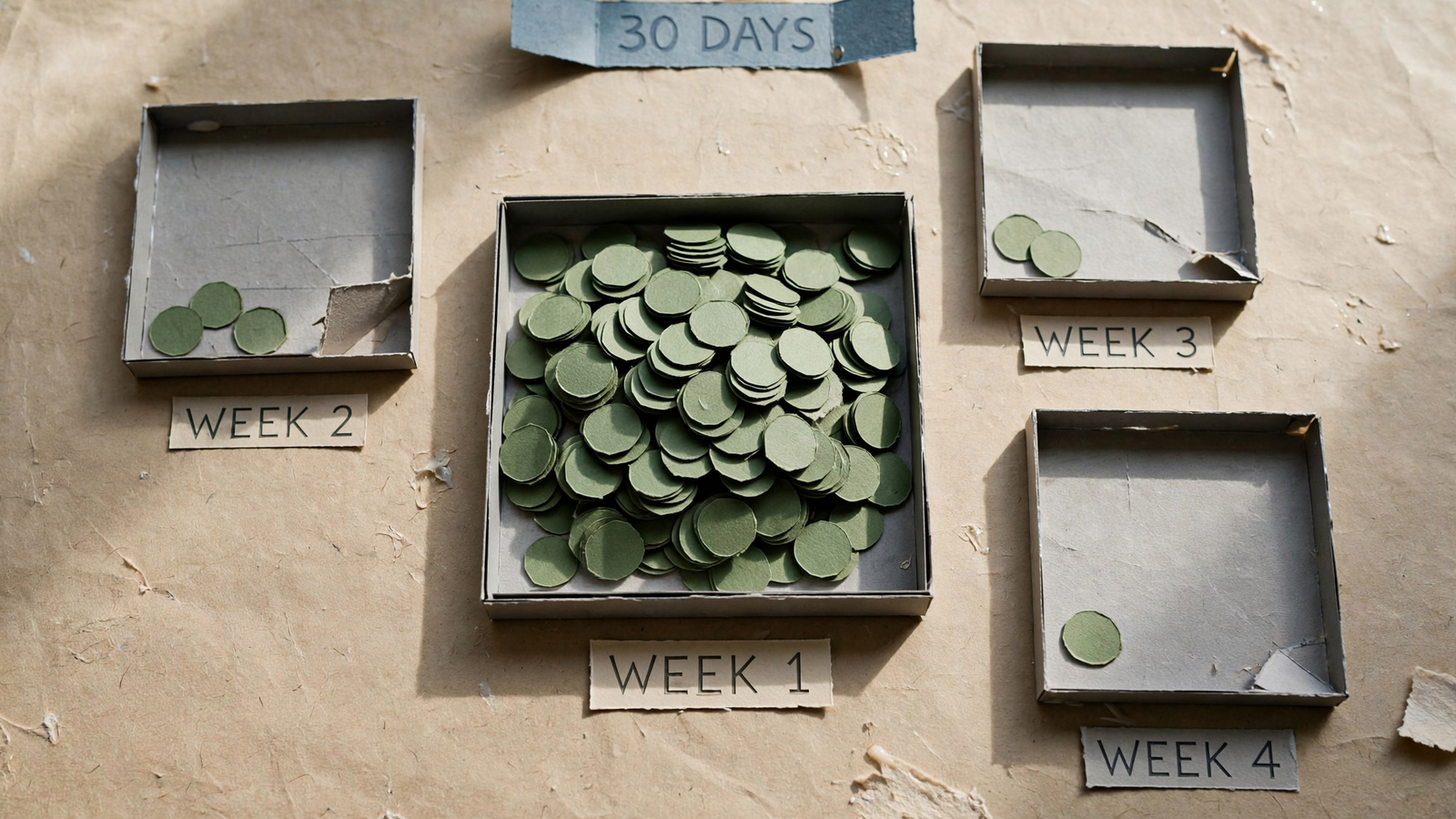
The plan below accounts for all four weeks of media spend. Week one is not a free week or a pause: the existing ads keep spending while I fix what their results mean. No new test gets a separate slice of the budget.
1. Week one: spend $750 fixing the lead signal
The first roughly $750 keeps the existing account running while I inspect its leads. It buys a baseline and, if the owner does their part, a way to tell useful enquiries from cheap form fills. I do not spend that week-one media on a replacement campaign.
I start with the event Meta is optimizing toward, then open the Instant Form. If the event is raw Lead, Meta can find inexpensive form-fillers without knowing whether any of them can buy the service. Facebook clicks at $1 to $3 can look cheaper than Google clicks at $6 to $25-plus, while cost per qualified lead runs higher. A Meta lead form interrupts someone who was doing something else. The fill is the start of qualification, not the end.
Many service accounts I inherit use the More Volume form: tap, auto-fill, done. Higher Intent adds a review screen and slide-to-submit. I would pair that with two or three useful questions about budget and timeline, including an answer that lets the wrong prospect rule themselves out. That costs no extra media; it may reduce raw fills. Good. Fewer accidental taps means fewer Tuesdays spent calling them.

Next, I make qualified outcomes visible to Meta. The standalone Offline Conversions API was deprecated on May 14, 2025; offline outcomes now go through Conversions API and Datasets with the appropriate action_source. The point is not to install a pipe for the pleasure of having a pipe. It is to send back the lead stages the business can actually verify. One cited example reports a 20% lift in lead-to-opportunity and 12% in click-to-conversion after switching from raw Lead to QualifiedLead optimization. That example is a reason to care about the signal, not a result this $3,000 account can assume.
I would not immediately switch optimization to a stage that occurs only a handful of times. If the business closes eight jobs a month, Closed-Won is too sparse to steer delivery on its own. Track the qualified stage that occurs 20 to 30 times a month, send Closed-Won too, and use those outcomes to judge the account. Whether to optimize delivery toward QualifiedLead is a separate decision once the signal has enough volume. Measure quality first; do not pretend a sparse event will solve the learning problem.
The owner has a week-one job as well. For 15 minutes every Monday, mark each lead from the prior week in one sheet: qualified or dead, plus a reason. Wrong area. Renter. Price shopper. No answer after three tries. Without that grading, the feedback pipe has nothing trustworthy to send. Then call new leads fast. A lead called in five minutes is not the same opportunity as one called tomorrow morning, and no bid setting fixes slow follow-up.
2. Week two: spend $750 on one funded learner
The next roughly $750 buys concentration, not another campaign. I collapse duplicate prospecting and retargeting splits into one campaign and, usually at this spend, one ad set. If a second ad set cannot get meaningful volume without starving the first, it goes. I have inherited accounts with six or seven ad sets on this budget, each sitting in Learning Limited. That is an account structure pretending the budget is bigger than it is.
The 50-event math for modest Meta budgets explains the decision. At roughly 25 raw leads a week across the account, consolidation does not guarantee that the survivor exits Learning Limited. It gives the available events to one ad set instead of scattering them across five. That is the best use of this constraint.
Here is what I cut:
- Duplicate prospecting and retargeting ad sets competing for the same $100 a day.
- Interest stacks with $15 a day behind them and “tests” that have been testing since March.
- Placement or audience splits whose cheap raw leads do not become qualified leads.
I break out raw cost per lead and cost per qualified lead by placement and ad set before making that last cut. Audience Network and right-hand placements can be repeat offenders on lead forms, as can broad age bands left open past 65 for a service that never closes those prospects. I do not kill a placement because its name looks suspicious. I kill it when the lead grading shows cheap fills that go nowhere.
I used to tell clients more ad sets meant more learning. I was wrong. On $100 a day, more ad sets usually mean more thin learners. One funded ad set beats four starved ones, even if the funded one still needs more volume to leave Learning Limited.
3. Week three: spend $750 testing five ads, not 20
The third roughly $750 buys the first fair creative read. I put one batch into the surviving ad set: three angles, two formats, five ads total. No new campaign and no audience launch to muddy the result.
For a service business, I would cover:
- Offer: a flat quote or a clear account of what the visit includes.
- Proof: before-and-after work, review count, or jobs done nearby.
- Friction: no phone tag, a text option, or evening slots.
Then I would make those angles work across two formats: phone-shot video from the owner or tech, and a plain static ad with a headline people can read in feed. Five ads already stretch $100 a day. At an even split, each would have about $20 a day; Meta may not distribute spend evenly. Twenty variations would give each even less room before an early favourite emerged from noise.

With about 25 raw leads a week, three to five new ads is a more defensible ceiling than 20. Launching too many variations can starve each one and favour an early winner. I read the sequence in order: three-second hook rate, hold through 50%, outbound click-through rate, then cost per qualified lead. Raw cost per lead comes last. An ad that fills the CRM with tire-kickers failed, however tidy its dashboard looks.
At the end of the week, I make a Scale, Iterate, Retire pass and note what lowered cost per qualified lead without buying dead leads. That gives week four evidence to work from rather than somebody’s favourite video. Five placed bets beat 20 lottery tickets.
4. Week four: spend $750 judging the leads that count
The final roughly $750 buys a qualified-lead read. The owner gets two numbers: raw cost per lead and cost per qualified lead. Raw CPL is spend divided by form fills. The useful second measure is spend divided by qualified leads, such as booked estimates rather than fills. Pick the qualification stage in week one and keep its definition fixed.
Say the month ends with $3,000 spent and 100 fills. Raw CPL is $30. If 25 become qualified site visits or booked estimates, qualified CPL is $120. Suppose the next $3,000 buys only 70 fills but 30 qualified opportunities. Raw CPL rises to about $43; qualified CPL falls to $100. The second month wins, even though a report built around form fills would make it look worse.
I keep the consolidated ad set if it produces qualified volume. I pause ads or placements that have enough delivery to show a persistent quality problem, not an ad with zero qualified leads after an arbitrary 2,000 impressions. At this budget, a few outcomes can swing the number. I will not call a 15% movement skill because it appeared in a weekly screenshot. Report qualified leads, keep the proven structure, and resist another rebuild.
What stays cut for the full $3,000 month
Four requests get a no, even if they would make the takeover deck look busy:
- A full rebuild in week one. It spends the first roughly $750 relearning before anyone has checked the lead signal. That is onboarding theatre with a media budget attached.
- Separate retargeting, lookalike, and testing campaigns. A local service retargeting pool may be only 2,000 to 5,000 people. On $100 a day, it does not get its own ad set just because the campaign diagram has an empty box.
- A return to More Volume to make raw CPL prettier. Cheaper fills do not help if the qualified share falls. I will not trade booked estimates for a better-looking form-fill number.
- Paid extras that eat the media. Small-business Meta rate cards can run $500 to $3,500 a month plus spend, or 10% to 20% of spend; setup fees and video packages add more. A $750 fee and a $1,000 shoot are real costs beside $3,000 of media. Price the management separately and plainly. Do not quietly shrink the ad budget to pay for a production plan it cannot support.
The refusal is not anti-creative or anti-manager. It is arithmetic. Anything that splits this $3,000 before the account can produce a readable qualified-lead signal waits.
When the $3,000 constraint lifts: add spend before structure
I would not ask for more budget until cost per qualified lead holds steady for two full weeks. When it does, add spend to the winner, about $25 a day at a time, and let it prove itself again. A second ad set comes later, when the weekly budget and the cost of the event you are using can support it. More money alone is not permission to rebuild the starvation problem.
This is why I like a flat fee for this slot. groas runs Meta ads for a flat $1,499 a month, with audiences, budgets, and ads worked around the clock and new ads tested against winners, rather than a percentage fee that rises when spend rises. That fee is separate from the $3,000 media constraint and belongs in the owner’s total-cost calculation, just like any manager’s fee.
On a modest budget, the order stays the same: subtraction first, proof second, spend third. Any manager who wants to skip to step three in week one is telling you how they sell, not how Meta learns.