LinkedIn

A screenshot of ChatGPT naming your competitor is not evidence that you lost your place. It is one answer, at one moment, to one prompt. I spent a decade testing Google Ads copy against control groups; I would not call a headline a winner because an ad group with three monthly conversions got one on a Tuesday. Yet AI visibility dashboards routinely ask you to treat a sampled answer like a fixed search ranking. That is how teams spend money chasing phantom drops and celebrating meaningless spikes.
Myth 1: “We Rank #2 in ChatGPT”
Twenty-five years of search results trained marketers to picture a page with positions. You occupied slot one, slot four, or the bottom of page two. A dashboard that says your brand ranks #2 in ChatGPT borrows that familiar shape. It is reassuring. It is also the wrong model.
As Searchable’s analysis of AI visibility tracking explains, a language model does not return the same ordered list of links every time. It generates an answer from the prompt, its context, and, where applicable, retrieved material. Run the same prompt again and the wording, order, or cited sources may change. A single numbered list in an answer does not give your brand a durable position.
Measure how often your brand appears across repeated answers, not where it sat in one of them. If an engine answers a commercial prompt 50 times and names your software in 22 runs, your observed share of answers is 44%. That tells you what happened in your sample. An “average rank of 1.8 in AI search” is a rank tracker in a lab coat: a tidy spreadsheet shape applied to an untidy system.
Myth 2: “I Checked the Prompt, So I Know Where We Stand”
I understand the appeal. You type a buyer question into ChatGPT, your company appears, and the weekly report gets a green arrow. But one run cannot tell you whether the answer favors your brand or whether you caught a convenient variation.
Language-model answers can vary between runs, even when the prompt stays the same. Attrifast’s discussion of AI search share of voice recommends 3 to 5 repeated runs per prompt across a fixed panel of 50 to 300 buyer queries for a steadier read. The precise panel you can manage will depend on your resources. The principle does not: repeat the prompts and keep the panel fixed if you want to compare one period with the next.
Run a prompt once and you have a screenshot. Run it repeatedly over seven days and you can begin to see whether your Tuesday mention is common or unusual. That is the starting point for measuring AI search visibility without trusting one screenshot. I would not declare an ad-copy winner after one conversion; I would not declare an AI visibility win after one answer.

Myth 3: “Buyers Use the Prompts We Use”
Most teams start with the keyword already sitting in their Google Ads account: “best project management software for construction.” It is easy to track because everyone agrees on the words. That does not make it representative of what a buyer asks an AI assistant.
A buyer can bring the messy context into the question: “We are a 45-person commercial electrical contractor switching from QuickBooks, need daily job-costing sync and iPad field access, budget under $800 a month. Compare our options.” The answer to that prompt may differ from the answer to a broad category query because the constraints differ. If your brand fits one but not the other, a generic prompt panel can hide the distinction.
Vendors selling tools to identify prompts that trigger brand mentions often lead with large sets of synthetic, high-volume terms. I would start closer to the buyer: sales-call transcripts, CRM closed-lost notes, customer onboarding conversations, and Google Ads Search Term Reports. Build the panel from decisions people actually describe, then keep it stable enough to track. Otherwise, you may measure a neat collection of keywords while the interesting conversations happen elsewhere.
Myth 4: “An AI Bot Fetched Our Page, So We Got Cited”
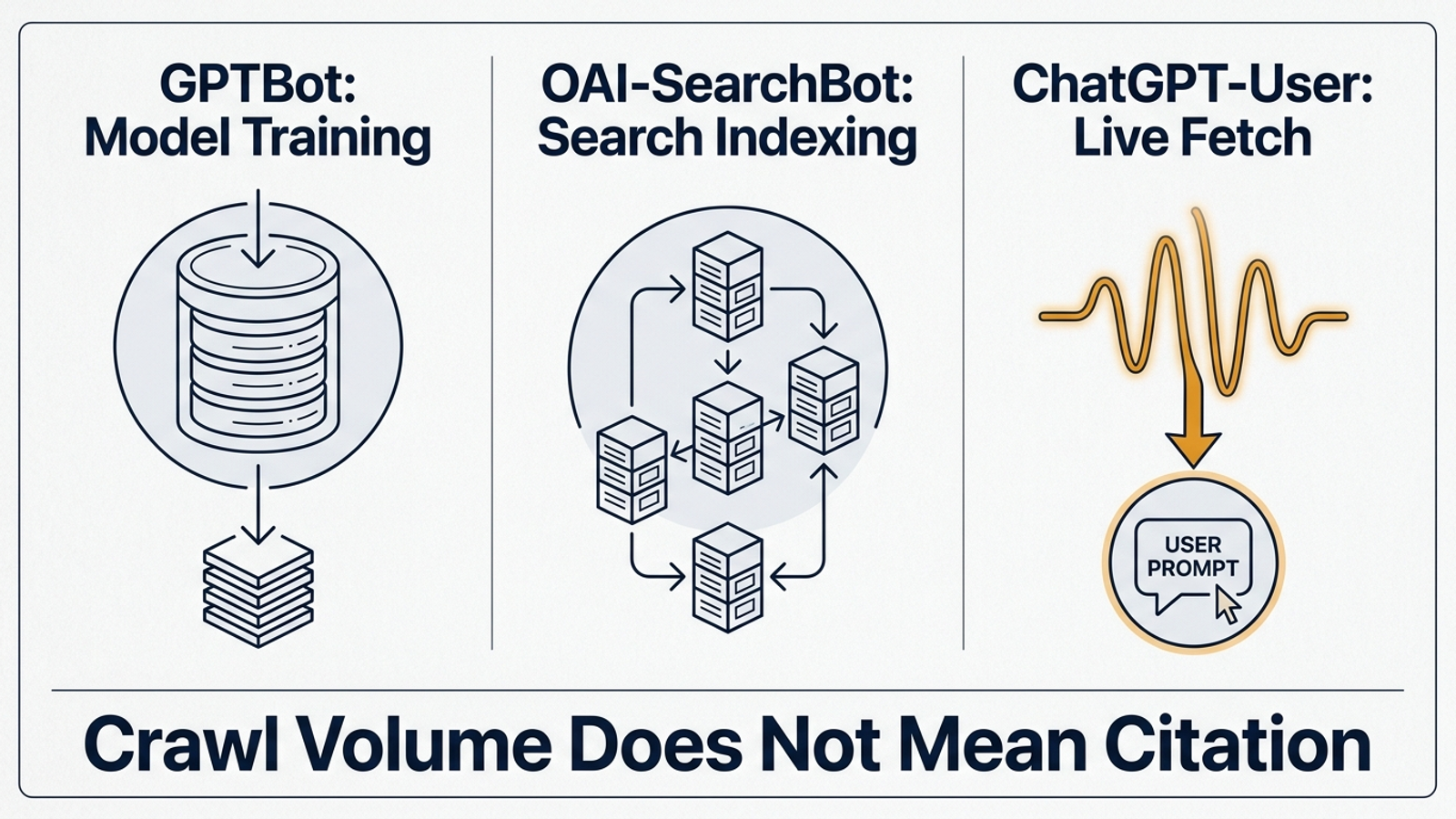
Server-log monitoring pitches have an effective hook: “See which AI models are reading your site.” Then comes a chart full of crawler requests, with the quiet implication that all those visits must turn into visibility. I spent enough time looking at Googlebot crawl logs to distrust that implication. A bot can spend its day on duplicate faceted navigation instead of revenue pages. A busy log is not a useful answer.
A fetch is not a citation. In seoClarity’s study of 308.6 million enterprise server-log hits, crawler activity and live citation visibility moved separately: citation visibility fell on major sites during the period examined while search-bot crawl traffic to those domains tripled. Counting requests alone would have told the wrong story.
The user agent matters, too:
GPTBotcrawls material for model training.OAI-SearchBotcrawls web content for search indexing.ChatGPT-Userfetches pages on demand in response to a user request.
Those are different activities, not three names for a citation. Promptwatch’s analysis of 71,060 AI requests also found traffic arriving in volatile bursts across engines, with ClaudeBot, ChatGPT-User, and GPTBot accounting for different shares. If your log shows GPTBot fetching your blog archive, record the crawl. Do not record a recommendation you have not seen.
Myth 5: “One AI Engine Gives Us the Whole Picture”
The shortcut is tempting: run your prompts through Perplexity, export its citations, and call the result your generative-search baseline. After all, the engines can draw on the web. Surely they draw on roughly the same parts of it?
Not reliably. In an analysis of 22.7 million citations across 531,889 identical questions across ChatGPT, Gemini, Perplexity, Google AI Overviews, and AI Mode, 79.6% of cited sources appeared on only one engine. Just 0.31% of websites were cited across all five. Even ChatGPT and Perplexity shared only 10.9% of their citation sources when answering the same question.
Conductor’s research on cross-engine source preferences describes differences in the kinds of sources these platforms favor. You do not need to memorize every preference to see the measurement problem: visibility on one engine does not stand in for visibility on another. If buyers might find you through ChatGPT and Google AI Overviews, a Perplexity-only report leaves both questions unanswered. Choose the engines you need to understand, then run the same relevant prompt panel across them.
Myth 6: “A Mention Is a Citation Is a Recommendation”
Software likes a single score. Buyers, unfortunately, encounter distinct things that a single score can blur. A brand can appear in an answer without a link. A page can earn a footnote while the answer recommends someone else. ZipTie’s discussion of how LLMs select sources calls out this mention-versus-citation divergence.
Picture a buyer asking Perplexity for the best CRM for field sales. The answer recommends Competitor A for routing and Competitor B for pricing, then links your documentation to support a detail about an API call. Your site earned a citation. Your product did not earn the recommendation. A blended “AI Visibility” score can conceal that difference behind the illusion of certainty Search Engine Land describes.
I would log three outcomes separately:
- Footnote citation: Your page supplied reference material, but the answer did not endorse your product.
- Entity mention: Your brand appeared in the answer without a linked source.
- Primary recommendation: The answer presented your product as a leading fit for the buyer’s stated need.
Do not give those events the same weight in a commercial report. The third is closest to the decision you care about, while the other two help explain how the answer was assembled. Rolling them together is like putting ad impressions, clicks, and closed-won deals in one column and calling the total “performance.”
Myth 7: “Monitoring Is the Work”
This is the hardest myth to kill because a dashboard can look productive even when nobody changes a thing. I saw the paid-search version for years: a 40-page monthly PDF reported that exact-match impression share fell 12%, while bids, match types, and negative lists stayed untouched. The report was detailed. The account was not better managed.
An alert that ChatGPT did not cite your page cannot create a citation. Before you act, you need to distinguish the missing mention from a missing source link or recommendation, inspect the answers and sources you can observe, and look for a content or crawlability gap you can actually address. Observation tells you where to investigate; execution gives the next measurement a chance to change. That is the premise of the 30-day citation test: log specific changes to live, crawlable assets, then check whether repeated model responses move against a baseline. A chart with no record of what changed is an expensive thermometer.
A small business can build a useful monitoring baseline in-house without buying an enterprise dashboard. The setup is not glamorous:
- Choose 20 to 50 conversational buyer prompts. Pull them from closed-lost reasons, onboarding conversations, and paid-search term reports. Keep the panel fixed for at least 90 days so a changing prompt list does not masquerade as changing visibility.
- Schedule repeated runs. A lightweight script or job can run the prompts through the OpenAI and Perplexity APIs three times a week. Keep the settings consistent between runs; if you use a temperature setting between 0.2 and 0.5, log it rather than quietly changing it mid-test.
- Record distinct outcomes. For each answer, note whether the brand was named, the domain was cited as a linked source, and the product was recommended rather than mentioned in passing.
- Review the trend, not Tuesday. Put the results in a spreadsheet and compare your 30-day moving average share of answers with the baseline. If recommendations appear in 12% of sampled runs in month one and 28% in month two, you have a change worth investigating. You do not yet have proof that one particular edit caused it.
That last distinction matters. When I changed a bid or an ad headline, I logged the timestamp. Without a change log, a conversion spike might reflect my edit or a competitor pausing spend. Treat AI visibility the same way: record when you publish a comparison guide, restructure schema markup, or earn a third-party review. Otherwise, your spreadsheet can tell you that citations moved but not help you work out why.
The script still will not write missing comparison content, fix crawl blocks, or manage the paid campaigns reaching buyers now. Traditional agencies often fill that gap with monthly calls and percentage-of-spend retainers. At groas, we built a fully autonomous growth engine around continuous execution, with specialized models handling content, crawl issues, and paid search while a dedicated human strategist sets direction and guardrails. That operating model is a better alternative to paying for periodic observations dressed up as progress.
By all means, build the simple baseline. Keep the prompt set fixed, repeat the samples, separate citations from recommendations, and log every change. Then ask what the monitoring led someone to do. If the answer is “we sent another chart,” you did not buy growth software. You bought the thermometer.