
Agencies are selling AEO the way we sold PPC in 2015: buy a tracker, put your logo on the report, mark it up to $900 a month, and call it a retainer. That is a reporting add-on pretending to be execution, and it will eat your margin as clients grow. I sold a version of it with rank reports. I was wrong then, and it is worse now because an AI answer has no page two to hide in. If you are adding AEO across 5 to 15 client domains, the service you need to deliver is the work that makes those clients visible, not a prettier account of where they are missing.
Myth 1: Prompt tracking is the service clients pay for
I understand why agencies believe this one. Rank reports helped support PPC retainers for years, so an AI visibility dashboard that checks ChatGPT and Perplexity every morning feels like a familiar sale with fresh labels. Profound’s tracking-focused model is a clear example: Lite starts around $499 a month, enterprise contracts typically run over $2,000 a month, and the offering includes SOC2, SSO and 10+ engines. Its monitoring does not include a content execution layer. You get the chart. You do not get the fix.
The mechanism is simple: a citation is an output, not an input. ChatGPT cites pages it can reach, read and trust, and skips the rest. Knowing you were not cited on Tuesday does not make you citable on Wednesday. What can change the answer is the work after the chart: repairing crawl blocks, rewriting the page into a direct answer, adding structure bots can parse and earning a third-party mention. Clients need the answer to change, not the graph to get prettier. If your vendor monitors the problem and leaves every fix to your already full SEO team, you bought a chore list.
Myth 2: White-label just means your logo on someone else’s dashboard
Agencies believe this because that is how many white-label guides describe the setup: your logo, colors and domain on the dashboard and PDFs, with automated digests sent from your agency domain. The report can carry zero vendor branding. It looks clean in a sales call. Same metrics logic underneath, same homework for your team, just your header font on top.
Clients can tell the difference by month two. A logo does not fix a page ChatGPT cannot read, and it does not write the replacement paragraph. White-label fulfillment that includes audits, execution and reporting makes a more useful distinction: the work happens under your brand without requiring you to add headcount for every task. If the vendor does not do the work under your name, you have not white-labeled a service. You have rented a PDF template.
Myth 3: Per-prompt pricing is fine until you scale
This one survives because the starter price looks harmless. Otterly lists $29 a month for 15 prompts, $189 for 100 and $489 for 400, with daily tracking; Gemini and Google AI Mode cost extra, and another 100 prompts costs $99. Peec’s pricing follows a similar shape: about $95 a month for 50 prompts, $245 for 150 and $495 for 350, with those tiers limited to 1, 2 and 5 projects. For one local client with 20 buyer questions, that feels cheap. I used to think about PPC tools the same way: buy the small plan now, upgrade when we grow.
The arithmetic at 5, 10 and 15 client domains
Say each client needs 30 buyer prompts tracked daily. That is modest once you cover services, comparisons and best-of questions:
- 5 domains: 150 prompts.
- 10 domains: 300 prompts.
- 15 domains: 450 prompts.
At 15 domains, even a 400-prompt tier is short before you add a new service or location. You buy overage blocks or split clients across workspaces. An agency comparison of AEO tools warns that per-domain and per-prompt pricing gets expensive fast at 15 to 50 clients. Client growth becomes a cost line. Every new retainer raises the software bill before you have shipped a fix. Then someone suggests tracking fewer questions to protect margin, which means the report becomes less useful precisely as the account gets more complex.
Myth 4: You need a developer for every client’s technical setup
Agencies believe this because technical SEO trained them to. Every client site has a different CMS, a different robots.txt and a different plugin holding the sitemap hostage. Budget two dev hours per onboarding and hope nothing breaks. The fear is rational: access is a gate. Cloudflare’s Agent Readiness work starts with whether AI agents can reach and read structured content, then asks whether they recommend the brand. I have watched a clean-looking site return a soft block to an AI crawler while loading fine in Chrome, usually because of a bot rule nobody remembers adding.
What edge-level setup changes
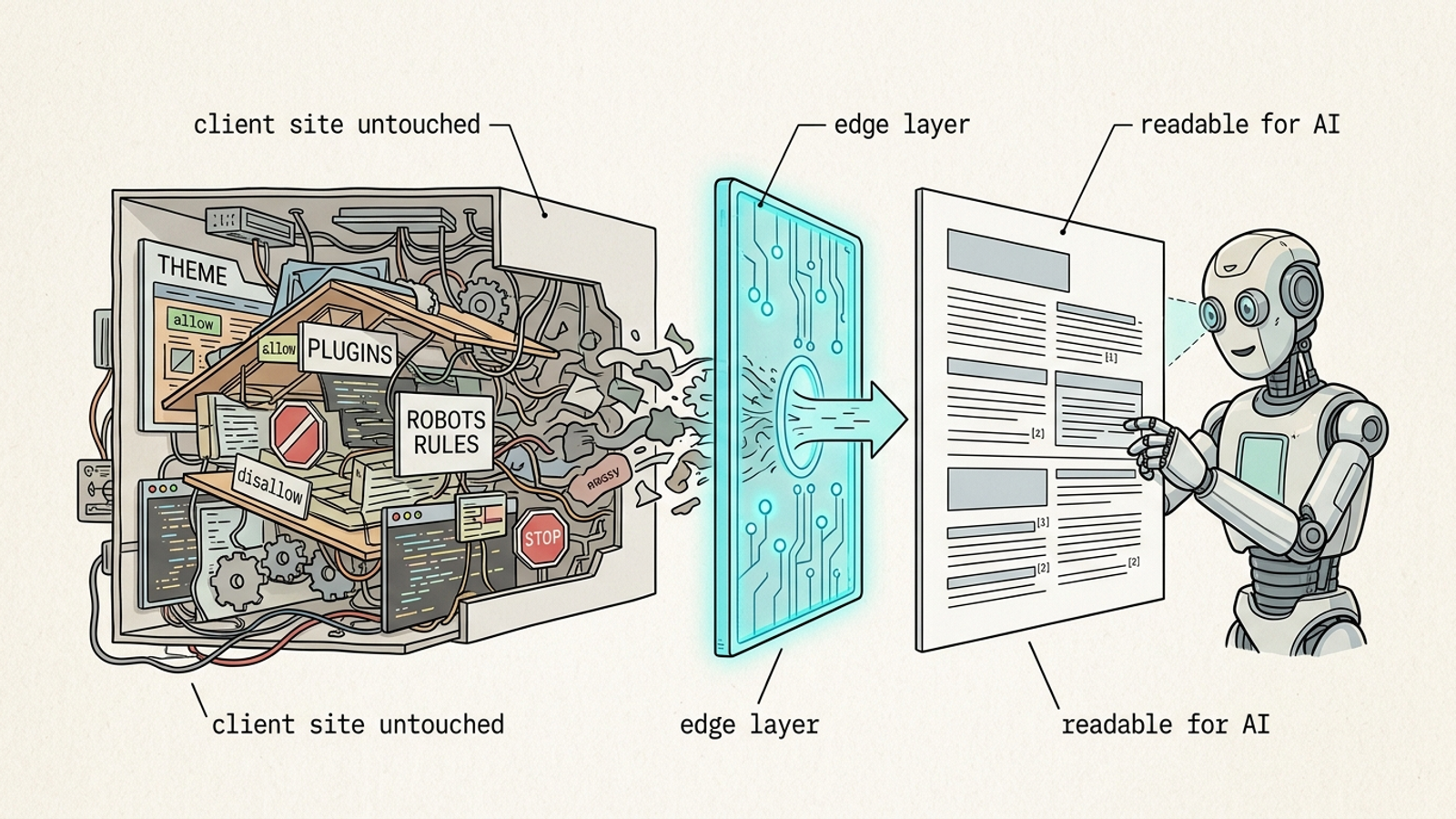
An edge layer can sit in front of a site and serve bots a readable version without changing the client’s theme, plugins or deploy queue. That changes the onboarding conversation. Instead of opening a development ticket for every readability fix, you can deal with that part of the problem at the edge. If your AEO tool requires core site changes for every client, you have bought yourself a dev queue. Check where a proposed fix actually ships before promising the client a quick turnaround. A crawl diagnosis is useful; a crawl diagnosis waiting six weeks for a release is still a wait.
Myth 5: AEO is SEO with a new acronym, so your SEO team already covers it
This is the most comforting myth because it appears to cost nothing. The team already writes title tags and builds links, so you relabel the monthly blog post as GEO and keep the retainer. I told clients a version of this when universal search arrived. I was wrong. SEO and AEO use different scoreboards: ranking and clicks on one side; citations inside answers and AI referrals on the other. The work overlaps. The failure points do not.
A page can rank third on Google and still be invisible to an AI buyer because the bot never loaded its JavaScript, because robots.txt blocks that crawler while allowing Googlebot, or because the copy buries the direct answer under 800 words of throat-clearing. The same AEO explainer makes the practical distinction: Google has no special AI Overview requirements, but a Cloudflare or robots rule can hide a site from ChatGPT entirely. Reusing the SEO team’s skills makes sense. Assuming its existing checklist catches these failures does not. Your SEO team can learn AEO; pretending it already covers AEO bills the client for work you have not done.
Myth 6: Clients will judge it by a ranking report
Clients will nod at a ranking report on the call and then cancel over the numbers that run their business. I learned this selling PPC with impression-share graphs while the client stared at booked jobs. An AI answer is stricter: there is no page two or position four to rationalize. Either the model names the client when a buyer asks what to buy, or it names someone else. Movement from unranked to mentioned on ten informational prompts means little if the five prompts with purchase intent still cite the competitor. Report citations if you want. Expect to be judged on AI referrals, calls and qualified pipeline.
Myth 7: Done-for-you means losing control of client sites
Agencies believe this because they have lived the alternative. A vendor publishes AI-written pages straight to production, breaks a template or rewrites copy the client’s legal team approved word by word. After one rollback at 11pm, every outsourcing pitch sounds like handing over the root password. So owners keep execution in-house. Not because in-house is fast, but because in-house is reversible. That caution is sensible. Keeping every fix queued behind a two-person content team for six weeks, though, is how you lose the citation while keeping control of the failure.
Control was never about who types the paragraph. It is about who approves what goes live and who can see what changed. The agency version that scales is guardrailed execution: an engine drafts the fix and content change and proposes the citation work; your team approves per client; publishing happens at the edge or through the existing CMS without touching the theme. Actions are logged with their reasoning, and pages can be reversed. If a vendor asks for blind publishing rights, walk away. If it leaves all publishing to you, you did not buy execution.
The three-question buying test for AEO software
Before you resell anything, run the math the way a client will run it on you in month three. Agency GEO pricing shows the pressure: 54.3% of agencies raised prices in 2025 to 2026, with 37% citing GEO as the reason; GEO often appears as a $900-a-month add-on, while focused retainers sit at $2,000 to $5,000 a month. White-label resale typically needs a 40 to 60% margin to survive. If your cost rises with every prompt, every domain and every fix handed to a developer, that margin starts disappearing before the report goes out. I put vendors through three questions, in this order:
- Does my cost stay flat when a client grows? If adding 30 prompts or one more location raises the bill, you are reselling usage, not a service.
- Does white-label include the work, or just the logo? If your team still has to turn every dashboard finding into a fix, count that labor before you quote a retainer.
- What changes without a developer ticket? If crawl access, readable pages, content and citations cannot move without client dev time, you have a recommendation queue, not an execution service.
That is the margin test. My longer set of buying questions for agencies comes back to the same pressure points: caps, setup burden and execution depth matter long before the report template does. A flat per-domain price is useful when it pays for fixes, content and publishing rather than merely flattening the bill for a tracker.

The myth I still can’t kill
It is Myth 1: tracking is the service. It survives because it feels like work. A dashboard updates every morning, the client sees their name in green, and your team forwards the PDF with a note. Everyone feels busy. I kept a PPC client for eight extra months on good-looking impression-share graphs while booked jobs went flat, so I know how comfortable that feeling is. But an AI answer does not grade on effort. Either your client’s page is readable, structured and backed by a citation the model trusts, or another brand gets named and your report explains why you lost.
That is why I keep arguing for flat per-domain execution that covers fixes, content and publishing under your brand. When cost does not rise with every prompt and the work actually ships, you stop selling visibility reports and start selling answers that name your client. Everything else is 2015 again with better fonts.