

 LinkedIn

Your client opens ChatGPT in a sales meeting, asks a question your AI search report claims to cover, and gets no mention of their company. The failure is visible before you can explain the slide. This list is for agency owners and freelancers reselling AI search and traditional SEO under their own brand. Each of the seven failures has a question to ask before a pilot client puts your name on the work.
1. Catch the vendor name before your client does
It starts with something small. A status update comes from a Gmail address your client has never seen. A dashboard loads on someone else’s domain. A PDF footer says Generated by followed by a tool you never mentioned. The client asks who that company is, and you spend the next call explaining your fulfillment model instead of talking about their leads.
I used to think a PDF with our logo was enough. I was wrong. The lightest version of white-label is often just that: a static report that still leaks the vendor name in a footer URL, favicon or forwarded notification. A fuller setup covers the dashboard, domain, branding and email sender, not just the export. One reseller guide calls rebrandable reports and dashboards non-negotiable. The reason is less glamorous than the sales deck: clients click links.
Start by requesting the exact report and dashboard a client would receive. Open every link, forward the report to yourself and check who sends any notification. Then ask the question the demo rarely answers: Who ever contacts my client, and through what channel? A good answer is nobody, with communications routed through you and a written NDA and non-solicitation clause to back it up. Agency owners name client poaching as a top white-label fear. Do not settle for a verbal promise that the vendor will “respect the relationship.” If their name or message can reach the client without you, you have not bought a white-label service. You have bought a future explanation.
2. Put one owner in charge of every page
Say you hire one vendor for classic SEO and another for AI search. Both edit the same service page. The AI vendor turns it into a neat Q&A block; the SEO vendor changes it back to serve search intent and internal links. Rankings slip while AI mentions rise. The client asks which vendor broke Google. You own both contracts, so you own the answer.
The split sounds tidy on an invoice, but the work overlaps. Many pages cited by AI engines already rank well in classic search, and an Ahrefs study of 1.4 million ChatGPT prompts found that 88% of cited URLs came from web search. The same pages feed both efforts. Two teams working from separate audits can duplicate research, issue conflicting instructions and leave you to arbitrate every change.
Before you sign, give a prospective partner one URL and ask how they would handle it across both channels. Do you run SEO and AI search as one plan? Look for one roadmap, one approval path and one owner for changes to that page. If the answer is two teams and two sets of recommendations, price your coordination time honestly. I laid out the margin implications in one SEO plus AI search partner or two vendors. The practical rule is simple: one owner per URL, or do not resell the work as one coherent service.
3. Stop disputed claims before they go live
AI drafts read fluently. That is exactly the danger. A polished paragraph states your client’s pricing, warranty or process with total confidence and gets it wrong. It publishes under their brand, a prospect quotes it on a sales call, and the sales manager asks who approved the page.
I used to tell clients AI content needed only a quick skim. I was wrong. Clumsy copy invites scrutiny; fluent copy can pass through an overloaded approval queue looking finished. The mechanism is not mysterious: a draft becomes a public claim unless someone checks it against what the client actually sells and how the client describes it. A named human needs to verify claims against a real source, using a checklist and claims-verification step, before anyone presses publish.
Map the workflow before the pilot. Who drafts? Who checks facts? Who at your agency gives final sign-off? Who handles a client correction? Then ask: What is the approval step before publishing? A shared document is not an answer unless someone owns the decision recorded in it. Direct publishing to the client’s site without that gate is worse. No approval gate, no resell.
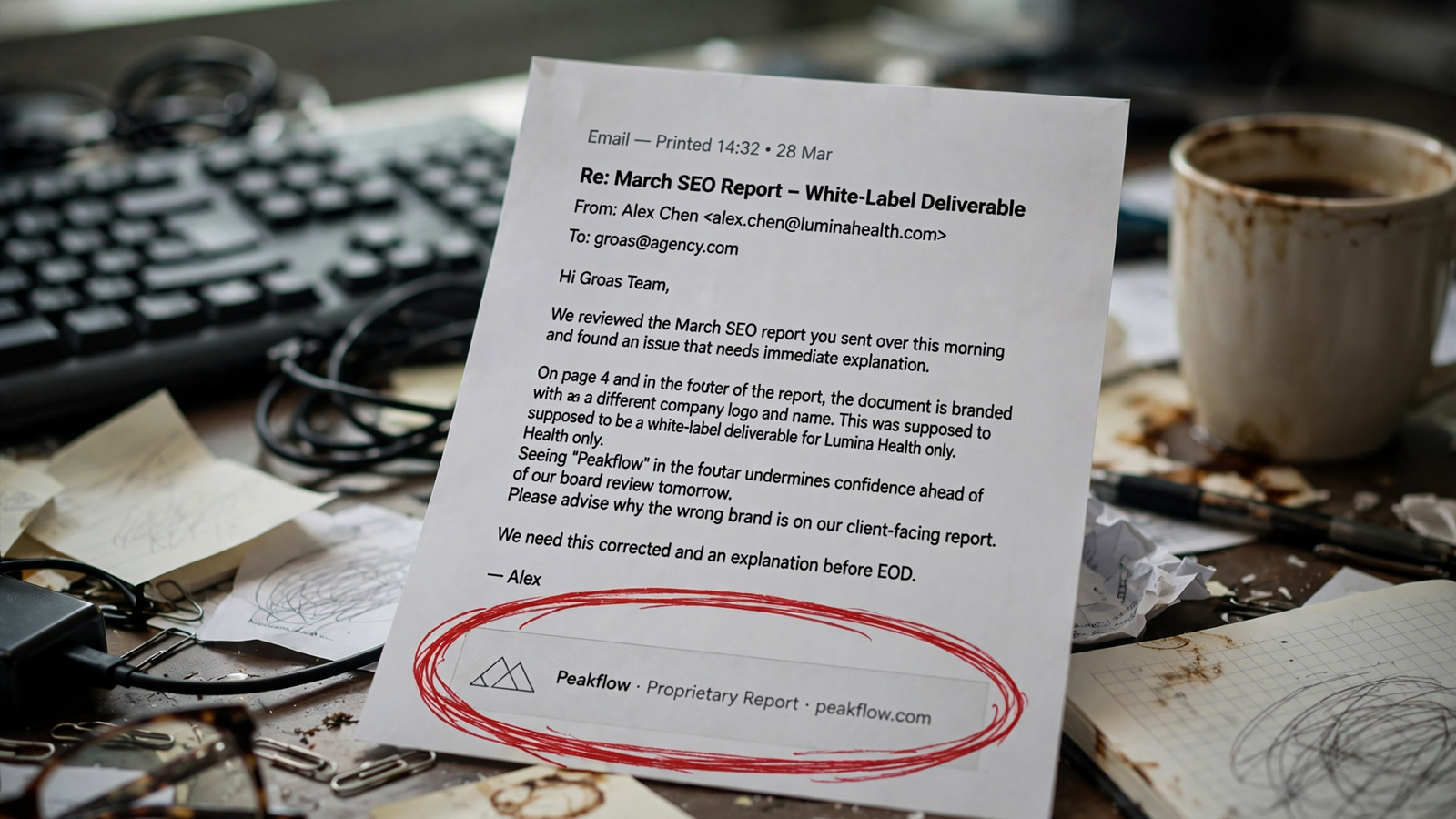
The forwarded email from entry one and the disputed page have the same problem. The client does not need to audit your process; they only need to find the artifact you failed to rebrand, verify or own. Content hurts more because their team has to defend the claim. Before buying a tool to check an AI content plan, run the prompt audit in before you buy an AI visibility tool, audit your own prompts. If you cannot reproduce the questions behind the plan, you cannot confidently approve what it publishes.
4. Inspect placements before they carry your client’s name
AI answers have to cite something, so a lazy provider hears citations and starts stacking placements anywhere that will take a link. A client finds one by accident: a personal injury firm quoted between coupon codes, or a SaaS brand listed beside casinos. Then comes the call where you explain why their name sits there.
This is old SEO rot in new packaging. Google lists buying links or participating in link schemes to manipulate ranking as a violation. A human reviewer can issue a manual action that keeps some or all of a site out of search results. Even without a penalty, a placement your client would be embarrassed to show a prospect is a poor thing to sell them.
Ask for evidence you can inspect, not a slide about “authority.” Give me ten examples of placements from last month. Click all ten and read the surrounding page, not just the link. The standard to put in writing is straightforward: placement URLs shared, link-building standards stated, client ownership of accounts and content, and an SLA. If a provider will not show you live URLs before you sign, assume you will not want to show them to your client afterward. No list, no resell.
5. Price the eighth client, not the first
The first client looks profitable. By the eighth, your team is reviewing reports, answering questions and managing approvals while the wholesale bill keeps arriving. That work belongs in your cost model, even if the vendor’s price sheet pretends it does not exist.
One loaded-cost example puts the numbers at $900 wholesale plus $625 for your own account, reporting and communications time: $1,525 all in. Resell a $900 wholesale service for $1,800 and, on that model, you keep $275, or about 15%. Typical wholesale ranges in another guide run $300–$900 a month for local, $900–$2,500 for mid-market and $2,500–$6,000-plus for ecommerce. A 2–3x resale price can produce a healthy gross margin, but not if you forget review time, tools, strategy and risk.
AI tracking adds another meter. Prompt libraries and daily checks can consume credits by client and engine. At 25 prompts across three engines daily, one comparison priced Otterly near $26.20 per client at 30 clients, versus Profound near $402.30. It also notes that unlimited clients can mean unlimited workspaces, not unlimited tracking. Credits are still a cap.
Before the pilot, build a margin sheet with your own review and communications time beside the vendor fee. Then ask: Is pricing flat per account regardless of the client’s size? If prompt count, engines or reporting seats change the bill, get the full table in writing. Model the margin at eight clients, not just one; scaling a thin margin gives you more work, not a better business.

6. Get the exit terms before you need the exit
The ugliest failure can happen after you cancel. Logins stop working. Scheduled pages vanish. Then an email says content the client already paid for was licensed, not sold, and has to come down. You get to explain why leaving your vendor may mean unwriting the client’s website.
Contracts can create that problem by separating licence from assignment. Some providers keep the IP and grant a licence that ends with the engagement. If the agreement says licence, check what happens when it expires. If the work is assigned on payment, the ownership position is different. Do not leave that distinction for the cancellation call.
Read the exit clause before you read another testimonial. What do I keep if we part ways? The answer should name pages, links and placements, logins, Search Console and GA4 history, reports and the prompt library. Put the keep-list alongside client ownership of accounts, data and content, plus a written SLA covering branding, direct contact, non-solicitation and handover. This is why I take the groas position seriously: your accounts, pages and data stay yours, with work done behind agencies under their brand. Get the keep-list in the contract, not the sales call.
7. Demand the prompts behind every AI visibility claim
The report looks confident. Mentions up 22%. Share of voice at 14%. Your client nods, then asks the question that kills the meeting: mentioned where, for what question, on which date? If you cannot show the prompts and raw answers, you have just taught the client that your reporting cannot be checked. I have seen that trust gap close a retainer faster than bad results ever could.
The problem is the hidden denominator. A vendor can run a small prompt subset and present the result as broad visibility, even though precise percentages depend on what was tested and can swing with model changes. Prompt-level work may call for 200–500 prompts across the buying journey, tracking inclusion, position, framing and sentiment, not ten keywords presented as the whole market. One tracker saw a brand swing from 0% to 19.6% day to day; single-day snapshots need context such as multi-day averages, a date range, the prompt list and the denominator.
Start with the client’s sales calls and support tickets: collect the questions buyers actually ask, then see whether the vendor’s prompt set covers them. Show me the prompt list and the raw answers. A useful response includes the full list, the date range behind each percentage and the answer text. A monthly slide alone is not proof. If the vendor will not show the test, you cannot resell the score.
This is the question I would ask first. Not because a bad email, disputed page or ugly placement is harmless, but because an uncheckable measurement makes every promised improvement harder to challenge before the client does it for you. If a client’s first question is whether they appear in ChatGPT, you can share an open letter to the SEO agency owner asked, are we in ChatGPT after you have done the vetting yourself. Your name goes on the work. Ask for the raw answers before it does.