If you are the one who has to answer your SEO client’s email asking, “Are we in ChatGPT?”, do not send a visibility dashboard. I watched PPC agencies sell reports for years. Your client’s next question will be the same one that exposed those retainers: What did you actually change?
You may already have spent twenty minutes testing their brand in ChatGPT and Perplexity, followed by another twenty looking for white-label AEO software you can put your logo on before Friday. I understand the impulse. A dashboard feels like something you can send while you work out what to do. It is not the work.
Dear agency owner: the clock starts with that email
In practitioner discussions among agency owners wrestling with generative engine optimization, this question is already familiar. The mistake that follows is familiar, too. You buy a monitoring tool, export a neat PDF showing the client appears in 12% of target queries across Claude and ChatGPT, and say you are “actively monitoring their generative search presence.”
That may buy you a little breathing room. Then the client asks why the percentage has not moved. Eventually they ask the question a report cannot answer: “What did your team actually change on our website this month?”
Hear the question behind “Are we in ChatGPT?”
Your client is not asking you to become a weather forecaster for search results. They are asking whether you are protecting their business while buyer behavior changes. According to white-label SEO benchmarks in 2026, agencies are trying to deliver AI visibility without blowing up payroll on specialist hires or sacrificing their 20% to 50% margins. I get why a ready-made score looks attractive under that pressure.
But if your answer is a page of share-of-voice gauges, you have turned your agency into an expensive weather station. You are charging $2,500 a month to tell the client it is raining while nobody is building an umbrella. The first useful answer is not a score. It is a plan for work you can show them.
I have seen this movie in Google Ads
When the report became the product
I spent almost a decade in paid search watching agencies slip into this trap. An agency could charge a $3,500 monthly retainer, pull automated charts from WordStream or Optmyzr, spend two hours pasting them into a slide deck, and run a call about healthy impression share. Formatting twenty slides takes time. That does not make the slides account management.
The uncomfortable question was always specific: “Which ad tests, bid caps, or negative match lists did you launch between the 1st and the 30th?” If nobody could answer, the client saw the gap between reporting on performance and doing something to improve it.
I am not arguing against measurement. I am arguing against selling observation as execution. SEO agency owners are at risk of repeating that sequence with generative search. As practitioners note in discussions of AI search tracking flaws, prompt tracking captures changing retrieval samples. Answers change; sources change. A dashboard testing twenty prompts once a week can show you something worth investigating, but it cannot, by itself, show that your client has built durable authority.
The engine will not start citing your client because you bought software that watches it ignore them. Keep the report as a diagnostic, not the retainer’s main event.
Ask what the AEO software actually does
Monitoring tells you where to look. Execution changes the site.
Much of what gets sold as agency AEO software is an alert layer. A survey of dedicated AI search visibility software puts average subscriptions around $337 a month, with agency plans ranging from $99 to beyond $500. In return, you may get a portal showing where a client is absent, which competitors are cited, and how sentiment appears to shift.
That information can help you choose the next job. It is not a modified line of code, a rewritten answer, or a published page. Somebody still has to do the job.
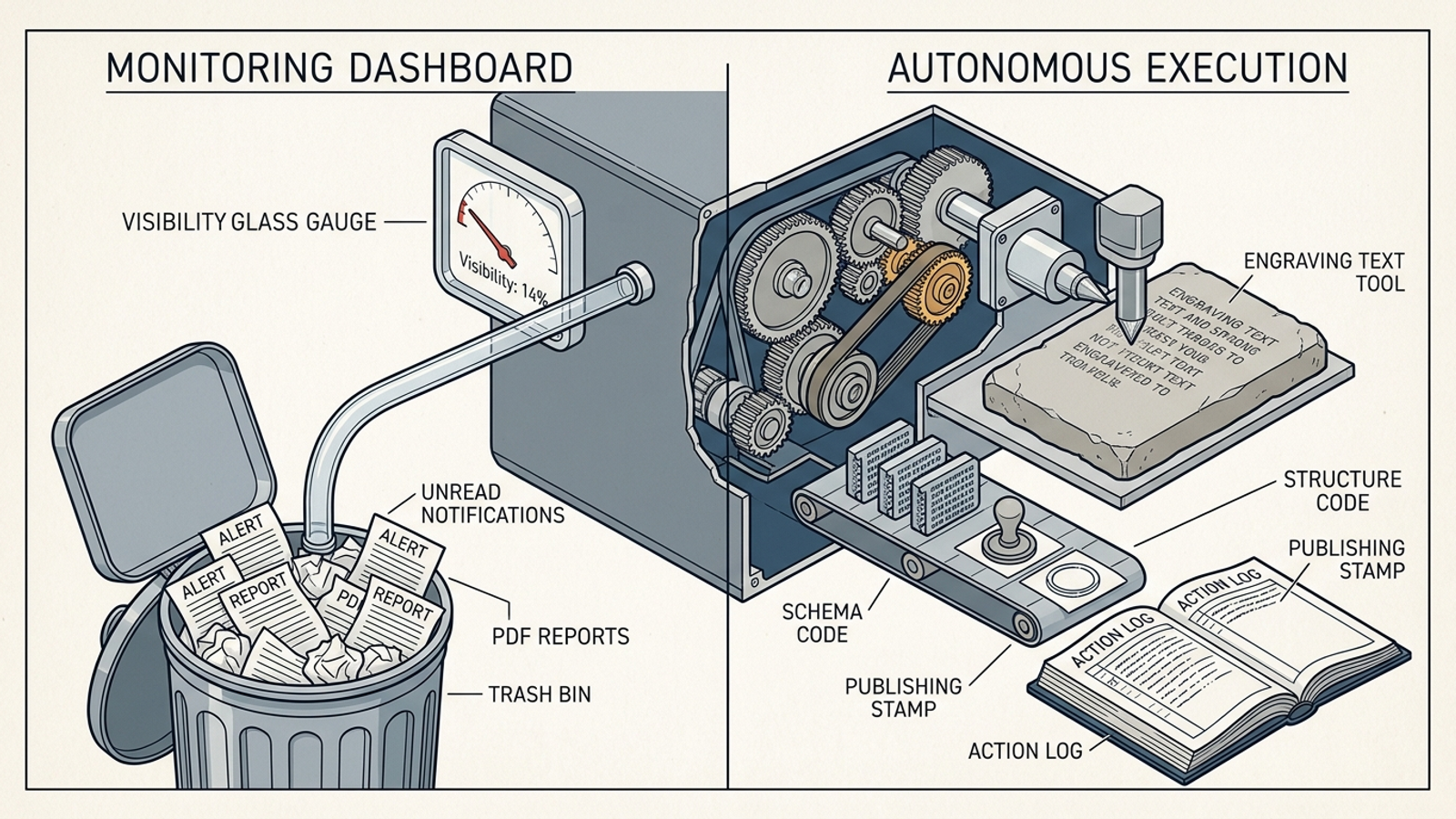
Tools built primarily for in-house brand managers, such as Profound, Peec AI, or Otterly, can leave your agency with recommendations your existing staff must resolve. Your engineers are not sitting idle, waiting to patch client CMS templates, add schema, and write forty new direct-answer pages every month. If a tool drops eighty unexecuted tasks into your account manager’s inbox on Monday, you have not bought scalable white-label delivery. You have bought a chore list with a login screen.
That distinction matters most when the client asks for proof. You can point to a chart and explain that visibility is volatile, or you can point to work completed on their site. Buy the second capability before you buy another chart.
The action log is the deliverable
A visibility score is not an input a generative engine reads when deciding what to cite. The work is in the material it can find and use: clean HTML, clear answers to buyer questions, and coherent signals about the brand and its subject matter. Tracking can tell you where to investigate. Changes to content and technical structure give you something to investigate after you have acted.
When the client asks what they paid for in month three, give them an auditable, timestamped record: which pages were drafted or updated, which technical barriers were addressed, what went live, and what remains to be done. Do not claim a citation was earned if you only attempted to establish one. A useful log separates the action you control from the result you are watching for.
That is the retainer I would rather defend. Sell logged execution, not a prettier visibility score.
The retainer math punishes unfinished work
Compare per-prompt costs with flat per-domain delivery
You already do this calculation when you quote an SEO retainer. Agency retainer margin benchmarks put software and third-party fulfillment costs at roughly 15% to 20% of the client fee if you want to protect gross margins of 45% to 65%. On a $1,500 monthly retainer, that leaves about $225 to $300 for those costs. It is not the entire delivery budget: your team’s labor still has to fit in the economics of the account.

Now look at how monitoring can expand. A breakdown of entry-level tracking software like Otterly.ai describes a $29 starter tier covering 15 prompts across four engines. Tracking 100 buyer-intent queries raises the price to $189 a month, with additional fees to include Google Gemini or AI Overviews. A low entry price can be real and still tell you very little about the cost of serving a growing client list.
Here is an illustrative agency calculation using the monitoring costs and $50-per-hour labor assumption shown below. It is not a vendor quote. It shows the cost you still carry when software identifies work but your people must do it:
| Active client domains | Monthly monitoring SaaS cost | Labor to act on alerts | Total monthly delivery expense | Gross margin on $1,500/month retainers |
|---|---|---|---|---|
| 5 | $450 | 35 hours ($1,750) | $2,200 | 70.6% |
| 10 | $1,150 | 70 hours ($3,500) | $4,650 | 69.0% |
| 15 | $1,950 | 105 hours ($5,250) | $7,200 | 68.0% |
At fifteen clients, that is nearly $2,000 a month for monitoring before the team spends another $5,250 acting on what it finds. The table’s margins are not terrible on their face. The problem is what those hours have to cover, how costs grow with scope, and whether the client can see enough completed work to keep paying the retainer. A healthy-looking percentage does not rescue a delivery model your team cannot sustain.
A flat per-domain model changes what you have to manage. With groas for agencies, autonomous execution takes on crawl fixes and content work, while updates are logged under your agency’s brand. The contrast I care about is not “AI versus people.” It is paying to identify another task versus paying for a system that carries it through, with a human responsible for direction and guardrails. Your account managers can spend less time moving recommendations between tools and more time owning the client relationship.
Put five questions to the vendor
A product demo will have citation charts and sentiment timelines. Fine. Let the sales rep show them. Then ask what happens on Monday morning, when your client expects a change rather than another screen share. I would ask these five questions before signing:
- “Does your platform make changes in the client’s CMS, or does my account manager have to copy and paste recommendations?” If it stops at CSV exports, Jira tickets, or PDF audit lists, you still own the implementation workload. Price it that way.
- “What happens to our cost when the client wants 50 more buyer prompts or wants to test Claude and Gemini?” Per-prompt and per-engine tiers can turn a sensible expansion of scope into a margin problem. Get the answer before you promise coverage.
- “How do you distinguish a useful visibility signal from variation in model answers?” A client appearing on Tuesday and disappearing on Wednesday is not, by itself, a trend. Ask what the vendor’s score measures before you put it in a client report.
- “Can we export a white-label action log showing the technical and content updates completed this week?” A client asking what they bought needs a record of live work, not a sentiment chart with a new color.
- “When visibility drops after a model update, who diagnoses the gap?” Find out whether an experienced strategist owns direction and can answer for the work, or whether you are left interpreting an automated alert alone.

This is why we built groas earned search around autonomous execution rather than advisory alerts. Specialized models work on landing-page answers, technical schema, and entity citations around the clock. When an agency partners with groas, a dedicated senior strategist supervises the account within client guardrails, and the agency can send white-label logs of what was delivered. The brand does not have to ask its account manager to turn another recommendation queue into next month’s slides.
You still have to own the promise you make to the client. Ask for evidence of completed work, not just a tour of the interface.
Who should ignore this letter
If your agency charges $25,000 a month for quarterly strategic governance to Fortune 500 CMOs, you may not need this delivery model. Those clients have internal engineering teams and buy a different kind of engagement. If your core deliverable is high-level brand positioning rather than attributable pipeline, a visibility dashboard may suit the conversation you are paid to have.
I am writing to the agency owner billing $1,000 to $5,000 a month for search retainers. Your clients are founders, marketing directors, and local business owners running lean teams. They do not read monthly slides for the pleasure of colorful graphs. They hire you to protect their customer pipeline as buyer habits shift.
You do not have to pretend every model answer is controllable. You do have to be able to say what your team changed, what went live, and what you are checking next. If your response to the ChatGPT email is only an advisory memo explaining that generative search is complex, the client will look for someone who can do the work.
P.S. What I would say tomorrow morning
Reply without the defensive jargon, and do not attach a monitoring screenshot as your answer. You can be candid about what you need to assess without claiming you have already audited the site. Give the client a concrete execution plan, then log what actually happens:
“We’re checking the buyer questions your customers ask in AI search and whether our key pages give those systems clear, useful answers. A visibility score alone won’t fix a gap. Over the next 30 days, our plan is to review our five highest-intent pages for direct answers, address the technical crawl barriers we find, and work on the entity citations we can substantiate. We’ll send you an action log every Friday showing what content and technical updates have gone live, what is still in progress, and what we’re seeing afterward.”
Do not send that note unless you can staff the work behind it. The point is not to replace a dashboard with a more convincing promise. It is to give your client an answer you can keep giving every Friday.
Alexander