

 LinkedIn

A Meta agency can raise your ROAS while starving your business of new customers. If that number climbs three months in a row, ask what got cut to make the chart look good.
I used to make that trade when I managed accounts by hand. The client wanted higher return on ad spend, so I moved budget into retargeting and past buyers and pulled back on broad prospecting. Meta can count a purchase within 7 days of a click or 1 day of a view, even when the ad did not create the sale. Platform ROAS climbed. New customers flattened. The dashboard got prettier while the business lost its source of future buyers.
Hiring for ROAS invites the wrong work
The standard buyer brief sounds responsible: find the best Meta ads management company for ecommerce, then pick the one focused on improving ROAS. I read it as an invitation to shrink the business slowly enough that nobody notices for two quarters. A manager paid to improve a reported ratio will feed that ratio the cheapest conversions. Often, those conversions come from people who already know you. The brief rewards the agency for finding the easiest sale to claim, not the next buyer the business needs.
Combined platform-reported revenue often runs 20–40% above actual store revenue. The same buyer can appear in prospecting and retargeting reports, while organic and branded demand still bring people to the store. An agency can claim credit for a purchase without having caused it. That distinction disappears quickly when the monthly report leads with one blended number.
The 1-day view window makes the problem plain. Someone scrolls past your video, buys the next morning because they already had the product tab open, and Ads Manager claims the sale. At the budget meeting, retargeting looks efficient because it catches people already about to buy. Say you spend $20k a month. Move $5k from broad prospecting into site visitors from the last 30 days and reported ROAS can jump in a week. The manager can point to the improvement without showing how much less the account now spends finding strangers. Nothing about your business has to improve for the chart to move.

How cheap ROAS gets made
Meta and the agency report against the same in-platform results. When broad prospecting wobbles, the easy response is to shift delivery toward warm audiences, retargeting pools, and repeat buyers. They convert more readily, so reported CPA falls and ROAS rises. That is the growth-ceiling trap: the account gets better at collecting credit from existing demand instead of creating new demand. I watched the path of least resistance win in accounts I ran myself. Reported ROAS recovers in days while prospecting starves for months.
The gap between reported and incremental results can be large. In matched geo-holdouts, prospecting was about 93% incremental while remarketing was about 39% incremental. Roughly six in ten remarketing conversions claimed by the platform would have happened anyway in those tests. A separate Haus analysis of 640 Meta experiments found new customers drove 70% of measured impact in Advantage+ and 65% in manual campaigns, even though retargeting accounted for only about 15% of spend. Retargeting finds people already holding the product in their head. That is credit without much creation.
Advantage+ can accelerate the drift. In one analysis of 55,661 Meta campaigns, average Advantage+ new-customer cost rose from $257 to $528 in a year while manual campaigns got cheaper. Last-click ROAS stayed strong as first-click ROAS fell. Read that slowly. The system looked better at being last and worse at finding the first reason to buy. A blended ROAS report will not show you that switch. If the report cannot distinguish a new buyer from a returning one, it cannot tell you which kind of growth you bought.
The warning signs are in your store, not the slide deck
ROAS up and first-time buyers flat is the tell. Count first-time buyers by month in your store data, then put that line beside Meta’s reported ROAS. If one climbs while the other stalls, you are not scaling. You are harvesting. Look for overfed retargeting, high-frequency loops, view-through credit, and Advantage+ drift toward repeat-heavy audiences. I used to tell clients that high retargeting ROAS proved the creative was working. I was wrong. It proved the audience was already close to buying.
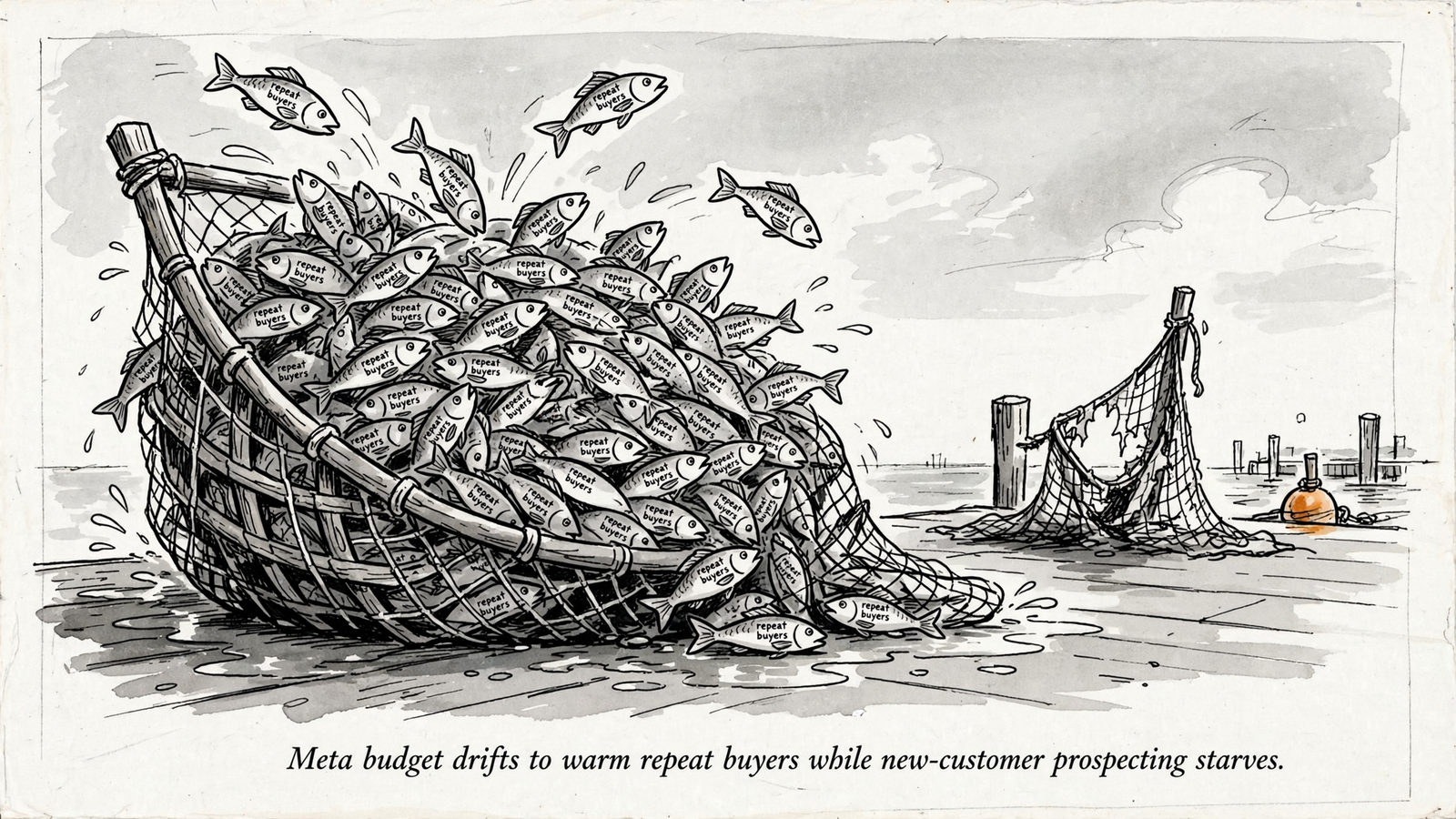
Then check the budget split. Open the last three months. If prospecting went from 70% to 50% to 30% while the report celebrated better ROAS, that is not optimization. That is retreat. Creative testing slows next: one proven retargeting ad runs for 90 days, frequency climbs, and nobody makes anything for strangers because strangers make the chart look worse. The shrinking prospecting budget gives new creative less room to prove itself, which makes the next budget shift toward retargeting easier to defend. When testing stops, growth has already stopped.
Hire for first-time buyers at a sustainable cost
Stop making blended ROAS the headline. Ask for new-customer acquisition cost, or nCAC, alongside first-time buyer volume. Start with a store-counted check: total Meta spend divided by first-time customers in the same period. That is not proof Meta caused every purchase; it is a number your agency cannot improve just by claiming more view-through credit. Read it alongside buyer volume, not in isolation. A lower cost is no victory if the account reaches fewer new customers. Use a holdout to test what the ads actually added.
Meta offers a lever through its Customer Lifecycle Strategy, available to all advertisers since October 6, 2026: a Sales ad set can exclude existing customers, though only the ones Meta can match from lists you supply. Remove those cheap conversions and reported ROAS will usually drop. That drop is not automatically bad news. Judge the change by whether store-counted nCAC falls while first-time buyer volume rises. The point of the exclusion is not to make a different chart look good. It is to make the account do harder work.
Across more than 10,000 campaigns, 64% of incremental conversions were new-to-brand. So when an agency shows you a 4.2x and cannot tell you what share came from new buyers, it is showing you the receipt without the meal. Demand prospecting and retargeting results separately, with first-time buyer counts from Shopify or your CRM beside them. If prospecting nCAC rises while blended ROAS holds steady, you are paying more to grow less.

Make a ROAS jump survive a holdout
A sudden ROAS jump on flat spend and unchanged creative deserves suspicion. I have seen one after a settings change, after an attribution-window change, and after nothing obvious at all. The test I trust is a holdout. Exclude one geography or audience segment for 2 to 4 weeks, then compare its revenue with a similar exposed segment. The gap, not the platform’s claim, is the lift you are trying to buy. Agree on what you will compare before the test starts. Otherwise, a disappointing result can turn into another argument about which dashboard deserves to win.
Between full tests, use True ROAS as reported ROAS times your incrementality factor. The factor is incremental conversions divided by reported conversions. Say Ads Manager claims 4.0x, but your holdout shows that only half those claimed sales were created by the ads. True ROAS is 2.0x. That second number is the one that pays rent.
The math tends to hurt retargeting first, which is why you should run it. It is the same lesson from Google: set target ROAS too high and volume can collapse as the algorithm chases the ratio over profit. On Meta, the collapse is quieter. Ads Manager keeps showing conversions while the store stops gaining new customers. Run a holdout once per quarter and the conversation with your manager changes. You stop arguing about credit and start arguing about creation.
Ask these questions before an agency gets your budget
Do not ask for an agency’s average ROAS. An agency that harvests demand can have a great average. Ask for the operating model behind it, in writing:
- What new-customer cost will you report? Have them calculate it from Meta spend and first-time buyers in your store, and name a target for the first 90 days. Ask for the buyer count beside the cost so a smaller acquisition program cannot pass as progress.
- Will you separate prospecting from retargeting? Ask for a sample monthly report showing each one’s spend, reported revenue, and first-time buyers. If they show only blended results, they can hide in blended results.
- How much credit comes from views? Ask what share of reported conversions had no click, and what ROAS remains without that view-through credit.
- What happens when existing buyers are excluded? Make them explain how Advantage+ sales and manual structures handle existing customers once those cheap conversions are removed.
- Will you agree to a holdout before spend scales? Put the excluded geography or audience, test length, and lift needed to justify more budget on the page. Hesitation here tells you how much they believe their own numbers.
Those are not gotcha questions. They are the minimum needed to tell a business that creates customers from one that claims them. Get the answers before the agency has a good-looking month to protect.
Who should skip a new-customer program
This does not fit every account. If you sell a single-purchase product with almost no repeat buying, retargeting people who have not bought yet can be rational. Mattress protectors, chimney liners: the thing people buy once and never think about again. Capturing existing intent may be the job, though it still does not make every claimed conversion incremental.
The same practical limit applies when spend is too small to split prospecting and retargeting without starving both. Say you spend $2k a month. Two $30-a-day ad sets with separate exclusions may struggle to exit learning. Hire for simple creative volume and clean tracking instead of a complicated new-customer program. A standard industry ROAS benchmark cannot tell you whether that account is profitable, either. Margin and repeat rate decide break-even, not a category average.

For everyone else selling repeat-purchase ecommerce, the brief is blunt: nCAC down, first-time buyers up, blended ROAS kept as a diagnostic. That is how groas runs Meta ads at a flat fee of $1,499 a month, with audiences, budgets, and creative worked around the clock rather than reviewed once a week. There is no cut of spend, so nobody on my side gets paid more for parking budget in warm audiences. Changes come with reasoning in plain language, and a named strategist owns the store-counted new-customer number. It is a different incentive from the percentage-of-spend model I used to bill under, where more spend against the same past buyers meant a larger bill.
Keep hiring for reported ROAS and you will get exactly what you asked for. The chart will rise, prospecting will shrink, and creative will narrow to safe retargeting winners. Then the warm pool runs dry, acquisition costs spike, and the manager who shifted the budget will propose more spend to fix it. Buy new customers instead. Count them where the money lands, and make every impressive ROAS jump prove itself in a holdout. An agency that refuses those terms is telling you how it planned to hit your target.