

 LinkedIn

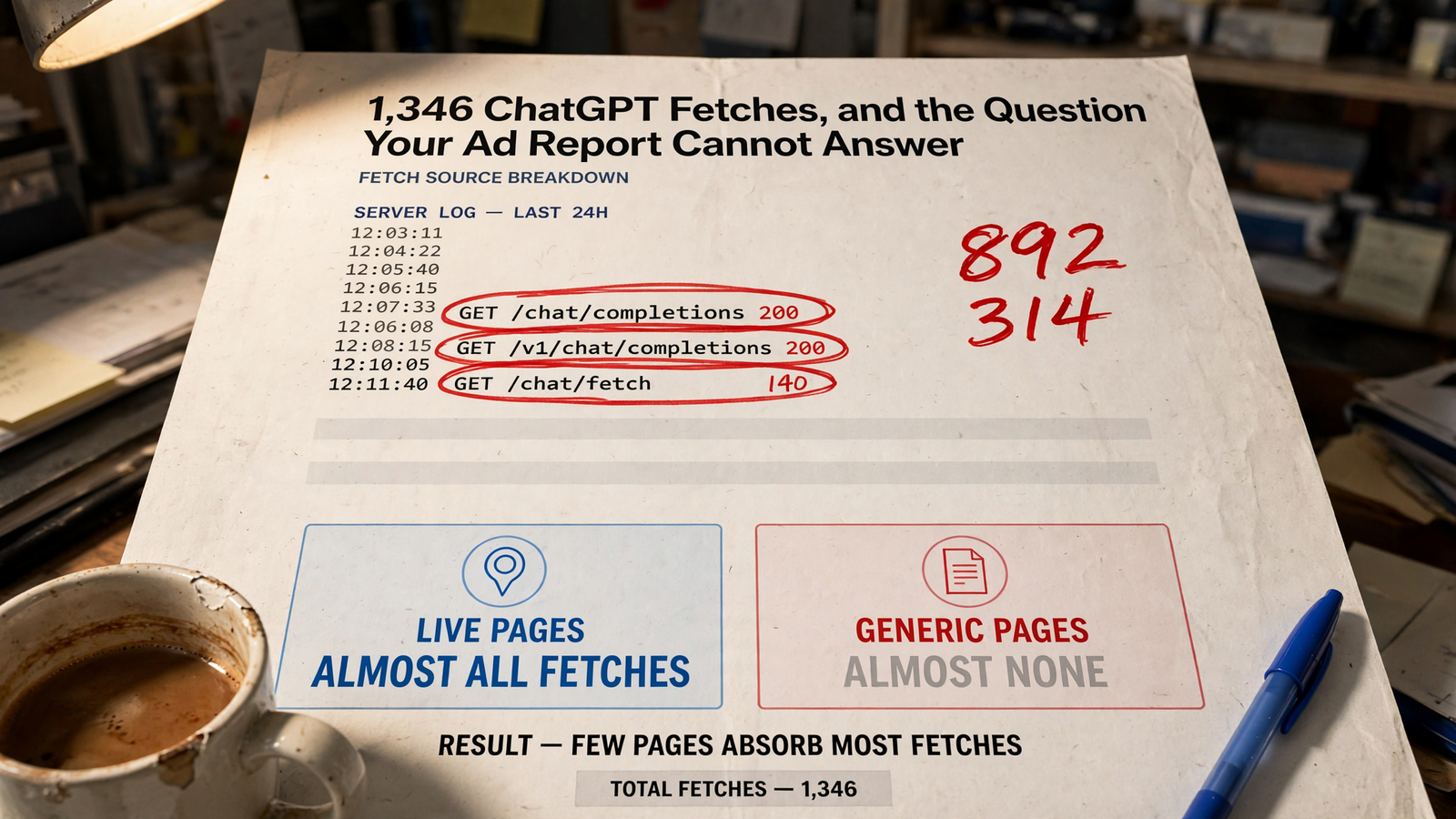
Two pages on our site received 1,346 verified live-answer fetches in 30 days. ChatGPT-User pulled them while responding to users, not as part of a background crawl. The verified fetch log is the reason I look at ChatGPT ads differently: an ad sits below an answer that may have drawn on somebody’s page before the advertiser ever gets a click.
The log cannot tell me that our pages appeared beside any particular ad. It can tell me that the answer is an active surface, not empty space above a sponsored slot. If an agency sells you ChatGPT clicks without accounting for that answer or following the click into pipeline, its results deck leaves out most of the story.
The 30-day log: two pages drew 1,346 fetches
I do not trust a bot chart straight out of server logs. Anyone can fake a user-agent string. The fetch analysis separates three counts:
- Hits: every request bearing ChatGPT-User in its name.
- VerifiedHits: requests that reverse-resolve to OpenAI and fall within its published ranges, filtering out spoofers and unrelated scrapers.
- LiveAnswerHits: verified requests for pages pulled while answering a live user, rather than for background crawling.
Every page count below is a verified live-answer fetch count. It is not a count of citations, ad impressions, distinct users, or sales.
| Page | Verified live-answer fetches in 30 days |
|---|---|
Homepage / | 777 |
| Changelog post 1 | 569 |
| Changelog post 2 | 377 |
| Generic service page | 41 |
The homepage and one changelog post account for the 1,346-fetch total. A second changelog post drew another 377. The generic service page we spent real time polishing drew 41.
That is a concentration worth noticing, not a site-wide law. The log covers one site and one window. It shows repeated reading of a few pages; it does not show every answer those pages helped shape. Treat the fetch as evidence of a read, not proof of a mention.
Why the dated pages are worth a closer look
A study of 193,507 answers across ChatGPT, AI Mode, and Overviews found higher citation odds for several page characteristics: more than double the odds for a year in the title, 88% higher odds for a page updated in the past 12 months, and 69% higher odds for a page with tables. Those are associations across a larger dataset, not an explanation of why ChatGPT fetched any particular groas page.
Still, the contrast in our log is useful. The changelog posts are dated and specific, with concrete changes, prices, and tables. The service page is timeless by design. I cannot assign the difference in fetches to one feature, and the homepage’s high count is a reminder that a page need not be a changelog to get read. But if I have to choose what to write before testing ads, I would rather publish an answerable, current page than another paragraph about full-service PPC management for growing brands.
The same citation study found that ChatGPT cites about 27% of pages it pulls, compared with 85% to 92% for Google AI answers. A fetch is not a citation. I can show that our two pages were fetched 1,346 times. I cannot show that they were quoted 1,346 times. Anyone putting those counts in the same column is either confused or hoping you are.
An ad sits below an answer, not on a blank page
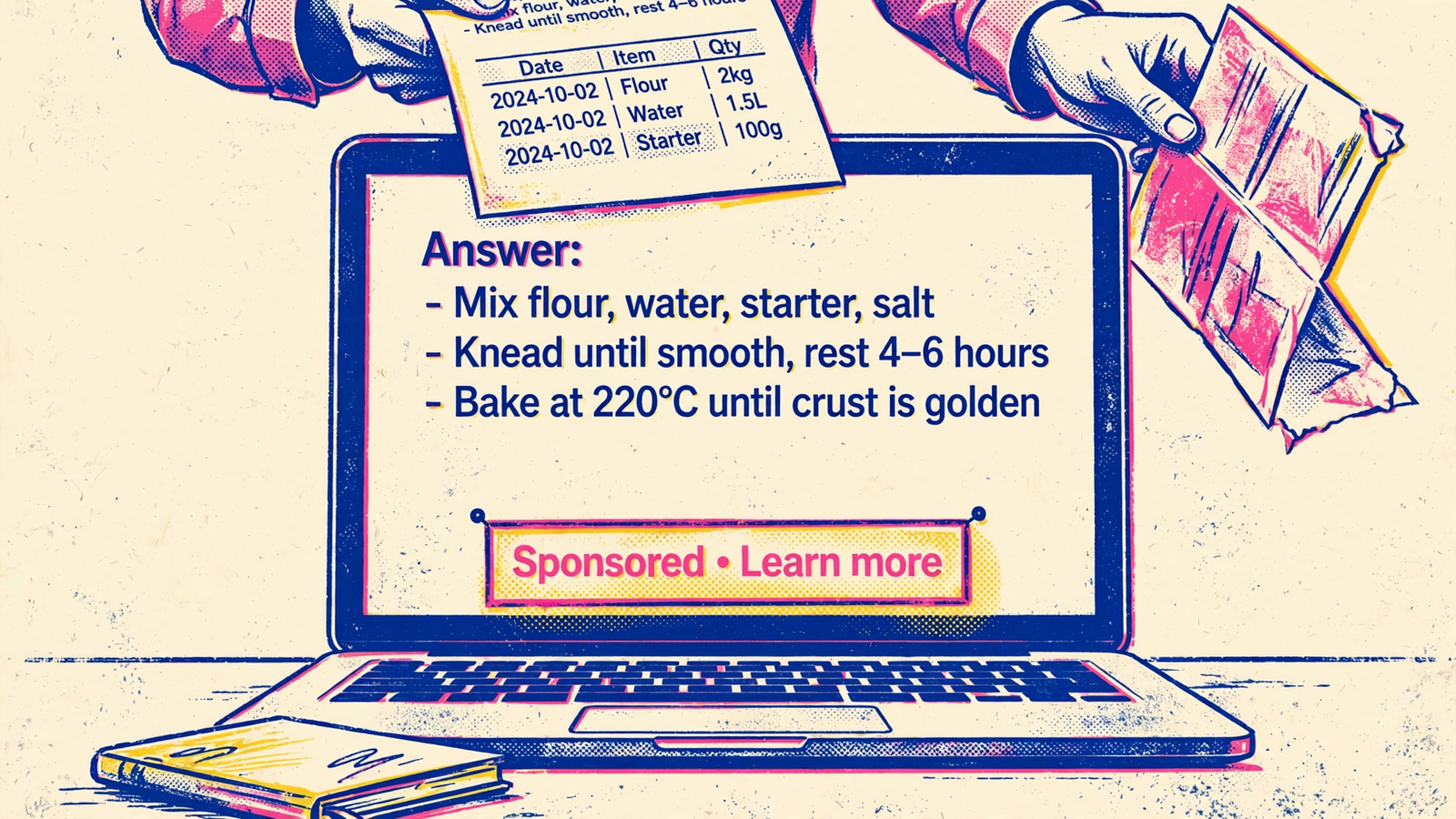
ChatGPT ads began as a US test for logged-in adults on Free and Go plans on February 9, 2026. By October 14, 2026, OpenAI said ads ran in more than 60 countries, with self-serve buying in 63. The placement matters more to this argument than the rollout map: the sponsored ad sits below the answer, and separate systems keep ads from changing that answer.
Paid and organic are therefore two surfaces stacked in one reply. They are not one system, and buying the lower slot does not buy influence over the upper one.
Say you bid beside a prompt about PPC pricing. The answer above your ad may rely on a dated page that explains a competing offer while your own generic page goes unread. Our fetch log does not prove that exact pairing happened. It shows why I would check for it rather than assume the ad owns the whole reply.
I used to tell clients the landing page only had to convert the click. That is too narrow here. A useful page may help shape what the reader knows before the click, while the landing page still has to do the usual job afterward. Build for the read; measure the click. Neither substitutes for the other.
The paid numbers are thin, uneven, and hard to read
The early ad data does not support a tidy ChatGPT CTR benchmark. The studies below ask different questions, use different samples, and have limits worth keeping beside the headline figures.
| What was measured | Reported result | What it does not establish |
|---|---|---|
| Adthena indexed nearly one million queries across 20 industries and five markets from March to May 2026 | Ads appeared on 4.5% of US queries. None appeared in 170,000 UK indexes. | Coverage in that window is not a forecast of what every advertiser can buy later. |
| Adthena counted ad items in answers that carried ads | The average was 1.06 ad items per ad-bearing answer. Legal, Pharma, Banking, and Nonprofit saw none; Retail represented 24% of queries and 39% of US ad items. | An overall average hides how unevenly ads appeared by vertical. |
| Adthena tracked more than 40,000 daily prompts and reported one client comparison | That client saw 0.91% CTR in ChatGPT versus 6.4% in Google Search in the same sector. | One client’s CTR comparison is not a universal engagement rate or a conversion comparison. |
Another enterprise advertiser spent only 3% of a $250,000 budget after weeks, while a reporting glitch blocked visibility into its own data and ROI. When delivery is sparse and reporting breaks, a polished average can hide a very small set of observations.
Relevance adds another problem. In an examination of around 55,000 responses, Seer classified 38% of ads as fully on-topic, 58% as category-adjacent, and 4% as unrelated. Those categories tell me to inspect the actual prompts and answers, not just the campaign label. A category-adjacent impression can look fine in a delivery report and still be a poor place to ask for a demo.
The post-click contrast is sharper in the reported Barn2 test: $477 bought 19,154 impressions and 370 clicks with zero conversions. During the same period, organic ChatGPT produced 552 sessions averaging 443 seconds and five sales; paid produced 210 sessions averaging 37 seconds and zero sales. That is one advertiser, not a prediction for yours. It is an excellent reason not to mistake a click count for demand.
Measurement itself can fail. Accuracast saw form fills that Ads Manager still displayed as zero conversions two weeks later. If the ad platform and your own records disagree, the delivery screenshot is not the verdict.
Run the test so a click can become a pipeline number
For a first test, I would ignore the circulating CTR benchmark and keep the budget isolated. The Barn2 comparison gives me a reason to look beyond raw sessions, but it does not establish that every paid ChatGPT visitor behaves the same way. I would measure the path in order:
- Engaged sessions over 60 seconds, separated from raw paid sessions. This is a working threshold for the test, not a platform benchmark.
- Form starts and demo bookings by source, so ChatGPT paid does not disappear inside organic ChatGPT or another referral bucket.
- Cost per started conversation, followed by qualified pipeline and closed-won revenue. Cost per click stops too early.
An agency that reports only clicks and impressions is reporting delivery. That is what many Google Ads graders do, too: score the setup while the money leaks after the click.
Say you spend $20k a month on search and carve out $1,500 for a ChatGPT test. Those are illustrative budget numbers, not a prescribed spend level. Give every ChatGPT ad its own UTM, record paid ChatGPT as its own CRM source, and evaluate it the way I evaluate the B2B pipeline case study: qualified leads, sales-accepted rate, and closed-won dollars rather than MQL count.
My working rule is no pipeline read before 30 days and no scale before at least 20 sales conversations from that source. That is a decision rule, not a statistical guarantee. It forces the team to wait for something closer to sales evidence instead of declaring victory on the first good-looking click report. If the test cannot produce enough conversations to apply the rule, that is information about the test, not a reason to rename impressions as results.
Ask an agency for the answer behind the ad and the sale after it
Any deck can put 370 clicks on a slide. In the Barn2 test, 370 clicks came with zero conversions. When an agency claims real ChatGPT ad results, I want the records behind the slide:
- Which prompts and answers appeared with the ads, and what spend and impressions went with them?
- What share of paid sessions lasted more than 60 seconds, started a form, or booked a call?
- How many sales conversations and how much qualified pipeline came from ChatGPT paid in the measurement window?
- Which pages, if any, were verified as fetched for relevant live answers? Can the agency distinguish that evidence from proof of a citation or a specific ad pairing?
- Where did Ads Manager and the CRM disagree, and how was that disagreement reconciled?
If the agency cannot separate ChatGPT paid from organic ChatGPT in the CRM, it has not measured the result it is selling. It has watched delivery happen.
Put a readable page in place before paying for the slot
The least expensive part of this test comes before media spend. Our fetched changelog posts were dated and concrete; the generic service page drew far fewer fetches. The wider citation study associates recency and tables with higher citation odds. Neither source proves that adding a table makes a particular answer cite you. Both give me a practical reason to stop publishing pages that say almost nothing checkable.
For a ChatGPT test, I would ship one dated page per offer before spending: what it costs, what changed this quarter, a short comparison table, and a last-updated line I intend to keep current. Then I would watch the verified fetch log for two weeks. A fetch would tell me the page is being read for live answers; it would not certify placement beside my ad. The page earns its own test. The ad earns a separate one.
groas runs those efforts together: paid execution and the pages an answer can read, with changes logged and a strategist accountable for pipeline. I would rather have continuous execution across both surfaces than a freelancer checking an ad account on Fridays. That preference still needs to survive the CRM numbers.
Audience delivery deserves a final caution. In a Brookings audit using 91 test accounts and more than 3,600 collected ads, accounts in low-income zip codes received ads more often and in greater numbers. The audit found no evidence that race changed delivery and no breach of guardrails on violent, political, or hateful content in its small sample. Its test accounts also stopped seeing ads after a month. A two-week recording from one account cannot stand in for your audience or your whole campaign. Ask what the agency actually observed, and in whom.
So here is the decision the numbers support. The 1,346 fetches show that pages on our site were repeatedly read for live answers; they do not prove what appeared beside an ad. The coverage, engagement, and reporting data show why I would not yet buy ChatGPT ads as though they were a familiar Google Search intent harvest. I would buy a small, isolated test, publish the readable page first, separate paid from organic in the CRM, and let qualified pipeline decide whether to scale. Any agency asking for the work should accept those terms in writing. If it will not, keep the money in search.
If you want that loop under one owner, I would start with a free trial of groas rather than another deck of click screenshots. The ad buys a slot below the answer. The page and the follow-through have to do the rest.