

 LinkedIn

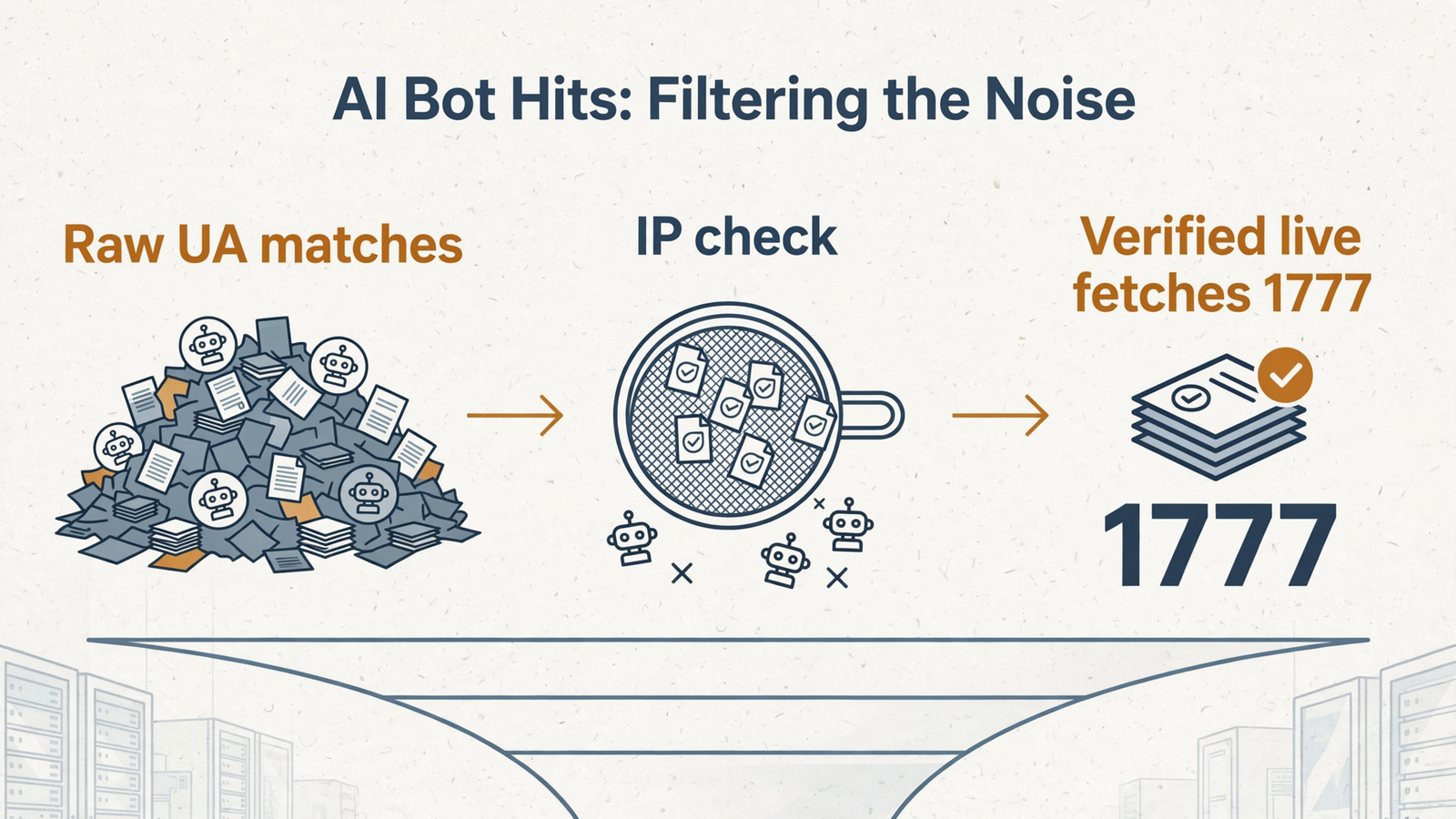
ChatGPT fetched groas pages 1,777 times in 30 days. Most requests went to two places: our homepage and a dated updates post. That is a useful signal for anyone watching vendor research move into AI conversations. It is not proof that our pages appeared in 1,777 answers, or that every request came from a buyer.
I counted only ChatGPT-User requests from IPs in OpenAI’s published verification file. The logs show what was fetched, not what someone asked or what ChatGPT ultimately displayed. Keep that limit in view. Then ask any agency pitching “proven ChatGPT ads results” a harder question: which numbers can it actually show?
The logs: 1,777 verified fetches, concentrated on two pages
I do not trust bot counts that start and end with a user-agent string. I used to. Then I watched too many AI visibility reports count every scraper that typed ChatGPT-User into a header as if OpenAI had visited. One October 2026 probe campaign cycled through about 32 fake AI-bot identities to hunt for paths like .env files. Fastly counted 6.3 million fake AI-crawler requests in a single day. The header proves nothing.
That is why our count is smaller than the header-only version, and more useful. I kept requests that claimed to be ChatGPT-User and came from IPs listed in OpenAI’s published verification file. Everything else went in the bin. Header matches alone run roughly four times higher on most sites; in our earlier look at why raw AI-bot hits mislead, about three quarters of the claimed traffic failed verification. Report the verified portion or do not present the total as OpenAI traffic.
Here is the 30-day breakdown from our logs. The shares describe fetches, not people, conversations or ad impressions.
| Page | Verified ChatGPT-User fetches | Share of total |
|---|---|---|
Homepage (/) | 783 | 44.1% |
| 2026 updates / changelog post | 576 | 32.4% |
| All other groas pages combined | 418 | 23.5% |
| Total verified | 1,777 | 100% |
The homepage and changelog took more than three quarters of verified fetches. I find that pattern interesting because, when I vet a vendor, I want to know what it does and what changed recently. Those two pages are built to answer those questions. But the logs do not contain the prompts. They cannot tell me how many requests came from commercial comparisons, or whether ChatGPT used the fetched text in its answer.
For the full fetch-level walkthrough, I have published the logs separately. The practical takeaway here is narrower than “we won 1,777 answers”: make your company description and dated updates worth fetching. Those are the pages ChatGPT-User requested most often from us.
A live fetch is not the only way into an answer
In our logs, ChatGPT-User behaved more like a research assistant checking a source. Claude-User made far fewer verified live fetches and almost none to dated posts. That difference describes requests to our site, not everything either service knows or cites.
A separate controlled 10-question test illustrates the limit: ChatGPT cited the author’s pages in 9 of 10 answers but fetched only one homepage live. The same account reports Cloudflare Radar showing ChatGPT-User at 30% of its June peak by mid-September, while OAI-SearchBot had its busiest week in late August. Neither observation lets me calculate how often an answer uses a fresh page rather than a stored copy. It does mean a live-fetch count is not a complete answer-visibility count. Do not sell it as one.
What the fetches do—and do not—tell us about ads
Our edge logs measure organic page requests. They do not measure ChatGPT ads. The connection is the setting: ChatGPT can fetch a vendor’s pages while working through a conversation, and its ads are selected using conversation context rather than the search-term report I am used to in Google Ads.
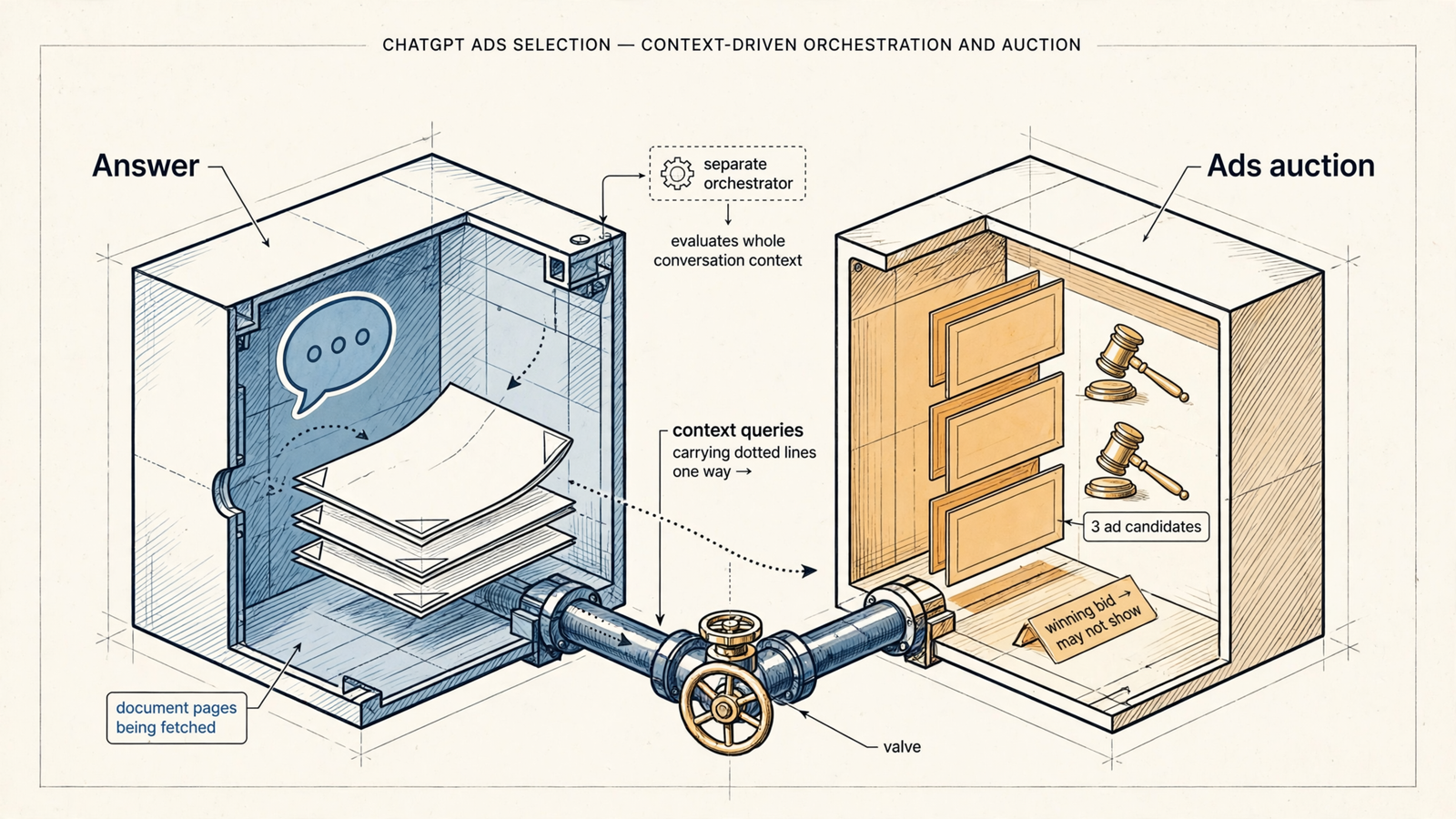
OpenAI’s description of the ad stack lays out the mechanism. A dedicated LLM orchestrator turns conversation context into queries and embeddings, checks eligibility and relevance, then sends candidates to a separate auction for ranking and pricing. Winning the auction does not guarantee an impression; later relevance checks and delivery timing can still drop the ad. Advertisers do not get a report showing where that happened.
In Google Ads, I can buy against a query and inspect search terms. Here, I am buying eligibility inside a conversation I will not read. OpenAI provides aggregated insights, not the transcript or a prompt-theme report. Our fetch pattern offers a reason to care about clear, current vendor pages. It does not tell us which conversations would have shown a groas ad, or whether those impressions would convert. That question needs a paid test.
Early ad results: a range, not a playbook
The published paid numbers are thin and split. Early tests put CTR at 0.5% to 2% and CPCs from under $3 to over $10. In one reported test, an advertiser spent $477 over six weeks for 370 clicks and zero conversions. That is a result worth seeing, not a channel-wide verdict.
I have seen early curiosity clicks before. When I ran first-month Demand Gen tests while that inventory was new, conversions came later than clicks. That experience is a reason to set a test boundary, not a reason to promise ChatGPT will follow the same path.
Coverage also limits what a small test can tell you. As of late 2026, ads appeared on about 25.94% of commercial prompts, and about 14% of those ads had limited or no connection to the query or thread. If the system has to judge a whole conversation rather than match one keyword, relevance deserves scrutiny. A click alone will not settle it.
| Measure | Reported early figure | What to watch in your test |
|---|---|---|
| CTR | 0.5% to 2% | Whether clicks lead to tracked outcomes |
| CPC | Under $3 to over $10 | Cost alongside conversion quality |
| Commercial-prompt coverage | About 25.94% | How limited delivery affects the test |
| Ads with weak or no match | About 14% | Whether relevance holds up for your offer |
Give ChatGPT its own small test budget and CPA target. Do not quietly move search spend over because a slide calls the inventory “high intent.” The available figures do not establish that for your offer.
What an agency can show you now
Self-serve access opened on May 5, 2026 at ads.openai.com, when OpenAI dropped the pilot’s $50,000 minimum and added CPC alongside CPM. That date matters. As of late 2026, nobody has a year of self-serve learnings. The inventory also reaches logged-in adult Free and Go users, while Plus, Pro, Business and Enterprise remain ad-free. A confident deck cannot expand the eligible audience.
Ads Manager reports Spend, Impressions, Clicks and CPC, with slices for Device, Country and Platform. It has no query report, prompt-theme report or search-terms tab. If the pixel and Conversions API are in place before launch, an advertiser can also see conversions, Attributed Sales Value and Sales ROAS, with UTM macros for campaign, ad group and ad and separate view-through and click-through values. Put tracking in late and there is no retroactive attribution. Counting starts from installation.
That distinction is where an agency pitch gets interesting. Spend and clicks are available. Conversion claims depend on setup. Query-level intent, prompt-theme ROAS and a placement report identifying the conversation are not available from OpenAI’s reporting. For measurement habits that carry over from search, I still point clients to the Google Ads metrics that predict outcomes. The habit is to follow outcomes, not admire a busy dashboard.
The dashboard nobody can honestly hand you
I used to tell clients a new network would settle in 30 days. I was wrong to treat that as a rule. Here, relevance-weighted second-price auctions, headline rewriting through text customization by default, and delivery decisions controlled by OpenAI’s system leave advertisers with a small observable set: spend, impressions, clicks, CPC and, if measurement was ready in time, tracked conversions and CPA.
An OpenAI revenue run-rate around $1B tells you the channel sells. It tells you nothing about your CPA. An agency showing a “ChatGPT keyword dashboard” may be showing its own model; it is not showing an OpenAI search-terms report. Ask which fields came from the platform and which were inferred. That question does more work than another logo slide.
Scope the test so the result means something
If you test, keep it small and instrumented. OpenAI’s guidance points to a $3 to $5 starting max CPC against a $60 default CPM max, within a relevance-weighted second-price auction. Set a daily budget you can tolerate exceeding on a given day. In Ads Manager it is an average: OpenAI can spend up to 2x in one day and up to 7x across seven days. Set $100 a day and a $200 spike day is possible. I learned to read pacing rules closely on Discovery campaigns years ago. Same lesson, new box.
Two defaults deserve attention before launch:
- A catalog upload does not buy organic shopping presence. The upload dialog says items become eligible for ads only.
- Text customization starts on. It can rewrite and translate headlines without individual review. Turn it off until you have a CPA baseline.
Install the pixel and Conversions API before launch. Tag ads with {campaign_id}, {ad_group_id} and {ad_id} so you can inspect campaign-level traffic alongside the platform’s click-through and view-through reporting. If you cannot tell when measurement began, you cannot treat a low conversion count as a clean verdict on the placement.
What to demand before you sign
I would ask an agency for a short, dated readout, not a proprietary-sounding dashboard:
- Spend, impressions, clicks and average CPC from Ads Manager.
- Tracked conversions and the pixel installation date, so I know which part of the test was measurable.
- CPA beside Google Search CPA for the same offer and weeks.
- Two settings: whether text customization was on, and the daily budget set with the platform’s pacing rule in mind.
That fits on an index card. An agency that has run ChatGPT ads can explain what it observed and where its visibility stops. One selling a story will talk around the install date. I have sat in both chairs; the logo slide is easier to make.
At groas, Search Ads costs $1,499 a month and covers Google, Bing and ChatGPT. It is a flat fee, with bids, keywords and budgets worked around the clock, a named strategist accountable for direction, and a log of changes. There is no percentage-of-spend fee or setup fee, and onboarding can go live within 24 hours. For a channel where OpenAI controls delivery and reporting stops short of conversation-level detail, that structure is the point. You do not need another dashboard. You need someone to keep the test bounded, leave rewriting off until a CPA baseline exists, and stop if tracked CPA runs double Google’s for three weeks.
The 1,777 verified fetches show that ChatGPT requested our pages repeatedly, especially the homepage and dated updates. They do not prove 1,777 buyer conversations, and the early ad numbers do not prove anyone dominates this channel. Test it as a new network. Pay for the operator who will show you the measurements, the setup date and the limits. Anyone else is charging 2015 prices for a screenshot.