

 LinkedIn
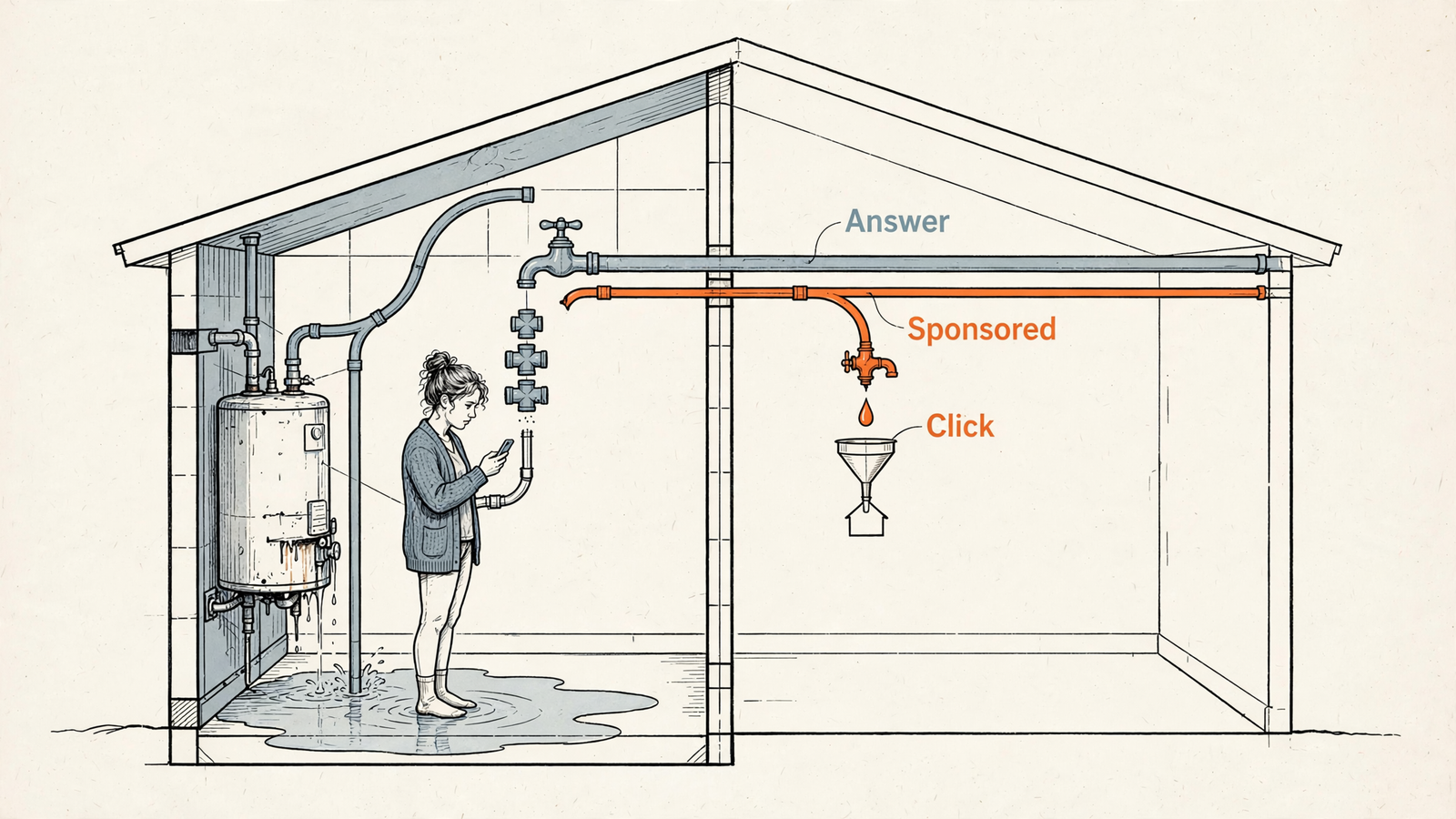
A homeowner in Austin tells ChatGPT her 12-year-old water heater is leaking from the bottom. Three follow-ups later, she has added that the house has no floor drain and she needs a same-day install because she works from home. That whole conversation is the targeting, not the phrase water heater.
Everything else follows from that fact. The ad system matches eligible advertisers to the current conversation using advertiser context hints, landing pages, and location. A winning ad appears below the answer, labeled Sponsored; ad selection runs on separate models and code from answer generation. Once you see those two systems working side by side, three consequences become hard to miss: your landing page has to do the persuading, your keyword list matters less than you think, and conversion tracking decides whether you can judge the channel at all.
Start with the situation the homeowner describes
In search, a query gives you a compact expression of intent. In this ChatGPT conversation, intent arrives in pieces. The first message asks whether to repair or replace a leaking unit and what it should cost. The follow-ups add constraints that could change which plumber fits: no floor drain, work happening at home, same-day availability.
The ad system considers that current conversation alongside an advertiser’s context hints, landing page, title and copy, and location and device. When a user has ads personalization switched on, signals from wider use may also apply. Our plumber cannot assume an ad built around water heater replacement will be judged on those three words alone. The system has a fuller situation to match.
That distinction is the useful one. Water heater replacement names a service. Leaking unit, no floor drain, same-day install describes a job someone needs handled. If the plumber’s page addresses that job, the match has something concrete to work with. If the page only says cheap water heaters, a large bid cannot make it answer the homeowner’s constraints.
Write for the situation, not just the service category.
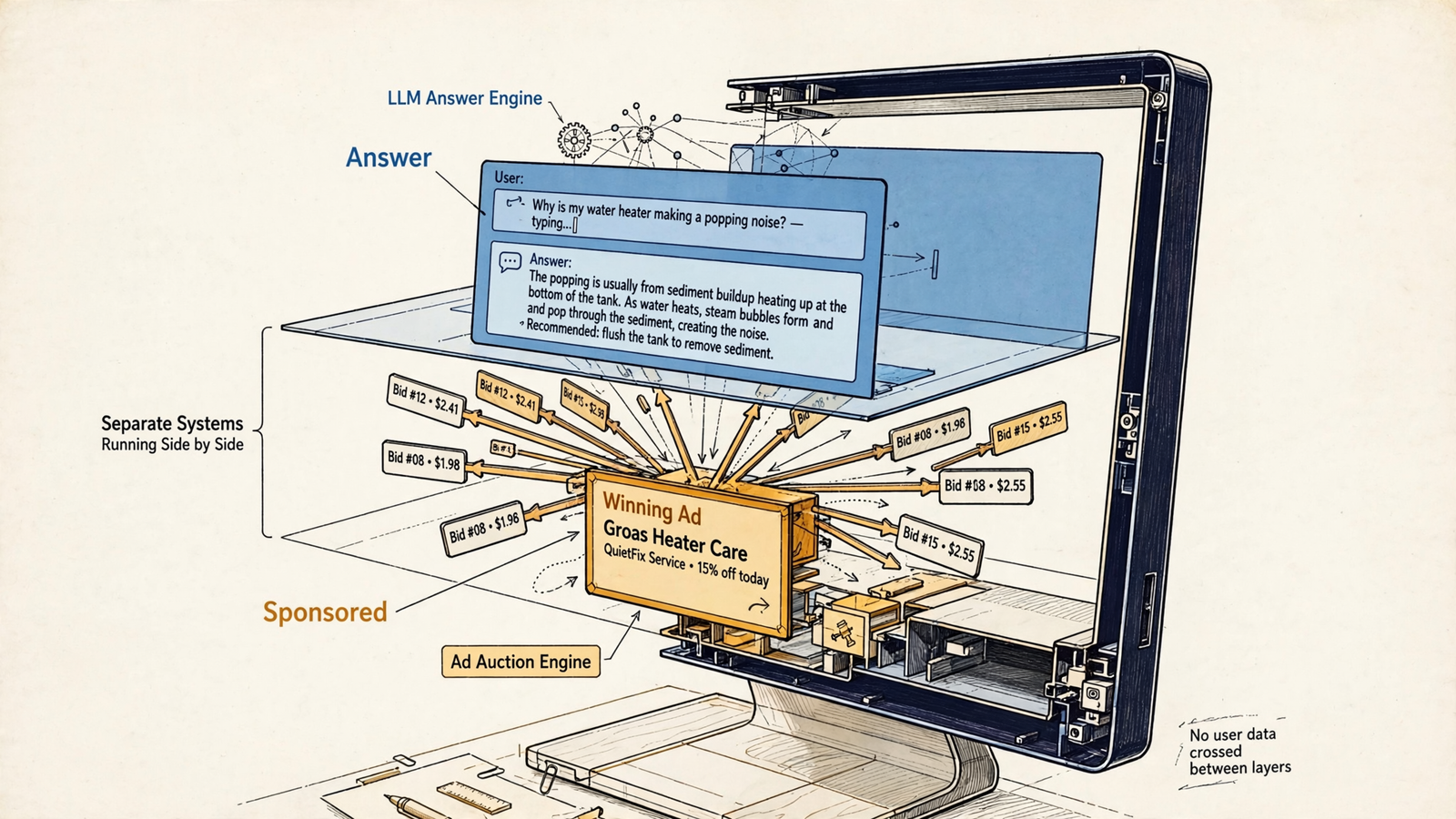
Follow the prompt through two separate systems
Here is the sequence when that homeowner asks her question:
- The answer system starts responding to her repair-versus-replace question.
- In parallel, a separate ads system reads the conversation and pulls eligible ad groups into a relevance-weighted second-price auction.
- A winning ad, if one is served in time, appears below the answer.
- If the homeowner clicks, URL parameters and an opaque click ID travel to the advertiser’s landing page, where they can help connect the visit to a later conversion.
The two processes run alongside each other. One produces help; the other decides whether a sponsored message fits the situation. The ad can be late without delaying the answer. That is not a small interface detail. It tells you what an advertiser is buying.
I used to tell clients to think of this kind of placement as buying the sentence. I was wrong. You buy a slot next to the answer, not a place inside it. Paying does not make ChatGPT recommend your plumbing company in its explanation of tank failure. The answer can discuss repair and replacement while your ad offers a next step beneath it.
The separation shows up in the numbers, too. In Seer tracking cited by uncited.ai, the ad-slot brand appeared in the adjacent organic answer only 5.4% of the time and was cited as a source only 3.3%, with no significant correlation. I would not build a campaign around the hope that buying the ad also buys a mention in the answer. For our plumber, the practical job is to earn a relevant placement and make the click useful.
Replace the keyword list with a better description of intent
Advertisers do not select keywords here. They write context hints at the ad-group level to describe relevant conversations, topics, and needs. Those hints are not exact-match instructions and do not guarantee delivery. The landing page, title and copy, plus geo and platform targeting, give the system more to judge.
For the Austin plumber, an ad group hinted around emergency leak containment and same-day 50-gallon replacement makes a clearer case than one aimed at water heaters. A corresponding page could address same-day slots, leak cleanup, and haul-away. Those details matter because they connect the advertiser’s offer to the constraints the homeowner supplied. They do not guarantee the auction result; they give relevance something to recognize.
Search managers will miss some familiar controls. There is no demographic targeting, search-terms report, or Keyword Planner equivalent. Advertisers cannot see which prompt triggered each impression. Custom audiences need 25,000 matched users for targeting. If your usual routine is to inspect queries, add negatives, and polish an exact-match list, you cannot simply move that routine into a new console.
Instead, test at the level you can control: the hint theme and the page behind it. A broad hint about plumbing may enter many conversations that have little in common beyond the category. A narrower one can describe the work the business is actually prepared to do. When booked jobs cluster around same-day replacement rather than generic repair, that is a reason to separate those themes and give each a page that fits.
Stop asking which keyword triggered the ad. Ask whether the hint and page describe the same customer problem.
Let the landing page finish what the answer starts
Eligible ad groups enter a relevance-weighted second-price auction. Rank reflects bid and relevance; relevance draws on the hints, landing page, title, and copy. A higher bid alone does not guarantee delivery, and a better fit can outrank a higher bid. This is why the page matters before anyone clicks it: it is part of the case the advertiser makes for the placement.
After the click, the page takes on a second job. ChatGPT has already addressed the homeowner’s repair-versus-replace question. The sponsored unit is short and separate from that advice. Neither can show, in full, how this particular plumber would handle the appointment. The landing page has room to do that.
For this homeowner, useful persuasion looks less like a paragraph about dependable service and more like answers to the questions she has already raised: What same-day arrival windows are available in Austin? What does a 50-gallon replacement cost with haul-away? How would the crew handle a bottom leak where there is no floor drain? Can she book from a phone while standing in a wet utility closet?
Those are examples of what the page should make clear, not claims about a particular plumber’s offer. If the company cannot provide a same-day slot, the page should not pretend it can. A relevant ad that sends someone to a generic page merely postpones the mismatch until after the click.
Early results illustrate how sharply the experience can vary: Stream turned over 70% of clicks into sessions versus under 10% elsewhere, while Jotform pushed over 10% of clicks to signup. Those figures do not tell our plumber what her results will be. They reinforce the question she needs to test: does the page carry the conversation forward, or make the visitor start over?
The ad earns the visit. The page has to earn the booking.
Keep the click ID alive long enough to measure a job
Suppose the homeowner clicks and books an installation. The plumber still needs a way to connect that job to the ad group that brought her in. Every ad click carries an opaque click ID, oppref, appended to the landing URL and saved by the pixel in a first-party __oppref cookie for 30 days. Send the ID back unmodified through the Conversions API, and add {campaign_id}, {ad_group_id}, and {ad_id} macros to the URL template. That gives the advertiser a path from booked revenue back to the hint theme.
There are several ordinary ways to break that path. A redirect can strip the parameter before the page loads. A form can drop it before submission. The click can appear in a dashboard while the booked job never joins back to it. Default attribution is 30-day click and 1-day view, but that window cannot repair an ID lost on the way to the conversion event. This is where the trail goes cold in a first test that looked fine from the ad side.
The privacy boundary makes clean conversion tracking more important, not less. Advertisers do not receive chats, chat history, memories, names, or precise location; they receive aggregate views, clicks, and spend, plus the conversions they track themselves. There is no prompt-level report to mine the way a search manager mines search terms.
So the plumber can see that an ad group spent money and brought clicks. Without a working conversion trail, she cannot tell whether its hint theme brought booked work. She may call the channel weak because she cannot find the jobs it produced, or keep funding a theme that brings visits but no bookings. Both verdicts would rest on incomplete evidence.
Before judging performance, check that oppref survives the redirect, consent flow, form, and conversion event. Tracking is not paperwork here. It is how the channel becomes measurable at all.
Assign the work the auction keeps creating
The mechanism leaves four recurring jobs. None is picking keywords:
- Refine context hints. Describe the conversations the business wants to serve. Split a broad ad group when booked jobs point to a narrower need, such as same-day replacement rather than general repair.
- Align the landing pages. Make sure each page answers the constraints its hint attracts. For the plumber, that means clear information about price, arrival windows, leak handling, and phone booking where those are part of the offer.
- Protect the measurement path. Check that the click ID survives the redirect, consent banner, and form, and that booked revenue joins back to
{ad_group_id}. - Manage bids and budgets against relevance. Do not treat a larger bid as a substitute for a better-fitting page. The auction will keep running whether the page improves or not.
A tool can show you a dashboard. A course can explain the auction. Neither necessarily does those four jobs every week. When an owner asks what help to buy, I start there. If you have ten hours a week and clean tracking, learn the work yourself. If you want software that suggests hints while you handle the pages and oppref plumbing, buy a tool. If you want the hints rewritten, pages aligned, and revenue joined back without learning another console, hire a done-for-you manager.
This is the work groas runs around the clock through its Search Ads bundle, which covers Google, Bing, and ChatGPT ads for a flat $1,499 a month, rather than a percentage of spend. The point is not that an owner needs one particular dashboard. The point is that someone has to own the work after the ad appears. As I wrote in they buy what happens next, that is where the slot starts to prove its worth.
Test the model on a different conversation
Now leave the utility closet. A controller asks ChatGPT to compare AP automation for a 40-person company on NetSuite. In a follow-up, she adds that the company needs SOC 2 and approval workflows across three entities. Nothing about plumbing transfers, but the mechanism does.
First, the ad system has more to match than the phrase AP automation. It has NetSuite, SOC 2, and multi-entity approvals in the live conversation. Second, the answer explains the options while a sponsored placement, if one is served, sits beneath it. The advertiser cannot pay to turn that answer into its sales pitch. Third, a vendor with a hint describing NetSuite multi-entity approval workflows and a landing page showing its connector, SOC 2 badge, and three-entity approval screenshot gives the system a more specific fit than a vendor pointing to a generic invoice-automation page. Relevance matters before the click; the page must make the case after it.
Finally, the vendor has to keep the click ID intact and join any signup or sale back to the ad group. A broad hint, a generic page, or a redirect that drops oppref can each spoil the test for a different reason. I check those three before I believe a verdict on ChatGPT as a channel. The conversation changes. The work does not.

Describe the situation, finish the conversation on the page, and measure what happened next. Hire whoever will own that part.