

 LinkedIn

An agency with 10 clients can buy AEO software or hire a white-label partner. I would pick the partner unless the agency already has people ready to write the pages, ship the fixes and earn the citations. A dashboard can find the work. It cannot make time for your team to do it.
I spent years selling hours I did not have. I would buy a tool that listed 40 fixes per account, show the client the pretty chart, then realize nobody on my team had 12 spare hours to write the pages and fix the schema. AEO software can put an agency in the same position: better visibility into the problem, with the same old queue of work behind it.
The contenders: a to-do list or finished work
If you run around 10 retainers and now have to sell AI search, your choice is between two operating models:
- AEO and GEO software you run: a tracker for ChatGPT, Perplexity, Gemini and Google AI Overviews that monitors prompts, flags gaps and gives your team a to-do list.
- A white-label partner you resell: a team that handles research, pages, technical fixes, citations and client reports under your brand.
I am keeping an in-house hire as a cost reference, not a third contender. Hiring a specialist is a different commitment from choosing how to fulfill these 10 accounts next month.
Tools such as Otterly, Peec AI and Profound watch prompts and show where a client or its competitors appear. That is useful. It does not, by itself, write a good page, ship a technical fix or earn a third-party mention. I used to tell clients software would make us faster. I was wrong about where the hours went. The hours were never in the chart. They were in the writing and implementation after it.
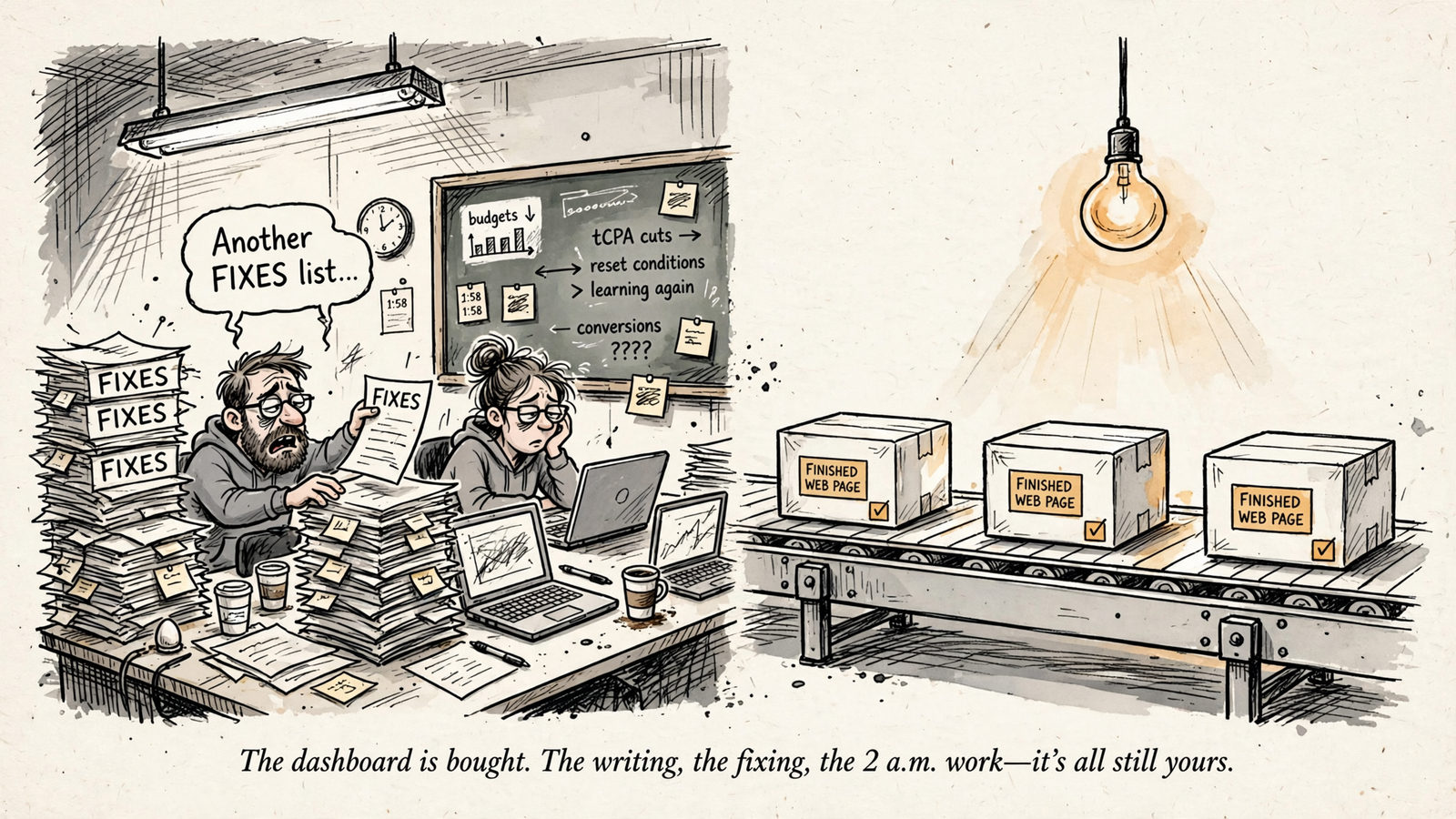
A white-label partner takes on that implementation under your name. Published offers vary: Ranked AI lists white-label plans from $99 per client per month, while White Label SEO Firm lists AEO plus GBP work at $199 per month and suggests resale at $499 to $799. Those are starting points for a price comparison, not proof that every partner ships the same work. The question I would put to each vendor is simple: which pages, fixes and citations will you actually handle?
Axis 1: who writes, fixes and earns citations?
AEO work is three jobs stacked together. First come pages that answer prompts directly, with quotable facts and clean structure. Then come technical fixes: internal links, schema, page speed and the JavaScript traps that can block extraction. Finally, there is third-party proof: mentions on review sites, directories, press and forums.
Software watches the prompts and points to gaps in that work. The list then lands with your team. That is why the warning that tools bring insights while the work falls on your team matters more than another feature grid. Finding a missing citation is not earning one.
A done-for-you partner takes on all three jobs under your brand. The better arrangement is one where new pages get published, technical fixes get shipped directly or handed over as exact developer instructions, and citation work gets done rather than left in a report. At 10 clients, the handoff is the product. If nobody writes and nobody ships, the tracking chart just documents you losing.
My test for this axis: ask to see the work that leaves the queue, not only the gaps that enter it.
Axis 2: how many hours does each client take?
A tracker subscription has a clean price. Fulfillment does not. Peec AI Growth is listed at $495 per month for 10 projects with pooled credits. That is $49.50 per client for tracking. It is not $49.50 per client for AEO.
For planning, I would allow 6 to 10 hours per client per month for a solid pass: review prompts, draft one or two pages, fix schema and internal links, and chase a citation. Across 10 clients, that is 60 to 100 hours. At the draft’s illustrative contractor rate of $75 an hour, the labor alone is $4,500 to $7,500 a month. The subscription has not made those hours disappear; it has helped direct them.
A white-label partner bills per client and takes the writing and implementation off your desk. You still review the work and manage the relationship. The planning allowance here is 30 to 60 minutes per client for review and forwarding the report, rather than 6 to 10 hours of production. That is a meaningful distinction for a small agency whose writers and technical people already have full queues.
A tool can win this axis. If you have two or three writers and a technical SEO with room to clear the work, a tracker gives that team a useful brief. If those people do not exist, the $495 line item is the start of the cost, not the end.
Axis 3: what does the client see under your brand?
Clients do not pay for logins. They pay for proof they can forward to a boss. A tracker may give you a dashboard, view-only access or a PDF export. Your team may still have to turn that output into a report that looks and reads like your agency’s work. That rebuild takes time even when the underlying data is good.
There can be a separate price for presentation, too. A branded portal such as AgencyAnalytics runs about $20 per client per month; SE Ranking’s Agency Pack adds $69 per month before the tracker itself. Do not confuse either charge with fulfillment. A better-looking chart does not publish a page.
A white-label partner can send a report with your logo on it, showing rankings, AI citations won, pages published, fixes shipped and what comes next. That is the distinction behind the argument that a white-label dashboard without execution falls short of a client retainer. One report shows movement. The other can show movement and the work behind it.
My test for this axis: could you forward the report to a client without rebuilding it or explaining why the promised work is still pending?
Axis 4: can one operation cover Google and AI answers?
Your client does not care whether a lead came from a blue link or a ChatGPT answer. They care that the phone rings. Yet an AI prompt tracker does not replace the rest of a Google search operation. If you buy it as an additional tool, you still need the people and processes handling rankings, content and links.
The subscription floors are not hard to find: Otterly Lite is listed at $29 per month for 15 prompts, Peec Starter near $95 for 50 prompts across three models, and Profound from $99 for ChatGPT only. The point is not that a small plan is inherently bad. It is that each plan buys a defined slice of monitoring. Add the coverage your clients need, and you still have to do the work the monitoring identifies.
A done-for-you partner can take on Google and AI-search work in one retainer. Pages built for Google can also be structured so models can quote them. Technical cleanup and third-party mentions serve both parts of the job. That is an operational reason to buy fulfillment instead of stacking trackers: one production queue for the outcome you sell, rather than separate dashboards feeding the same understaffed team.
My test for this axis: when a client asks for a page or fix, who owns it from request to publication?
The cost at 10 clients: $990 to $8,195 a month, depending on what you buy
Here is the total before the tidy subscription price gets mistaken for the whole bill. At 10 clients, the software example comes to $5,195 to $8,195 per month when you include the illustrated fulfillment labor and branded reporting. The listed white-label starting points run from $990 to $2,990 per month for 10 accounts, with groas at the $2,990 end. Those partner prices are not identical-scope quotes; the work included matters. One in-house specialist is a separate reference point at roughly $6,600 to $10,800 per month in loaded cost before you assess capacity across all 10 clients.
| Cost item | Software you run | White-label partner | Source or basis |
|---|---|---|---|
| Tracking subscription, recurring | $495/month for 10 projects | Included in the partner model described here | Peec AI Growth listing; partner scope must be checked before purchase |
| Writing and implementation labor, recurring | $4,500–$7,500/month | Covered by the partner fee in this comparison | Draft planning assumption: 60–100 hours across 10 clients at $75/hour |
| Branded reporting portal, recurring | About $200/month for 10 clients | Branded report included in the partner model described here | $20 per client per month multiplied by 10 |
| Partner fee, recurring | Not applicable | $990–$2,990/month for 10 clients | Ranked AI from $99/client, White Label SEO Firm at $199/client, groas at $299/client account; these are different offers |
| Illustrative recurring total | $5,195–$8,195/month | $990–$2,990/month at the listed price points | Sum of the recurring figures above; compare scope as well as price |
| Initial setup, one-off | 20–30 staff hours across 10 clients | Check the partner’s onboarding process | Draft planning assumption: 2–3 hours per client for prompt sets, connections and staff training; no dollar rate assigned |
The software total is not a universal quote. It uses one 10-project subscription, the draft’s labor assumption and one branded-reporting example. Take away the portal if you do not need it. Change the labor requirement if your team can do the work faster. Just do not leave labor out and call the remainder your cost of delivery.
The partner range needs the same honesty. A $99 starting plan and a $299 groas account are prices for different offers, not interchangeable promises. Legacy wholesale pricing can run from $480 to $3,500 per client, which is another reason I would inspect the work before treating the lowest number as my budget. Groas lists $299 per client account. At 10 accounts, that is $2,990 a month, with the branded reporting and fulfillment described in this comparison.
An in-house hire is not free capacity, either. One breakdown puts a mid-level SEO base salary at $55,000 to $95,000 and loaded cost at $80,000 to $130,000 once benefits, tools and training are added. That is roughly $6,600 to $10,800 per month. I have carried that hire. A good person can still be one vacation, one resignation or one busy week away from a slipping deadline.
The less visible costs come after setup. Thin pages get rewritten. Schema gets fixed twice. A client asks why a competitor is quoted while their own promised work is still in a queue. I would not turn a general churn figure into a precise forecast for these 10 accounts, but the risk is plain: a report cannot retain a client on behalf of work that never shipped. For a closer look at one domain’s line items, see the real cost of done-for-you AEO.
| Axis | AEO software you run | White-label partner | Winner for a thinly staffed 10-client agency |
|---|---|---|---|
| Writing, fixes and citations | Identifies the work; your team fulfills it | Takes on the work under your brand | Partner |
| Hours per client | Plan for 6–10 hours of production monthly | Plan for 30–60 minutes of review monthly | Partner |
| Client reporting | May require a branded rebuild | Branded report tied to work performed | Partner |
| Google and AI answers | Monitoring sits alongside your existing search operation | One fulfillment operation can cover both | Partner |
| Illustrative recurring cost at 10 clients | $5,195–$8,195 with labor and portal | $990–$2,990 at the listed price points; check scope | Partner |
Verdict: buy the partner unless your team can clear the queue
For an agency with 10 clients and no spare fulfillment bench, I would buy the white-label partner. It wins on the work performed, the hours left on your team’s calendar, the client-facing report and the ability to run Google and AI-search work through one operation. At groas, the listed price is $299 per client account. The reason to choose it over another login is the pages, fixes and citations handled under your brand, not the existence of another chart.
Pick the software instead if you already have the people. Two or three writers and a technical SEO with open capacity can use prompt tracking to decide what to do next and then clear the resulting 60 to 100 hours of monthly work. In that agency, a tool has operators. In a thinly staffed one, it has an audience.
Before you sign, ask one question: who writes the page, ships the fix and earns the citation? The cheapest mistake is buying a $495 tracker your team cannot use. The expensive one is losing a $2,500 retainer because you bought homework instead of fulfillment.