

 LinkedIn
Most white-label AEO is a monitoring dashboard that hands the work back to your agency. The pitch says you can put your logo on it, charge a client $1,500 a month, and pocket an easy margin. Then the screen-share ends with a 400-row CSV labeled prioritized roadmap. If my account managers still have to write the copy, ship the schema, and chase the citations, that is not fulfillment. It is homework with my logo on it.
The demo ends when your team’s work begins
Upload a client domain and watch the screens fill with citation-share graphs, visibility gaps, and lists of things an AI engine supposedly gets wrong. Vendors like LLMPulse sell agencies on custom subdomains, white-label client portals, and Looker Studio connectors. Its agency pitch even presents missing engine citations as a way of “handing you next month’s outreach list.”
That phrasing gives the game away. The vendor hands you a list. Your team does the outreach.
The dashboard might flag forty pages missing structured data and twenty-five entity definitions that Gemini gets wrong. Useful to know? Sure. But the tool has not corrected a definition, updated a page, or touched the client’s CMS. It has counted the ways a client is hard to find, then put your agency logo above the count. You still need people with the access, time, and judgment to turn those findings into changes.
The screen makes the gap easy to miss. A flagged page looks like progress because it now has a label, a priority, and perhaps a place in a client report. But the page is unchanged. Someone still has to decide what belongs on it, make the edit, and check the live result. None of that happens because a row turned red.
Ask what happens after the finding appears. If the answer begins with “export,” the demo is showing you the start of your workload, not the end of it.
A logo swap is not white-label fulfillment
White-label used to mean you could put your name on a finished service. A partner did the work; your agency owned the client relationship. In print, manufacturing, and web hosting, the product did not arrive as a list of instructions for your staff to assemble it.
Somewhere along the way, letting an agency upload a PNG and map a custom domain became enough to call analytics software a white-label service. In search marketing, that is a costly change of meaning. Printing a Google Ads Search Terms report, highlighting forty non-converting queries, and handing it to an account manager is not account management. Calling the highlights action items does not type the negatives into the account.
I spent nearly ten years on the receiving end of recommendations like that. I managed Google Ads accounts spreadsheet by spreadsheet. Tools would identify search terms needing exclusions or landing pages with mismatched headlines, then generate another alert queue for someone to work through. The diagnosis was sometimes right. It still left a person to open the account or CMS, make the edit, and check that nothing broke.
A better-looking queue did not shorten the distance between spotting a problem and fixing it. It just made the unfinished work easier to present at a meeting. I could sort it, assign it, and explain it. After the meeting, I still had to do it.
I respect that work because I did it. I object to selling software as though it made that work disappear. A recommendation is not the service an agency promised to deliver. AEO did not change that distinction; it gave the recommendation queue a new vocabulary.

The $1,500 retainer still has a payroll bill
Here is the margin trick: count the software subscription, then pretend nobody has to do anything with its output. Ayzeo lists $149 a month for three client projects plus $49 for each additional domain. Its agency pricing example presents $500-to-$1,500 monthly visibility retainers and projected net monthly profit of $4,508 to $14,508 across ten clients against a $492 software bill. The low software cost is real in that example. The missing question is who writes, edits, implements, and checks the work for those ten clients.
It is the same question behind what a 10-client AEO retainer actually costs. A dashboard export does not fulfill a retainer. If your staff must translate every alert into a page edit, a technical ticket, or an outreach task, those hours belong in the calculation before you admire the projected profit.
One white-label SEO benchmark puts manual fulfillment at 15 to 20 hours per client each month when teams handle technical fixes, content, and related optimization themselves. Even the assisted automation trap leaves account managers interpreting alerts, translating CSVs, and copying text into a CMS. That can still consume 8 to 12 hours per client each month.
Run the simple version. At a loaded $45 an hour, ten clients taking fifteen hours each cost $6,750 a month in direct payroll. Add the $492 software bill and you are at $7,242 before two monthly check-in calls per client, revisions, or developer time. On a $15,000 monthly retainer book, that does not automatically mean a loss. It does mean the easy 70% gross margin pitch has left out a very large part of fulfillment.
Nor does an export become free labor because the agency already employs the account manager. Those hours have to come from somewhere: the client’s retainer, another client’s work, or the time your team thought it had for strategy. Calling the software inexpensive answers only the subscription question. It does not answer the fulfillment question.
And the work rarely arrives in neat fifteen-hour parcels. An automated audit produces a technical recommendation; a strategist spends two hours explaining it; a developer charging $85 an hour still has to add the JSON-LD to staging. White-label pricing analysis points to the drag from revisions, technical interpretation, and internal back-and-forth. The dashboard may be cheap. The people required to act on it are not.
“Actionable insights” are usually your action items
Spend twenty minutes in an AEO demo and listen for the handoff. You will hear insights, visibility scorecards, prompt sets, and actionable signals. Ask who publishes the page. The vocabulary tends to get less elaborate.
There is a useful divide in how AEO tools for agencies are ranked by work done: monitoring search engines is different from changing a live site. A cap on prompts monitored tells you how much measurement you can buy. It does not tell you how much optimization gets done. Knowing a brand seldom appears in Perplexity is a finding. What changes on the site because of that finding?
The document handoff is the clearest tell. In a conventional white-label workflow built around suggested changes, software can generate twenty copy rewrites and drop them into a Google Doc or project queue. Someone at your agency still has to check the copy, correct mistakes, format the page in Webflow or WordPress, publish it, and verify the result. If the vendor marks the task complete when the document lands, it has finished its task by starting yours.
That distinction matters when you report the work, too. “Generated twenty rewrites” describes what the tool did. “Published and checked the revised pages” describes work the client can inspect. Put those statements side by side and the missing steps become difficult to hide behind the word actionable.
You can see why practitioners bristle at retainers backed by rank graphs rather than visible changes. When a client asks what changed last month, a graph may show movement. It cannot, by itself, show what your agency built. An alert is not a fix. A screenshot is not a deliverable.

I want shipped fixes and a record of them
Technical-search practitioners make the basic point: audits and diagnostic checklists need developer and content execution behind them. Otherwise the recommended JSON-LD waits in a ticket queue while the client’s developer fixes checkout bugs and your account manager sends another status update. I have nothing against a good audit. I have something against charging for the audit as though it were the repair.
This is the fix I want from white-label AEO: software that executes the work and logs each change. Published pages. Shipped technical fixes. Citation work someone actually carried out. A per-domain record an account manager can use to answer “What changed?” without reconstructing a month from Slack messages and CSV exports. If a change needs approval or cannot be deployed, that should be clear too. The point is to make the handoff visible rather than hide it inside the word optimization.
The record matters as much as the action. Without it, an account manager is back to piecing together a story from documents, tickets, and messages. With it, the conversation starts at the change itself: what was done, what still needs approval, and what did not ship. That is a better use of a client call than narrating a dashboard.
On groas for agencies, the platform connects to client ad accounts and CMS environments to execute technical fixes, publish intent-targeted content, and manage citations under the agency’s brand, from $199 a month per domain. It logs changes and their operational reasoning, with a named human strategist supervising without stepping in front of your client. That is a stronger white-label alternative than a portal that leaves the implementation on your payroll. You can show a client what was changed instead of billing them for a list of things you might change.
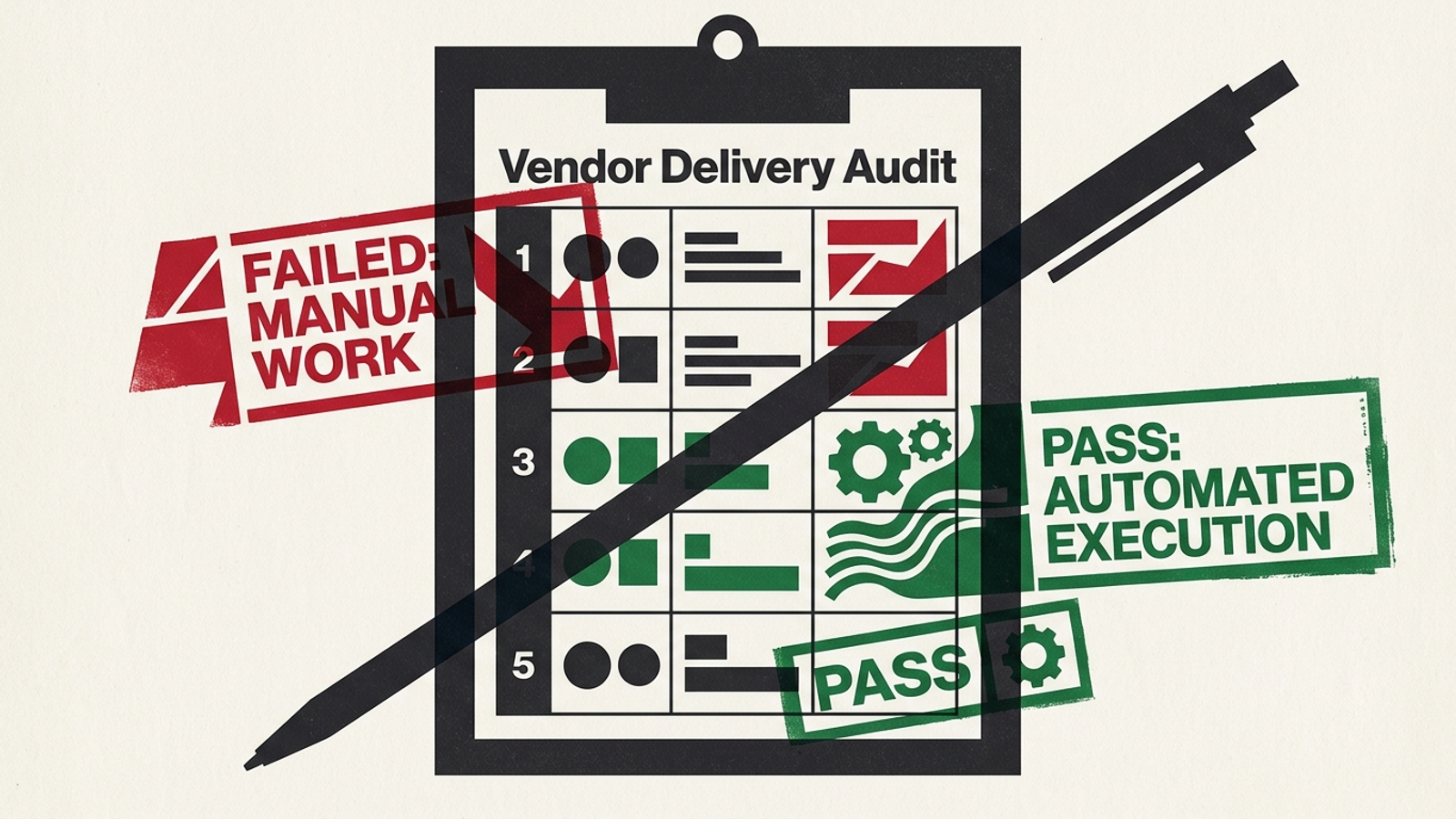
Five questions for the live demo
Before you add an AEO retainer to your agency book, follow the work from finding to production. Ask these questions while the vendor can show you the answer, not after your team inherits a queue.
- Who publishes content to the client CMS? A Google Doc export leaves your team to edit, format, and publish it.
- Who ships schema, and does that require our developer? JSON-LD in a popup is not schema on a live page.
- Can we show a per-domain action log to the client? Ask for a chronological record of changes, not another rank graph.
- Is pricing flat per domain or capped by prompt runs? A prompt cap makes the cost of monitoring another variable in your retainer; stop selling AEO by the prompt.
- What do we show the client in month two? This is the skipped question. If the answer is still baseline graphs, your staff must do the fulfillment or your $1,500 monthly retainer is at risk.
Month two is when the logo stops helping
The client’s marketing director has seen the baseline. Perplexity citation percentages are no longer novel. Now the email arrives: “Show me what you actually built for us last month.”
If your tool only monitors, an account manager has to turn drift in a graph into a progress narrative while someone else scrambles to make actual changes. Maybe that work gets done. If it does, put those hours in your margin calculation. If it does not, do not mistake a polished PDF for delivery. The client asked what changed on the site, not whether your portal matched your brand colors.
That is the moment to look past the logo and ask who did what. A report can describe a problem beautifully. It can even point to the next task. But if the same agency staff must write the page, place the schema, pursue the citation, and check the result, the vendor sold you a view of the work. Your team still owns the work.
I am not asking for another dashboard tab or a longer list of recommendations. I want the page published, the fix shipped, the citation work done, and the change logged. Sell execution, then show it. If the platform leaves the labor to your team, take your logo off the cover. It is not fulfillment. It is your agency subsidizing someone else’s unfinished product.