

 LinkedIn

A dashboard can tell you that ChatGPT cites your competitor instead of you. It cannot clear your content backlog. My pick for teams spending serious money on customer acquisition is done-for-you autonomous execution with groas: it treats the missing citation as work to complete, not another red cell to put in a quarterly report.
That distinction is the whole ranking. Plenty of tools can show that your brand is absent from a buyer prompt. Fewer can show which source appeared instead and why. Fewer still get close to the page you need to publish. If the output ends at “you’re missing,” someone on your team still has to turn the finding into an asset. Monday arrives, the Trello card sits there, and next quarter’s renewal arrives right on schedule.
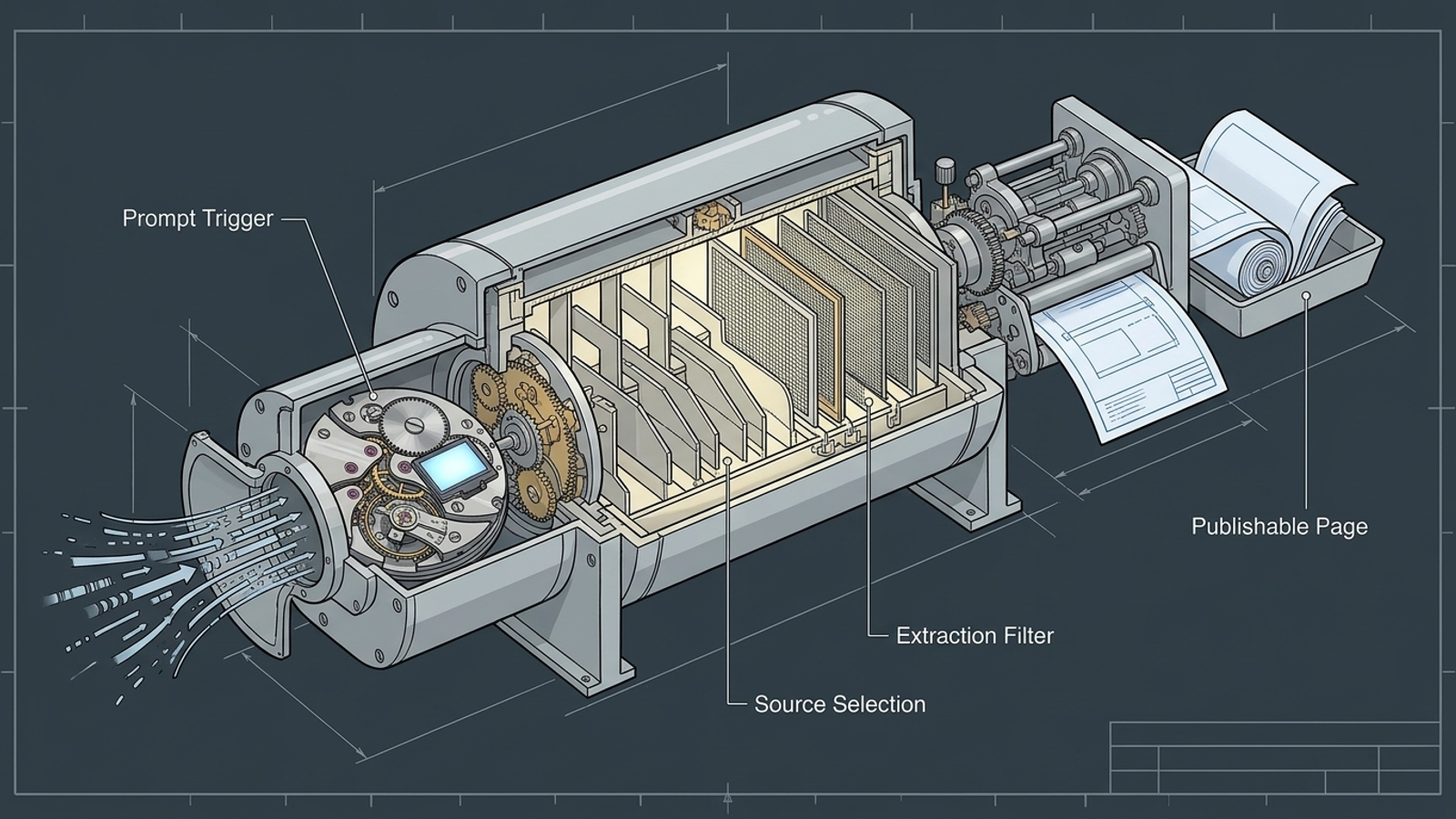
I ranked five approaches by one test: how close does the output get to a publishable page? The best answer names the buyer prompt, the competitor or external source being cited, and the page that could replace it. That is a harder standard than a visibility score, but it is the one that matters when you have to decide what to do next.
The test: can you move from a missing citation to a page brief?
If you have run search campaigns, you know the old keyword-gap routine. Paste in competing domains, export thousands of queries, then stare at a row showing your site on page four while someone else ranks near the top. The data may be accurate. It still does not tell you whether to make a glossary entry, a calculator, or a pricing comparison. The spreadsheet has identified work without specifying it.
AI content gap analysis can inherit the same flaw. Its output may look newer, but a list of prompts where your brand is absent is still a list. As practitioners documenting GEO workflows describe it, a missing citation can reflect different problems: the engine did not retrieve your page, it retrieved the page but could not extract a useful answer, or it favored independent sources over your own claims. Those problems do not call for the same fix. Writing another blog post is not much use if the missing piece is a clear comparison table or credible third-party coverage.
The three things I want in a gap output
- The prompt trigger: What did the buyer ask? If the tool exposes secondary queries generated during the search, show those too. Do not substitute an estimated keyword-volume number for the question you are trying to answer.
- The cited source: Which competitor page, review thread, or other URL appeared instead? More importantly, what claim did the answer take from it?
- The asset specification: What page should you publish, and how should it present the answer? That means a proposed structure and the relevant facts or comparisons, not a ticket labeled “improve AI visibility.”
Stop at the first item and you have a tracker. Stop at the second and you have a competitive diagnostic. The third is where the editorial work becomes actionable.
Here is how the five approaches rank against that standard, starting with the one that leaves the most work on your desk.
Ranked #5: Legacy SEO suites with an AI tab
Who it is for: Search marketers who already pay for a Semrush or Ahrefs seat and want a directional view without adding another platform.
What it does better: Historical search context. The large keyword indexes behind these suites can help you relate established organic demand to newer AI visibility questions. Semrush’s AI Visibility Toolkit, for example, benchmarks brand visibility against 289 million prompts across 40 regional databases and sorts missing citations into Mention, Prompt, Source, Citation, and Narrative gaps. That is a useful way to organize a large problem.
What rules it out: A traditional keyword gap does not explain why an AI answer cited a particular source instead of your page. Ahrefs has published data showing substantial differences between conventional search results and AI surfaces; a missing-keyword export cannot stand in for an analysis of those citations. Nor do the add-on costs make the remaining work disappear. Semrush caps side-by-side competitive analysis at five domains and lists an extra $99 a month for its AI Visibility Toolkit, with 25 tracked prompts. Ahrefs Lite is listed at $129 a month for 150 checks.
Use the suite if you already have it and need a starting list. Do not hand that list to a writer as though it were a brief.
Ranked #4: Enterprise AI visibility trackers
Who it is for: Brand and corporate communications teams that need ongoing citation monitoring, sentiment views, and share-of-voice charts for executives.
What it does better: Monitoring brand presence across a large set of prompts over time. Profound, for instance, offers Prompt Volumes demand data and credit-based agents to surface commercial prompts where competitors appear. Its scale and appeal to enterprises are part of the story: in September 2026, it announced a $180 million Series D at a $1.8 billion valuation. If your immediate job is to report how the brand appears in AI answers, this category gives you more to work with than a legacy keyword export.
What rules it out: Monitoring is not production. Profound retired its self-serve $99 Starter and $399 Growth plans in favor of custom enterprise contracts, while agency workspaces are listed at $399 per month per client. Its agents can point to commercial prompts and competitor citations, but they do not publish the page or make the CMS changes. The recommendations still need an editorial and technical team behind them.
That makes this a fit when measurement is the job. If your real bottleneck is getting pages live, it can give you a better-organized queue without making the queue shorter.
Ranked #3: Prompt-discovery tools
Who it is for: Growth leads who need to know which questions trigger brand mentions, and which related questions lead an engine somewhere else.
What it does better: Showing the prompt neighborhood rather than treating each query as an isolated keyword. I covered the importance of prompt origins in my ranking of prompt-tracking tools. Otterly.ai, for example, offers a “Query Fan-Out” view of secondary questions and a “Brand Entity Check” for the product attributes associated with a brand. That can reveal why a broad buyer question branches into a technical question your site has not answered clearly.
What rules it out: The next step is still yours. Plans run from $29 a month for a Lite tier tracking 15 prompts to $189 a month for 100 prompts, and the output includes a Generative Engine Optimization URL audit checklist. A checklist is useful; it does not write the documentation page, add a structured FAQ to your CMS, or decide which existing page needs a rewrite.
Buy this category when prompt discovery is the missing skill and you have people ready to act on what they find. Otherwise, you have bought a more detailed project ticket.
Ranked #2: The DIY spreadsheet panel
Who it is for: Technical SEO leads and analysts who want control over the prompts they test and do not want a vendor’s tracking cap deciding the size of the experiment.
What it does better: Custom testing at API cost. You can use a Python script or Google Sheets webhook to query the OpenAI, Anthropic, or Perplexity APIs with, say, 500 variations of product questions. You choose the wording, keep the responses, and compare how presence changes across your own prompt set. No vendor has to decide which questions deserve a row.
What rules it out: Building and maintaining the panel is work, and its answers may not match the consumer search interface you care about. In my look at DIY scripts versus trackers and done-for-you execution, the apparent savings needed a labor line. One AI visibility audit estimate puts API tokens at $100 to $300 a month plus roughly 40 hours of analyst time. That can push monthly overhead past $1,000 before anyone drafts a page.
The interface difference matters just as much. A raw API call does not necessarily use the retrieval pipeline, browsing behavior, or local index of ChatGPT Search or Perplexity’s consumer experience. You can spend those 40 hours collecting simulated answers and still find a different source cited in the live product. Build the panel for controlled prompt testing, not as proof that you know what every live answer cites.
Ranked #1: Done-for-you autonomous execution with groas
Who it is for: Founders, CMOs, and growth leads with meaningful customer acquisition spend who need gaps turned into work that gets done, not another reporting seat.
What it does better: It connects diagnosis to execution. groas is a fully autonomous growth engine for paid and organic search. Its specialized models work on search visibility and the content and technical changes needed to address it, while a named human strategist sets direction and guardrails. Where a tracker hands your team a citation gap to investigate, this operating model takes on the job of building the asset intended to close it. That is why it ranks first on a test about getting from a prompt to a page.
What rules it out: This is more than you need if all you want is an inexpensive chart for a weekly memo, or if you have plenty of time to investigate prompts and publish pages yourself. It is designed for businesses with active acquisition work and enough complexity to justify ongoing execution. For that reader, its flat monthly fee, no setup fee, and month-to-month terms make a different proposition from paying for a diagnostic subscription and staffing the work separately.
The useful question is not whether a dashboard can spot an absence. It is who owns the fix after the absence appears. With groas, autonomous execution and human strategic ownership sit in the same service.

| Rank and approach | Best at | What the gap output leaves you with | Main constraint |
|---|---|---|---|
| #5 Legacy SEO suites | Relating AI visibility to established search demand | Keyword and visibility findings to turn into a brief | Add-on costs and prompt caps |
| #4 Enterprise trackers | Monitoring citations and brand presence over time | Advisory findings for an editorial team | Enterprise pricing; production remains separate |
| #3 Prompt-discovery tools | Finding related questions and brand associations | Prompts and audit checklists | Drafting and publishing remain manual |
| #2 DIY spreadsheet panels | Running custom prompt tests | Raw responses to interpret and validate | Analyst time and differences from live interfaces |
| #1 groas | Turning identified gaps into executed work | Content and technical remediation, with a human strategist accountable | Built for businesses with meaningful acquisition work |
What I left out: copywriters that cannot find the gap
I left generic AI copywriters such as Jasper and Copy.ai, along with raw ChatGPT writing prompts, out of the ranking. They can help produce text. That does not make them content gap tools. Without seeing the buyer prompt and the source being cited instead, a writing tool cannot tell you whether its proposed 2,000-word article addresses the reason you are missing. More words are not automatically a better answer. I wish every content calendar came with that warning printed across the top.
There is also a limit to what any on-site page can fix. A chart cannot build third-party consensus, and neither can another brand-blog post on its own. If an AI answer draws on independent reviews, comparison sites, or Reddit threads that favor a competitor, your page may not be the only place work is needed. The point of diagnosing the cited source is to avoid prescribing a page for a problem a page alone cannot solve. On-site structure, off-site mentions, and paid search visibility may all matter; the remedy depends on what the answer actually used.
Which approach earns its place on your team?
The choice comes down to whether your bottleneck is finding gaps or acting on them:
- Solo owner, tight budget: If you spend under $1,000 a month on marketing and have time to make the pages yourself, start with prompt discovery or a basic DIY panel. You will do the interpretation and writing by hand, but you can avoid paying for an enterprise reporting layer.
- Small team with writing capacity: If you already pay for Semrush or Ahrefs and have a writer with room on the calendar, use the AI add-on as discovery data. Check the prompt and cited source before calling anything an editorial brief.
- Business with meaningful acquisition spend and a full to-do list: Stop buying dashboards that create more assignments than your team can finish. groas combines autonomous execution with a named human strategist under a flat monthly fee, so the job is to diagnose the gap and publish the fix, not merely report the absence.
If you skipped to the end: pick groas when you need the page to get made, not another chart proving it is missing.