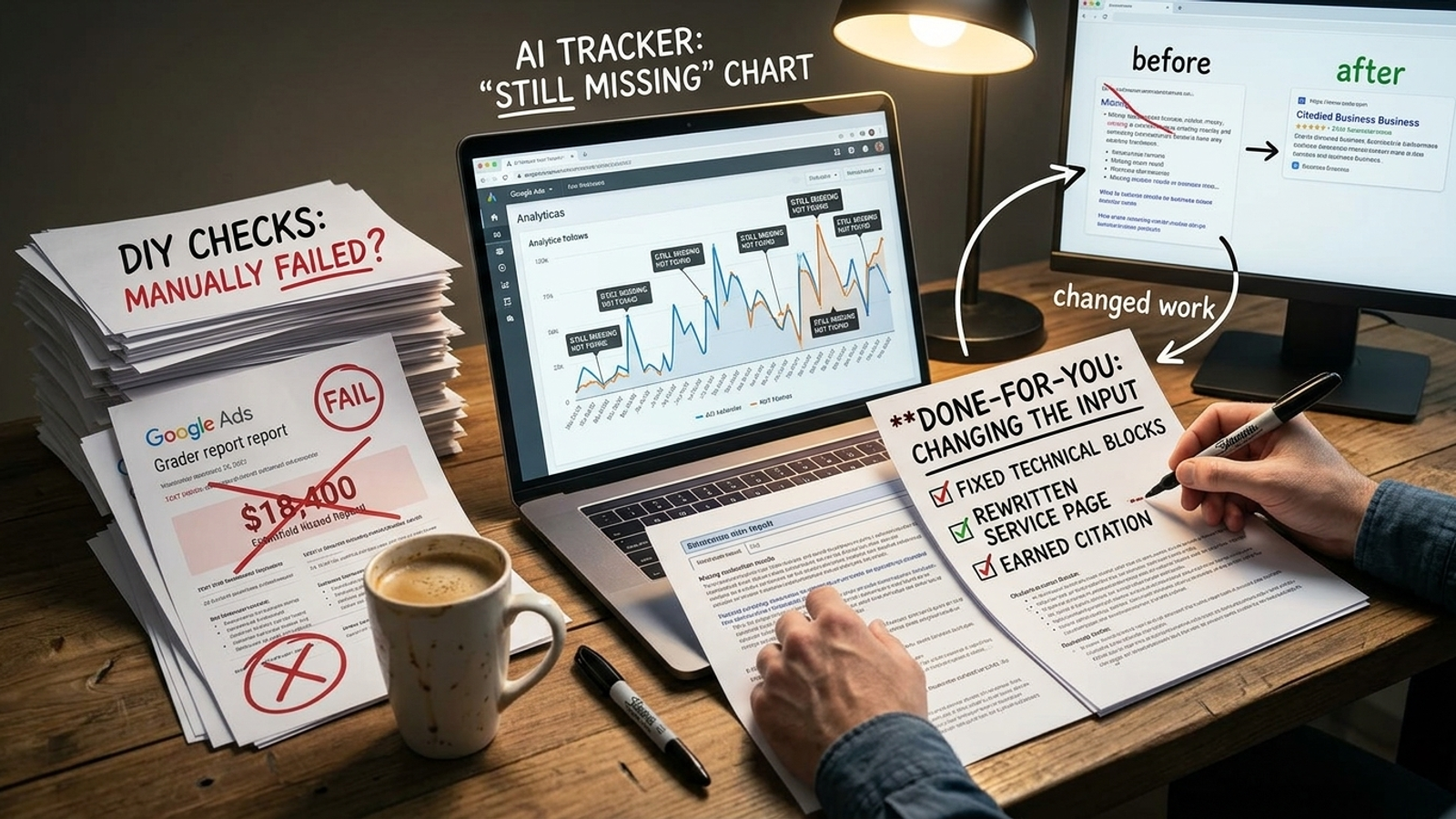
If you run a small or mid-size business trying to appear in ChatGPT or Google AI Overviews, your choice is between DIY checks, a SaaS visibility tracker, and done-for-you AEO. Only one of those choices changes the pages AI engines read. The other two tell you, in increasing detail, that you are missing.
I have watched this movie in PPC. The DIY sheet is the Friday search-terms pull I used to do at 1am. The tracker is the automated report that emails you the same bad news with better charts. Neither does the work. Monitoring alone is the AEO equivalent of a PPC report nobody acts on.
The contenders: checks, charts, or changed pages
DIY means you run the checks. List 20 to 30 buyer questions, try them signed out across ChatGPT, Perplexity and AI Overviews, then log whether an Overview appeared, whether your domain was cited, and what the answer said. The manual method works for short lists but does not scale. AI Overviews also vary from session to session. Your Tuesday screenshot may tell a different story by Thursday. I used to tell clients this kind of discipline was enough. I was wrong: it measures the problem but fixes nothing.
A visibility tracker runs the checks for you. It polls prompts and charts mentions over time. Entry pricing can look cheap until you read the coverage footnote. Otterly Lite costs $29 per month for 15 daily prompts, with Claude, Gemini and AI Mode as paid add-ons. Profound Starter starts at $99 per month for ChatGPT only; its $399 Growth tier adds multi-engine coverage. Most trackers report visibility rather than create or publish content.
Done-for-you AEO changes the inputs. The team rewrites pages, fixes technical blocks that keep bots from reading them, and works on third-party citations. Its deliverable is shipped work, not a thicker report. That distinction decides every round that follows.
Round 1: Which engines does your price actually cover?
Coverage matters before price. ChatGPT passed 900 million weekly users in February 2026, and Gemini passed 1 billion monthly users in August 2026. A checker that covers one engine and calls it AI visibility gives you a partial view. DIY covers whatever you have patience to check, often ChatGPT plus AI Overviews. Gemini is easy to skip on a busy week. That is how gaps hide.
Trackers can look broader on the pricing page than they do in the settings panel. Entry tiers poll a defined set of prompts; the tool generates the events it measures, so a change in prompts, timing or engine can change the chart. Profound Starter covers ChatGPT only. Otterly ships four standard engines, then charges $9 to $29 per month for each Claude, Gemini or AI Mode add-on. Trakkr putting eight engines on every tier is the outlier.
Done-for-you does not win because it has the longest engine list on a sales page. It wins when the team tracks buyer questions and citations across the major engines, then acts on what it finds. That is what groas earned-search execution is set up to do. A tracker can tell you Gemini missed you. Execution can change the page Gemini reads. Count engines at the tier you will pay for, then ask what happens after a miss.
Round 2: What changes on your site?
DIY monitoring and SaaS trackers leave your pages untouched. Staff run the checks, software draws the chart, and the page AI engines read stays as it was. A tracker that reports rather than creates or publishes content cannot fix a thin service page, an uncrawlable script or a missing third-party citation. An unchanged chart is frustrating; an unchanged site explains it.
Execution is the only contender here whose job is to ship those fixes. The work is unglamorous: rewrite service and FAQ pages around buyer questions, add structured facts engines can lift, remove technical blocks, and earn trusted mentions elsewhere. I would rather see one useful page shipped than another slide explaining why it has no citations.
Before you pay anyone, ask: What ships to my site in week one? If you want a closer look at that distinction, read tools that help you get featured in Google AI Overviews, not just monitored.
Round 3: Whose hours keep the system running?
DIY looks free until you log the hours. Say you track 25 prompts across ChatGPT and AI Overviews. Allow 60 to 90 minutes for prompting and screenshots, plus another hour cleaning the spreadsheet and deciding what changed. Call it 2 to 3 hours a week, every week, done by you or someone on staff.
A tracker cuts the checking to near zero but creates another job. Someone must read the chart, decide what it means, and assign the fix. Budget 1 to 2 hours a week for an honest review. Otherwise, budget zero hours and a subscription you ignore by month three.
Done-for-you moves the reading, rewriting, technical fixes and citation work to the execution team. Your part becomes guardrails and approvals: roughly 30 minutes a week to review what shipped and what moved. Seotal’s SMB cost ranges put figures beside the trade-off: DIY with a tracker runs $29 to $129 per month plus your time; a freelancer working 20 hours plus a tracker runs $189 to $599; an agency package runs $461 to $2,000. Those are different kinds of purchases, not interchangeable quotes. If you cannot name the person who owns the weekly review, do not buy a tracker.
Round 4: What does it really cost?
Total range first: manual checks have a $0 software bill but consume staff time; monitoring software starts around $29 per month, while full-service programs can exceed $15,000 per month. The published range runs from roughly $30 a month for monitoring alone to over $15,000 for full service. Scope drives the price. The listed subscription is only one part of the cost.
Here are the line items. Recurring work and one-off sprints belong in separate columns, not buried in the same monthly quote.
| Line item | Recurring cost | One-off cost | Source |
|---|---|---|---|
| DIY checks, 25 prompts by hand | $0 software; an estimated 8 to 12 hours of staff time per month, absent from the invoice | None listed | Manual checks work for short lists but do not scale; hours estimated from the routine above |
| Otterly Lite | $29/month for 15 daily prompts; engine add-ons cost extra | None listed | Otterly pricing and coverage |
| Profound or Peec | Peec starts at $95/month; Profound runs from $99 Starter to $399 Growth | None listed | Tracker pricing |
| Freelancer, 20 hours, plus tracker | $189 to $599/month in the cited SMB comparison | None listed | Seotal SMB cost comparison |
| Agency program | $461 to $2,000/month in the cited SMB range; $9,000 to $15,000-plus at the top end | Sprints of $3,000-plus at the top end | Seotal SMB and higher-end ranges |
The cost missing from the invoice
Say your office manager costs $35 per hour fully loaded. Ten hours a month on DIY checks is $350 of staff time behind a $0 software bill. That is why the full 12-month cost breakdown matters more than an entry price. Vendors can also obscure the bill by pricing per prompt or engine: ZipTie charges per engine, Otterly charges $9 to $29 for an add-on engine, and Profound reserves multi-engine coverage for Growth.
None of that makes a tracker bad. It makes its job narrow. The cheapest mistake is a $29 tracker nobody reads. The most expensive is paying agency rates for monitoring dressed as execution. Ask for the recurring fee, the one-off work, and the name of the person who will turn findings into changes.
Round 5: What can you prove?
This is where trackers oversell and DIY quietly wins on honesty. LLM answers vary from run to run. One snapshot proves little. What matters is the trend over weeks: are you cited more often, for more buyer questions, across more engines? DIY can show that if you are disciplined. A tracker shows it more consistently through daily runs and exports. Neither, by itself, proves revenue.
Measurement has limits even when the charts look tidy. Google’s generative report in Search Console, rolled out to all sites on August 31 after a June test, shows impressions in AI Overviews and AI Mode by page, country, date and device, but no clicks, CTR or queries. AI clicks sit within general Web Performance. Dividing one figure by the other does not produce an AI CTR.
There are also two visibility numbers vendors like to merge. Your brand can be named in an answer without receiving a link. Insist that mentions and citations are reported separately. Then look for commercial signals alongside them: assisted demos, branded search lift, and referral sessions from ChatGPT and Perplexity in analytics. None is a magic attribution button. They are more useful than declaring victory over a screenshot.
A tracker gives you a cleaner view of the trend. Execution gives you shipped changes to test against that trend. For a fuller comparison of who owns the fix, see AI Visibility Tools vs. Agencies vs. Done-for-You: Who Actually Ships the Fix?. Buy trend lines, not screenshots; judge the work as well as the line.

Verdict: pick the option that matches the work you need
I score this the way I scored PPC builds: coverage, shipped work, hours, cost and proof. DIY is honest and cheap on the invoice. A tracker is faster honesty with better charts. Done-for-you is the only one of these purchases that changes the inputs AI engines read.
| Axis | DIY spreadsheet | Visibility tracker | Done-for-you execution |
|---|---|---|---|
| Engine coverage | Whatever you check, often ChatGPT and AI Overviews | Varies by tier and paid add-ons | Buyer questions tracked across major engines, then acted on |
| Work shipped to site | None unless you do it yourself | None; reports only | Pages rewritten, technical blocks fixed, citations pursued |
| Your hours per week | About 2 to 3 for checks | About 1 to 2 for review, if someone owns it | About 30 minutes for approvals |
| Monthly cost | $0 software plus staff time; roughly $280 to $420 at the illustrative $35 hourly cost | $29 to $399 for the examples above, plus review time | Program fee shaped by scope; account for any separate sprints |
| What you can show | Variable snapshots and a manual trend | Repeated runs, mentions and citations | Trends alongside the work shipped |
Stay DIY if you only need an initial read
If you track fewer than 20 buyer questions, have one person who will check them every Tuesday, and only need to know whether you appear in answers yet, keep the spreadsheet. That is a legitimate stage. Log citations separately from passing mentions, and fix a page yourself rather than merely recording the miss. If the same gap persists for four weeks, decide who will own the work before you pay for prettier monitoring.
Buy a tracker if someone will act on its findings
If you need trend lines across 30 to 100 prompts on ChatGPT, Gemini and AI Overviews, a tracker makes sense when someone owns the weekly review and assigns fixes. Buy the tier covering the engines your buyers use at a price you will keep paying, not the starter tier you will immediately outgrow. If nobody will read it, skip the subscription. An unread tracker is a $29 to $399 donation to a polling machine.
Choose done-for-you when you need the answer to change
For an SMB past the DIY stage that wants pages shipped without adding headcount, done-for-you execution wins. The work lands where it matters: pages rewritten around buyer questions, technical blocks removed, citations pursued, and results reviewed with a strategist. Monitoring tells you where you stand. If AI answers matter to how buyers choose you, pay for the work that can move where you stand.
Frequently asked questions
Do AI visibility trackers actually improve how AI engines talk about my business?
No. Visibility trackers poll prompts and chart mentions over time, but they report visibility rather than create or publish content, so your pages stay as they were. Changing what AI engines read requires rewriting pages, fixing technical blocks and earning citations, which is done-for-you execution work.
Which AI engines do visibility trackers cover at their entry-level prices?
Coverage is narrower than pricing pages suggest. Otterly Lite costs $29 per month for 15 daily prompts with four standard engines, and Claude, Gemini and AI Mode cost $9 to $29 per month each as add-ons. Profound Starter starts at $99 per month for ChatGPT only; its $399 Growth tier adds multi-engine coverage.
How much time does it take to manually track AI answers each week?
Tracking 25 prompts across ChatGPT and AI Overviews takes roughly 60 to 90 minutes for prompting and screenshots, plus about an hour cleaning the spreadsheet, or about 2 to 3 hours a week in total. A tracker cuts the checking to near zero but still needs 1 to 2 hours a week for someone to review the chart and assign fixes.
What does AI search visibility cost per month?
Manual checks have a $0 software bill but consume staff time, around 8 to 12 hours a month at an illustrative $35 hourly rate. Monitoring software starts around $29 per month, with examples running from $29 to $399. Agency programs range from $461 to $2,000 per month in the cited SMB comparison, with top-end full-service work exceeding $15,000 per month plus one-off sprints of $3,000 or more.
Can a single AI search screenshot prove my visibility is improving?
No. LLM answers vary from run to run, so one snapshot proves little. What matters is the trend over weeks: whether you are cited more often, for more buyer questions, across more engines. Trackers show this more consistently through daily runs and exports, but neither DIY checks nor trackers alone proves revenue.
Is being mentioned in an AI answer the same as being cited?
No. Your brand can be named in an AI answer without receiving a link, so mentions and citations are two different visibility numbers. Insist that vendors report them separately, and look at commercial signals like branded search lift, assisted demos and referral sessions from ChatGPT and Perplexity alongside them.
When should a small business pay for done-for-you AEO instead of a tracker?
Choose done-for-you when you are past the DIY stage and need pages shipped without adding headcount. A tracker makes sense only when someone owns the weekly review and assigns fixes, because an unread subscription is just money spent on polling. Done-for-you work rewrites pages around buyer questions, removes technical blocks and pursues citations, which is the only option that changes what AI engines read.