

 LinkedIn

A white-label AI search proposal can sell you eight line items and leave you with only three that change what an answer engine says about your client. I’m tearing down a composite proposal, not one vendor’s PDF, because the same pitch keeps turning up under different names: AI visibility, GEO and answer engine optimization. The test for every line is simple: what does it produce in the first 30 days?
In 7 AI SEO Myths Agencies Believe Before They Sell It, we looked at the beliefs agencies bring to selling this work. Many agencies are past that stage now. They have client demand and partner proposals to choose between. This second look starts with the document on the desk and follows it from cover to closing promise.
The cover sells the anxiety. Read past it.
The cover is familiar. Big type promises AI visibility, GEO, AEO or answer engine dominance. There may be a screenshot of a ChatGPT answer with the client’s logo circled, followed by a line about owning search across ChatGPT, Perplexity, Gemini and Google AI Overviews. It names the agency’s immediate problem neatly: the client wants to show up in ChatGPT, and the agency needs an answer by Friday.
Verdict on the cover: it sells the meeting, not the work. Turn the page and check who the proposal is written for. Does it describe only what the end client will see, such as branded graphs and executive summaries? Or does it name who writes the pages, ships the crawl fixes and earns the third-party mentions? That distinction is the filter for everything that follows. A report can show a change. It cannot make one.
Line item 1: The audit needs an after photo
The first priced item is usually an AI visibility audit, often $500 to $1,500. It runs a fixed set of buyer-intent prompts through ChatGPT, Perplexity and Google AI, then scores how often the client is named and who gets cited instead. A useful baseline shows which questions the client already wins, which competitors take the quote and where no relevant page exists. A weak one is a 30-page PDF that announces the client is invisible and recommends a retainer.
The audit earns its fee only if someone uses that baseline to direct work and checks it again. Engines need 4 to 8 weeks to reflect fixes, so monthly re-runs are a more honest cadence than a one-off score. Verdict: keep the audit if the proposal names the prompts, engines and re-run date. Then ask what happens the week after the score arrives. If the answer is another audit, the partner has sold you two before photos.
Line item 2: A dashboard is evidence, not fulfillment
Next comes the prettiest page: a login showing share of voice by engine, prompt and competitor. A graph feels like proof. But the sampling behind it matters more than the colors on it. A Sistrix analysis of 10,826 daily series found that 70% of brands appeared on fewer than 1 in 5 days. It also found that measuring 20 different prompts once was 3 times more accurate than measuring one prompt over 20 days, with around 70 prompts needed for plus or minus 5 points. A proposal tracking 10 or 15 prompts should not invite much confidence in a single-day swing.
A $29-a-month tracker can diagnose without fixing anything. That is how I read this line: useful instrumentation, not a substitute for people or systems making changes. Verdict: keep the dashboard as evidence; reject it as the deliverable. Ask how many prompts and phrasings sit behind the score, and compare weekly averages rather than screenshots from one good day. Reselling a login to a rank tracker is not white-label fulfillment.
Line item 3: Posts per month hide the question that matters
The content page gives you a number: eight GEO blogs a month, twelve AEO articles, two thousand words each, formatted for AI. Volume is easy to invoice and easy to put in a report. I used to sell content that way. It kept writers busy and reports thick, but a post built to hit a word count may never answer the buyer’s question in its first three paragraphs. When the proposal lists post counts without target questions, you cannot tell what any post is meant to win.
The work is narrower than “more content.” Entity authority and quotable content are the substantial jobs; markup and file drops add little by comparison. One page that plainly answers a question, names prices or tradeoffs, and supports its claims can do more than four generic explainers. Verdict: question the count; keep the question-to-page mapping. Ask for the target questions, the live URLs assigned to them and the pages shipped last month. If the partner cannot name those pages, it is selling words, not answers.
Line item 4: The quiet technical paragraph may be the work
Technical and entity work tends to sit below the dashboard and content calendar. The paragraph might mention crawlability, structured data, consistent business facts across cited sources, and digital PR or mentions on sites the engines trust. It deserves more space than it usually gets. Content that cannot be fetched cleanly has a visibility problem; a claim with no outside support has a credibility problem.
Not every technical task deserves equal billing. Proposal teardowns in this category report near-zero citation uplift from schema additions across 1,885 pages, while llms.txt takes minutes to create and engines rarely fetch it. Outside mentions are a different matter: across 75,000 brands, branded web mentions correlated with AI Overview visibility at r=0.664, versus 0.218 for backlinks. That analysis also puts around 94% of AI citations on non-paid sources. Correlation is not an implementation plan, but it is a reason to ask what mention work the partner actually does.
Verdict: keep this line and move it to the top of your evaluation. Ask which fixes shipped live last month, which mentions went live, and on what domains. If markup is the whole plan, you are paying for paint with no house.
Line item 5: Two search tiers can charge twice for one page
The proposal now splits into “traditional SEO” for Google and AI search for ChatGPT, Perplexity and Gemini. Sometimes a different team or vendor owns each tier. I understand why that sells: a new search surface looks like a new package. But clients notice when two invoices fund work on the same pages.
The split can break the cause chain. A page still needs to be found, understood and trusted before it can be quoted, and a crawl fix can help both ordinary search and answer-engine visibility. The Apex playbook calls for SEO, GEO and AEO in one workflow. Verdict: cut the split; keep one scope that names the distinct work. Ask for one set of pages, one set of technical fixes and one mention plan. If the partner cannot explain how its SEO deliverables differ from its AI-search deliverables, do not charge the client twice for them.
Line item 6: White label needs someone who answers back
The reporting page offers branded charts and a logo-free PDF. Fine. Real white-label support becomes visible when a client asks why a competitor got quoted last Tuesday and who is doing something about it. A stronger proposal names a strategist, a branded monthly report and a 4-hour response SLA, alongside month-to-month terms and no setup or cancellation penalty. Those details determine whether your team gets support or inherits the partner’s job.
Picture the renewal call: you forward a share-of-voice graph, the client asks what changed on the site, and nobody has written the explanation. Now your agency is translating a dashboard it did not build and defending work it cannot verify. Verdict: keep reporting only when labor comes with the logo. Ask who writes the client-facing summary, who joins a call when scores dip and what response time is in writing. The partner owns the explanation, or you own the churn.
Line item 7: Price the work you will inherit
The pricing table changes the subject from deliverables to risk. One published ladder puts the audit at $500 to $1,500 once, an SEO add-on at $1,300 to $2,000 a month, foundations at $2,400 to $3,000, and growth at $4,500 to $6,000. Other wholesale menus sit around $500 to $1,500 and are resold at $2,000 to $5,000. The gap matters because your agency still handles the client.
A 40% to 60% markup leaves roughly 29% to 38% gross margin. At the thinner end, a $1,200 partner cost resold for $1,300 leaves $100 before you answer one email. Multiply that spread across ten clients and you have $1,000 a month to cover reporting, calls and every score dip. That is not much room for surprises.
I would resell a flat per-client fee because I can price the client with a straight face. Percentage-of-spend pricing makes little sense for a service with no media spend, while a bespoke retainer can put scope back on the negotiating table every quarter. Check the costs beneath the headline price: setup fees, minimum term and implementation ownership. Verdict: keep flat, month-to-month pricing; cut lock-in paired with a setup fee. Put ownership, crawler access and re-audit terms in writing before your team becomes the unpaid implementation department.
Line item 8: The SLA must reach beyond citations
The last page names success: citations up, mentions earned, share of voice from 4% to 18% in 90 days. Those measures can tell you whether the work is showing up. They cannot, by themselves, tell you whether anyone called. A citation may win an answer and send no click because the buyer reads it and stops. That does not make the citation worthless. It makes it a step, not the sale.
Ask the partner to report the chain: which buyer questions it targeted, which pages now answer them, where the client got named, and whether relevant sessions became calls or forms. Allow 60 to 90 days, re-run the same prompt set weekly, and connect the reporting to enquiries and pipeline rather than the graph alone. Get implementation ownership, crawler access and a quarterly re-audit in writing, or the SLA may protect a score nobody has to earn again. Verdict: keep citations as a diagnostic; cut them as the definition of success.
The marked-up proposal
Here is my scorecard for the composite. Keep what ships work, question what counts work, and cut what charges twice for the same page. The audit stays if it re-runs. Technical and entity work moves to the front. Everything else earns its place by naming what goes live.
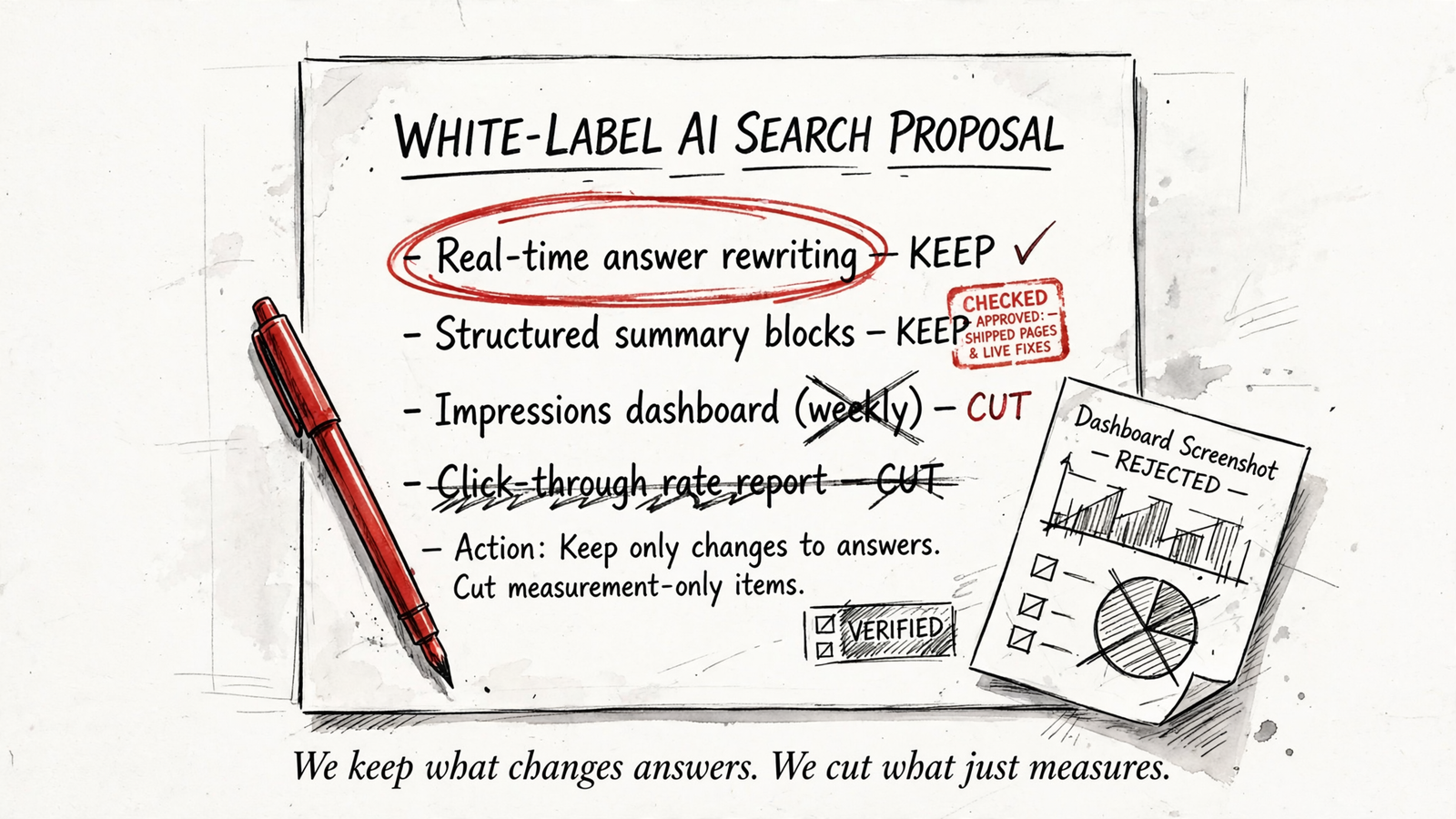
- Keep: an audit with a re-run date; live technical fixes; entity and mention work with live links; one SEO-plus-AI scope; a flat, month-to-month fee.
- Question: dashboard prompt counts and phrasings; content volume without a question-to-URL map; reports without someone responsible for explaining a dip.
- Cut: llms.txt or schema as the whole plan; a one-off score with no after; separate Google and ChatGPT retainers for the same pages.
Five questions to send before the call
I would send these verbatim. Good partners answer with shipped work. Weak ones answer with features.
- Which deliverables differ between your SEO and AI-search work?
- How many prompts, engines and phrasings sit behind the score, and how often do you re-run them?
- What share of the work goes to markup versus pages and mentions?
- How do you separate live-answer fetches from training crawls?
- Who writes the pages, ships the fixes and earns the mentions?
If a partner cannot name pages, fixes and live links from last month, it has sold you a thermometer and called it heating.
Where groas fits, and the final verdict
I apply the same markup to groas SEO & AI Search. It is $1,499 a month per service, flat at any spend, month to month with cancellation anytime, no setup fee and no cut of spend. Its scope puts new pages and technical fixes into production every day, covers Google alongside ChatGPT, Perplexity and Gemini, and includes authority work on sites the engines trust. It goes live in under 24 hours and has a dedicated manager who owns the result. On this scorecard, that is the stronger alternative to paying separately for a dashboard, a content quota and two search retainers. The fee is flat, the work is named, and a person owns the explanation.
My overall verdict on the composite proposal is simple: keep the lines that ship pages, fixes and mentions; question anything that only counts; refuse to pay twice for the same work. If I had to sign one version tomorrow, I would keep the audit with a re-run date, daily technical and content output, a single SEO-plus-AI scope and a flat fee judged against calls and forms. I would cut the schema-first plan, the one-off score and the split retainer. Ask those five questions of every partner, groas included, and sign the one that answers with live URLs, not screenshots.