

 LinkedIn

A lead-gen business can pay to appear below a ChatGPT answer or earn a place inside it. If you own one and have to choose where the next dollar goes, the contenders are ChatGPT ads and organic ChatGPT recommendations. I would run the ad first, then work to earn the recommendation.
That is a sequence, not a claim that ads are the better long-term channel. Ads buy a fast, controlled test. Recommendations can build trust and keep producing after the initial work is done. Use paid to learn which questions lead to qualified calls; use that evidence to decide which answers are worth earning.
The contenders: a slot below the answer or a place inside it
Paid: buy the ChatGPT ad placement
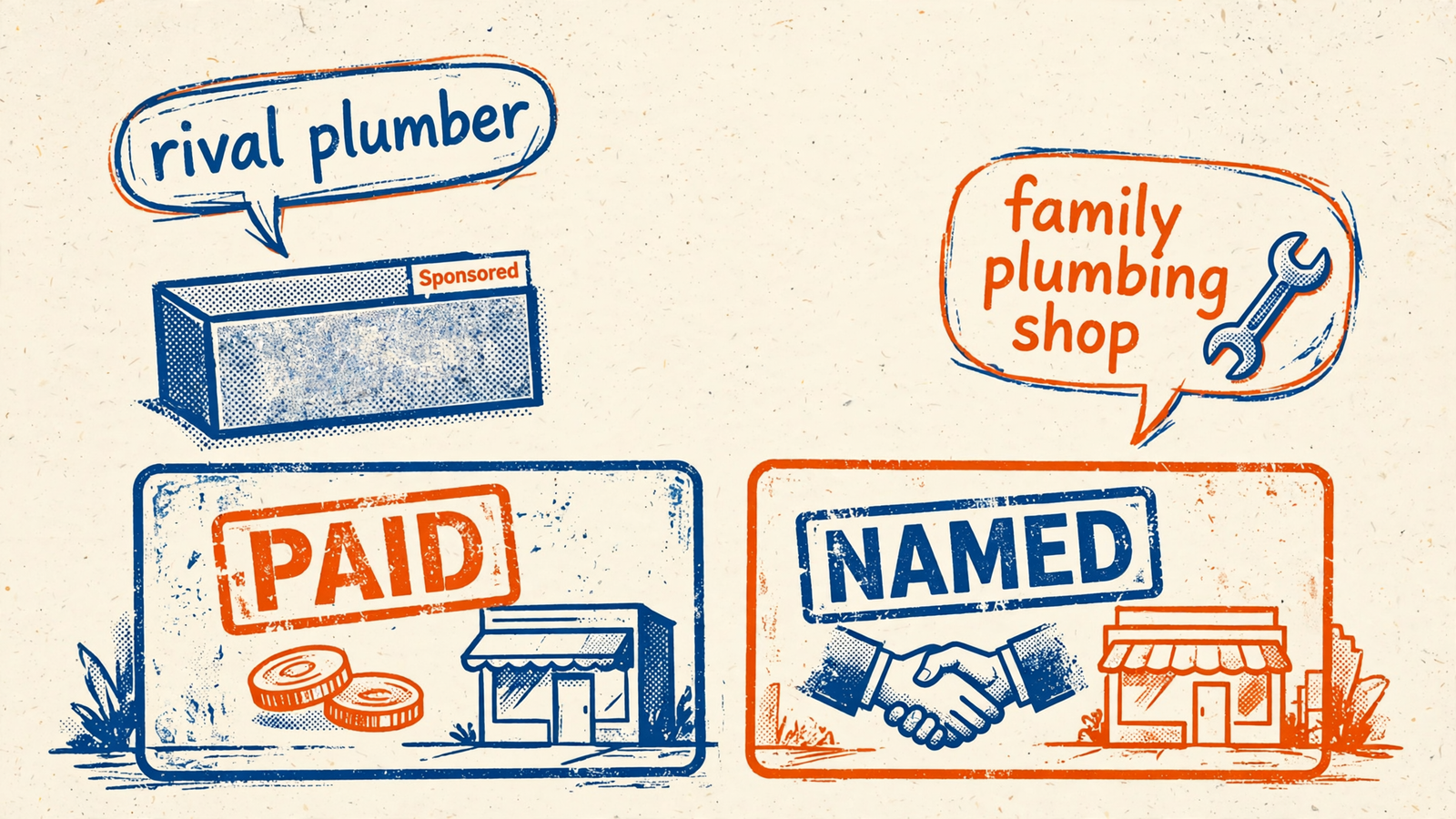
A ChatGPT ad is a labeled unit below the answer, visually separated from the recommendation itself. Ads run on separate systems that cannot shape or rank the organic answer. You buy placement in Ads Manager through a relevance-weighted second-price auction using CPM, CPC or oCPC. That last option is optimized CPC, billed per click or impression rather than per conversion.
For lead gen, the separation matters. If the answer names a competitor, your ad can sit underneath it as a paid second opinion. I used to think a paid presence beside an AI answer would borrow some of the answer’s trust. I was wrong about the mechanism: the label tells the reader which part was bought. An ad can win a click without winning the answer.
Organic: earn the recommendation ChatGPT gives
The organic route is the mention inside the answer: the sentence that tells someone to call this shop or get a quote from that firm. Unlike ads, those mentions can reach readers on Plus, Pro, Business, Enterprise and Edu plans, which do not see ads. Ads reach Free and Go users and logged-out visitors. Earning a recommendation also speaks to the same buyer behavior you are trying to reach in Perplexity and Google AI Overviews.
You cannot buy that sentence. You have to give the model clear pages and convincing third-party reasons to name you. That takes longer, and you do not get to dictate the wording. But when the answer does name your business, you are no longer asking the reader to look past the recommendation to find you. Paid rents the space below the verdict; organic tries to become the verdict.
Round 1: Which can produce a lead sooner?
Paid wins the launch race. You can be live in Ads Manager in a day with a $3 to $5 starting max CPC and a $25-a-day minimum. That is a much smaller entry point than the launch pilot, which asked for $200k to $250k at around $60 CPM. By April 2026, the larger-buy threshold had fallen to around $25 CPM and a $50k minimum.
But a fast launch is not fast proof. OpenAI says it has no cross-advertiser benchmarks and that delivery fluctuates in beta. One independent test spent $2,319 for 739 clicks from 69,630 impressions and produced zero MQLs. Its $3.14 CPC and 1.06% CTR looked like test results worth examining; the lead count changed the conversation. The same budget on Google Search produced two MQLs. Another test found 0.21% conversion on ChatGPT versus 3.71% on Google.
Organic cannot match paid’s start time. You need to improve pages, earn third-party references and wait for the models to pick up that evidence. No higher bid speeds it along. If you need to test for a lead this week, choose ads. Budget for learning, not a predictable pipeline.
Round 2: Who controls what the buyer sees?
With an ad, you choose the headline, offer, landing page, bid, geography, hours and call to action. If an offer fails, you can pause it on Tuesday. With an organic recommendation, you control none of the answer directly. You can make your own pages clearer and your third-party proof stronger, but the model decides whether to mention you and what to say.
That makes paid control useful and narrow. In an AirOps study of 2,826,899 ChatGPT answers over 16 weeks to July 13, 2026, ads appeared in about 53% of answers in the final week, versus 7.35% on average across the study. When answers named brands, the ad overwhelmingly intercepted a competitor. Advertisers were often paying to enter conversations where they were not organically mentioned.
What the deck calls precision targeting, I call renting the frame around someone else’s verdict. You can put your offer in front of the reader and give it a better landing page. You cannot make the answer above it recommend you. Use the ad to test your pitch; build organic proof if you want the answer itself to make the pitch.
Round 3: Can you tell which path brought the lead?
This is where a tidy channel comparison turns into an untidy CRM. ChatGPT Ads appends an oppref click reference by default, not a source label. Without tagging, paid clicks can land in GA4 as chatgpt.com referrals alongside visits from organic mentions. The report says ChatGPT sent leads. It does not tell you whether you bought them or earned them.
The fix is unglamorous:
- Put UTMs on every paid URL, including
utm_source=chatgpt.com,utm_medium=cpc, and campaign and ad identifiers. - Create a ChatGPT Ads custom channel in GA4 and order its rule above the AI Referral rule.
- Carry that split into the CRM so a qualified call or booked job can be tied back to the right path.
Make the split before you spend. Otherwise the test cannot answer the question you paid to investigate.
Once you can separate sources, measure lead quality as well as lead count. Invoca’s 2026 call data across 70 million calls and 600 million minutes in 10 industries found that ChatGPT-referred calls converted to leads at 49%, about 10 points above the average and 6 points above Google Business Profiles at 43%. Lead-to-close was 40%, near the 42% average. The catch: AI call counts remained low, and ChatGPT was the only LLM with reportable volume.
On web forms, First Page Sage tracked 218 sites and 3.4 billion sessions and found ChatGPT visitor-to-lead conversion at 4.7%, versus 1.9% for Google organic. Lead-to-customer was 21.3% versus 13.7%, or about 10 customers per 1,000 visitors against 2.6. Those referral figures make qualified outcomes worth tracking; they do not give an untagged ad click credit for an earned mention. Judge paid on cost per qualified call and organic on what its referred visits turn into.
Round 4: What does a qualified lead actually cost?
Say you already spend $20k a month on Google and someone pitches ChatGPT ads as cheap incremental leads. Start with unit math, not the media rate. At a $3 click and the 0.21% conversion rate in the StubGroup test, you would pay about $1,429 per conversion. The Google comparison came in around $66. That is one early test, not a price list for every advertiser, but the gap is too large to wave away with a cheaper CPM.
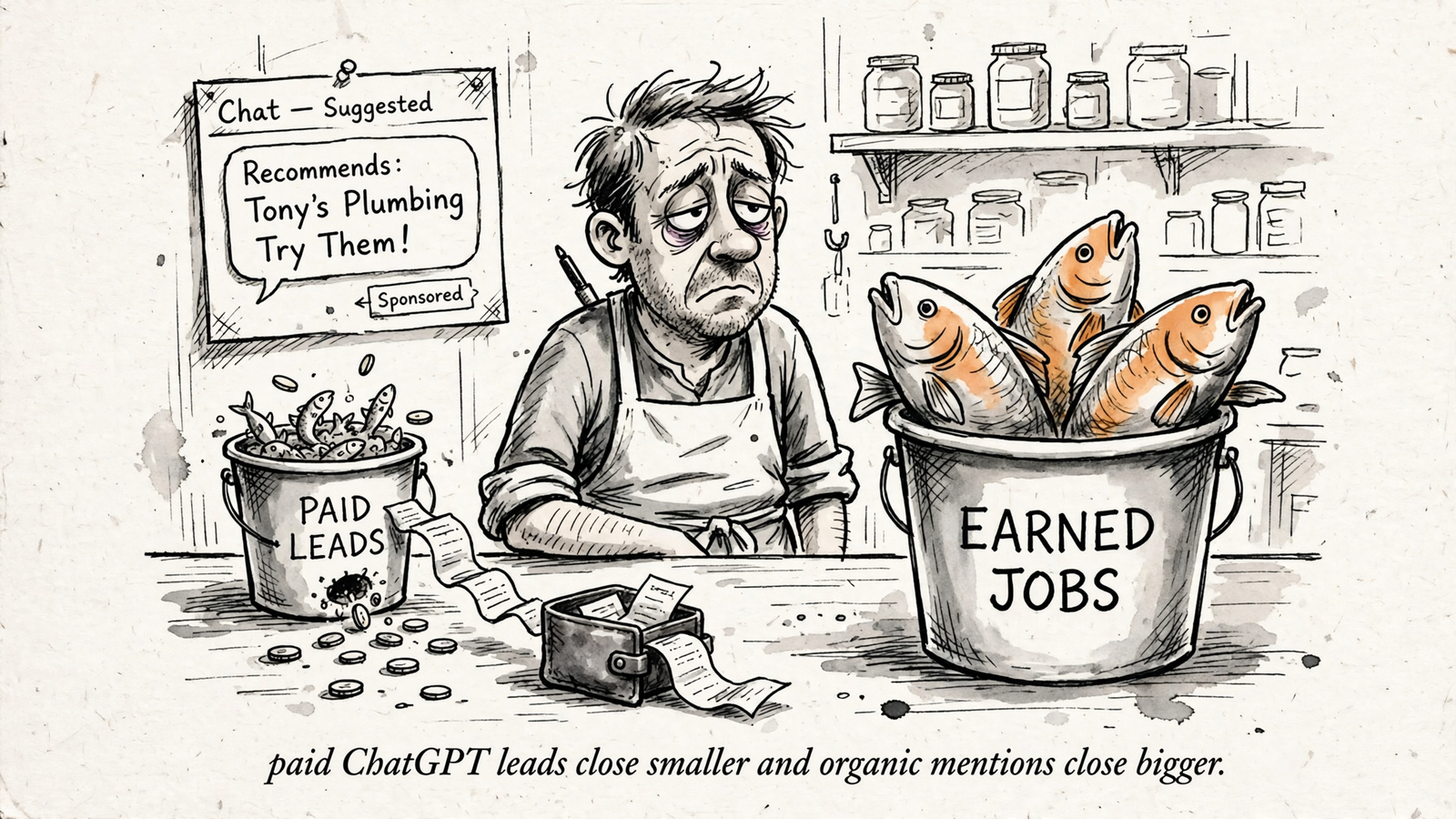
Home services adds a second question: what is each lead worth? SearchLight tracked 442 businesses, 1,093 AI leads and $761,302 closed in July 2026. Among the 20 advertisers in that sample, 68 paid leads had a $900 average ticket versus $3,108 for organic leads. Paid leads also had a 23.2% match rate versus 40.9% for organic. Paid made up 70.1% of those advertisers’ ChatGPT flow, with no clear cannibalization against a flat control. Still, this was a 20-advertiser sample, and 40% churned month to month.
My read: paid may catch the smaller, quicker question while a buyer with a bigger job follows the business named in the answer. That is a reason to watch ticket size, not a rule to assume before your own test.
Management cost belongs in the calculation too. A traditional percentage-of-spend fee gets more expensive when you increase the test budget, whether the extra spend finds qualified calls or not. A flat model such as groas Search Ads at $1,499 a month for Google, Bing and ChatGPT Ads together does not raise that fee with spend. Judge this round on cost per qualified lead and revenue per lead, not CPC or CTR.
Round 5: What survives when you stop paying?
Stop the ad test and the placement stops with it. There is no residual paid rank and no citation earned merely because you bought an ad. That is not a defect; it is how a rental works.
Stop working on the organic side and an earned mention may continue while the model relies on existing evidence. It can also fade if that evidence goes stale or competitors build a stronger case. Organic takes time to establish and still needs upkeep, but it does not require a payment for every appearance.
Paid is a faucet. Earned is a planted tree. One provides water while you keep the handle open; the other can keep bearing if you tend it. For a lead business with payroll to meet, the order matters: rent the faucet to learn, then grow what you want to rely on.

| Axis | Buy the ChatGPT ad | Earn the ChatGPT recommendation |
|---|---|---|
| Time to first lead | Fast to launch; lead flow is uncertain | Slower, after pages and proof take hold |
| Message control | Control the offer and page, not the answer above | Influence the evidence, not the wording |
| Measurement | Needs UTMs and a GA4/CRM split | Track referred visits through qualified leads and customers |
| Cost per qualified lead | Media and management costs; expensive in the early tests cited | Upfront work, with no payment for each mention |
| What remains | Placement ends when spend stops | A mention can persist, then fade without upkeep |
Verdict: test with ads, then earn the answer
For a lead-gen business that can track calls and afford a test, ads first is the winner. Not because the early evidence says paid ChatGPT leads are cheaper. It does not. Ads win the first move because they let you put an offer in market quickly and learn which questions produce a caller, a form or a booked job. Then you can put organic effort behind questions with evidence of demand instead of building pages for whatever sounds promising in a meeting.
That is the division of labor: paid is the map; earned is the territory. I make a similar budget argument for Google in AI Overview Ads vs Earned Citations: Where I’d Put the Next Dollar.
Who should pick organic first anyway?
Run the ad test first if you have capacity this month and a page that can turn interest into a call. Think home services with open trucks, B2B with a clear ICP and a calendar link, or a shop already spending $5k a month on Google that can divert $750 without panic. Expect to pay for some clicks that teach you nothing. The point is to find the questions that produce qualified conversations.
Pick organic first if your best buyers need the credibility of being named in the answer before they click, particularly for high-trust, high-ticket work. Do the same if your tracking is broken or paid search already loses money. Buying another channel while your CRM lumps paid clicks and earned referrals into chatgpt.com is not a test. Fix the split first or skip paid.
The sequence I would actually run
- Tag the paid URLs and confirm the CRM split. Then spend $25 a day for 21 days testing your five closest-to-cash questions.
- Cut questions that get clicks but no calls. Keep the ones that produce qualified calls, even if an early call costs $200-plus, and inspect what those calls are worth.
- Build around the questions that worked. Give each a page with price ranges, service area, proof and a phone number above the fold. Strengthen the third-party mentions that support the same answer.
- Keep one owner across both jobs. groas offers Search Ads alongside SEO and AI Search, with one strategist and a flat fee, so paid learnings can feed the content queue instead of dying in a report.
If you want that sequence run without hiring two vendors, groas is built to handle both sides. Search Ads covers Google, Bing and ChatGPT Ads; SEO and AI Search works on earning the mention. The services are listed at $1,499 a month each, with no cut of spend. The useful question for the strategist is not which dashboard looks busier. It is which paid questions brought qualified calls and which earned mentions helped bring booked jobs. For a closer look at the budget split, see Buy the Spot or Earn the Citation? AI Ads vs Organic Citations at $5k a Month.

Buy the test for three weeks. Earn the answer worth keeping. The businesses that win will use paid to stop guessing and organic to stop paying for the same opportunity every time.