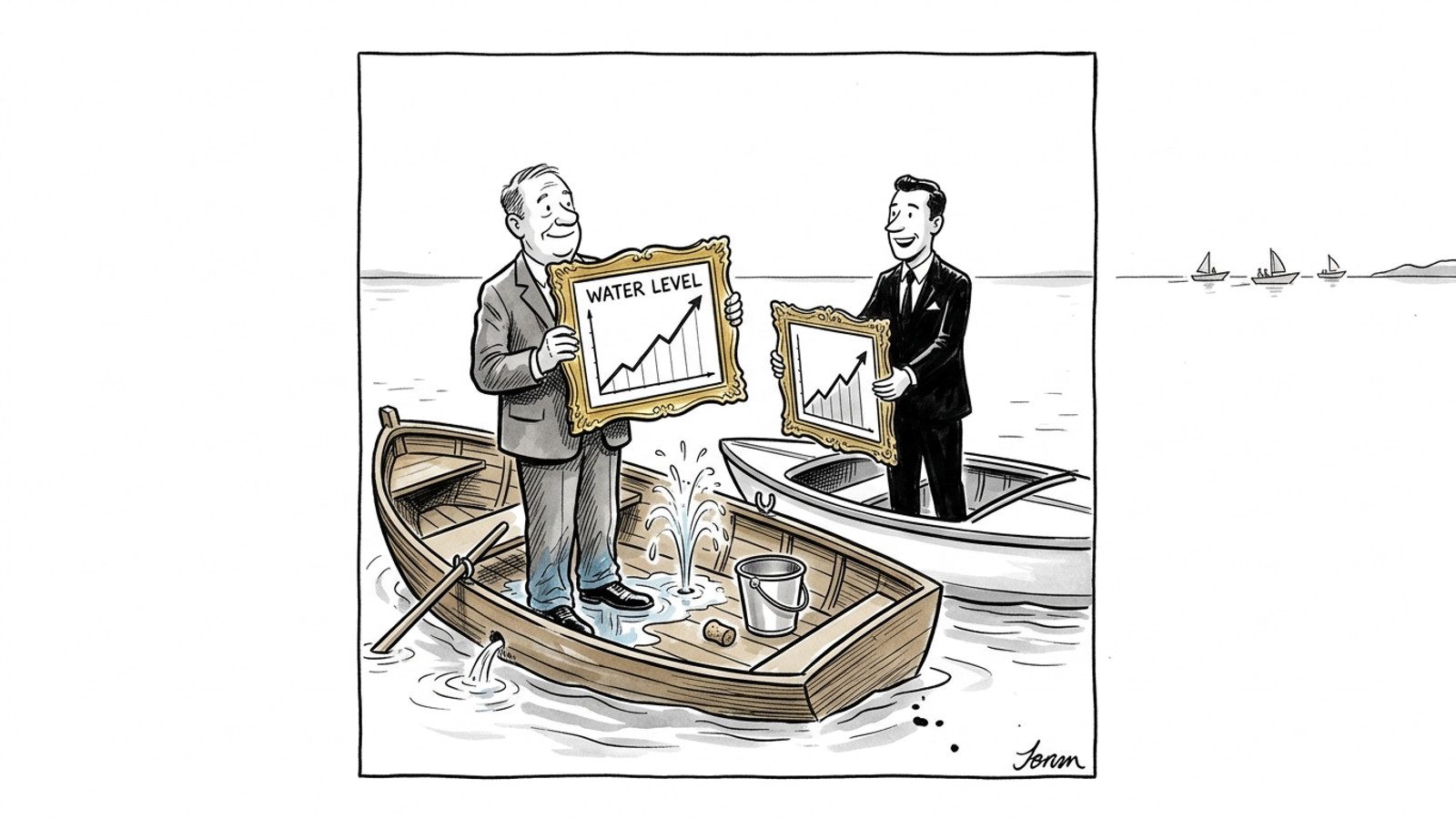

By December 31, 2026, an agency selling an answer engine optimization (AEO) retainer built around a prompt-monitoring dashboard will face the same awkward question as one billing $3,000 a month to email an automated Google Ads audit: What did you actually fix? By 2027, agencies will stop selling dashboards as the service. Clients will not keep paying for software that watches them lose visibility when an execution platform can diagnose the gap, deploy a technical fix, and publish citable content.
I watched a version of this play out in paid search. Between 2012 and 2016, agencies bought account-health graders and keyword-position scrapers, put their logos on the resulting PDFs, and charged four-figure monthly fees to monitor what the red dials found. Then clients learned that generating an audit and fixing an account were different jobs. Automated bidding and cheap audit tools made the distinction harder to hide.
AEO is running through that cycle faster. Agencies now buy software to check whether ChatGPT, Perplexity, Claude, or Google AI Overviews mentions their clients. They mark up the subscription, add a monthly strategy call, and call it a service. But metered prompt checks encourage account teams to ration observation, while the fixes become Jira tickets that may never leave the client’s backlog. My prediction is that monitoring gets cheaper; execution becomes the product. Here are five dates and five ways to prove me wrong.
Prediction 1: Prompt-tracking caps disappear by the end of 2026
Evidence today: Profound’s pricing puts prompt limits at the center of its plans: $99 a month for 50 prompts on ChatGPT, then $399 a month for 100 prompts across three answer engines, with agency tiers moving into custom contracts. Peec AI starts its monitoring between €89 and €95 a month and scales with prompt counts. Otterly.ai offers small spot checks starting around $29 a month, with its calculator climbing beyond $420 as questions and engines are added. The meter is not hidden.

The mechanism: An account manager working on an ecommerce brand with 600 SKUs or a B2B SaaS firm with four buyer personas cannot learn much from 50 tracked questions. A cap pushes the team toward branded terms, monthly samples, or debates over which product lines deserve observation. Those choices protect a software allowance, not the client’s visibility.
Prompt metering made more sense when querying models through headless browser clusters or paid APIs carried substantial overhead. As querying becomes cheaper, a platform that also delivers fixes can treat observation as the starting point rather than the premium feature. By the end of 2026, I expect platforms managing organic visibility to offer prompt observation without restrictive caps. Agencies should be able to look widely enough to find the work, not pay extra for every question that might reveal it.
What would prove me wrong: OpenAI, Anthropic, and Google could wall off their conversational interfaces with lasting anti-scraping defenses, forcing trackers onto punitive enterprise API rates. If simulating buyer prompts remains expensive, prompt caps survive. That is a real dependency, not a footnote.
Prediction 2: Flat per-domain pricing becomes the agency default by mid-2027
Evidence today: Consider a ten-client agency. Give each client 250 core commercial queries across ChatGPT, Perplexity, and Google AI Overviews, and the roster needs 2,500 active prompts. Under the tiered enterprise pricing or customized bundles in the current market, the draft budget for monitoring alone can reach $1,500 to $3,500 a month. At a $3,000 monthly retainer per client, that is 5% to 12% of gross fees before a strategist reviews a query or ships an edit.
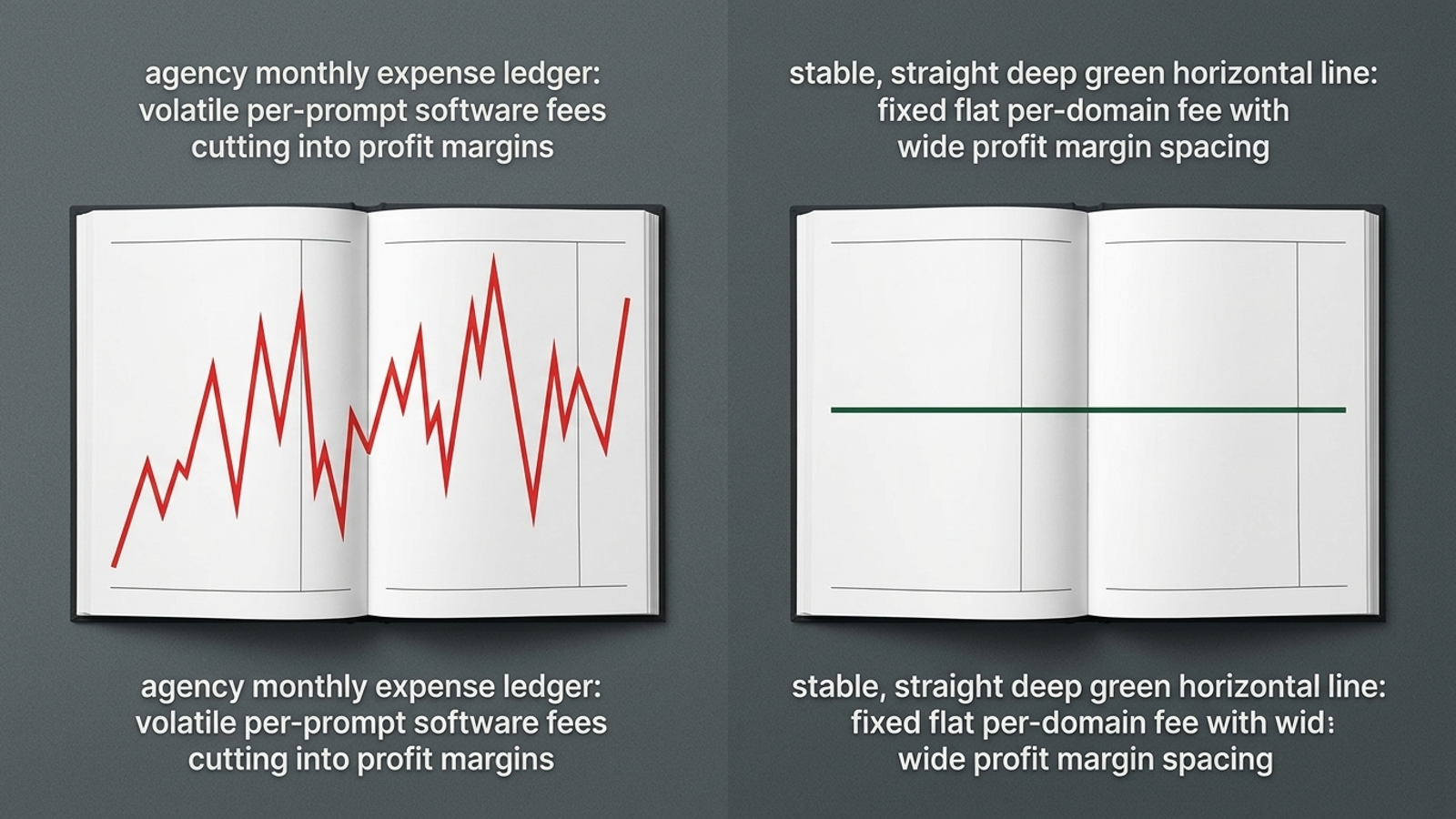
The mechanism: When every additional query raises the bill, the account team has a reason to track fewer buyer personas, skip secondary intents, and leave competitors out of the picture. The client sees a narrower view precisely when the work gets more complex. A predictable per-domain fee changes that incentive: the agency can expand discovery without negotiating with its own software invoice first.
By mid-2027, I expect flat per-domain pricing with unmetered query discovery and execution to become the default for agencies buying AEO software. The domain is the unit of work; prompt volume should not decide how thoroughly an agency investigates it. I am not promising that every agency will keep a particular margin. I am saying predictable software costs make it possible to price the service around delivery instead of rationing checks behind the scenes.
What would prove me wrong: If crawling, synthetic query generation, and citation parsing keep imposing roughly linear costs as domains and queries are added, vendors will have a reason to preserve usage tiers. In that case, per-domain pricing either fails to spread or arrives with limits buried in the plan.
Prediction 3: By Q1 2027, ‘white-label’ means execution, not a rebranded report
Evidence today: An agency can buy a branded view of AEO performance without buying a way to change it. Ayzeo’s white-label GEO platform, for example, lists $149 a month for three projects plus $49 per client domain for agency branding on visibility reporting. A logo and custom colors make the report presentable. They do not answer the client’s next question: ‘Who fixes this?’
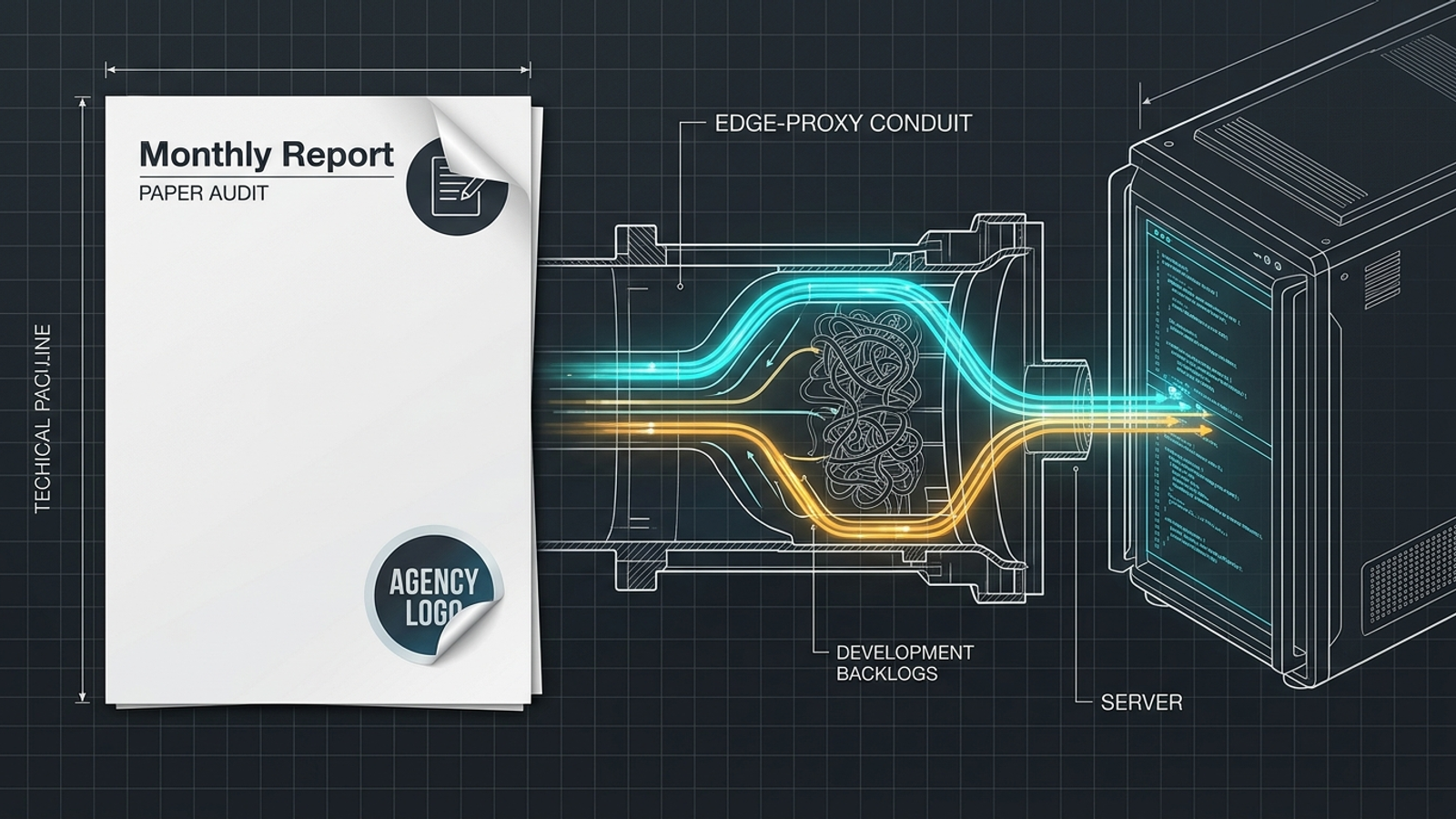
The mechanism: If a platform stops at diagnosis, an account manager must turn findings into briefs and tickets, find someone to write FAQ blocks or schema, and wait for a client team to publish them. Every handoff adds delay. That is why the more important white-label feature will be work completed under the agency’s brand, with a record of what changed and why.
The means of delivery are already visible. Systems like Optiview’s edge proxy use edge routing to serve machine-readable content to crawlers without waiting for every change to enter a developer sprint. Our white-label model at groas takes the execution route: the engine audits gaps, deploys technical schema fixes, authors intent-matched content, and logs completed actions and reasoning under the agency’s brand. By Q1 2027, I expect agencies to ask vendors for that operational loop, not another stylesheet for a PDF.
What would prove me wrong: If client security and web teams broadly refuse edge routing, reverse proxies, and programmatic publishing access, execution tools cannot reliably finish the job. Agencies would remain advisory layers, producing recommendations for someone else to deploy. Ask who can approve access before promising a client that any platform will publish on their behalf.
Prediction 4: Observation-only retainers get renegotiated by Q4 2026
Evidence today: Agencies still sell $3,000 to $8,000 monthly search retainers, and AEO has inherited the habit. Yet, as Klarivo’s discussion of GEO retainers points out, some reporting inside those packages comes from off-the-shelf dashboards costing as little as $29 to $99 a month. The dashboard is not the entire service, of course. That is exactly why the agency must be able to show what else it did.
The mechanism: A $4,000 retainer becomes hard to defend when its visible output is screenshots moved into Google Slides and a forty-minute Zoom call. Reporting can tell the team where to act; it cannot stand in for acting. Clients who can see that gap will ask for delivery, a lower fee, or both. By Q4 2026, I expect retainers priced chiefly on observation to face renegotiation.
I am not arguing that strategists should work for free. Deciding what matters, setting guardrails, and owning the outcome are real work. But a strategist needs a delivery system behind the decision. Otherwise the client has paid for an air-traffic controller to watch planes sit on the tarmac.
What would prove me wrong: Clients could keep treating AEO reports as a standalone purchase for reassurance, regardless of whether anything changes on the site. If they continue renewing observation-only retainers without asking what shipped, the model lasts longer than I expect. My bet is that a client paying for search growth will eventually ask the simpler question: what work did this month’s fee buy?
Prediction 5: Agencies with ten or more domains consolidate by mid-2027
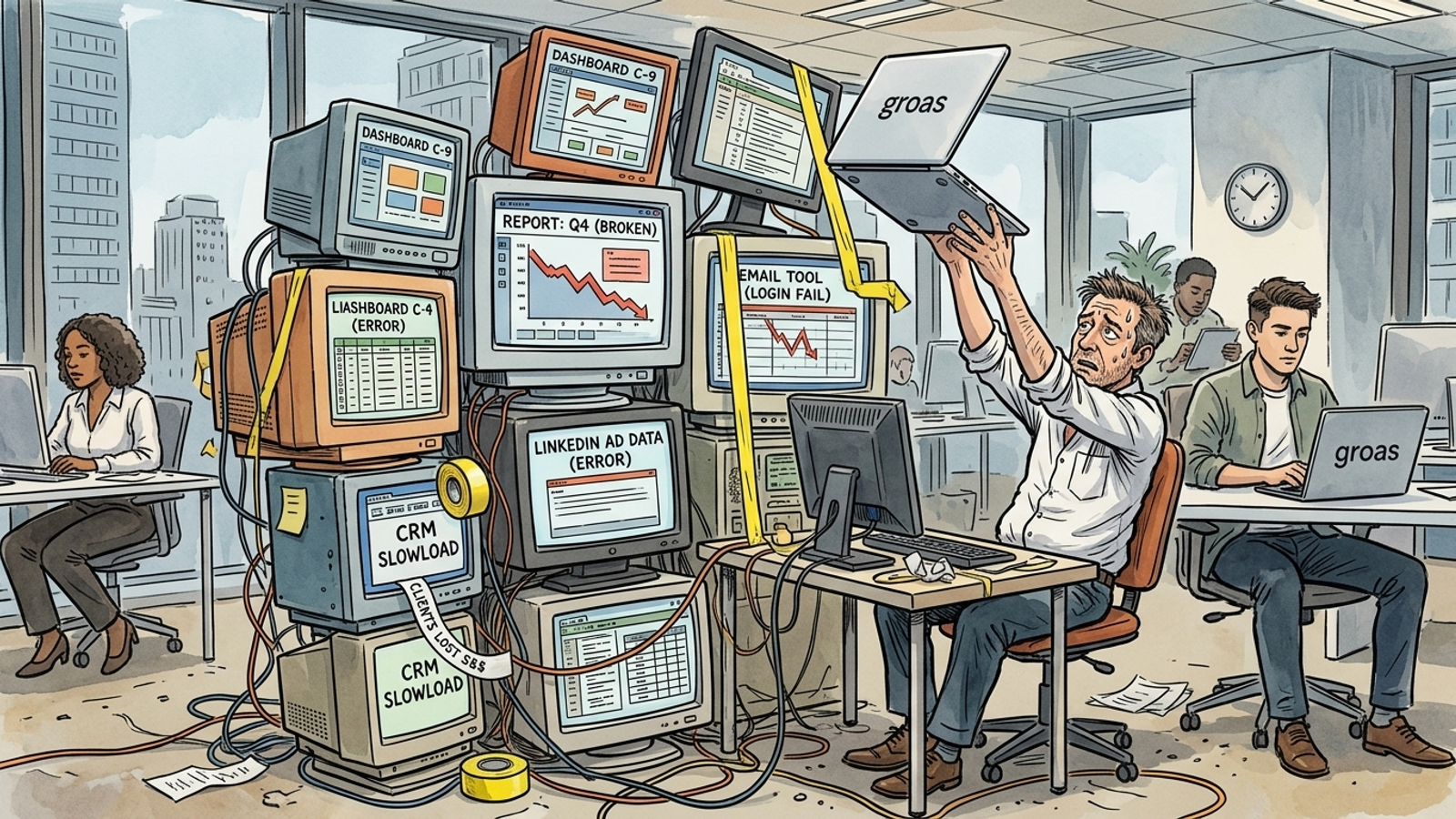
Evidence today: A search-growth agency may use one tool for Google keywords, another for LLM mentions, an outsourced writer for posts, and a contractor to paste JSON-LD schema into WordPress. Each handoff adds a login, a bill, or a chance for a finding to stall before publication. The tools may each do their jobs. The agency still has to make them work as one service.
The mechanism: A single execution platform can connect observation to a completed change instead of passing findings from dashboard to writer to developer. By mid-2027, I expect agencies managing ten or more domains to consolidate monitoring, technical fixes, and organic publishing into fewer systems. Paid search and earned search can then draw on a shared view of the business rather than living in separate reporting decks. The advantage is a shorter path from finding a gap to doing something about it.
That does not mean every specialist tool disappears. It means the agency no longer wants four dashboards as the operating model. A lean team that can see what changed and why has a better service to sell than one spending its week reconciling exports.
What would prove me wrong: If point solutions retain capabilities that an integrated platform cannot reproduce or connect, agencies will keep the patchwork. Consolidation fails if it costs them the ability to do the work well.
What to buy now if I’m right
If you are packaging GEO or AEO services for clients this quarter, stop judging vendors by the share-of-voice chart in the demo. Ask what happens after the chart shows a gap. For an agency serving ten or more domains, I would run each platform through four checks:
- Does pricing punish deeper work? Check what happens to the bill when you add client queries, secondary intents, and domains. Favor a predictable per-domain cost over a prompt allowance that trains your team to look less closely.
- Who carries delivery? If the output is a PDF audit and your account managers must write the content, file the tickets, and chase the client’s engineers, you are buying another source of chores.
- Can it execute, with permission? Ask whether the platform can deploy structured schema, update robot directives, or serve machine-readable markdown, rather than merely recommend those changes. Then ask what access the client must grant.
- What does ‘white-label’ cover? Your logo on an export is branding. The useful version is a continuous optimization loop delivered under your agency’s name, with completed actions the client can inspect.
I put the fuller rubric in our guide to questions to ask before buying an agency AEO dashboard. You do not need to buy the most elaborate system today. You do need to know whether a vendor’s answer to ‘Who fixes this?’ is a person on your payroll, a ticket in the client’s backlog, or the platform you are paying for.
I have seen what happens when a measurement tool gets mistaken for the service. At first, the view is scarce, so selling the view works. Then the view gets cheaper, and clients start paying attention to what changed. My call for the next eighteen months is blunt: drop the prompt meters, stop selling monitoring as the deliverable, and buy the engine that does the work.
Frequently asked questions
Will AEO tools still limit how many prompts I can track in 2027?
The prediction is that restrictive prompt caps disappear by the end of 2026, so platforms managing organic visibility offer prompt observation without caps. Metering only made sense when querying AI models was expensive; as that cost falls, observation becomes the starting point rather than the premium feature.
How should an agency pay for AEO software across many clients?
By mid-2027, flat per-domain pricing with unmetered query discovery and execution is expected to become the default for agencies. Under tiered prompt-based pricing, monitoring for a ten-client roster can run $1,500 to $3,500 a month, or 5% to 12% of gross fees, and the meter pushes teams to track fewer buyer personas and competitors.
What should white-label mean for agency AEO tools?
By Q1 2027, white-label should mean work completed under the agency's brand, with a record of what changed and why, rather than just a logo and custom colors on a PDF report. The useful version is a loop that audits gaps, deploys technical fixes, and authors intent-matched content that the client can inspect.
Will clients keep paying retainers that only deliver AEO monitoring reports?
By Q4 2026, retainers priced chiefly on observation are expected to face renegotiation. Reporting shows where to act but cannot stand in for acting, so clients who notice the gap will ask for delivery, a lower fee, or both. Strategy remains real work, but it needs a delivery system behind it.
Do agencies need one platform for AEO instead of separate monitoring, writing, and schema tools?
The prediction is that agencies managing ten or more domains consolidate monitoring, technical fixes, and organic publishing into fewer systems by mid-2027. Every handoff between point solutions adds a login, a bill, or a chance for a finding to stall, so a single execution platform shortens the path from finding a gap to fixing it.
What should I check before buying an AEO platform for my agency?
Run each platform through four checks: whether pricing punishes deeper work with prompt allowances, who carries delivery after the audit, whether the platform can execute changes like schema or machine-readable markdown and what client access that requires, and what white-label actually covers. A branded export is branding; a completed optimization loop is the useful version.