Can ChatGPT Read Your Site? A 45-Minute Check Before You Write More AEO Content
October 6, 2026
•
11
min read



Agencies adding AEO to a retainer can lose margin before anyone opens a dashboard: promise citations, leave prompt counts uncapped, and a client can reasonably expect work you never priced. I’d sell logged execution instead of model outcomes; the language below puts that distinction into the proposal, contract, report and client conversation.
When to use it: Put these tiers in a proposal when introducing AI search work to a prospect or expanding an existing search retainer. The prices are proposed retail fees, not a promise about what delivery will cost your agency.
Starter AEO Engine — $2,500/month
robots.txt permissions; map entities and deploy applicable JSON-LD schema.Growth AEO & Earned Search — $4,500/month
Enterprise Authority Engine — $7,500/month
The one adjustment that matters: Write the prompt ceiling and engine list into the signed scope. For a client who wants 15 new questions mid-month, offer a $350/month expansion for each additional block of 10 monitored prompts rather than quietly adding them to the baseline. A prompt panel is a deliverable, not an invitation to monitor every question someone thinks of on Friday.
When to use it: Insert these clauses into Schedule A of a Master Services Agreement or a standalone Statement of Work. Have the agreed tier and access requirements beside them before anyone signs.
1. SCOPE OF SERVICES & VERIFIABLE DELIVERABLES
Agency will perform the technical, structural, and content work specified in [TIER_NAME] for [CLIENT_NAME] on the engines listed in [ENGINE_LIST]. Contracted deliverables may include crawler-access configuration, JSON-LD schema deployment, answer-first page restructuring, relevant entity-reference updates, and execution logs. The monthly quantities and monitored prompt limit are those stated in [TIER_NAME]; work outside those limits requires an agreed Change Order.

2. NON-GUARANTEED MODEL OUTPUTS
Client acknowledges that third-party answer engines control their own crawling, retrieval, and generated responses. Agency will complete, verify, and log the contracted work. Agency does not guarantee citation inclusion, ranking placement, recommendation frequency, or a particular change in generated answers. Search-crawler access will be assessed separately from permissions for other bots, including model-training crawlers.

3. CLIENT ACCESS & CHANGE CONTROL
Client will provide the CMS, DNS, search console, and other access reasonably required for the agreed work. If changes to Client templates, plugins, server permissions, or firewall settings overwrite Agency work or impede implementation, affected milestones will pause while the issue is assessed. Remediation of client-introduced breaking changes requires a Change Order and will be billed at $[HOURLY_RATE]/hour.

4. REVIEW & ACCEPTANCE
Agency will deliver a monthly execution log identifying completed work. Client has five business days after delivery to submit written technical objections identifying a contracted deliverable that was not completed as logged. Deliverables without such an objection during that window will be deemed accepted. New requests and later changes to third-party model outputs are not objections to previously accepted work.

The one adjustment that matters: Keep clause 2 even if a client wants a citation target in the proposal. You can monitor citation movement; you cannot sign away a third party’s control over its answers. Clause 4 gives both sides a concrete way to dispute the work without reopening a finished sprint because an answer changed later.
When to use it: Send this immediately after signing. Use the answers to choose the contracted prompt panel instead of filling it with broad queries that look impressive and tell you nothing about a purchase.
1. SALES QUESTIONS
List the top 5 questions qualified prospects ask before buying [CLIENT_PRODUCT_OR_SERVICE]. Use their wording, not marketing copy.

2. COMPETITIVE EVALUATION
Which 3 products or providers do prospects compare with [CLIENT_BRAND] during evaluation?

3. PRODUCT FACTS
Where can we find current product specifications, pricing, integrations, and technical documentation? Supply the relevant URLs.

4. KNOWN ANSWER ERRORS
What inaccurate features, outdated prices, or other factual errors have you seen answer engines state about [CLIENT_BRAND]? Include the prompt and answer where available.

5. CRAWLER ACCESS
Does your hosting setup or CDN block or challenge search crawlers, including OAI-SearchBot or PerplexityBot? Ask your technical lead to confirm rather than guessing.
The one adjustment that matters: Freeze the initial panel at kickoff and put the selected prompts in the SOW. If a client later tests “most innovative agency in Chicago,” you can discuss it without pretending it was one of the buyer questions you agreed to monitor. New prompts go through the expansion rule in Swipe 1.
When to use it: Send this on the first business day of each billing cycle. Keep the performance view tied to the contracted panel, then show exactly what shipped. A score without the work log invites a conversation nobody can resolve.
CLIENT: [CLIENT_NAME]
PERIOD: [MONTH_YEAR]
CONTRACTED PANEL: [PROMPT_COUNT] buyer prompts
ENGINES: [ENGINE_LIST]

1. RETRIEVAL & CITATION OBSERVATIONS
- Brand mention rate: [BRAND_MENTION_RATE] ([BRAND_MENTION_CHANGE] vs. prior period)
- Recommendation rate: [RECOMMENDATION_RATE] ([RECOMMENDATION_CHANGE] vs. prior period)
- Cited client URLs: [CITED_URL_COUNT] unique URLs; see [CITED_URL_LOG]
- Factual discrepancies: [ERROR_COUNT] active; [CORRECTION_COUNT] previously logged errors no longer observed on the panel

2. COMPLETED WORK LOG
- [DATE]: [CRAWLER_ACCESS_CHANGE] on [AFFECTED_URL_OR_PROPERTY]; verified by [VERIFICATION_METHOD].
- [DATE]: Deployed [SCHEMA_TYPE] JSON-LD on [URL]; verified by [VERIFICATION_METHOD].
- [DATE]: Restructured [URL] to answer the buyer question [TARGET_PROMPT]; published and checked on [DATE].
- [DATE]: Updated [REFERENCE_SOURCE] with current [CLIENT_BRAND] facts; status: [STATUS].

3. NEXT 30-DAY SPRINT
- [PLANNED_ASSET_1]
- [PLANNED_TECHNICAL_CHANGE]
- [PLANNED_VERIFICATION]
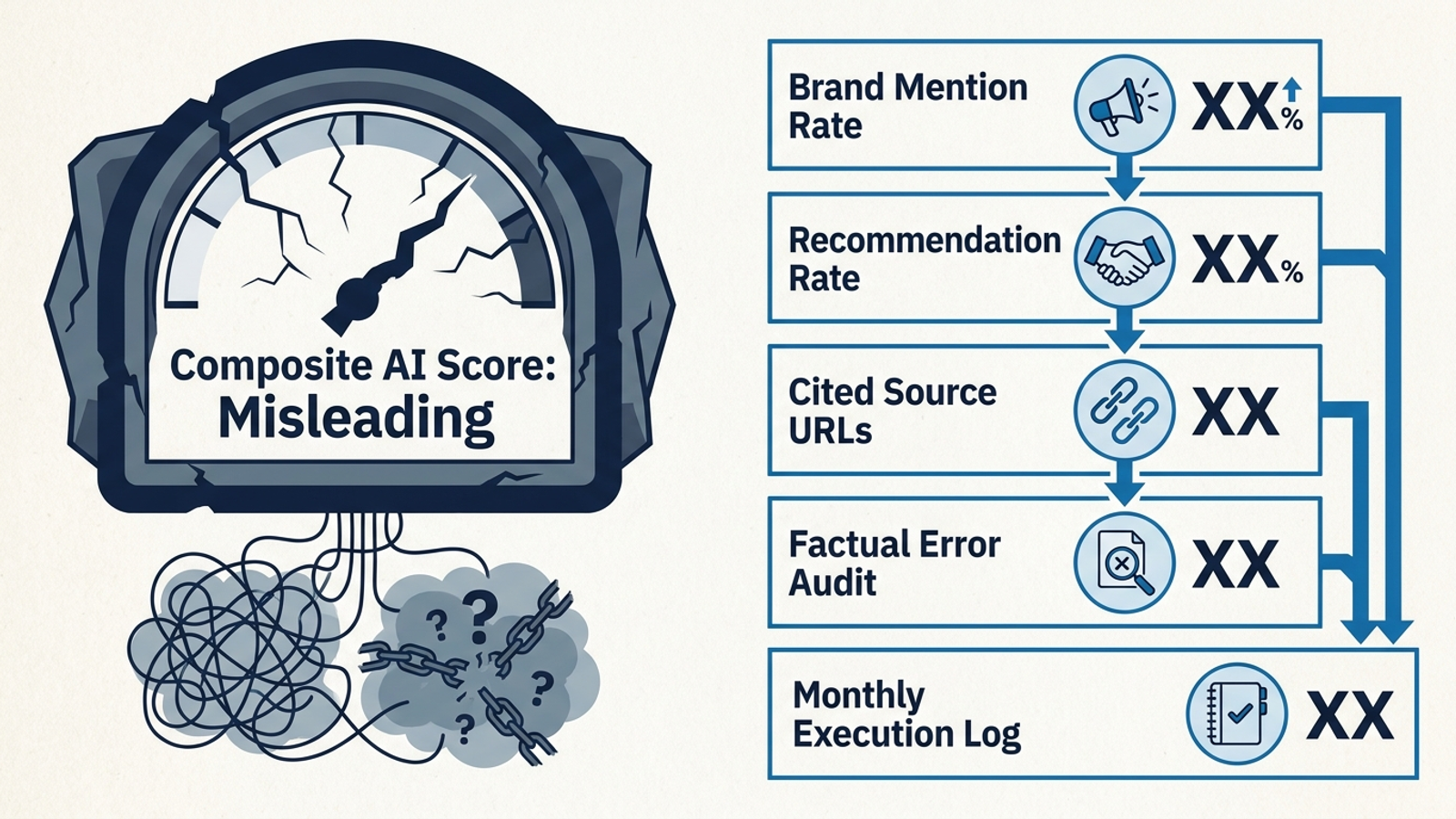
The one adjustment that matters: Delete the composite AI visibility score. Report brand mentions, recommendations, cited URLs and observed factual errors separately, alongside the completed work. If an answer changes, the client can see what moved without mistaking that movement for proof that a schema deployment did or did not happen.
When to use it: Send this to an existing SEO or Google Ads client only after you have run the 15-query check it describes. If the competitor pattern is not there, do not manufacture one to make the email sharper.
Subject: A buyer-query check for [CLIENT_BRAND]

Hi [CLIENT_FIRST_NAME],

We checked [CLIENT_BRAND] across 15 high-intent questions buyers ask while evaluating providers. On [COMPETITOR_RECOMMENDATION_COUNT] of those queries, the answer recommended [COMPETITOR_A] or [COMPETITOR_B] while [CLIENT_BRAND] was [OBSERVED_BRAND_RESULT].

I want to separate the answer from the work we can control. We can check search-crawler access, restructure key pages around those buyer questions, and correct the product facts we publish and maintain. We cannot promise that an engine will cite a particular page.

I recorded a 3-minute walkthrough of the prompts, answers, and work I would put in the first sprint. Want me to send it?

Best,
[YOUR_NAME]
The one adjustment that matters: Put the actual observed result in [OBSERVED_BRAND_RESULT], even if it is merely an outdated specification rather than a missing mention. A real competitor recommendation makes the case better than a chart; an invented one makes the next call worse.
When to use it: Give these to whoever handles proposal reviews and renewals. They should answer the objection, then return to the agreed deliverable rather than selling certainty the agency does not have.
“Can you guarantee ChatGPT will mention us?”
Response: “No. The engines control their answers. We guarantee the contracted checks, deployments, content work, and execution logs. We’ll monitor the agreed buyer prompts so you can see whether citations change, but a citation is not the thing we invoice you for.”
“Isn’t this just SEO with a new name?”
Response: “Some of the work overlaps. We still need accessible pages and accurate product facts. The added scope is a fixed set of buyer questions across named answer engines, with content structured to answer those questions and reporting that shows both the answers observed and the changes shipped. I’d rather show you the SOW than pretend every familiar task has a new name.”
“Why not buy a monitoring tool ourselves?”
Response: “You can. A monitoring tool shows you the answers it observes; it does not complete the crawler-access checks, schema work, page restructures, or reference updates in this scope. You’re paying us for the completed work and its verification, not for someone to watch a dashboard.”
“How long until citations move?”
Response: “I can give you the sprint schedule and show you when changes go live. I can’t give you an honest citation date because the engines decide when and how to use a page. Each month, you’ll get the work log and the results from the same contracted prompt panel.”
“What happens if we cancel?”
Response: “Published pages and technical changes deployed on your domain remain there, subject to changes you or your providers make later. We’ll identify the completed work in the final execution log; ongoing monitoring and new delivery stop with the engagement.”
The one adjustment that matters: Do not let an account manager turn “we monitor citations” into “we will get you cited.” Those sound close during a sales call. They land very differently in a renewal conversation.
When to use it: Run this during a white-label platform demo before putting client domains on the platform. If software exports a list of chores to your team, price the human work as well as the subscription.
[ ] EXECUTION: Does the platform complete agreed changes, or only recommend them? Ask to see one change from instruction through verification.

[ ] LOGS: Can an account strategist read what changed, why it changed, and whether it was deployed?

[ ] UNIT COST: What is the total cost for [CLIENT_DOMAIN_COUNT] domains and [PROMPT_COUNT] monitored prompts? Identify any expansion charges.

[ ] SEARCH COVERAGE: Which organic and paid-search work does the platform actually perform, and which tasks stay with the agency?

[ ] CLIENT OWNERSHIP: What appears under the agency brand, what access does the vendor need, and who speaks to the client?
The one adjustment that matters: Ask for a raw execution log, not a polished sample dashboard. groas white-label AI agents are built around autonomous search execution with human strategic ownership; the useful demo question is still what was done on a client domain and how your team can verify it. If your account manager must translate every recommendation into a developer ticket, that time belongs in your delivery cost.
Swipe 2: the SOW clauses is the most useful part of this file. You can revise a prompt panel or a report next month. Once a client signs a promise that leaves model outputs and extra requests open-ended, you are negotiating the work after you have agreed to do it. Set the boundary in writing first: contracted actions, a fixed panel, an acceptance window, and no guaranteed citations. Then the rest of the swipe file has something solid to stand on.
The three tiers are $2,500/month (Starter, up to 25 prompts), $4,500/month (Growth, up to 60 prompts) and $7,500/month (Enterprise, up to 120 prompts). Each includes a fixed monitored prompt panel, technical work, answer-first content assets and execution reporting. Prompt work is capped, and additional blocks of 10 prompts cost $350/month.
No. Third-party answer engines control their own crawling, retrieval and generated responses, so citation inclusion cannot be guaranteed. The agency completes, verifies and logs the contracted work such as crawler-access configuration, schema deployment and page restructuring, and monitors the agreed prompt panel to show whether citations change.
Send an intake form right after signing that asks for the top five questions qualified prospects ask in their own wording, the three competitors compared during evaluation, product fact sources, known answer-engine errors, and whether hosting or CDN settings block search crawlers like OAI-SearchBot or PerplexityBot. Use those answers to build the panel, freeze it at kickoff and put the selected prompts in the SOW.
Report brand mention rate, recommendation rate, cited client URLs and observed factual discrepancies alongside a completed work log with dated, verified changes, plus the next 30-day sprint. Skip any composite AI visibility score; reporting each measure separately lets the client see what moved without confusing that movement with proof that a specific change did or did not happen.
Only after running the 15-query check it describes. The email reports the actual observed result, such as a competitor being recommended on several high-intent queries, and separates it from controllable work like crawler-access checks, page restructuring and fact corrections. If the competitor pattern is not there, do not manufacture one.
Give the sprint schedule and show when changes go live, but do not give a citation date, because the engines decide when and how to use a page. Each month the client receives the work log and results from the same contracted prompt panel. The distinction matters because monitoring citations is not the same as promising to get the client cited.
Check whether the platform completes agreed changes or only recommends them, whether its logs show what changed and whether it was deployed, the total unit cost for the client's domains and prompts, which search work stays with the agency, and what appears under the agency brand versus what the vendor accesses. Ask for a raw execution log, not a polished sample dashboard.