

 LinkedIn

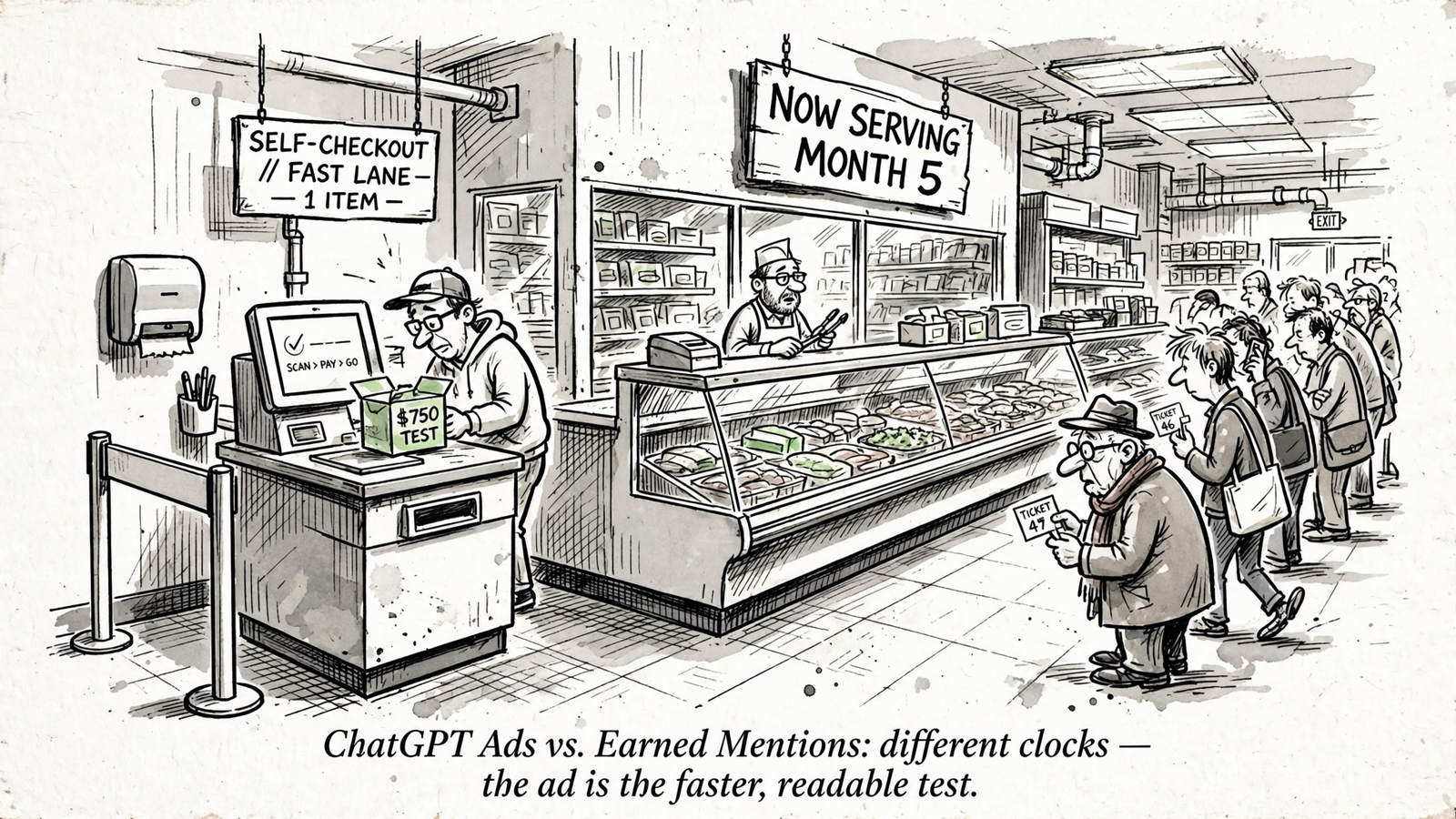
A ChatGPT ad can fail in two weeks. An earned recommendation can take months to earn, and you cannot pause it when it stops helping. If you are deciding where your first ChatGPT dollar goes, those are the contenders: a sponsored card below the answer and a mention inside the answer. They are separate purchases with different clocks. For most businesses, I would buy the one whose failure I can measure fastest. That is the ad.
Contender A: buy the sponsored card, not the answer
A ChatGPT ad buys a sponsored card below the answer, labeled and separated from the organic text. It does not buy influence over the answer itself. Buying an ad does not change what the model says about you. I used to tell clients that paid presence builds organic presence. I was wrong here.
The card appears to Free and Go users, not Plus, Pro, Business, or Enterprise users, under-18s, or people in sensitive conversations such as health or politics. That reach limit matters, especially if you sell to businesses.
Matching also works differently from Google search. You write a short description of when your ad is relevant; OpenAI matches it to conversations semantically and runs a relevance-weighted auction. You do not see the conversation that triggered your ad. Because you cannot see the prompt, you cannot negative-match your way out of bad context as you would with search keywords.
The appeal is the size and speed of the test. Self-serve is available through ads.openai.com, with a $25 daily minimum per campaign. Early starting bids run around $3 to $5 max CPC, while one practitioner reports roughly 0.5% CTR and $10 CPMs. A single campaign at the daily floor costs about $350 over two weeks; a broader $750 to $1,500 test buys more room to learn. Neither is a reason to abandon a working Google campaign.
Early results are uneven. Some local-service advertisers report cheaper clicks; others report low-quality leads, glitches, and one case of five-second average time on site. I can live with uneven results when I can see the miss and pause the spend. The point of the first test is a fast, affordable answer, not a new playbook carved in stone.
Contender B: pay for work that might earn a mention
An earned recommendation is not a placement you purchase. You pay for the work that might make your business more likely to appear: a baseline audit, page rewrites, schema and entity consistency, answer-first content, and digital PR on third-party pages AI already cites.
The invoices vary widely. Published retainers run $390 to $10,000 a month; one-off audits start around $8,000 to $10,000; and full-service guides quote $5,000 to $25,000 a month. Some lower tiers are mostly monitoring under a new label. I have seen that invoice before. It said SEO.
The schedule tells you what you are buying: audit in weeks one to four, foundation work in months two to four, then authority and PR from month five onward. No provider can guarantee the mention. To judge progress, rerun the same prompts weekly against a fixed baseline.
The work that correlates with visibility is not mysterious, just slow. An Ahrefs analysis of 75,000 brands found YouTube mentions strongest, followed by branded web mentions. Its analysis also points to fresh pages and clear answers near the top of a page. Publishing, earning mentions, and waiting to see whether the answer changes takes months. This is a build, not a two-week test.
Axis 1: How soon can you read the result?
With ads, you control the clock. Spend the $25 daily minimum and, after 14 days, you have roughly $350 in spend plus impressions, clicks, CTR, and on-site behavior. If traffic lands and leaves in five seconds, you can investigate the offer or the matching context before spending another month. I will take a fast no over a slow maybe.
With earned mentions, you pay while the work accumulates. You audit, rewrite, publish, seek citations, and rerun the same prompt list to see whether you appear. Even a sensible page rewrite cannot make someone else’s cited page update on your schedule. If you cannot wait months for a signal, do not put your first dollar into a months-long signal.
Axis 2: What can you control when it goes wrong?
Ads give you switches. You can pause a campaign, target by country, region, DMA, or zip, and limit delivery to approved categories. That is not total control: you cannot see the triggering prompts, and paid tiers never see the card. But if a zip performs badly, you can stop paying for it.
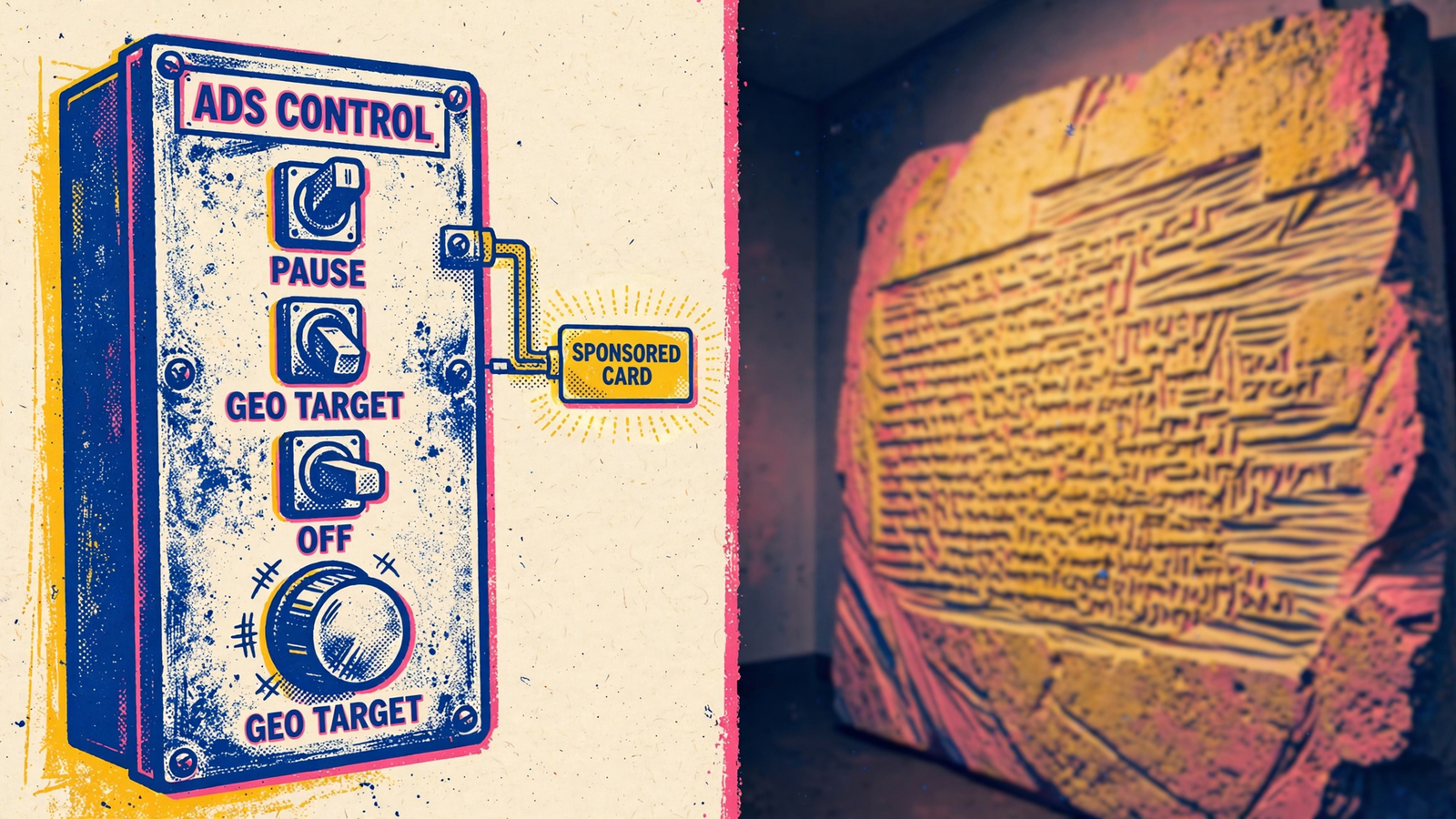
With earned mentions, there is no comparable switch. A mention cannot be guaranteed, edited, or paused like an ad. If an answer repeats an old price or cites an unhelpful third-party page, your response is more publishing and more outreach, followed by more waiting. And paying for ads will not boost the organic mention. Buy the channel you can turn off first.
Axis 3: Can you connect the spend to a lead?
Ads offer familiar click plumbing. Ads Manager reports impressions, clicks, spend, CTR, average CPC, CPM, and conversions. A pixel, Conversions API, and UTM persistence help connect that activity to what happens afterward. That does not make attribution perfect. The published WeightWatchers, Dose, and Portland Leather results are single-brand studies, not benchmarks to paste into your forecast.
Earned mentions give you a visibility scoreboard: prompt coverage, citation rate, and how the answer describes you. They do not give you an ad click attached to a campaign budget. If pipeline is your job, that difference matters. For long sales cycles, I track early pipeline signals in the CRM rather than wait for closed-won revenue to judge an initial ad test. Ads let you follow spend toward a lead; mentions let you watch for visibility.
Axis 4: What does a failed attempt cost?
An ad can fail because semantic matching finds a related conversation without finding a buyer. A context hint about project software might bring in someone researching a topic rather than shopping for a tool, and you cannot inspect the prompt to sort the two. At the $25 daily floor, two weeks cost about $350 plus your time. A larger $750 to $1,500 test costs more, but you can stop it when the evidence turns.
Earned work can fail after you have paid for several months of rewrites and PR. At $5,000 a month for four months, that is $20,000 before you know whether your fixed prompt list will show a useful change. You might earn citations on pages the answer never uses. You might appear beside information you cannot edit. A failed ad test gives you a quick bill and a readable lesson. A failed retainer keeps billing while you wait for the lesson.

Axis 5: Where does Google fit?
ChatGPT should not take the job of an existing Google campaign just because it is newer. Google catches bottom-funnel keyword demand; ChatGPT can meet people earlier, while they are researching. That difference changes the offer. A guide, comparison, or calculator suits the research conversation; pricing, demo, and trial pages suit the later search. Use consistent UTM naming and CRM lifecycle reporting so neither platform gets to grade its own homework.
Here is the first-dollar decision in one table:
| Decision axis | ChatGPT ad | Earned ChatGPT mention |
|---|---|---|
| Time to signal | Weeks; about $350 at the two-week daily floor | Months of publishing and PR |
| Control | Pause, geo-target, and set category limits | No switch to pause or edit the answer |
| Measurement | Clicks, conversions, UTMs, and CRM follow-through | Prompt coverage and citation rate |
| Failure cost | A contained test budget | Potentially months of content and PR fees |
| Reach | Free and Go users who are eligible to see ads | Can appear in answers across tiers, if earned |
| First-dollar winner | Most businesses | Businesses already earning useful mentions |
The winner changes only when you already have something to defend
Ecommerce: test the sponsored card first
For a physical product, the ad gives you the quicker read. You control the offer, geography, and pause button, then check whether researchers click and buy. The earned route leans on branded mentions and third-party pages AI already trusts, work a new store may not have done yet. Keep Google working for product and pricing searches. Use the ad test to learn which comparisons get attention before funding the slower content and PR effort. For ecommerce, test with the ad before you build for the mention.

B2B with a long sales cycle: buy the ad, change the scoreboard
I hear this one most from buyers looking for a ChatGPT ads approach to a B2B sales cycle measured in months. Start with ads, but do not demand closed-won revenue in week two. Paid reach excludes Plus, Pro, Business, and Enterprise users, so some valuable buyers will never see the card. Judge the early test on useful email captures, sales acceptance, and whether contacts enter pipeline.
Earned mentions have an appeal here: a recommendation inside the answer feels more credible than a sponsored card. They also take longer to earn and cannot be edited on your positioning schedule. Buy the cheaper lesson first, even if the final revenue decision takes longer.
Local and home services: keep the ad inside a tight fence
Local advertisers get practical use from zip-level targeting. You can stop spending in a poor-performing area; you cannot remove an earned mention by zip. Given the mixed early reports on lead quality, I would start at $25 a day across a small set of zips, send visitors to a call-first page, and keep Google as the booked-jobs core. If the calls do not hold after 14 days, pause. That is a roughly $350 answer, not a four-month argument with a retainer.
Buy the fast answer, then build on it
I would run the purchases in sequence. First, test the ad to learn which offer, comparison, or calculator earns attention. Then put earned-search work behind the useful themes: rewrite matching pages, pursue relevant third-party mentions, and rerun the same prompts weekly. That is also my answer to whether a small business should test ChatGPT ads now or wait: run a contained test now; commit to the slower build with something to guide it.
The business that should pick the loser first is a category leader already getting useful mentions. If the answers already name you, defend that ground. Earned mentions can reach users ads cannot and may keep appearing after you stop paying a retainer. They are worth work. They are just a poor first experiment for a business that still needs to find out whether its message lands.
At groas, Search Ads covers Google, Bing, and ChatGPT ads for a flat $1,499 a month, alongside the content and technical work for AI search. One owner can see what changed across the two efforts without charging a percentage of spend. The order still matters. Buy the ad to learn fast. Earn the mention to keep what you learned.