

 LinkedIn

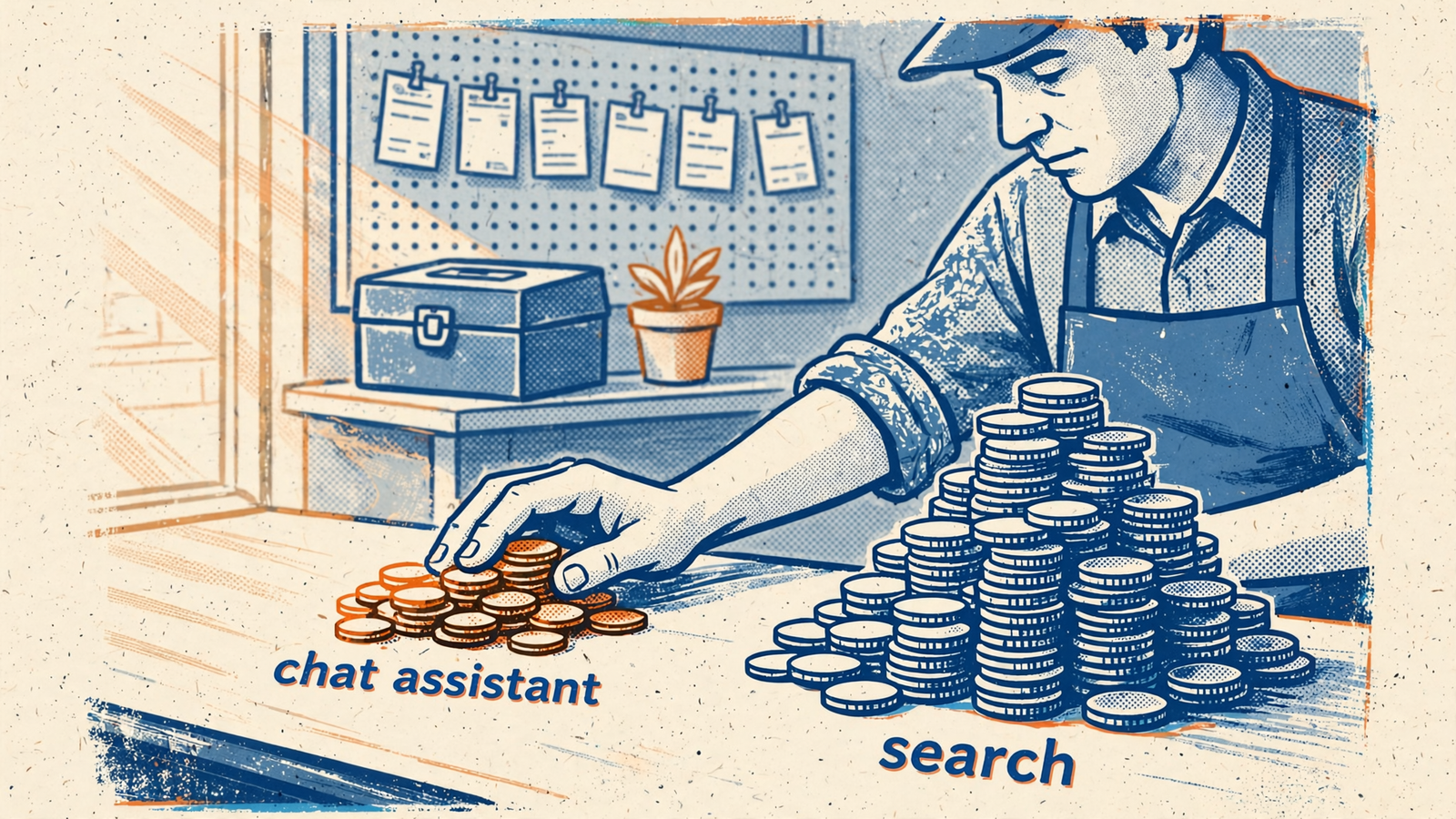
A client asked me whether he should move $2,000 off Google and put it into ChatGPT ads. He spends about $18,000 a month, his CPA is stable, and he does not want to look stupid twice: once for testing too early, once for waiting too long. Smart people disagree because both risks are real. The wait camp sees thin inventory, blunt targeting, and shaky measurement. The test-now camp sees an early auction and a chance to learn before competitors arrive. My verdict: test, but only as a capped side budget next to Google, with a kill rule written before day one.
The case for waiting: you cannot target or measure this like Google
The wait camp has the stronger facts right now. ChatGPT ads have no keywords, no demographics, and no in-market audiences. Your levers are geography, first-party audiences, ad and landing-page wording, and freeform context hints at the ad-group level. Those hints guide matching; they are not exact-match rules (self-serve access details). Custom audiences sound useful until you reach the floor: 25,000 matched users, which rules out most small businesses (audience requirements). I spent years mining search terms at 1 a.m. I do not love being told to trust the prompt.
Measurement is where I tell most owners to slow down. One coaching firm spent $500 in just over an hour, paying about $3.50 CPC for 140 clicks. It could verify only 13% of those clicks in Wix or GA4 and got zero leads (small-business field test). In a same-site test with about 1,500 users from each channel, Google averaged 41 seconds of engagement and a 3.71% conversion rate; ChatGPT ads averaged 17 seconds and 0.21% (GA4 comparison).
Direct tracking can also miss later demand. One agency analysis warns that only about 40% of ChatGPT-driven conversions track directly, while the rest return days later through branded search or direct traffic and get credited elsewhere (attribution warning). That does not make a weak campaign strong. It does make a weak measurement setup harder to trust. If your tracking is already messy, this channel will make the decision messier.
Then comes opportunity cost. Self-serve opened in May 2026 with no overall minimum spend, down from a $200,000 pilot minimum, but a US campaign still has a $25 daily minimum (self-serve access details). Observed CPCs run $2 to $5 across industries, and setting a max CPC below $3 triggers a may-not-deliver warning (early CPC observations). Say you spend $20,000 a month on Google at a CPA you can live with. Money moved to ChatGPT is money you cannot spend on intent you already know converts. I used to tell clients to chase every new placement. I was wrong. Feed the proven channel before you fund the new one.
The case for testing now: a small budget can buy early learning
The test-now camp starts with the auction. In one July snapshot, ads appeared beside 25.94% of 50,006 US commercial prompts. Roughly three quarters of those chats had no ad (July 23 snapshot). Less competition for placements is a reason to look now, before more bidders arrive. It is not, by itself, proof of a cheap customer.
There is at least one encouraging outcome: Weight Watchers measured CPA 15.3% below its blended paid-search benchmark using independent measurement, although its spend and conversion counts were not disclosed (Weight Watchers result). I would not build a forecast from that number. I would pay attention to the possibility it demonstrates: a conversation can put an offer in front of someone while they are working through a purchase, not just when they type a short query.
That difference matters. A Google query says plumber near me. A ChatGPT thread asks whether an ageing water heater is worth repairing or replacing before the owner requests a quote. The same agency analysis that warns about attribution sees the best fit in considered purchases: B2B and SaaS, furniture and appliances, services with long sales cycles, and education (considered-purchase fit). A business that sells through explanation gets a chance to meet the buyer inside that explanation.
The limit is just as instructive. Barn2 spent $477 from June 1 to July 14 across four products. It recorded 19,154 impressions, 370 clicks, roughly 1.93% CTR, and zero conversions (Barn2’s test). Conversational interest did not turn those clicks into customers. Test because your offer needs explaining, not because a new placement makes clicks look interesting.
What a 60-day test costs: $1,500 in media to about $9,000 with management
The cash range starts at $1,500 for media alone: one US campaign at the $25 daily minimum for 60 days. At the other end, $6,000 in media plus two months of the listed $1,499 flat-fee service comes to $8,998. Neither figure includes variable landing-page and tracking work; the low end also excludes the owner’s time. So this is a range of listed costs, not a promise that every business can launch an all-in test for $1,500.
I price this the way I price any small account: recurring media and management, one-off setup, then the time nobody quotes. For a longer line-by-line treatment, see what a small-budget ChatGPT ads test really costs.
| Line item | Cost or commitment | Source and price driver |
|---|---|---|
| Media, minimum | $1,500 over 60 days | One campaign at the $25 US daily minimum. Daily billing is averaged over seven days, with a maximum of 2× in one day and 7× in a week. |
| Media, readable test | $3,000–$6,000 over 60 days | $50–$100 a day, the recommended test pace. At observed $2–$5 CPCs, that is roughly 600–3,000 clicks. |
| Landing page and tracking, one-off | Varies by build | Install the pixel and Conversions API before launch, per attribution setup advice. The bill depends on whether you need a new page, form or call tracking, and GA4 repairs. |
| Management, DIY | Your hours | Budget 6–10 hours to build and 2 hours a week to read results. No cash management fee does not mean no cost. |
| Management, freelancer | Rate × hours, plus any fee | Published comparisons list $20–$45 an hour plus up to a 7.99% client fee on Upwork. Hours included vary by quote. |
| Management, percentage agency | $1,950 for two months at the stated floor | A published comparison lists the greater of $975 or 15% for $5,000–$30,000 in spend. On a $3,000 test, the $975 monthly floor applies twice. |
| Management, flat-fee done-for-you | $2,998 for two months | groas Search Ads at $1,499 a month covers Google, Bing, and ChatGPT ads, with bids, keywords, and budgets worked around the clock. Compare that model with the other routes in course vs consultant vs done-for-you. |
The hidden recurring cost is attention. Keep UTMs clean, watch branded search during the flight, and make time for weekly reads that may not settle the question immediately. The authors of that GA4 comparison argue for judging cost per acquired customer rather than click rate (measurement advice). That takes more work than admiring a dashboard.
The cheapest mistake is spending $25 a day with no tracking, then calling the channel a failure after $300. The most expensive is handing a $3,000 media test to a percentage-priced manager who needs three revision rounds to change a context hint. Cap the media, fix tracking first, and do not pay a percentage fee to manage a tiny test.
Where the wait camp and the test-now camp go wrong
The wait camp treats rough edges as a reason to do nothing. Yes, the dashboard lags about a day, and billing appeared as five partial charges in that $500 field test. Yes, the structure is only Campaign > Ad group > Ad, with Reach, Clicks, or Conversions objectives; Conversions still bills per click as oCPC (campaign structure). None of that stops a disciplined test. I managed Google accounts when exact match was not exact and the app kept moving buttons. You contained the mess with a capped budget and clean UTMs. Same job here.
The test-now camp makes the opposite error: it treats a cheap click as a cheap customer. In the July snapshot, 14.35% of placements had no better topical match than random (placement analysis). Barred categories include health and medical, legal, finance, gambling, alcohol and tobacco, adult, and political; Australia targeting is country-level only (category and geography limits). If you sell impulse goods or tight-radius emergency work, clicks can stay cheap because they never turn into jobs. Do not pay to learn what the policy page or targeting controls already tell you.
My verdict: test as a capped sidecar, never as a switch
I side with the test-now camp, but on the wait camp’s terms. The deciding consideration is learning speed versus damage. A small test can show how your offer reads inside a conversation, whether your landing page holds up, and whether your tracking can handle demand that returns later through branded search. You cannot learn that from a webinar. You can run the test next to Google without putting the account that pays payroll at risk.
My year-one ceiling is 10–15% of search spend, with the test budget agreed in advance. If you spend $8,000 a month on Google, that is $800–$1,200 a month for ChatGPT. At $20,000, it is $2,000–$3,000. A $50–$100 daily test pace fits some accounts in that range; it does not fit all of them. Set the daily budget from your cap, not the other way around. groas runs ChatGPT inside the same Search Ads operation as Google and Bing, with one human owning the outcome. Splitting a small test across two managers is how small tests die.
Who should wait, and what to do instead
Wait if you sell impulse goods under $75, rely on tight-radius emergency calls, sit in a barred category, or have broken tracking. Country-level geography may waste your spend; short consideration gives the conversation little room to help; policy can block you outright. I would also skip if your Google account has no clean primary conversion, no call tracking, and no server-side backup.
Use the waiting period. Fix one primary conversion in GA4, install the pixel and Conversions API before spending on ChatGPT, record four weeks of branded-search baseline, and build one explainer page that answers cost, comparison, and fit in plain language. That page can serve Google now and become your ChatGPT landing page later. Waiting is not sitting out. It is getting measurable.
Who should test, and the rule that ends it
Test if you sell a considered purchase with questions attached: B2B and SaaS, home services with quotes, furniture and appliances, or education and training. Run for 30–60 days within your search-spend cap. Where the cap allows, use $50–$100 a day. Start with one campaign, two ad groups using different context hints, and a proven landing page against an explainer variant. Read cost per qualified lead and branded-search lift, not CTR.
Then enforce the rule you wrote before launch: if you reach 800–1,000 clicks or $3,000 in spend, whichever comes first, with zero qualified leads and no branded-search lift, pause and move the money back to Google. No extension for hope. No second test until the tracking and page change. The cheapest mistake is a small test you stop on time. The most expensive is letting cheap clicks talk you out of stopping.