

 LinkedIn
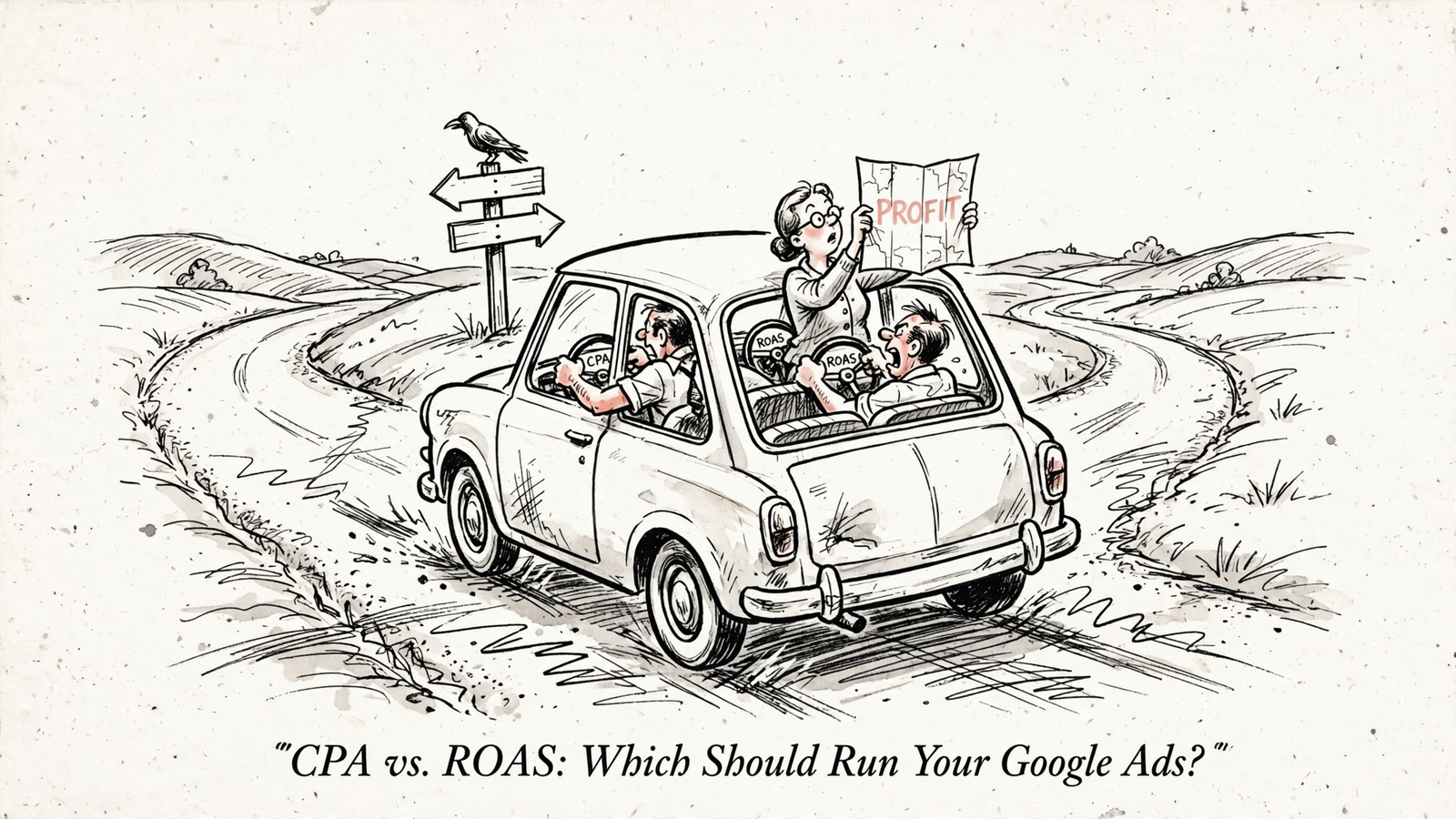
A $40 order and a $400 order can have the same CPA. A campaign can also hit 4.0 ROAS and leave nothing after costs. I’ve had this argument with three clients this year: the ecommerce owner wants ROAS because CPA ignores basket size; the lead-gen founder wants CPA because revenue on a dashboard is not money in the bank. Smart people disagree because each metric catches a mistake the other can make.
I used to tell clients to pick one and defend it. I was wrong. Neither CPA nor ROAS deserves to run an account until you know what a conversion contributes after its costs. Then the choice gets simpler: use the target that reflects that value, rather than asking a convenient dashboard number to stand in for profit.
The strongest case for ROAS: CPA cannot see the size of an order
CPA is ad spend divided by conversions. Spend $5,000 and get 100 purchases, and you have a $50 CPA. That is useful if those purchases are worth roughly the same amount. If one buyer checks out with a $40 part and another with a $400 order, though, CPA gives both purchases the same score. It tells you what you paid to get an order, not what came back.
The ROAS advocate has a straightforward answer: send the bidder conversion values. ROAS is reported revenue divided by ad spend. Spend $5,000 and report $25,000 in conversion value, and ROAS is 5.0, or 500% as a Google Ads target. Target ROAS uses auction-time signals to bid toward an average conversion-value-to-cost target. Where order values vary, it can bid with that difference in view. A flat conversion count cannot.
Take a parts catalog. Campaign A brings in 100 orders at $40 each on a $20 CPA. Campaign B brings in 50 orders at $400 each on the same $20 CPA. The CPA column reports a tie. The ROAS column reports 2.0 for A and 20.0 for B. If you manage that account by CPA alone, you have no reason to prefer the larger baskets. That is not a small blind spot. It is the difference the ROAS camp came here to talk about.
This is why practitioners commonly reserve Target CPA for predictable conversion values and use Target ROAS when order values vary. Savvy Revenue puts Target ROAS in its top tier for around 90% of ecommerce. The mechanism matters more than the ranking: when the values are meaningful, the bidder can spend differently on a likely $50 cart and a likely $500 cart instead of treating both as one more purchase.
The arithmetic explains why neither side can win by pointing at its column alone. For purchase campaigns, ROAS equals average order value divided by CPA. At a $100 average order and a $20 CPA, ROAS is 5.0. Raise the average order to $120 while CPA stays at $20, and ROAS rises to 6.0. Nothing in that example requires the ads to get cheaper. The orders got larger.
So the ROAS advocate’s best argument is not that CPA is wrong. It is that a CPA target cannot distinguish cheap conversions from valuable ones. If your basket sizes move, check what each order is worth before you let a flat cost target steer the account.
The strongest case for CPA: ROAS counts money you may not keep
Now the CPA advocate gets the floor. His objection is just as concrete: a revenue figure can look healthy while the business loses money fulfilling it.
A 4.0 ROAS at a 25% margin is break-even on ad spend. Four dollars of revenue produce one dollar of margin before advertising; the dollar spent on ads takes it. The report is green. The bank account has not moved. In one published teardown, $100,000 in attributed revenue became negative $2,000 in contribution after returns, discounts, product and fulfilment costs, fees, support, and $25,000 in ad spend. The account reported 4.0 ROAS and still lost money.
That is not a complaint about the ROAS calculation. It is a complaint about what went into it. If two products each send $100 of gross conversion value, but one leaves $70 before ad spend and the other leaves $18, a bidder reading those values sees two equal orders. Returns, shipping, discounts and fees do not disappear because the conversion tag omits them. Gross revenue is not a profit signal.
CPA makes a narrower promise. It tells you the cost of an observable action without pretending that the action has a trustworthy revenue value attached. That restraint is useful when value data is missing, inconsistent or late. A lead-gen team with one fairly uniform offer may know its cost per qualified lead well before it knows what every lead will eventually buy. Google’s own guidance maps Maximize conversions and Target CPA to cases where conversions are valued equally.
Long sales cycles make the point sharper. A form fill arrives today; the sale may close weeks later. Until those outcomes get back to the ad account, a ROAS target has no reliable sale value to work with. Feeding it an invented value for every form does not make it a revenue strategy. It makes it a form-fill strategy with a nicer label. A comparison of Performance Max lead volume with Search tied to CRM outcomes illustrates the danger: the reported MQL-to-SQL rates were 3% to 5% versus 18% to 25%. If you ask Google to find form-fillers, it can find form-fillers. You still have to find out which ones became customers.
The fix is operational rather than glamorous. Import qualified stages and, eventually, the money. One progression uses milestone values such as Lead $1, SAL $25, SQL $100 and Opportunity $250, then brings in actual closed-won value. If the sales cycle runs past 60 days, a 90-day click window may be needed to capture it. Until that pipeline exists, a CPA target on a qualified stage gives you a cost you can inspect instead of a revenue estimate you cannot yet verify.
Even then, CPA needs a connection to the business. At a 20% close rate, five leads produce one customer on average. If that rate falls to 10%, you need ten leads for the same outcome. For the same allowable customer-acquisition cost, a $100 lead CPA target would have to fall to $50, even if the ad account itself looks unchanged. The lead price did not tell you that on its own; the close rate did.
That is the CPA advocate’s best case: when revenue is delayed or the value feed cannot be trusted, buy an observable, qualified conversion at a cost the business can afford. Do not make a ROAS target out of numbers you wish you had.
Where both arguments break: the bidder learns from the values you send
The ROAS camp has proved that order value matters. The CPA camp has proved that reported order value may be the wrong kind of value. Both arguments can be true in the same account. The question is no longer which acronym wins the debate. It is whether the conversion signal describes money the business can actually keep.
Break-even ROAS equals one divided by contribution margin. At a 25% margin, that is 1 divided by 0.25, or 4.0. Use a margin that accounts for product costs, shipping, fees and returns, not a headline percentage that stops before those costs. A fashion-retail example shows how 40% gross margin and 25% returns can leave an effective margin in the low 30s, moving break-even ROAS from 250% toward 333%. The target changes because the money left from a sale changes.

A better target starts with the value feed
Feed Google gross revenue and it will pursue gross revenue. If margin differs by product, that can push spend toward orders that look strong in ROAS and weak in contribution. The alternatives are margin-adjusted conversion values or targets segmented by margin bucket. The same distinction drives How An Ecommerce Brand Cut Wasted Ad Spend By Optimizing Google Shopping For Margin: make the value signal reflect the economics you intend to optimize.
That does not mean switching a setting and trusting the next day’s chart. Savvy Revenue describes a Target ROAS YoYo pattern: a few large orders lift reported ROAS, bidding rises into weaker auctions, performance misses, and spend throttles as the remaining data gets noisier. A value-based target still needs enough conversion data to behave sensibly. It also needs reporting you can compare with the signal used for bidding. If Smart Bidding and a GA4 report credit an order differently, the reported value can differ even for the same $100 sale. Check the attribution basis before treating a gap between reports as a bidding failure.
Here is the part neither advocate gets to skip: CPA also fails if it celebrates cheap leads that never close, and ROAS fails if it celebrates high-revenue orders that barely contribute. The useful number is profit per conversion after its costs, including acquisition cost. Keep an eye on total contribution, too. A profitable average conversion is not a licence to ignore how many you get.
My verdict: profit decides; CPA or ROAS carries the instruction
I take the profit side. For an advertiser choosing a Google Ads target, the single deciding consideration is whether the value sent back to Google reflects contribution rather than just gross revenue. If it does, and conversions genuinely differ in value, ROAS can price those differences. If values are flat, absent or not yet reliable, CPA is the cleaner instruction. Neither raw metric gets to be the boss.

That rule settled the three client arguments better than picking an acronym first. The ecommerce owner was right to reject a target that treats a $40 order like a $400 order. The lead-gen founder was right to reject revenue figures that arrive late or misstate what a customer is worth. Their objections describe different failures of the input data, not rival theories of how profit works.
For an account decision, I use this short run-down:
- Run CPA when conversion value is roughly flat or still invisible. One offer, a subscription with uniform customer value, or lead-gen without dependable offline values can fit. Choose the most qualified stage you can measure, then connect its target cost to close rate and profit. Thin data matters here too: 15 conversions is a suggested floor, with 30-plus for more reliable optimization.
- Run ROAS when values vary and the value feed earns your trust. A catalog with $50 and $500 baskets is the obvious case, provided the values account for the margin difference that matters to the business. Google lists at least 15 conversions in 30 days for Search and Shopping Target ROAS; some practitioners prefer 50-plus in 35 days, ideally 100-plus, because a handful of orders can make a monthly ROAS figure jump around.
- Run neither in its raw form when the signal misrepresents the outcome. Gross revenue is a poor stand-in for contribution when margins vary. A raw form fill is a poor stand-in for a closed sale. Target CPA vs. Target ROAS: One Bid Decision, Two Ways to Get It Wrong covers that trap; the practical repairs are margin-adjusted values and offline conversions that show which leads became money.
Set the target from margin, then translate it
Start with what a conversion leaves behind, not last month’s dashboard average. At 50% contribution margin, break-even ROAS is 200%; at 25%, it is 400%. If you plan to spend only a share of that margin acquiring the sale, the target rises. The calculation is one divided by margin times the share allocated to ads. A 40% margin with half of that amount available for acquisition gives a 500% target.
For leads, the equivalent calculation starts with profit per closed customer: multiply it by the share available for acquisition and by the lead-to-sale rate. $1,000 in profit, a 50% acquisition share and a 20% close rate give a $100 target CPA per lead. If you are comparing purchase campaigns, basket size translates between the two dashboard languages: a $120 average order at a $24 CPA is 5.0 ROAS. That translation is arithmetic, not proof that a 5.0 target is profitable. Margin still has the final word.
So I set the economics first, check what value reaches the bidder, and only then choose the target. ROAS wins when order values vary and those values tell the truth about contribution. CPA wins when value is flat, hidden or weeks away. Profit per conversion is the boss. CPA or ROAS is how you give Google the instruction.