
YouTube Ads Won’t Get Fewer: Six Calls to Check by 2027
October 1, 2026
•
11
min read



A $15 spatula and a $900 espresso machine both count as one conversion. If you tell Google Ads to buy conversions at a fixed cost, it has no reason to prefer the machine. That is the practical difference between Target CPA and Target ROAS, even though both start with the same bid decision: what is this click worth under your efficiency target?
I’ve seen these strategies presented as competing philosophies. Lead generation gets CPA; ecommerce gets ROAS; someone puts both in a deck. The better way to choose is to work backward from the auction. Target CPA fixes allowable cost per conversion. Target ROAS fixes required revenue per dollar spent. When every conversion has the same value, those are two expressions of the same limit. When values differ, they tell the bidding system to favor different clicks.
An automated bid strategy has to make a decision before it knows whether a click will convert. It estimates the odds using signals available at auction time, then weighs those odds against the target you supplied. That is the part both strategies share: a conversion probability is useful only when paired with a value or a cost limit.
The arithmetic connecting the targets is straightforward. ROAS is revenue divided by ad cost. CPA is ad cost divided by conversions. If each conversion brings in roughly the same revenue, multiply target CPA by target ROAS, expressed as a ratio, to get the implied revenue per conversion. Or divide revenue per conversion by target ROAS to get the implied CPA. At a $100 target CPA and a 3.0 ROAS target, both imply $300 of revenue per conversion.
That equivalence has a condition: conversion value must be reasonably stable. If one sale brings in $15 and another brings in $900, there is no single revenue-per-conversion figure that makes the targets interchangeable for every auction. The economics described in Search Engine Land’s margin framework are useful here: the target has to leave enough room between revenue and acquisition cost. But the target cannot tell the auction which sale matters unless the conversion data can, too.
Here is the simplified Target CPA calculation:
Illustrative bid = predicted conversion rate × target CPA
Suppose someone searches for “commercial boiler repair.” If the estimated chance of booking a service call is 4% and your target CPA is $100, the arithmetic supports a $4 bid: 0.04 × $100. Raise the predicted conversion rate and the allowable bid rises. Raise the CPA target and it rises again. The conversion is a yes-or-no event; the calculation assigns no extra weight to one booking over another.
Google’s documentation on search bidding describes the auction-time signals behind these predictions. The formula above is a way to reason about the decision, not a claim that every live Google Ads bid equals that multiplication. The system evaluates more than a single probability and a number you typed into a field.
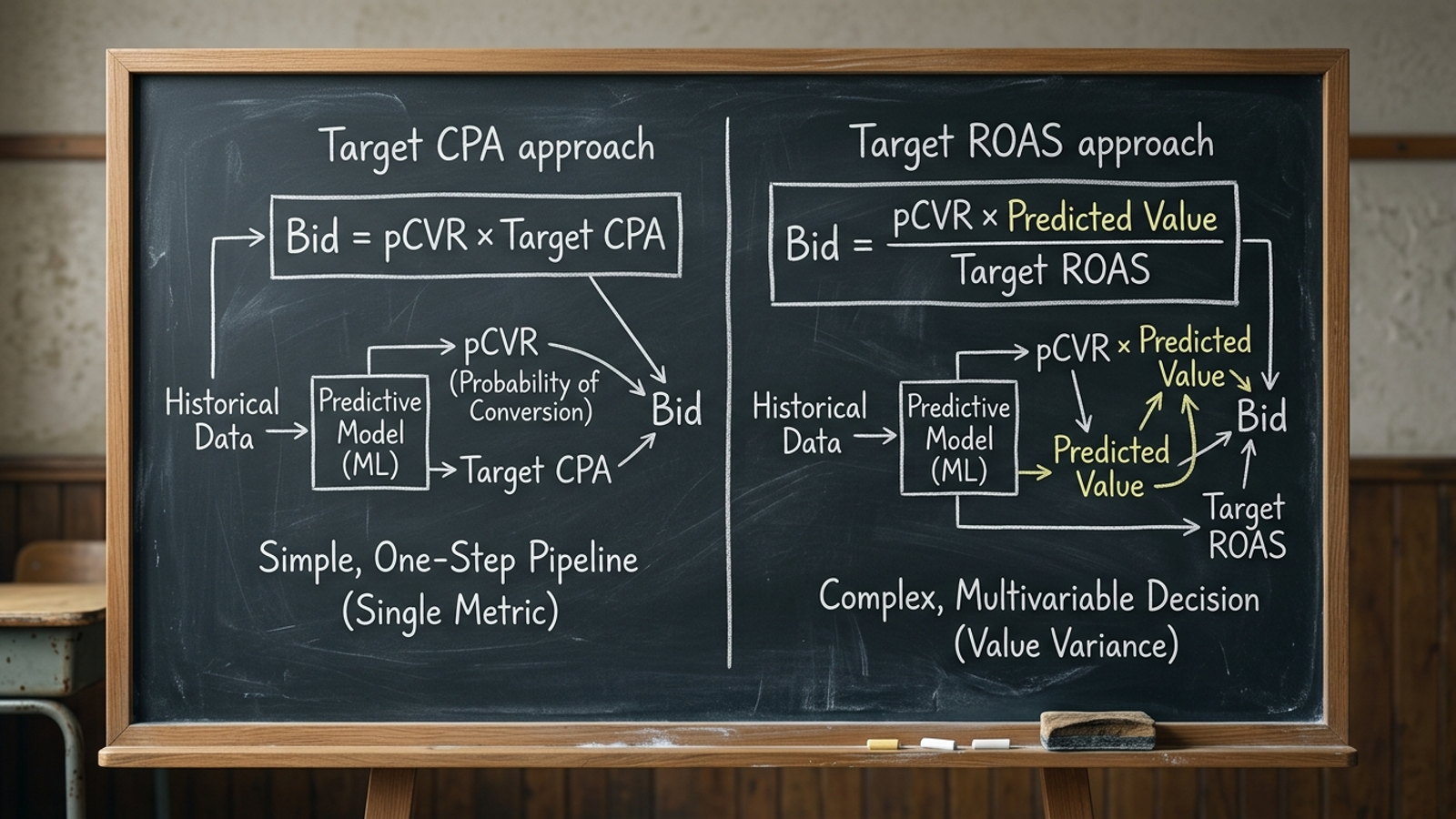
Target ROAS keeps the conversion estimate and adds another question: if this person converts, how much is that conversion likely to be worth? Its simplified calculation is:
Illustrative bid = (predicted conversion rate × predicted conversion value) ÷ target ROAS
Take a search for waterproof hiking boots. At a 3% conversion probability and a predicted $250 basket, expected revenue per click is $7.50. With a 300% ROAS target, expressed as 3.0 in the calculation, that supports a $2.50 bid. If the predicted basket falls to $100 while the conversion probability stays at 3%, the same target supports only $1.00.
This is the decision hiding behind the interface labels. CPA rewards the likelihood of a conversion; ROAS rewards the likelihood and expected value of that conversion. Neither label tells you which outcome your business needs. Your conversion values do.
Start with the simplest case: you sell one product at a consistent price, or the conversion you are buying has roughly the same commercial value each time. Asking the auction to distinguish high-value from low-value conversions buys you little if that distinction barely exists. Target CPA lets the system concentrate on who is likely to convert at an acceptable cost.
A business selling a single hero product with negligible upsells is an easy example. So is a campaign tracking purchases of a fixed-price offer. There will still be uncertainty about whether each searcher buys. There is much less for a value model to learn about how much they spend. As TNT Growth’s comparison of the strategies argues, modeling value differences that are not meaningfully present can add volatility without giving the bidder a useful distinction.
I would be more cautious with leads. A form submission is one conversion in the account, but the eventual customers may not all be worth the same amount. Target CPA can still be the more honest choice when the campaign has no reliable way to pass those differences back. It is a choice about what the system can measure, not a declaration that every lead has identical lifetime value.
The tempting workaround is to assign neat-looking values to actions: $25 for an ebook, $60 for a form fill, $200 for a phone call. Those figures may express your priorities, but they are not verified revenue. Under Target ROAS, the bidder uses them as conversion values. If the phone-call value is a guess, the system can spend harder to acquire calls for a reason that exists only in your tracking setup. Practitioners discussing ROAS for lead generation run into this distinction for good reason. Until your CRM can pass back values that reflect commercial outcomes, a plain cost limit is often better than precise-looking fiction.
Now return to the kitchen retailer. It sells $15 silicone spatulas alongside $900 commercial espresso machines. Set a $40 Target CPA across that mixed catalog and both purchases register as one conversion. If spatula shoppers convert more readily, the bidder has an incentive to chase them. It can hit the CPA target while letting expensive-machine searches go.

That is not the algorithm making a stupid mistake. It is doing the job the target describes. CPA does not ask whether the transaction brings in $15 or $900. ROAS does, provided the checkout or CRM passes dynamic transaction values into the campaign. The bidder can then weigh a less likely high-value sale against a more likely low-value one.
Say the expected conversion value for a commercial espresso-machine search is $900 and the estimated conversion rate is 3%. That is $27 in expected revenue per click. At a 300% ROAS target, the simplified calculation supports a $9 bid. For a spatula search with a $25 expected basket and a 6% conversion rate, expected revenue is $1.50 per click, supporting a $0.50 bid at the same target. The difference comes from the value of the likely purchase, not from a blanket preference for expensive products.
ROAS is still a revenue measure, not a profit measure. A $900 order is not automatically your best order if its costs leave little margin. Set the commercial target with those economics in mind. Once the values you send represent the outcome you want the campaign to favor, ROAS gives the auction permission to pay more when the expected return justifies it.
There is a catch. CPA asks the system to estimate whether a conversion happens. ROAS also asks it to estimate the value if it does. More variation requires more evidence. A campaign with only 15 or 20 sales a month gives a value model fewer chances to distinguish a repeatable pattern from an unusual order.
Imagine the kitchen retailer normally sells small accessories, then records one $1,200 checkout. That sale matters to the business. It does not, by itself, prove that every similar query deserves a much higher bid. With thin data, the model can read too much into an outlier; if it cannot find enough expected value at the target afterward, spend can contract. This is the mechanism behind a too-high ROAS target collapsing volume: a strict return requirement leaves fewer auctions the bidder can justify entering.

Treat conversion-volume numbers as diagnostic checks, not magic cutoffs. Optmyzr’s analysis of more than 14,000 accounts points to roughly 50 conversions in a 30-day window as a useful reference for stabilizing Target ROAS, versus roughly 30 for Target CPA. Those figures do not guarantee that a campaign above them will behave, or that one below them cannot. Value spread and signal quality still matter. Adalysis’s discussion of moving to target bidding likewise makes volume part of the decision, not a substitute for looking at the account.
I would not respond to every slow week by changing the target. That can make it harder to tell whether the original problem was thin data, a poor value signal, or a target the campaign could not meet. First check the number of conversions and the spread in their values. If the value signal is too sparse, consider whether related campaigns can share enough data through a portfolio approach, or whether CPA better describes the constraint you can currently enforce.
A campaign can look healthy on Target CPA while its average order value falls. The kitchen retailer is the obvious version, but the same pattern can hide inside a catalog where accessories sell quickly and flagship products take longer to buy. A falling CPA is not a win if the bidder is buying progressively smaller orders.
Put numbers on it. An $18 accessory converts at 7%; a $650 package converts at 1.4%. At a $1.20 click cost, their implied CPAs are about $17.14 and $85.71 respectively. Against a $30 CPA target, the accessory looks attractive and the package does not. The package may bring in far more revenue, but CPA cannot use that fact in its bid decision.
This is why I would read a CPA report beside order value and revenue, not on its own. The metric is answering the question you gave it: how cheaply did we get conversions? If you meant “how much valuable business did we buy?”, you asked the wrong question.
You do not need an agency debate to make the first pass. Pull your transaction and conversion data, then answer these in order:
These questions work together. High value variation is a reason to want ROAS; reliable value data and enough transactions determine whether it can do the job. Choose the target that matches what varies and what you can actually measure.
Consider an industrial equipment business renting small ground tools to homeowners for $120 and commercial excavators to contractors for $4,500. A single $65 Target CPA across the account risks favoring frequent small-tool rentals over rarer excavator business. A 600% Target ROAS across campaigns recording only 18 transactions a month asks a thin value signal to support a strict return target. Neither choice gets better because it fits neatly on one slide.
Reason through the segments instead. Small-tool rentals run about $100 to $140 and produce 90 rentals a month. Their values are relatively uniform and their conversion signal is frequent. Target CPA expresses the useful constraint there: buy more rentals without letting acquisition cost run away.
Heavy-equipment rentals vary from $1,500 to $7,000. Their value spread gives ROAS a real job, but low monthly volume makes standalone value bidding harder. One option is to group related commercial campaigns in a portfolio if that supplies enough relevant conversions. Another is to use Target CPA for sales-qualified quote requests until the business can pass back reliable pipeline values at a steadier volume. Neither option pretends a sparse $7,000 outcome and a frequent $120 rental are the same event.
This is bidding governance, not a monthly dropdown ceremony. Someone has to watch signal density, value spread, and the commercial result as they change. groas pairs continuous, autonomous execution with a named strategist who sets those guardrails. The underlying decision stays simple enough to audit: CPA prices the chance of a conversion; ROAS prices its expected revenue. Tell the auction which difference matters in each part of your business.
They become equivalent only when every conversion brings in roughly the same revenue. In that case, multiply target CPA by target ROAS to get the implied revenue per conversion, such as a $100 target CPA and a 3.0 ROAS both implying $300 of revenue per conversion. When conversion values differ widely, the two targets tell the bidder to favor different clicks.
No. The formula of predicted conversion rate times target CPA is a simplified way to reason about the decision, not a claim that every live Google Ads bid equals that multiplication. The system evaluates more auction-time signals than a single probability and your target number.
Use Target CPA when conversions have roughly the same commercial value, such as a single hero product or a fixed-price offer, or when the campaign cannot pass reliable value differences back. If assigned values like $60 per form fill are guesses rather than verified revenue, a plain cost limit is often better than precise-looking fiction.
Target ROAS makes sense when one conversion can be worth far more than another, such as a $15 spatula next to a $900 espresso machine, provided the checkout or CRM passes dynamic transaction values into the campaign. It lets the bidder weigh a less likely high-value sale against a more likely low-value one.
Target ROAS needs more evidence than Target CPA because it must estimate conversion value, not just conversion likelihood. Analysis of more than 14,000 accounts points to roughly 50 conversions in a 30-day window as a useful reference for stabilizing Target ROAS, versus roughly 30 for Target CPA. Treat these as diagnostic checks, not guarantees either way.
Yes. A campaign can hit its CPA target while buying progressively cheaper conversions, for example an $18 accessory with an implied CPA of about $17 versus a $650 package at about $86. A falling CPA is not a win if the bidder is buying smaller orders, so read CPA reports beside order value and revenue.
Reason through the segments instead of picking one account-wide target. Use Target CPA where values are uniform and conversions are frequent, and use Target ROAS where value spread is real and transaction volume can support it, possibly through a portfolio approach. Where reliable pipeline values cannot be passed back, Target CPA better describes the constraint you can currently enforce.