


By December 31, 2027, standalone prompt-tracking software will be a dead category: free diagnostics will absorb its core job, while agencies will pay for tools that execute the work. I have seen this movie in paid search. The dashboards were expensive right up until the platforms made them ordinary.
If you run an agency, you are probably being pitched Answer Engine Optimization (AEO) and Generative Engine Optimization (GEO) trackers right now. They show whether clients appear in ChatGPT, Perplexity, or Google AI Overviews. They charge $300 to $1,000 a month to watch a line chart move across a rationed bucket of 50 to 300 prompts. Package the screenshots into a client retainer, add a markup, call it a strategy. Easy margin, until your client can get the diagnostic for free.
In 2013, Marin Software went public at a valuation exceeding $500 million, riding on third-party bid rules and cross-engine reporting dashboards that charged 2% to 3% of ad spend. Then Google baked Target CPA, Target ROAS, and Performance Max into its own platform. As native automation took over more of the adjustment work, a dashboard showing operators where to click had a harder time justifying its price. Marin fell toward liquidation.
The smaller-account market followed the same direction. In January 2022, WordStream discontinued its flagship Advisor software and 20-Minute Work Week dashboard ahead of Google Ads API deprecations, pivoting into free audits and managed agency services. Recommendation checklists were a tough sell once bidding algorithms made many adjustments directly.
I see the cycle in three stages:
- Diagnostics: Software charges to show what happened.
- Alerts: Software tells an operator what to change, but leaves the work to them.
- Execution: Software makes changes; people set guardrails and judge business outcomes.
AEO software is still deep in stage one. Vendors package simulated prompts and brand mentions in clean tables, then charge agencies hundreds of dollars to inspect them. If your retainer depends on reselling those charts, you are renting space on a melting iceberg.

Prediction 1: Prompt tracking becomes free by 2027
By late 2027, standalone prompt tracking will lose most of its commercial value as first-party reporting expands. The mechanism is the same one that hurt paid-search dashboards: a platform can report activity on its own property without paying to simulate hundreds of outside searches. A third-party tracker pays compute costs every time it reruns those prompts.
There is already a signal. On August 31, 2026, Google rolled out its Generative AI performance report worldwide in Search Console, giving site owners first-party visibility into impressions across AI Overviews and AI Mode. Third-party trackers still fill real gaps: Google does not expose prompt strings or click-level CTR there, and OpenAI and Perplexity lack public webmaster consoles. My bet is that those gaps narrow.
Search engines need publishers’ material for retrieval-augmented answers. Giving those publishers useful citation and query reporting is one way to keep them participating rather than blocking crawlers. Watch for Search Console to add query-level attribution or Perplexity to launch a verified publisher dashboard. If major LLM providers withhold publisher reporting and agencies still need simulated prompts to measure visibility at the end of 2027, this prediction fails. Until then, I would not build a retainer whose main deliverable is a tracker screenshot.
Prediction 2: Per-prompt caps give way to flat per-domain pricing
By mid-2027, agency AEO pricing will move away from rationed prompt buckets and toward flat per-domain licensing. Metering makes sense to a vendor paying inference costs on each scan. It makes less sense to an agency that needs to monitor more buyer queries whenever a client adds a product line.
The current price ladder shows the squeeze. Pricing data across AEO tools puts entry subscriptions around $30 to $50 a month for a few dozen queries, per-brand agency add-ons at $50 to $150, and enterprise tiers at $500 to $2,000 or more. Teardowns of Otterly.AI and Peec AI show the prompt gates: Otterly.AI starts at $29 for 15 prompts and rises to $189 for Standard and $489 for Pro; Peec AI charges €89 for 25 prompts, €205 for 100, and €499 for 300.
Now put 15 client domains on the same agency roster. At 50 commercial buyer queries per client, that is 750 tracked prompts. The agency has to stack plans or move upmarket just to check visibility. It starts rationing which questions to monitor, not because the questions are unimportant, but because the software bill grows with them.
That is a poor fit for agency GEO retainers running $1,500 to $5,000 a month for boutique accounts and $5,000 to $10,000 for mid-market clients. As inference costs fall, I expect surviving vendors to treat tracking as background infrastructure rather than a luxury meter. groas already uses a per-domain model for SEO & AI Search, starting at $199 a month per client domain.
The test is straightforward: look at leading agency plans in June 2027. If prompt caps and meaningful per-query overages still dominate, rather than flat per-domain tiers, I am wrong. In the meantime, do not let a vendor’s prompt allowance decide how thoroughly you serve a client.
Prediction 3: Publishing becomes part of the AEO product
By the end of 2027, an AEO platform that only recommends changes will be a weak fit for agencies that need to deliver them. The reason is not mysterious technology. It is the client’s engineering backlog.
An agency can hand over a careful audit covering schema entities, missing brand citations, and direct-answer snippets. Six months later, none of it may be live. Developers have product sprints, checkout migrations, and CMS restrictions to handle. The agency spends its account-management hours chasing tickets while the client waits for a result. A prettier audit does not move the queue.
The alternative already exists. As technical analyses of Edge SEO implementation describe, serverless CDN tools such as Cloudflare Workers, Fastly Compute, and Akamai EdgeWorkers can intercept crawler requests and inject JSON-LD, meta descriptions, and robots directives at the network edge, with an average latency penalty of roughly 10 milliseconds. REST API publishing into Webflow, WordPress, and Shopify offers another route around slow manual handoffs. I covered the operational issue in The AEO Bottleneck Isn’t Tracking. It’s Access to the Client Site: if a tool cannot help push a fix live, it is selling recommendations, not delivery.
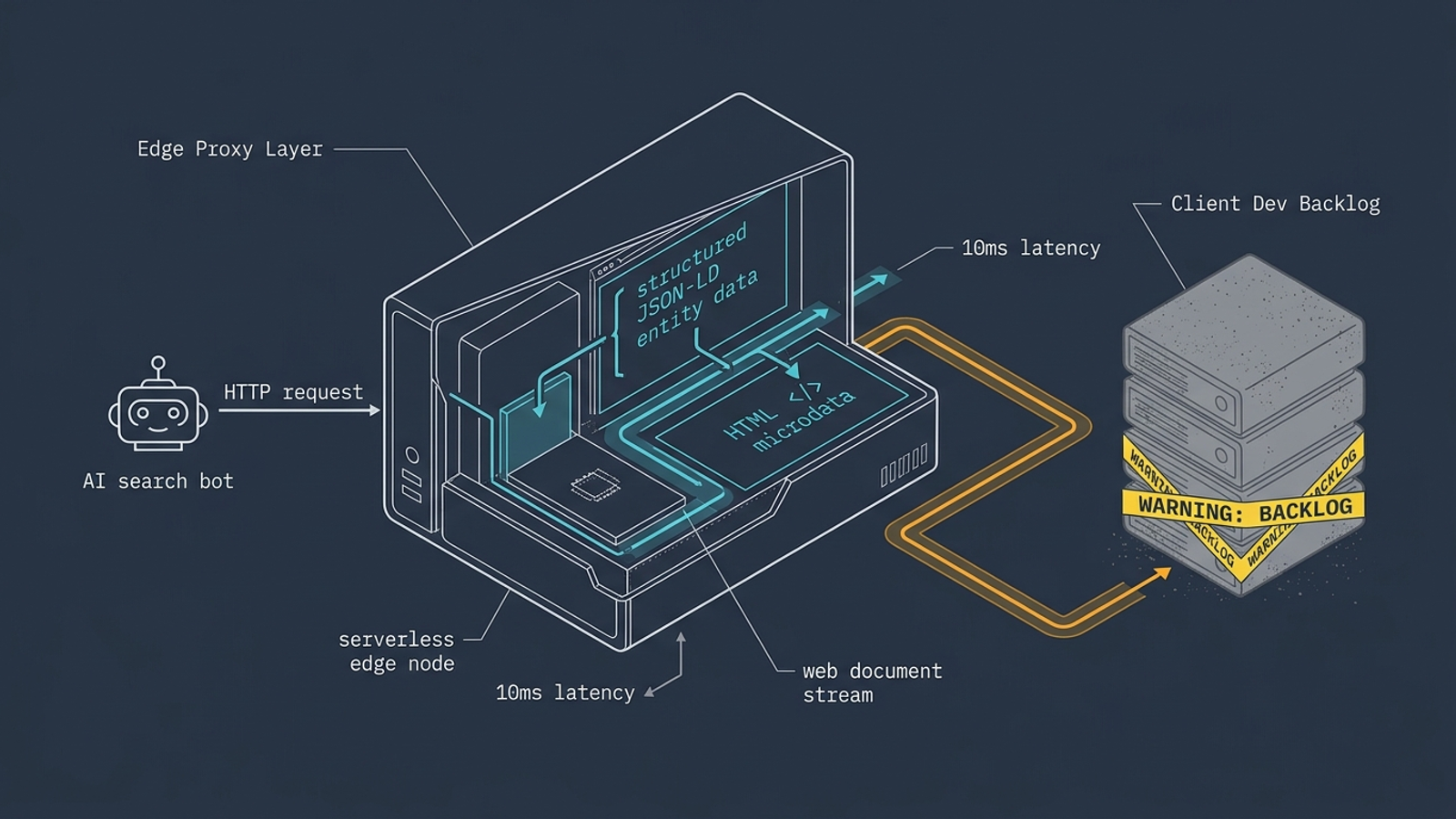
Execution changes the software math. A $500-a-month read-only audit tool can still leave an agency doing manual CMS entry or waiting on developer tickets. A platform that deploys approved changes takes work out of that loop. Watch for legacy enterprise SEO platforms to ship native edge deployment or acquire the middleware to do it.
There is a real failure condition. If enterprise security policies make edge-layer HTML changes impractical without the same slow staging sign-offs, and direct publishing does not relieve the backlog, this prediction loses its mechanism. For now, ask vendors to show a change reaching a staging environment. Do not settle for a slide showing the change they recommend.
Prediction 4: White-label retainers get repriced around executed work
By late 2027, a $3,000-to-$5,000 monthly retainer built around static reports will be a much harder sale. Clients will have more ways to see visibility for themselves. Once that happens, the question moves from “Where do we appear?” to “What did you change, and what did it do?”
Traditional SEO retainers could hide a lot of idle time inside strategic opacity. An agency could bill $3,500, assemble a Looker Studio report, tweak a few meta titles, and present the deck as the month’s work. I know good account management takes more than that. I also know how much repetitive work gets dressed up as strategy when the client cannot see the difference.
AI-answer visibility makes the gap more obvious. A client can see a competitor cited in a generative answer while its agency’s deck celebrates “top 10 impressions.” The work needed to respond is concrete: factual updates, citation reinforcement, entity disambiguation, and content deployment. A rank chart cannot do any of those things.
That is why I expect white-label agencies to sell deployed pages, schema changes, audit logs, and attributable pipeline, not just a monthly visibility PDF. The mechanism is client scrutiny plus faster execution tooling. The evidence today is the growing mismatch between passive reports and the structural interventions agencies say they provide. The prediction fails if passive-reporting retainers hold their price and clients continue buying the deck without demanding a record of live work. If you cannot show what went live this month, fix that before refreshing the reporting template.
Prediction 5: Knowledge-graph management becomes a base feature
By mid-2027, automated schema construction and knowledge-graph syndication will look like standard AEO plumbing, not a four-figure upsell. Entity mapping used to demand manual graph-database work and custom ontologies. The case for charging a premium weakens when specialized models can extract schema-ready entities from unstructured content and CMS webhooks can distribute updates.
The premium model is still visible in today’s pricing. WordLift lists its Business+ tier at $879 a month billed annually, or $1,100 monthly, with limits of 2,500 URLs and five knowledge graphs and entity interactions metered through Smart Credits. The entities themselves are familiar website material: Organization, Product, SameAs, and About, mapped between pages and schema vocabularies or Wikidata. Our guide to agency knowledge graphs and CMS publishing walks through the delivery model.
The mechanism behind my bet is cheaper entity extraction paired with automated syndication. Watch open-source knowledge-graph plugins and native headless-CMS schema generators. If automated graph construction remains a costly specialist service by April 2027, the premium tier survives and I am wrong. Otherwise, charging extra for the basic entity map will start to feel like charging extra for SSL certificates.
What I would buy this quarter
If these bets are right, an annual contract for a prompt-monitoring dashboard is the wrong way to build an agency’s AEO offer. The core diagnostic is heading toward free or cheap. The harder, more defensible job is getting useful changes approved, deployed, logged, and connected to business outcomes.
I would take this checklist into vendor demos:
- Reject lock-in tied to prompt growth. An annual contract with per-prompt, per-query, or per-seat charges makes expanding a client’s coverage a margin problem. Price the whole roster, not the first domain in the sales demo.
- Demand a live publishing demonstration. Ask the vendor to push a JSON-LD change or intent-matched answer into a CMS staging environment and show its edge-proxy configuration if it offers one. A recommendation on a screen is not a deployment.
- Check white-label delivery rights. Require client-ready audit logs and deployment reports under your agency’s name, without vendor co-branding.
Here is the scorecard I will use. These dates make the predictions testable, not inevitable:
| Prediction | Check date | What would show the shift |
|---|---|---|
| Free tracking | August 31, 2027 | Search Console or a major LLM offers free native prompt-level citation and click attribution, pressuring third-party tracker prices. |
| Flat per-domain pricing | June 30, 2027 | Leading agency plans replace meaningful prompt caps with flat per-domain tiers, or per-query pricing falls below $0.10. |
| Publishing as table stakes | December 31, 2027 | More than 50% of commercial AEO platforms offer native edge-proxy injection or direct headless-CMS publishing. |
| Execution-led retainers | October 31, 2027 | The average SMB and mid-market white-label retainer for passive reporting falls by more than 30%, with executed work and pipeline taking its place. |
| Base knowledge-graph management | April 30, 2027 | Upcharges above $500 a month for automated schema-graph construction disappear as it becomes a base feature. |
Do not build your agency’s future on reselling a dashboard that a platform can give your client for nothing. Set the guardrails, keep the human accountable, and buy the machinery that gets the work live.