
The AEO Retainer Swipe File: Tiers, Scope Clauses and Client Scripts
October 6, 2026
•
11
min read



Your AEO audit found the missing schema and drafted the answer blocks. Three weeks later, the fixes are still in a Jira backlog because the client’s developer deploys on the second Tuesday of the month.
I would not call that a tracking problem. It is a write-access problem. At fifteen client domains, an agency can be dealing with custom WordPress installations, headless Shopify stores, locked-down Webflow sites, and a legacy CMS built by someone who left years ago. Every recommendation has to find its way through a different set of credentials, permissions, plugins, and people. The work is ready. The site is not.
An edge proxy changes where that work happens. Instead of requiring a change inside the client’s CMS, it sits between the site and the people or bots requesting pages. It can modify the HTML response in transit, then serve the result. That makes schema, answer blocks, internal links, and even new pages possible without a developer ticket for each edit. It also puts the agency in the path of live site traffic. Before selling the first benefit, I would understand the second.
Take an industrial parts distributor whose catalog runs on an old Magento installation. A bot requests example.com/commercial-chiller-valves. DNS directs that request toward the infrastructure serving the domain. It may reach a content delivery network (CDN) edge node before Magento, the origin, receives it. If the CDN does not already have a usable cached response, it fetches the page from the origin and sends the HTML back.
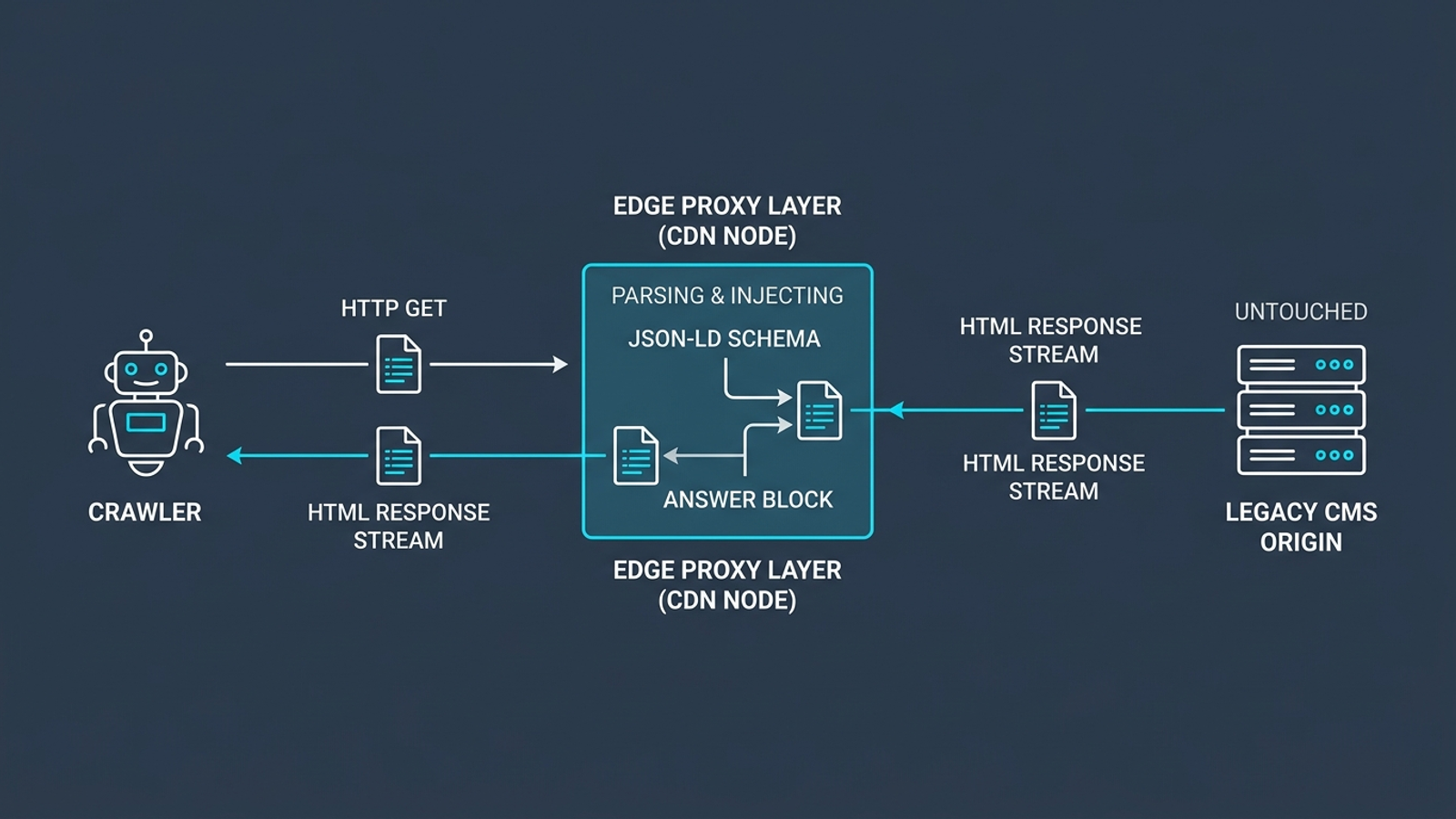
The response has to pass through the edge on its way out. That is the opening. The agency does not need to edit the Magento template to alter what the requester receives; it can apply a rule to the response before delivery. The distinction matters because identifying a missing answer block and getting one onto the page are separate jobs.
An edge worker can inspect the request path and relevant headers, then process the response as it comes back. Streaming HTML tools such as Cloudflare Workers’ HTMLRewriter provide one way to make those changes (Black Alpaca’s technical analysis of edge SEO). For the distributor, a rule might insert JSON-LD into the <head> or place a concise answer block near the valve specifications. Magento still produces the underlying page. The worker changes the document delivered from it.
Think of the proxy as an editor at an outbound mail desk. The origin prints a page; the editor adds an approved insert before it goes out. That analogy stops at the important part: this is not a person checking one envelope. It is code operating on live responses, and a bad rule can affect every request that matches it. No CMS edit does not mean no production risk.
The edge is useful because it can make repeatable changes to the HTML a site serves. On the distributor’s valve page, that could mean adding or correcting JSON-LD schema markup, inserting a direct answer beside the existing product information, or adding internal links to related catalog pages. A proxy can also respond to requests for files such as /robots.txt and /sitemap.xml, or serve a new page under a route such as /answers/, without storing that page in Magento.
Those are different kinds of work, though. A schema rule has to use accurate product data. An answer block has to match what the business actually offers. A new page needs a route, content, and a way to stay current. The edge removes the CMS publishing step; it does not remove editorial judgment or data ownership. If the distributor changes a valve specification at the origin while an edge rule keeps serving an old one, faster publishing has produced a faster mistake.
Nor does the edge replace Magento. It does not change the client’s inventory logic, database, or authentication. When someone adds a valve to a cart, that application state still belongs to the origin. The proxy can change what the page says, not make the underlying commerce system behave differently.
JavaScript-heavy sites add another boundary. A framework may expect the HTML it receives to match the page it is about to render in the browser. Inject a block into the wrong part of a React, Next.js, or Vue page, and you can create a hydration mismatch. The framework may replace the inserted markup or disrupt an interactive element. On the distributor’s catalog, that means an answer block is not worth much if it interferes with the controls a buyer needs to place an order. Test the rendered page, not just the source HTML.
Agencies have other ways to publish these fixes. I would separate them by where the change lives, because that tells you what can break.

Suppose the distributor’s Magento team has no time to approve a template edit. The edge route offers another way to ship an answer block. Suppose instead the team wants product copy maintained inside Magento by its own staff. Direct CMS publishing may fit that ownership model better. The edge solves access to the delivered page, not every reason a client uses a CMS.
It also requires access of its own. Someone must authorize the routing change that puts the proxy in the request path. After that, the agency may avoid a developer ticket for each schema or content edit. It has not made the client’s infrastructure disappear.
Once the proxy is running, access logs look tempting. Filter for GPTBot or ClaudeBot, count requests, and put the chart in the client report. I would not trust that chart on its own. A requester can put a bot name in a User-Agent header; unverified scrapers can spoof crawler identities. A label in a log is a claim from the requester, not an identity check.
For crawlers with suitable published verification methods, the system can check the connecting IP rather than relying on the label. Forward-confirmed reverse DNS involves looking up the hostname associated with an IP, then checking that the hostname resolves back to that IP. Where a crawler publishes IP ranges, those ranges offer another basis for verification. We walk through practical checks in our 45-minute curl and CDN audit.
Even verified access proves less than some reports imply. It can tell you that a crawler requested a page and received a response; it does not prove an answer engine cited the page or that a model absorbed the injected block. For the distributor, I would keep those questions separate: Did the verified crawler reach the valve URL? What response did it receive? Did the eventual search result or answer show any effect? One number cannot stand in for all three.
There is also a failure before the proxy gets to show its work. A client CDN or web application firewall can challenge or block automated requests before an edge rule runs (Patrick Stox’s analysis of edge SEO pitfalls). If a legitimate crawler gets a challenge page or a 403 response, polishing the answer block will not help. First check whether bots can read the page. Then measure what the edge delivered.
An agency that controls the response also owns new ways to break it. I would put three risks on the table before promising the distributor that edge publishing is frictionless.
Different content for bots and people. A vendor may propose showing concise answer blocks only to crawlers so the human-facing design stays untouched. That creates a cloaking risk (Conductor’s warning on AEO cloaking). If the valve page gets a useful answer, human visitors should be able to receive it too. The edge should not become a second, more flattering version of the site reserved for bots.
Rules that outlive the page they target. An injection might depend on a selector such as #product-specs. If the distributor’s frontend team changes that template, the rule may stop placing the block where intended. If Magento starts producing a canonical tag while the edge still adds another, production can send conflicting signals even though the origin looks fine in isolation. Each rule needs an owner who knows what happens when the origin changes.

Failures in the live path. Edge runtimes have execution limits; a worker that exceeds them can return an error instead of a page (Cloudflare Workers platform limits). A fail-open configuration is meant to let the raw origin response through when the worker fails. Do not assume that behavior exists because a vendor mentions it in a demo. Ask how it is configured and tested. Hosted platforms can introduce routing constraints of their own; Wislr’s Shopify proxy breakdown illustrates why those routes need particular care. A clean knowledge graph will not console anyone whose checkout no longer works.
For the Magento example, the practical test is straightforward: if an answer-block rule fails on the valve page, can the buyer still see the original page and use the cart? If the agency cannot answer that before launch, it is not ready to put the rule in production.
At five client sites, manual publishing can still look manageable. An account manager adds JSON-LD through a WordPress plugin, emails a Shopify client about a theme change, and waits for another client’s developer to approve a page edit. The delays are annoying, but each one is small enough to work around.
At fifteen, the exceptions become the operating model. Every origin has its own templates, permissions, updates, and people. Moving the work to the edge only helps if the edge rules are managed as a system. Fifteen hand-written workers with no shared logging or rollback have not eliminated maintenance. They have moved it from the CMS to the CDN, where a mistake may affect live traffic immediately.
That is the distinction I care about in an autonomous execution layer. The proxy is the delivery mechanism. The agency still needs a way to decide what changes, check the result, see who or what made the change, and recover when the origin shifts underneath it. groas brings autonomous execution together with a named human strategist who sets direction and guardrails. The appeal is not merely that software can publish around the clock. It is that the work needs accountable ownership rather than another pile of recommendations waiting for someone to paste them into a CMS.
I would judge any proposed setup by that standard, not by how quickly its demo inserts a schema tag.
If a platform promises AEO fixes with “no developer needed,” get past the publishing demo. Ask what happens on the day an origin deploy or edge rule goes wrong:
User-Agent labels, or does it use the verification methods available for the crawlers it names?Now apply the model to a new client: a Shopify store whose team cannot take on another theme edit. An edge layer may give the agency a route to publish schema and answer content without waiting in that queue. Before switching it on, I would confirm who can approve the routing change, whether the content matches what shoppers see, how the pages behave in a browser, and what happens if a rule or route fails. I would keep the secure purchase path out of an experiment I do not need it to run.
That is the decision in plain English. The edge can remove the CMS as the bottleneck, but it cannot remove responsibility for the page. If an agency can show what changed, what crawlers and customers received, and how it will back out a bad change, it has a credible way to scale AEO delivery. If it cannot, “no developer needed” just means the next production incident belongs to the account team.
Because publishing them requires write access to the client's site, and every domain comes with its own credentials, permissions, plugins and people. The audit and drafts can be finished long before the client's developer has time to deploy the changes.
An edge proxy sits between the client's site and the people or bots requesting pages. It can modify the HTML response in transit, for example inserting JSON-LD into the head or adding an answer block, and then serve the result. That makes many changes possible without a developer ticket for each edit.
No. The proxy only changes what the delivered page says; the client's inventory logic, database and authentication still belong to the origin application. On JavaScript-heavy sites built with React, Next.js or Vue, injections can also cause hydration mismatches, so the rendered page needs testing, not just the source HTML.
A plugin runs inside the client's CMS and can become another dependency to maintain. Direct CMS publishing writes through an authenticated API, creating a persistent record but requiring connector and permission work. An edge proxy changes the response outside the application, avoiding plugin conflicts and permission queues, but the agency then manages routing, rules, testing and rollback on a live delivery path.
Not on their own, because any requester can put a bot name in the User-Agent header, and unverified scrapers can spoof crawler identities. For crawlers that publish verification methods, check the connecting IP instead, for example with forward-confirmed reverse DNS or published IP ranges.
No. Verified access only tells you that a crawler requested the page and received a response. It does not prove an answer engine cited the page or that a model absorbed the injected content, so those questions should be tracked separately.
Three stand out. Showing answer blocks only to bots creates a cloaking risk, since human visitors should receive the same useful content. Rules tied to selectors can break or conflict when the origin changes its templates. And because the proxy sits in the live path, an edge runtime failure can return an error instead of a page, so fail-open behavior should be configured and tested, not assumed.
Not by itself. Fifteen hand-written edge workers with no shared logging or rollback have just moved maintenance from the CMS to the CDN, where a mistake can affect live traffic immediately. The edge rules need to be managed as a system, with clear ownership, change logs, alerting and a way to restore the previous response.