

 LinkedIn

By December 31, 2027, agencies will stop signing new white-label ChatGPT ads deals at 15% of ad spend. Flat-fee fulfillment will win, because there is no keyword auction to tend, no match types to rebuild, and no bid table that gets eight times harder to manage when a client spends eight times more.
Clients started asking about advertising inside ChatGPT after US testing began on Feb. 9, 2026, and self-serve access opened on May 5. By Oct. 21, the footprint had reached 89 markets and more than 100,000 advertisers. I spent a decade mining search terms at 1 a.m. for small ecommerce brands and home services shops. That work justified a cut of spend when management meant 10 to 20 hours a week of manual bids and negatives. ChatGPT runs a relevance-weighted second-price auction where advertisers pay per thousand impressions or per valid click, never per conversion. The more relevant ad can beat the higher bid.
That is a different job. Agencies reselling it on 2015 math are about to relearn the lesson.
The old pricing argument no longer fits the work
I used to tell clients a percentage of spend was fair because the account got more complicated as spend grew. I was wrong about how long that would stay true. Back then, more spend often meant more keywords, more ad groups, more negatives to mine, and more bid changes to log. Standard PPC pricing still sits at 10% to 20% of monthly spend, alongside a $500 to $10,000-plus flat-fee alternative. The percentage made sense when manual work scaled with the budget.
ChatGPT weakens that link. It has no keywords, demographics, or retargeting; its five levers are conversation context, context hints, location, platform, and custom audiences. Hints cap at 2,000 per ad group. They do not work like exact match or guarantee delivery; ChatGPT decides fit. If a client moves from $5,000 to $20,000 in ChatGPT spend, what gets four times more laborious? The reporting logo changes. The work does not.
A bigger budget is not, by itself, a bigger management job. That is the pricing mistake behind the next five predictions.
Prediction 1: The 15% reseller fee loses to a flat fee
By Q4 2027, new white-label ChatGPT ads deals will be priced at a flat fee, and partners still asking for 15% of ChatGPT spend will lose reseller business. OpenAI’s auction has a $25 daily minimum in USD and a suggested $3 to $5 max CPC to start. Advertisers pay per thousand impressions or per valid click, never per conversion. A $40,000 month does not necessarily create eight times the context-hint groups of a $5,000 month. It can mean the same five or six groups with a bigger daily cap.
The fee should reflect the work: setting up groups, improving creative, checking what happened, and deciding what to change. A percentage of spend instead rises automatically when the client raises the budget. That is a pleasant billing feature for a subcontractor, not a reason an agency should accept it.
There is already a packaging clue. WebFX publishes a $3,000-per-month starting price for ChatGPT ads management, with spend separate. One listed price does not settle the market, but it shows how the service can be sold without taking a cut of every additional dollar. For the wider argument, read Percent-of-Spend Fees Lose by 2028.
I am wrong if, by December 2027, credible white-label partners still publish 15%-plus ChatGPT rate cards and agencies keep signing them. Until then, do not sign a reseller deal that taxes your clients’ growth.
Prediction 2: The standalone specialist gets folded into search
By June 2027, the stronger agency offer will put ChatGPT ads inside a combined Google, Bing, and ChatGPT search program, not sell them as a standalone retainer. The channels do not work the same way, which is exactly why one search owner needs to see the whole picture. Google serves AI Overviews and AI Mode ads from existing Performance Max, Shopping, AI Max, and broad-match Search campaigns with no opt-out; ChatGPT is a separate buy inside Ads Manager. Perplexity stopped taking new advertisers in late 2025 and exited paid ads in February 2026, leaving citations as the way in.
So the work splits. On Google’s side, you improve feeds and campaign structure you already own. On ChatGPT’s side, you write context hints and creative for a separate buy. I would rather have one person accountable for search performance than a ChatGPT-only specialist protecting a line item. A separate interface is not a separate strategy.
The white-label market is already selling capacity this way. WebSpero runs ChatGPT ads through its existing PPC team, while E2M sells strategy, hint groups, creative, tracking, and reporting under the partner brand. That is fulfillment, not a new craft with its own throne.
I am wrong if ChatGPT-only shops are still winning agency RFPs against bundled search programs in June 2027. My hiring rule now: buy search coverage that includes ChatGPT, not a specialist waiting for enough ChatGPT hours to justify the seat.
Prediction 3: Proving revenue becomes harder than buying inventory
By Q3 2027, agencies will compete less on access to ChatGPT ads than on proof that the ads produced pipeline. Buying inventory is no longer the scarce part: there is self-serve Ads Manager, access across 89 markets, and a $25 daily minimum. Measurement is thinner. The IAB is building a framework for advertising served to or influenced by AI agents, with initial results expected in November. It aims to address what counts as exposure and how credit gets allocated when an agent researches and the user buys later.
That creates a governance problem. If the platform holds the data needed to prove influence, independent measurement can become the seller grading its own homework. I lived a version of this gap in early Google Performance Max. ChatGPT looks thinner still. An agency can show inexpensive clicks without showing whether those clicks became qualified business.
One B2B lead-gen account paid $0.76 average CPC on ChatGPT versus $10.46 on Google Search over the same 30 days, but converted at 0.8% versus 6.64%, producing a $92.21 versus $157.57 cost per lead. Across clients, the reported medians were $2.12 CPC, 1.39% CTR, and $29.61 CPM. Add a $1 billion annualized run-rate reached in under 200 days, and I would not build a sales pitch around cheap clicks lasting forever.
I am wrong if clean, closed-loop reporting for ChatGPT-assisted pipeline is standard in GA4 and CRMs by Q3 2027. Until then, sell the measurement plan before you sell more media. A client who cannot connect spend to pipeline has no useful reason to raise the budget.
Prediction 4: Lead buyers feel the auction crunch first
By Q2 2027, lead-gen and high-ticket services will feel the first ChatGPT auction crunch: lawyers, home services, SaaS, and clinics. The mechanism is intent. ChatGPT is a question box, and those businesses live inside expensive questions. Someone asks how to choose a personal injury lawyer or whether to repair or replace an HVAC system; an advertiser can write a context hint for that conversation. Ecommerce can wait for a product card. A roofer cannot wait while three competitors buy the same question.
Early cheap clicks make this tempting, then conversion does the sorting. Custom-audience inclusion or bid adjustment needs 25,000 matched users, with 100,000 recommended; smaller lists work only for exclusions. And Pro, Business, Enterprise, and Edu accounts see no ads, so part of an uploaded house list cannot be reached there. Big lead buyers with large match pools and CRM follow-up can absorb $0.76 clicks at 0.8% conversion. The five-location home services shop may not be able to.
I am wrong if ecommerce CPMs rise faster than legal and home services CPCs through 2027. The immediate decision is less complicated: if you sell leads, test while cheap clicks still give you room to learn. Do not confuse that room with proof that every click is worth buying.

Prediction 5: Waiting costs agencies margin
By December 2027, agencies that wait to secure white-label ChatGPT ads fulfillment will face worse margins than agencies that locked in a low flat fee early. Inventory opened in stages: a pilot with minimums, self-serve on May 5, then 89 markets and more than 100,000 advertisers by Oct. 21. That is the land-grab curve. Early fulfillment partners price to fill their books. As auction pressure builds alongside the $1 billion run-rate, the work shifts from setup toward defending CPCs and proving pipeline. A partner can then raise its flat fee or prioritize agencies that came early.
I watched a similar sequence with Google Performance Max freelancers in 2021. The first shops charged $800 flat. Eighteen months later, the same shops charged $2,000 and had a waitlist. I am not claiming those prices will repeat here. I am saying the timing risk is familiar: by the time every agency wants the same capacity, the early terms are harder to get.
I am wrong if comparable white-label ChatGPT fulfillment gets cheaper through 2027 as competition floods in. Get the terms before you need the capacity. Your margin depends on what the contract says, not on how early you noticed the trend.
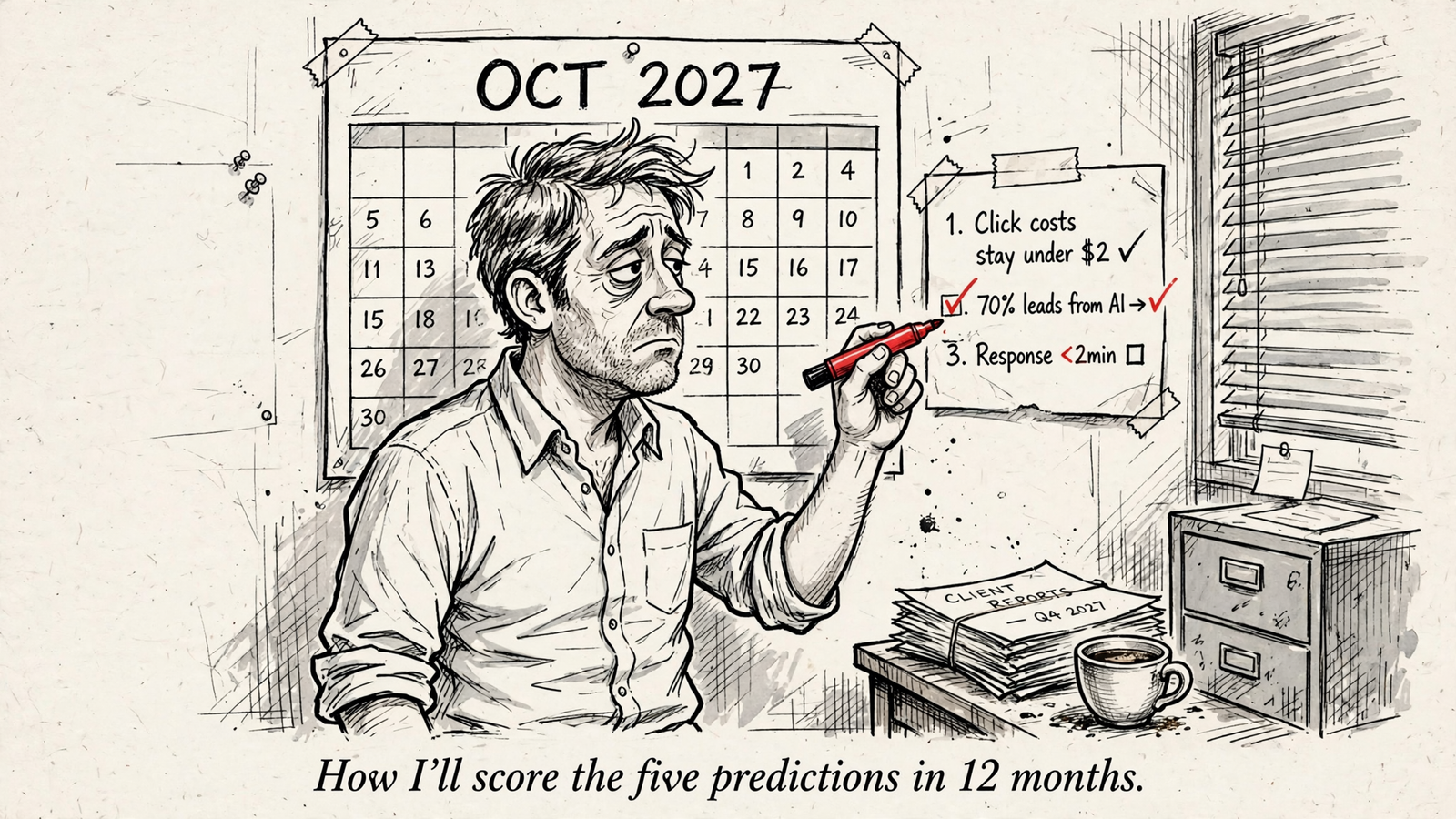
The October 2027 checkpoint
Tape this to your wall for October 2027. It is a checkpoint, not a way to quietly move the December deadlines.
- Pricing: Are the three cheapest credible white-label ChatGPT offers you can find flat fees? Has anyone you know signed a new percent-of-spend deal for ChatGPT alone?
- Bundling: Has your ChatGPT-only retainer disappeared into a search program covering Google, Bing, and ChatGPT?
- Measurement: Do clients ask for assisted-pipeline proof before more budget? Is the IAB framework expected in November becoming the document everyone argues about?
- Auction pressure: Are lead-gen CPCs rising before ecommerce CPMs?
- Fulfillment cost: Does the partner you could have signed at a low flat fee now charge more or cap intake?
If three of the five predictions land by their stated deadlines, the thesis holds: this was a land grab, and agencies that secured flat-fee fulfillment early protected their margin. If three miss, I was early or wrong, and I will write that post too. Most agency predictions say ChatGPT ads will be big and stop there. That sentence cannot be wrong. It is therefore not much use.
Put these three terms in the contract now
If I am right, you do not need a ChatGPT department. You need a contract that survives the shifts above. I would get three terms in writing before the first client asks for a proposal. Reseller offers already describe flat-fee work, reporting under your logo, and client-side control of budget increases. For the companion warning on vendor selection, read Your White-Label AI SEO Vendor Is Selling You 2015 With a New Logo.
- A flat fee you can mark up. Say you spend $20,000 a month across five clients. At 15%, you hand over $3,000 before adding your own margin. Compare that with groas’s flat $1,499-a-month fee per service for Search Ads across Google, Bing, and ChatGPT, with no cut of ad spend. That is a per-service price, not a per-account quote; compare the actual scope before you do your margin math. groas runs the work around the clock, can go live in under 24 hours, and logs each action with its reasoning.
- Reports under your logo. The client should see your agency’s work, not have to untangle a subcontractor’s reporting. E2M-style white-label delivery exists for a reason.
- Approval before budget increases. You set the goals and the budget; groas does the work and answers for the result. No daily cap moves without your sign-off.

The prediction that should worry you is the first one, because it hits your margin directly. If your subcontractor charges 15% of ChatGPT spend, every client budget increase makes fulfillment more expensive without necessarily making the work better. Lock in flat-fee terms, bundle ChatGPT inside one search program, and sell the measurement story before competitors do. For why separate search reports may start looking expensive, read how the Answer Box reshapes PPC and SEO reporting.
I will score all five in October 2027, then check the year-end claims at their deadlines. If I am wrong about pricing, I will say so and show the rate cards. Until then, my money is on agencies that stop paying a tax on spend and start buying execution at a known price. Apply, get the audit, and ask what is wasting your budget before the auction teaches you at full price.