The percentage-of-spend fee, the all-inclusive retainer and the free audit all promise to make Google Ads pricing easier to understand. Each can hide a cost you discover only after you sign. I spent the better part of a decade managing accounts by hand, and the number on the pricing page was rarely enough to tell a buyer what they would pay. Here are five myths worth checking before you hand over a budget or an account login.
Myth 1: “Percentage of spend aligns the agency with your results”
I understand why buyers believe this one. Spend more, pay more. Spend less, pay less. The fee moves with the size of the account, which sounds fair until you ask what makes it move. A percentage fee rises when your budget rises, not when your cost per acquisition falls. What the deck calls alignment, I call getting paid every time you spend another dollar, whether it worked or not.
At 15%, the management fee is $750 a month on $5,000 in ad spend, $3,000 on $20,000, and $15,000 on $100,000. That is the fee alone. Google gets the ad spend separately. If your $20,000 budget doubles while leads stay flat, the agency’s fee doubles from $3,000 to $6,000. Your results did not improve; your bill did.
I used to tell clients the percentage was fair because bigger accounts took more work. I was wrong to treat those things as interchangeable. More spend can create more work, but the work does not necessarily double when the budget does. A flat fee removes the automatic reward for adding another dollar of media spend. It does not guarantee good management, but it changes what earns the agency more money.
The practical test is not whether 15% sounds standard. Ask what the fee becomes at your current spend, at twice that spend, and if the account performs no better at either level. Then ask what result the agency is accountable for. I went deeper on why percentage-of-spend pricing misaligns incentives, but the buying rule fits in one line: pay attention to what makes the fee go up.
Myth 2: “All-inclusive means no surprise charges”
All-inclusive is comfortable language on a sales call. The seller says one number; the buyer stops adding numbers. The first problem is that a $2,000 monthly management quote usually means $2,000 to the agency. The ads still have to be paid for. Media is not a minor footnote to a Google Ads proposal. It is the budget that makes the proposal real.
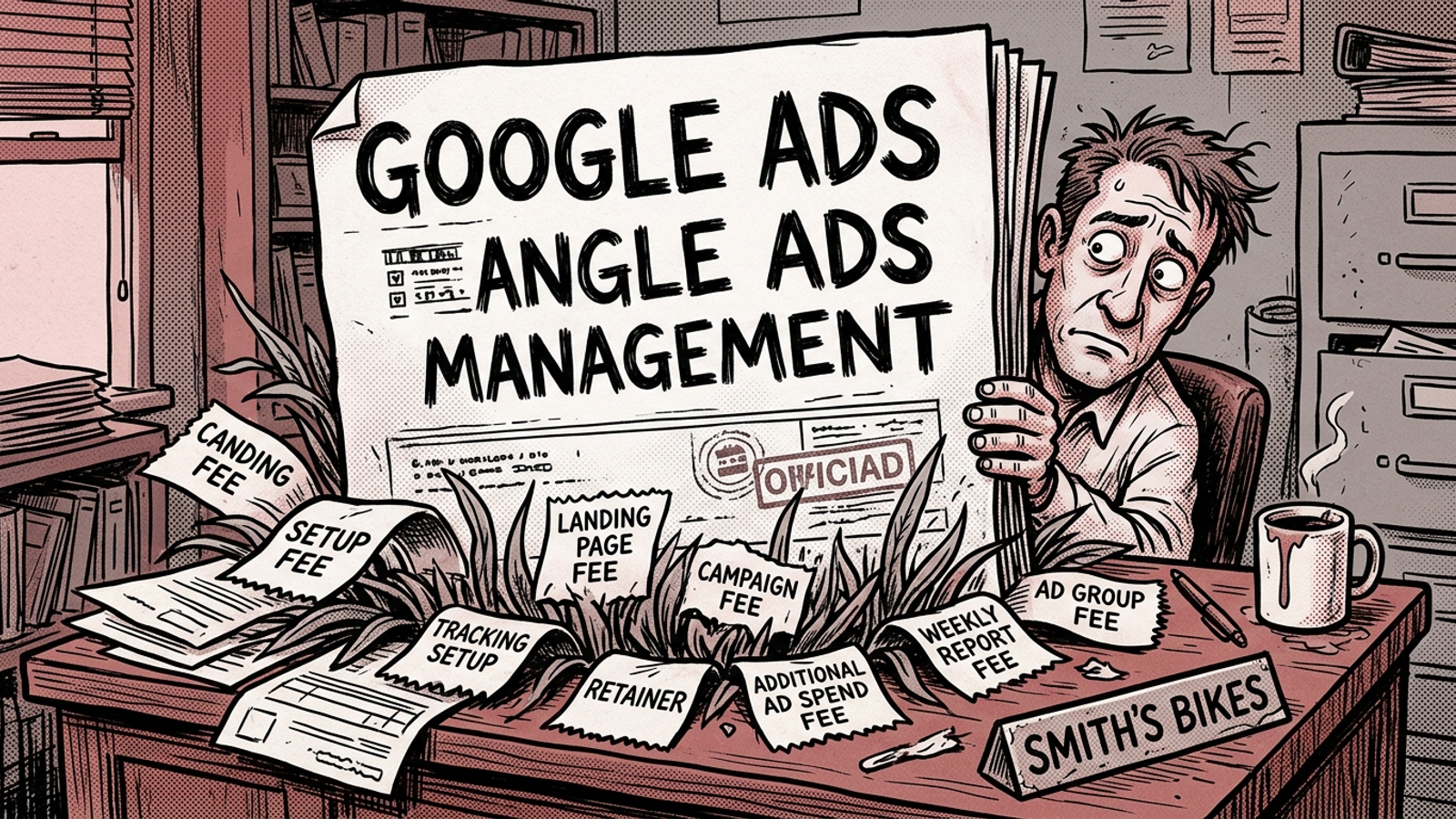
Then come the items that may not be in that monthly fee. A pricing breakdown lists setup charges from $500 to $5,000 and landing page builds from $1,000 to $5,000 per page, alongside costs such as creative, call tracking and feed tools. Exit terms can affect the cost too. None of these items is automatically unreasonable. Charging for a landing page is not a trick if you tell the buyer about it. Calling a retainer all-inclusive while leaving that work out of the quote is the trick.
Here is the equation I want on the table before anyone signs:
Media + management + setup + creative + landing pages + tracking + software = the cost to evaluate.
On $20,000 in monthly media, a $3,000 retainer puts you at $23,000 before any of those other charges. The retainer is a real number, just not the whole number. Ask which of the remaining items are included, which are optional, and which you will need to buy elsewhere to make the campaigns work. If a proposal does not separate media paid to Google from the fee kept by the agency, ask for a version that does.
I keep a list of hidden-fee red flags in agency pricing for this moment: setup charges, bundled services and landing pages billed later. All-inclusive means everything the seller chose to include. Find out what that is before the invoice explains it for them.
Myth 3: “A free grader tells you what management will cost”
A free audit can tell you where to look. It cannot tell you what a management contract will cost unless it actually quotes the work. That distinction gets lost because the score arrives first. You see wasted spend, Quality Score, impression share or account activity flagged, and it feels as though the vendor has already priced the fix. It has diagnosed something. Pricing is a separate conversation.
One well-known free grader asks for your email and Google sign-in to read the account, then points you toward the vendor’s paid help. That is a lead-generation path attached to a diagnostic. The score may be useful. It still does not say who will do the work, what they will charge, what sits outside the fee or whether the proposed changes will lower your CPA.
The gap between a score and a quote is where the upsell lives. You arrive wanting to know what management costs and leave with a list of problems, a sales conversation and no firm number. Even if the problems are real, urgency is not a substitute for a scope of work. I would take the free score as a prompt for questions, not as evidence that the vendor has offered a good deal.
Before you give anyone account access, ask what access they need and what you will receive in return. Before you buy management, get the paid proposal in writing. It should name the fee, any setup charge, the work included and the measures the manager will answer for. A diagnosis is not a price quote. Do not let a grade blur the difference.
Myth 4: “Flat monthly fees are always cheaper”
I like a fee that does not climb automatically with spend. I do not like pretending every flat number is a bargain. The minimum and the scope matter as much as the headline fee. A stable bill can still buy too little work, or take too large a bite out of a small budget.
Start at the small end. A shop quoting 15% with a $1,000 minimum charges $1,000 on $3,000 in spend, an effective rate of about 33.3%; on $5,000, the same minimum is 20%. The buyer hears a percentage but pays the minimum. That may be clearly stated in the contract. It is still worth doing the division before deciding the price sounds reasonable.
At the larger end, tiers complicate the picture. One published tier sheet lists Lite at $650 a month plus $1,200 setup, Pro at $975 or 15% plus $2,250 setup, and Enterprise at $4,500 or 12% plus $5,800 setup. A/B testing and retargeting cost extra there, and lower tiers use shared staff. The flat figure may look attractive until you add the setup charge, identify the add-ons and ask who is available to work on the account.
That is why I separate the pricing structure from the purchase. A flat retainer can remove the incentive to inflate media spend, but it cannot tell you whether the person managing the account has time to manage it. I have a fuller comparison of flat retainers and other pricing models. For a proposal in front of you, the quicker test is to ask which tier your current spend buys, what moves you to the next one and what work changes when you get there.
Then put every proposal into the same seven-line comparison. Ask for these in writing, with included items marked clearly:
- Media paid to Google, separate from all service fees.
- Management fees, including the minimum and your effective rate at current spend.
- Setup charges and exit terms, including who owns the account and its data.
- Landing pages, whether included or billed later.
- Creative, with the same included-or-extra answer.
- Tracking and software, including call tracking and feed tools.
- The person doing the work, how often they work on the account, and the CPA or ROAS they answer for.
Run the numbers as monthly costs so the one-time charges do not disappear. On a $20,000 media plan, add $3,000 for management. Amortizing $2,250 in setup over six months adds $375 a month. Two $2,000 landing pages spread over the same period add about $667 a month. If call tracking and feed tools add $300, the total is about $24,342 a month, before any separate creative charge. That is not the $3,000 retainer, and it is not just the $23,000 media-plus-management figure either.
A flat fee can be the cleaner deal when the scope is explicit. Without the seven lines, flat tells you how one charge behaves, not what the whole purchase costs.
Myth 5: “Cheaper management means cheaper outcomes”
This is the one I find hardest to kill. It feels responsible to choose the lower retainer. If the cheaper manager leaves irrelevant queries running, though, the saving on the fee can vanish inside the media budget. The fee is only one part of the cost; wasted spend and missed sales count too. A $500-a-month manager who lets $5,000 go to irrelevant clicks is not cheaper than a higher-fee manager who catches that waste.
The mechanism is capacity. At the cheap end, shops can juggle 30 to 50 clients, check accounts monthly, send automated PDFs and leave broad-match templates running without negative-keyword maintenance. That description will not fit every low-priced provider. It does show what to ask about. How often does someone inspect the search terms? Who makes the negative-keyword decisions? If the answer is an automated report and a monthly login, you may be renting a logo on the account rather than buying active management.
Use CPA to put the fee in context. Say your media spend is $20,000 a month. At a $120 CPA, it buys roughly 167 customers; add a $500 management fee and your combined spend is $20,500, or about $123 per customer. At an $80 CPA, the same media budget buys 250 customers; add a $2,000 fee and the combined spend is $22,000, or $88 per customer. The higher management fee costs another $1,500. The lower CPA, if the manager can deliver it, changes the economics by much more.
That is a comparison method, not a promise that paying more will produce an $80 CPA. Ask for CPA or ROAS tied to tracked calls and sales, rather than clicks and impressions. Ask what work is meant to move that number and how you will see whether it did. A low retainer with no answer to those questions is not evidence of efficiency.
It is also why I pay attention to autonomous management. groas offers a flat monthly fee with no setup fee; specialized models handle bidding, budget, targeting and optimization work continuously while a named human strategist sets direction and owns accountability. I am skeptical of automation sold as a reason to stop looking at an account. I have spent too much time looking at search terms to find that persuasive. The pricing logic here is stronger: the fee does not rise simply because the media budget rises, and continuous execution is not sold as a monthly human login. I would still put groas through the same seven-line test and hold it to CPA and pipeline. That is the point of the test.
Percentage fees tend to reveal themselves when spend scales. An all-inclusive quote reveals its limits when an extra invoice arrives. A grader shows its limits when you ask for a price and get a pitch. Cheap management lasts longer because the lower number is right there on the proposal, while the waste takes work to see. Before the next sales call, write your spend at the top of a page, ask who will inspect the account and how often, and demand the CPA math alongside the retainer.
The fee you can see is not necessarily the cost that hurts. That is why I will keep asking for the search term report before I congratulate anyone on a cheap quote.